Cost Per Workflow: Why Token Pricing Can't Prove Your AI Is Profitable
AI workflows now cost 30x more per task than in 2023, and 73% of enterprises still can't explain why. Here's how to price a workflow, not a token.
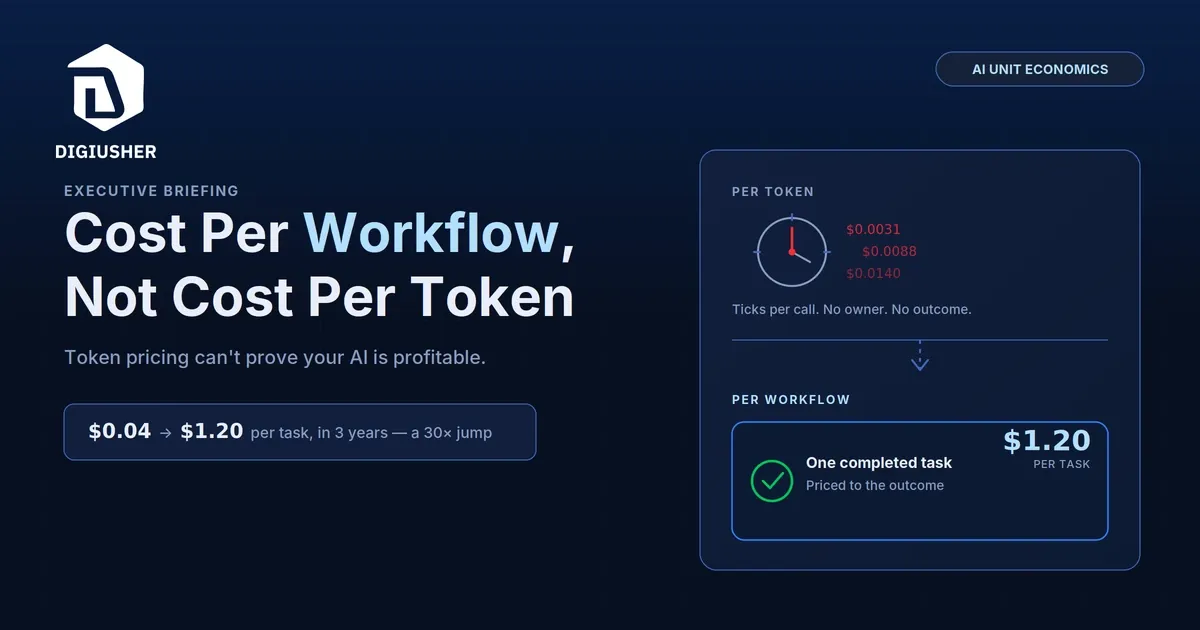
A simple, linear AI workflow cost $0.04 per interaction in 2023. By 2026, the same category of task, run through a complex, orchestrated agentic system with tools, reasoning, and iterative loops, costs approximately $1.20 — a 30-fold increase in three years. The token got cheaper. The workflow got dramatically more expensive.
73% of enterprises now report that their AI costs exceeded original projections. The reason is arithmetic, not mismanagement: total spend is price per token multiplied by volume, and volume is growing far faster than price is falling. Cost per token was never built to answer the question a CFO is actually asking — is this AI feature making us money. Cost per workflow is.
The Metric That Broke {#the-metric-that-broke}
Cost per token measures what a model charges. It says nothing about what the business got in return, and that gap is now expensive enough to show up on an earnings call.
MIT research, cited in CloudZero’s 2026 AI cost analysis, found that 95% of enterprise AI pilots deliver no measurable P&L impact, not because the models underperform, but because the organizations running them cannot trace spend to an outcome. Inference now accounts for 85% of enterprise AI budgets, per the FinOps Foundation’s 2026 State of FinOps survey, and a single agentic task can trigger 10 to 20 model calls before it produces one unit of finished work, according to 2026 industry analysis of agentic AI infrastructure costs. A dashboard reporting the blended price per million tokens is reporting on an input. It is not reporting on a result.
The FinOps Foundation’s own language has moved with the problem. Its 2026 State of FinOps survey found 98% of FinOps teams now manage AI spend, up from 31% two years earlier, and the Foundation has expanded its certification track to cover Technology Value specifically because token-level reporting stopped being sufficient the moment AI workloads stopped behaving like a simple API call.
What Is AI Unit Economics? {#what-is-ai-unit-economics}
AI unit economics is the practice of measuring the cost and value of AI spend at the level of a single completed unit of work — a resolved ticket, a processed claim, a merged pull request — rather than at the level of tokens, API calls, or aggregate monthly spend.
Unlike cost-per-token tracking, which prices a model’s output, AI unit economics ties consumption across every layer of an agentic workflow — inference, retrieval, orchestration, and tool calls — to a denominator the business already reports on. This is the mechanism by which FinOps for AI moves from a monitoring discipline into a board-reportable one. An enterprise that cannot state a defensible cost and margin per unit of AI-delivered work cannot distinguish a profitable initiative from an unbounded liability.
Why the Denominator Is Everything {#the-denominator}
Take a real example, drawn from a customer workflow DigiUsher tracked in 2026: an engineering organization using an AI coding agent to open and merge pull requests. The naive number is the API bill — call it $4,200 for the month. That figure alone tells finance nothing about whether the spend was worth it.
The workflow number looks different. Divide that same $4,200 by the pull requests the agent actually helped merge, and a defensible unit cost emerges, once retrieval calls, failed attempts, and multi-step tool use are counted alongside the final successful completion.
What a Merged Pull Request Actually Costs
──────────────────────────────────────────────────────────────
Cost component                     Monthly value
────────────────────               ───────────────────────────
Model inference (input + output)    $2,480
Retrieval and context calls         $890
Failed / abandoned attempts         $560
Orchestration and tool calls        $270
──────────────────────────────────────────────────────────────
Total workflow spend                 $4,200
Pull requests merged                 80
Cost per merged PR                   $52.55
──────────────────────────────────────────────────────────────
Compare that figure to the fully loaded cost of an engineer-hour spent on the same task, and the AI spend stops being a line item to explain and becomes a number finance can defend. As Correlation One’s 2026 enterprise AI token cost playbook notes, a workflow whose token bill doubled while handling triple the volume actually got cheaper — a conclusion invisible to anyone tracking spend without a denominator.
The Hidden Cost Outside the Model Invoice {#the-hidden-cost}
The model invoice is rarely the whole bill. In retrieval-augmented and agentic architectures, 2026 practitioner analysis of enterprise AI deployments finds the surrounding harness — vector databases, embeddings, rerankers, the orchestration runtime, caching, egress — routinely accounts for a substantial share of total feature spend, and none of it appears on the model provider’s invoice.
This is the layer Google Cloud’s Pravir Gupta described at the FinOps Foundation’s 2026 FinOps X conference, as reported by SiliconANGLE, as the part of the iceberg sitting under the water: the agent spins up a sandbox, writes a script, calls three other tools, and every step carries a cost with no natural owner. A single misconfigured agent can run up a six-figure bill in hours; Cockroach Labs’ 2026 analysis of agentic AI costs at scale describes one incident that approached half a billion dollars before anyone caught it. Attribution has to reach that whole layer, not just the token count, or the workflow number is just as incomplete as the token number it replaced.
This is the specific gap DigiUsher’s Meter module is built to close. Attribution runs at the token, agent-run, and workflow level — not just the model call — so harness spend that hides between the invoice and the outcome lands on the same ledger as the inference cost. Because DigiUsher is FOCUS 1.x native rather than FOCUS-compatible, that workflow-level view sits inside the same normalized ledger as the rest of the cloud and Kubernetes estate, instead of a separate AI reporting system finance has to reconcile by hand. For regulated enterprises, the same attribution runs through DigiUsher’s BYOC Secure Relay Proxy, so the billing data behind that workflow-level number never leaves the customer’s own perimeter — the deployment model ICICI Bank adopted to govern its AI estate at institutional scale.
How to Calculate Cost Per Workflow {#how-to-calculate}
Four inputs turn a token bill into a workflow number:
- Count the full task chain. Multiply tasks per day by steps per task by tokens per step, not just the final completion call.
- Add the harness multiplier. Retrieval, orchestration, and tool calls typically add a substantial share on top of raw inference — treat it as a cost, not a rounding error.
- Pick a denominator the business already reports on. A merged pull request, a resolved ticket, a processed claim — never a token count.
- Review it quarterly, not annually. Model routing, pricing tiers, and task volume all move faster than an annual budget cycle can track.
What This Means for the Board {#board-implication}
A CFO does not think in tokens, and asking one to approve an AI budget on a blended per-million-token rate is asking them to approve a number that describes an input, not a return.
Cost per workflow closes that translation gap. It is the same unit of analysis a CFO already applies to every other cost center: cost per unit, compared to the value of the unit produced. Under the maturity model described in a 2026 industry analysis of enterprise AI FinOps practice, the most advanced organizations report unit economics quarterly, alongside cost per loan, per ticket, or per line of code, and reconcile AI ROI against the same P&L line items finance already reports on.
Enterprises without that discipline are the ones showing up in this year’s statistics — 73% over original budget, 40% of agent projects headed for cancellation on cost grounds by 2027, according to Gartner’s 2026 AI Hype Cycle. Not because the technology failed, but because nobody could answer what it cost to produce one unit of the thing it was built to do.
An AI workflow’s token price is falling. Its cost per unit of business value is the only number that tells you whether that matters.
See your own cost per workflow. DigiUsher’s Meter module attributes AI spend to the workflow level — including the harness spend most tools miss — inside the same FOCUS-native ledger as your cloud and Kubernetes estate. Book a 30-minute walkthrough and bring one AI workflow you can’t yet price with confidence.
Related posts:
- The Ledger: What One Merged Pull Request Actually Costs (June 18, 2026) — the original worked example this piece expands into a full framework
- AI Cloud Margins: Why Gross Margin Is the New AI Governance Metric (May 2, 2026) — extends cost-per-workflow into product-level gross margin
- GPU Cost Governance: Closing the Idle-Compute Gap (April 14, 2026) — the compute layer feeding the harness multiplier
- The CFO’s Guide to AI ROI: From Aggregate Spend to Defensible Return (March 9, 2026) — takes this number into board-level P&L reporting
- FinOps for AI: What Changed When 98% of Teams Started Managing AI Spend (February 20, 2026) — background on the scope expansion behind this shift
DigiUsher in 15 min
Give your board a cost-to-outcome view they can actually act on.
DigiUsher connects cloud and AI spend to the outcomes it funds, in language finance already speaks.
Book my 15-min discovery callNo hard pitch · specific to your stack
Continue Reading
More from the DigiUsher editorial team.
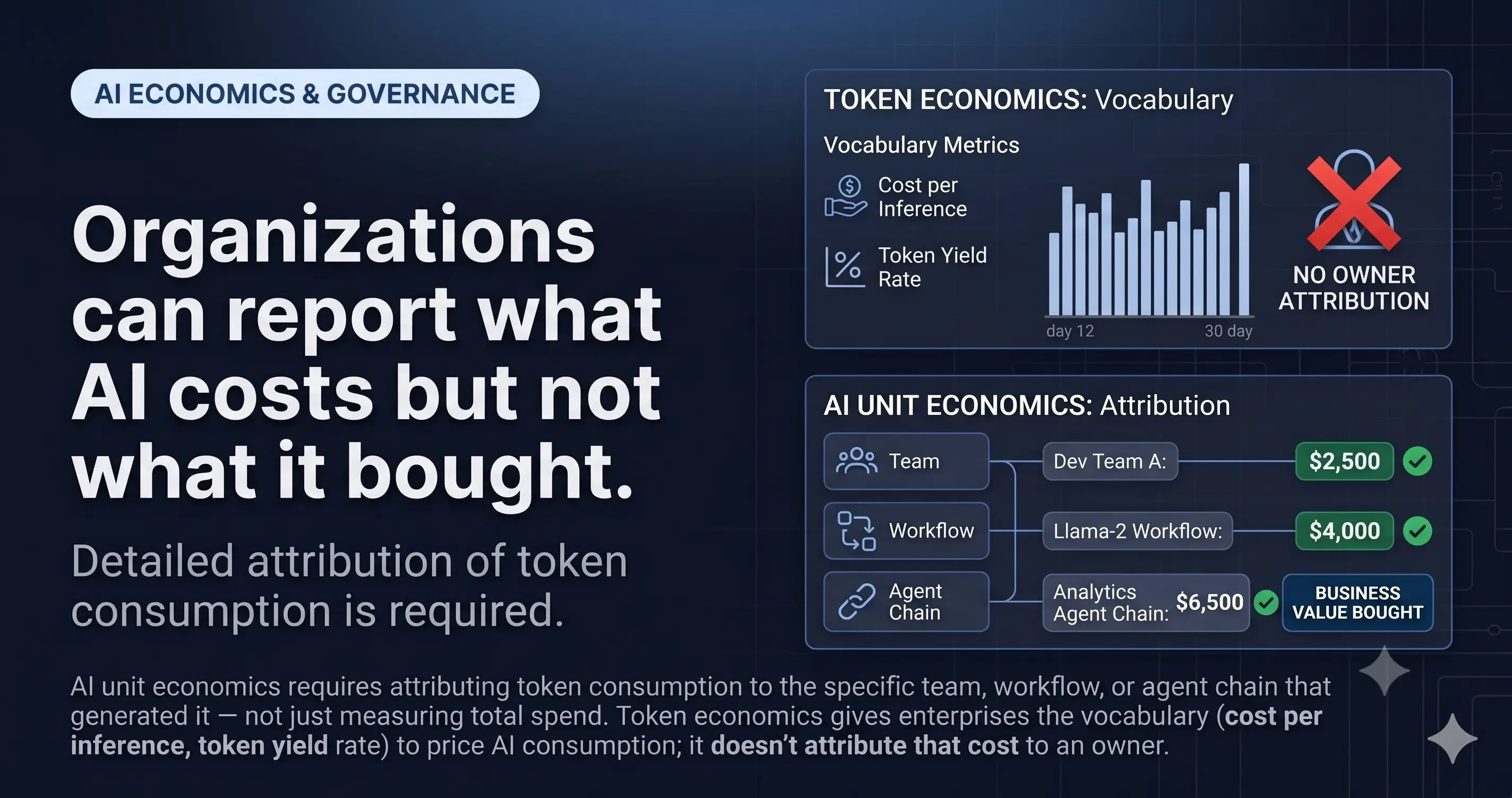
Token Economics Gave AI Spend a Vocabulary. It Still Has No Owner.
FinOps Foundation's token economics framework names the AI cost problem correctly. But naming a metric and attributing it to a team, workflow, or chain are two different disciplines — and most enterprises only have the first.
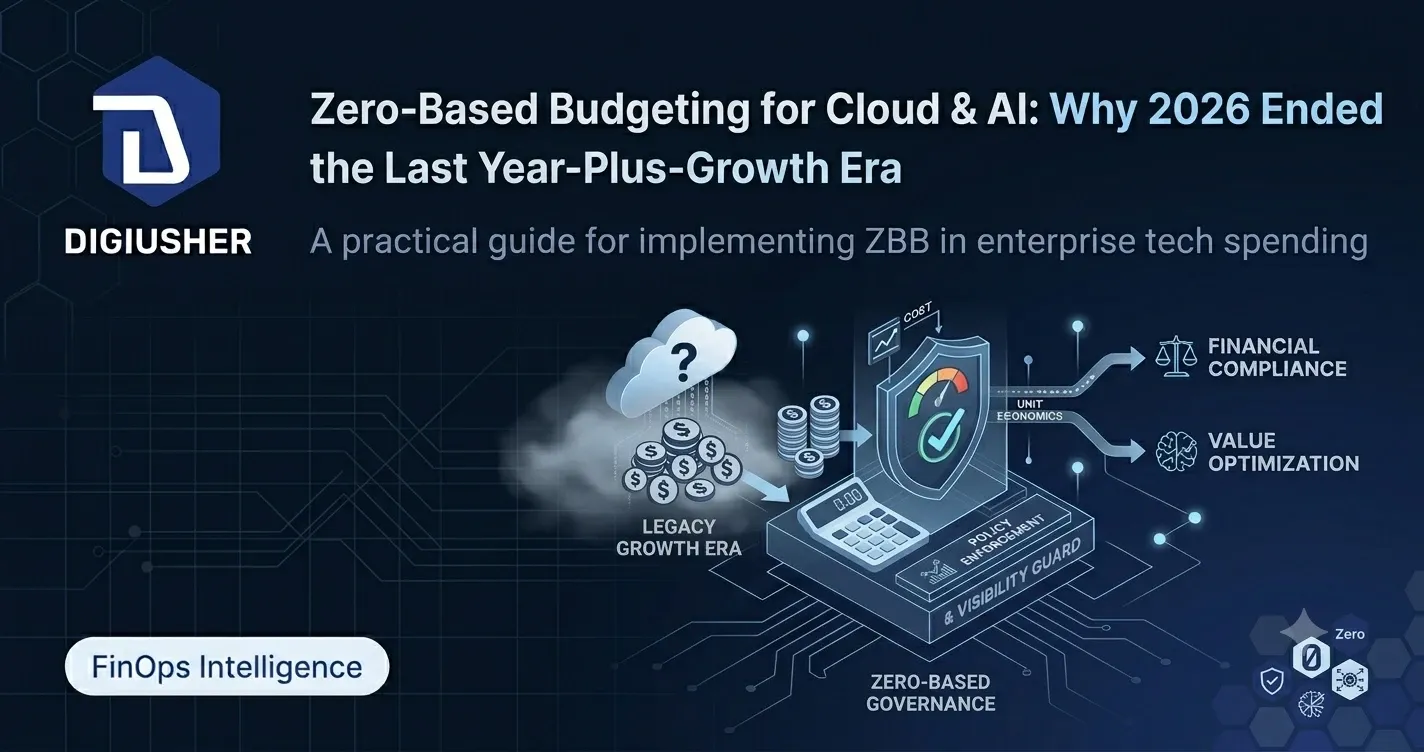
Zero-Based Budgeting for Cloud and AI: Why 2026 Ended the Last-Year-Plus-Growth Era
80–85% of enterprises miss AI cost forecasts by 25% or more. Zero-based budgeting is the discipline that ends the last-year-plus-growth model for cloud and AI spend.
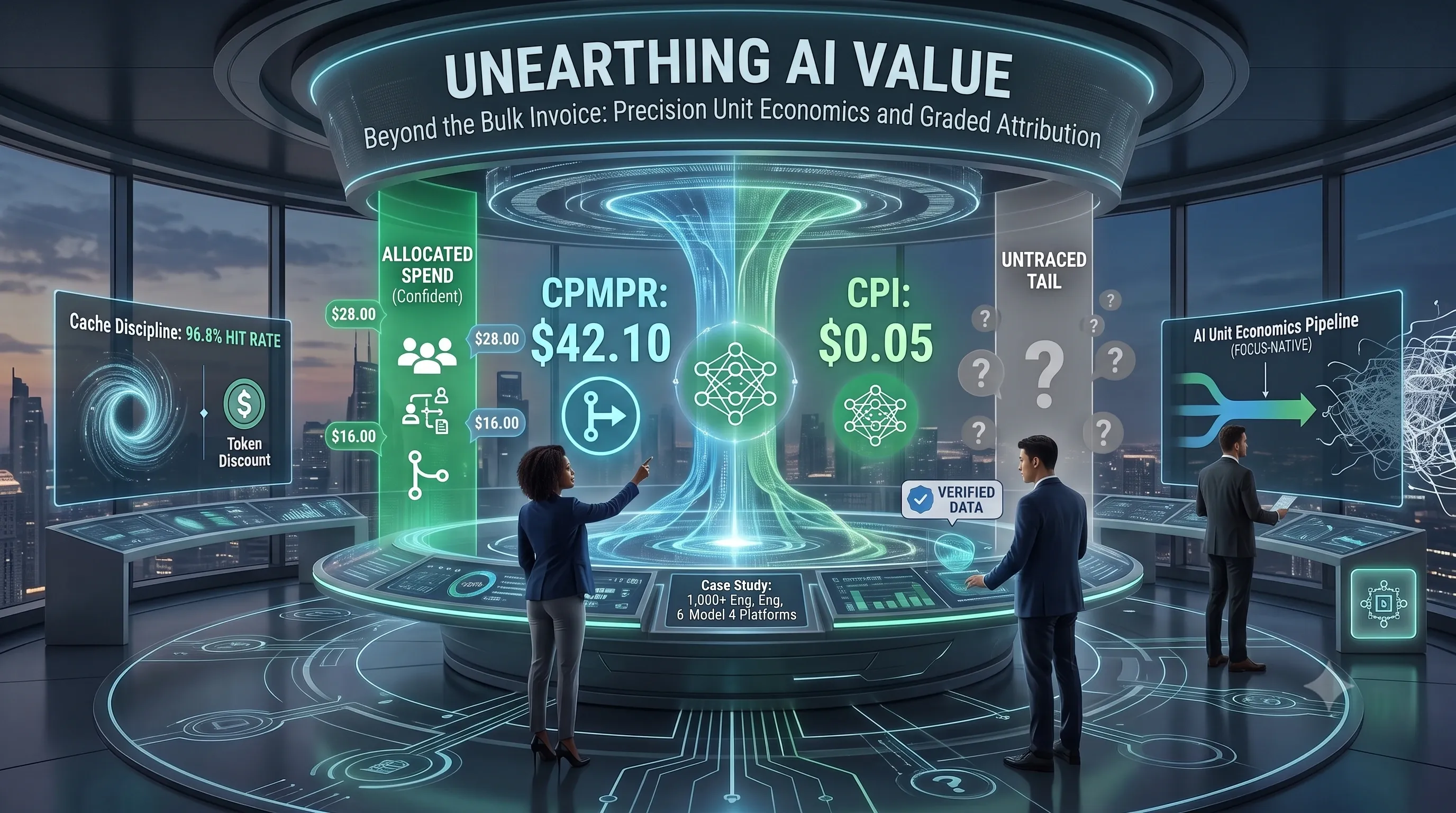
AI Unit Economics: Why Your AI Invoice Can No Longer Answer the Board’s Question
98% of FinOps teams now manage AI spend, but almost none can price a merged pull request. Here's the framework for AI unit economics in 2026 — and why the invoice alone can't answer the board's question.