Azure OpenAI vs AWS Bedrock vs Google Vertex AI: The FinOps Guide to GenAI Cost Governance
Enterprises are deploying GenAI across Azure OpenAI, AWS Bedrock, and Google Vertex AI simultaneously — three platforms with incompatible billing models, different governance capabilities, and hidden costs that erode AI ROI. This FinOps guide compares all three platforms on cost structure, attribution capability, optimisation levers, and governance gaps — with a practical cross-platform normalisation framework.

Executive Summary
Enterprises are deploying generative AI across Azure OpenAI, AWS Bedrock, and Google Vertex AI simultaneously — not as a considered multi-platform strategy, but because different teams chose different platforms for different workloads, and now finance cannot explain the combined bill.
The governance problem is structural, not operational. Each platform uses a different billing unit (tokens, compute hours, request counts), a different attribution mechanism (subscription scopes, Application Inference Profiles, project labels), and a different set of hidden costs that inflate the invoice beyond the published model price.
The 2026 data confirms what FinOps practitioners have been experiencing: 98% of FinOps teams now manage AI spend — up from 63% the year before. AI cost management is the #1 capability teams plan to add in 2026. IDC warns that G1000 organisations face up to a 30% rise in underestimated AI infrastructure costs by 2027 without dedicated governance frameworks.
This guide covers:
- Platform-by-platform cost structure, hidden risks, and attribution capabilities
- The five cost spiral drivers that apply across all three platforms
- The governance gap that native cloud tools leave open
- A practical five-step cross-platform AI cost governance framework
- How to select between platforms — and when platform choice matters less than the governance layer above them
The central FinOps insight for 2026: The platform you choose determines your capabilities. How you govern cost across platforms determines your margins.
The Three-Platform Problem
Most enterprises are no longer single-vendor for AI. Typical multi-platform patterns look like this:
- Azure OpenAI for enterprise copilots, M365 integrations, and Microsoft ecosystem deployments
- AWS Bedrock for model diversity, multi-provider access, and AWS-native application workloads
- Google Vertex AI for ML pipelines, data-centric AI, and GCP-integrated workloads
Each platform was selected rationally — the right tool for the specific team’s existing cloud commitment and technical requirements. But the aggregate creates a financial governance problem that no individual platform addresses.
As of 2026, all three platforms support token-based inference pricing for standard usage — but the important operational detail is where extra costs appear: Bedrock can include separate costs for model inference, guardrails, knowledge bases, logging, and related AWS services; Vertex AI adds charges for data pipelines, storage, evaluation, and retrieval; Azure OpenAI includes token usage, commitment tiers, provisioned capacity costs, and surrounding Azure services.
That is why model price and platform cost are not the same number — and why enterprises that budget on published token prices are consistently surprised by actual invoices.
The fundamental issue: three platforms, three cost languages.
| Platform | Primary Unit | Hidden Risk | Attribution Native |
|---|---|---|---|
| Azure OpenAI | Tokens / PTU capacity | PTU overcommitment, no hard budget limits | Subscription / resource group level |
| AWS Bedrock | Tokens / requests (model-dependent) | Model switching variance, Marketplace normalisation | Clean with AIPs; manual without |
| Vertex AI | Tokens + compute + data processing | Hybrid pricing complexity, egress, training separation | Project + label-based |
You cannot optimise what you cannot normalise. And you cannot normalise across three incompatible billing schemas without a FOCUS-native governance layer.
Platform Deep Dive: Cost Models, Hidden Risks, and FinOps Gaps
Azure OpenAI Service — Enterprise OpenAI with Microsoft Integration
Best for: Microsoft-standardised enterprises needing enterprise-grade OpenAI access with Azure RBAC, Entra ID, and compliance infrastructure.
Cost Model
Azure OpenAI operates on two pricing modes. Pay-as-you-go (PAYG) charges per token consumed — input tokens and output tokens at different rates, with model-dependent pricing. GPT-4o runs at approximately $2.50/million input tokens and $10.00/million output tokens in PAYG mode.
Provisioned Throughput Units (PTU) are reserved capacity commitments that provide guaranteed throughput and consistent latency for production SLAs. PTU delivers 30–50% cost savings versus PAYG for predictable, high-volume workloads exceeding 1 million daily tokens with minimum commitment.
Cached prompt inputs — the same system prompt reused across thousands of requests — are available at approximately 90% discount on Azure, making high-volume deployments with stable system messages significantly cheaper than headline PAYG rates suggest.
FinOps Strengths
Azure’s enterprise governance infrastructure — subscription hierarchy, resource groups, Azure Policy, Entra ID RBAC, and tag inheritance — provides clean cost attribution at the organisational level. For enterprises already running Azure workloads, cost allocation for AI follows the same patterns already in place for infrastructure. Azure Monitor integration surfaces model usage metrics alongside application telemetry.
FinOps Gaps
No hard budget enforcement. Azure OpenAI does not offer the same hard budget limit behaviour some teams expect from direct OpenAI billing, so budget enforcement requires alerts plus automation. Azure Budget alerts notify after a threshold is breached — they do not prevent additional spend. External automation is required to translate alerts into throttle actions.
Attribution ceiling at resource group level. Azure Cost Management provides clean visibility at subscription and resource group level, but workload-level and team-level token attribution requires external tagging enforcement. Multiple teams sharing a single Azure OpenAI deployment appear as a single billing unit without a governance layer mapping API calls to owning teams.
PTU overcommitment risk. Reserved capacity is billed at committed rate regardless of actual utilisation. PTU commitments made before validating stable baseline demand can generate committed spend on capacity that sits idle.
Amazon Bedrock — Multi-Model Flexibility with AWS-Native Controls
Best for: AWS-native teams wanting multi-model access (Claude, Llama, Titan, Mistral, Cohere) with cloud-native IAM and VPC governance.
Cost Model
Bedrock charges per token or per request depending on the model and provider — there are no base platform fees, and costs scale linearly with usage. For typical enterprise applications processing 10–50 million tokens monthly, AWS Bedrock generally provides 15–25% lower costs than Azure, while Azure becomes more competitive at scale with reserved capacity.
Bedrock Provisioned Throughput provides committed throughput for stable workloads. Additional costs accumulate for Bedrock Guardrails, Knowledge Bases, and Agents as separate billing dimensions.
FinOps Strengths
Application Inference Profiles (AIPs) are the standout FinOps feature. When teams attach profiles at call time, profile names show up in cost data, making showback by team or feature straightforward. AIPs are the most direct attribution mechanism of any managed AI platform — when enforced consistently through SDKs or an AI gateway, they enable clean team-level and feature-level cost reporting without log correlation.
AWS-native controls — IAM roles, VPC endpoints, CloudTrail, Service Control Policies — provide enterprise-grade governance infrastructure. AWS Budgets and Cost Explorer integration means Bedrock costs appear alongside all other AWS spending in existing FinOps tooling.
FinOps Gaps
Attribution breaks without AIP enforcement. Without AIPs, correlating costs requires CloudWatch metrics or access logs — a manual, error-prone process that is impractical at enterprise scale. AIP adoption requires SDK-level enforcement across all engineering teams — a governance policy problem, not a technical one.
Model diversity creates billing fragmentation. Different models have materially different pricing tiers, and Bedrock’s multi-model catalogue makes cost standardisation challenging. Some Bedrock models appear as Marketplace items with non-intuitive units that require normalisation when building cross-cloud token views.
Provisioned Throughput overcommitment. The same risk as Azure PTU — committed capacity billed regardless of utilisation. Quotas shape architecture: teams commonly spread inference across accounts or deployments to aggregate capacity while approvals catch up — creating both cost fragmentation and governance complexity.
Google Vertex AI — Data-Centric AI with GCP Platform Depth
Best for: ML-engineering teams with GCP data platform investment (BigQuery, GKE) and workloads benefiting from long-context or batch inference economics.
Cost Model
Vertex AI has the most complex pricing structure of the three platforms — combining token-based pricing for generative models, compute-based pricing for training and custom inference, and data processing charges for pipeline workloads. Gemini 2.5 Pro runs at approximately $1.25/million input tokens and $10.00/million output tokens — 10–20% cheaper than equivalent Azure OpenAI models, with a 1M token context window.
Batch prediction pricing at 50% discount makes Vertex AI the most cost-competitive option for non-real-time inference workloads: embeddings generation, document summarisation, nightly report generation, and offline data processing.
FinOps Strengths
Vertex AI’s project boundaries are simple and effective. Labels on endpoints, jobs, and pipelines flow into billing export and help stitch who used what. When organisations standardise on project-per-team and enforce labels consistently, Vertex AI attribution is clean and exportable to BigQuery for further analysis.
GKE and BigQuery integration means AI workloads and data platform costs can be analysed together — enabling total AI feature cost calculation that spans inference, training, and data pipeline dimensions.
Sustained use discounts apply automatically without reservation commitments — reducing the overcommitment risk that affects Azure PTU and Bedrock Provisioned Throughput.
FinOps Gaps
Hybrid pricing complexity. Vertex AI’s pricing is separated into model pricing, generative AI pricing, and quota/throughput behaviour — creating three billing dimensions that make accurate cost-per-workload calculation require external normalisation. Autopilot vs. Standard GKE configurations add another billing discontinuity.
Attribution requires joins for shared endpoints. For shared endpoints, plan to attribute via prediction counts or requestor metadata from logs — a requirement for cross-team attribution that is not natively surfaced in billing data.
Sustained use discount timing. The retroactive application of sustained use discounts makes real-time cost forecasting less precise during the billing month — a challenge for organisations that monitor AI spend daily.
The Five Cost Spiral Drivers — Applying Across All Three Platforms
The same five mechanisms drive AI cost overruns regardless of which platform generates them:
1. Prompt Inefficiency
Longer prompts generate proportionally higher token consumption on all three platforms. Poor prompt design — verbose system messages, unnecessary context, redundant few-shot examples — multiplies cost with every request.
The financial mechanics: Input tokens on every platform are cheaper than output tokens, but the volume of input tokens is under engineering control in a way that output token volume is not. A 30% reduction in average prompt length reduces input token cost by 30% immediately, across every request, with no infrastructure change. For a deployment generating 50 million input tokens per month, 30% prompt optimisation recovers 15 million tokens of spend per month — free.
Azure OpenAI provides cached input pricing at ~90% discount for repeated system prompts — making prompt caching the highest-return Azure-specific optimisation for workloads with stable system messages.
2. Over-Provisioned Throughput
Reserved capacity — Azure PTU, Bedrock Provisioned Throughput — is a powerful cost tool applied to the right workloads. It is an expensive mistake applied to the wrong ones.
The financial mechanics: Reserved capacity is billed at committed rate whether inference requests arrive or not. PTU utilisation below 70% of committed capacity means the enterprise is paying for headroom that generates no productive output. The correct sequence: measure actual inference baseline for 60–90 days → validate stability → then commit to reserved capacity on a verified demand profile.
Vertex AI’s sustained use discounts apply automatically without commitment, eliminating this specific risk — though the trade-off is reduced predictability compared to PTU.
3. Experimentation Without Governance
AI teams test models, prompts, and pipeline configurations at production model rates. Dev and staging experiments generate token spend billed identically to production inference — without any business value attribution to distinguish the two.
The financial mechanics: Untagged experiments can account for 20–40% of total AI spend in organisations without environment separation and tag enforcement. The governance fix is not restricting experimentation — it is separating experiment costs from production costs through enforced tagging and routing experiments to cheaper open-source models on Bedrock (Llama) or Vertex AI (Gemini Flash) before validating on premium models.
4. Fragmented Ownership Across Three Platforms
AI costs are centralised in three separate invoices while usage decisions are distributed across every team with model API access. Finance receives aggregate charges from three incompatible billing systems. Boards receive no cross-platform AI ROI view.
The financial mechanics: IDC’s FutureScape 2026 warns that by 2027, G1000 organisations will face up to a 30% rise in underestimated AI infrastructure costs — driven by under-forecasting and completely missing expenses unique to AI-specific projects. The attribution mechanism that prevents this is unified tagging across all three platforms mapped to a common internal taxonomy — implemented simultaneously, not sequentially.
5. Model Tier Selection Without Cost Approval
Engineers select models based on capability without cost approval. Upgrading from a mid-tier model (Llama 3.1 70B at $0.00055/1K tokens) to a premium model (GPT-4o at $0.0025/1K input tokens) increases cost-per-request by approximately 5× — multiplied across millions of daily requests, this is a material financial event.
The financial mechanics: Intelligent model routing — sending 60% of requests to cheaper tier models, 30% to mid-tier, and 10% to premium based on task complexity — reduces average API cost by 40–50% without performance impact. Model routing can reduce average cost per request by 40–50% compared to routing all requests to the highest-capability model. On Bedrock, this arbitrage is directly available across Claude, Titan, and Llama models within a single platform.
The Governance Gap Native Tools Cannot Close
Each platform’s native cost tools are valuable within their own cloud environment. None addresses the cross-platform governance challenge that multi-platform AI creates.
| Governance Requirement | Azure Cost Management | AWS Cost Explorer | GCP Billing | FinOps OS |
|---|---|---|---|---|
| Cross-platform normalisation | ✗ Azure only | ✗ AWS only | ✗ GCP only | ✓ All three unified |
| Token budget enforcement (not just alerts) | ✗ Alert-based | ✗ Alert-based | ✗ Alert-based | ✓ Automated throttle/suspend |
| Workload-level attribution (team + product) | ✗ Resource group | ✓ With AIPs enforced | ✓ With labels enforced | ✓ Unified taxonomy enforcement |
| Model tier governance | ✗ None | ✗ None | ✗ None | ✓ Policy-as-code model routing |
| AI unit economics (cost/inference, cost/feature) | ✗ Infrastructure metrics | ✗ Infrastructure metrics | ✗ Infrastructure metrics | ✓ Business outcome metrics |
| Cross-platform AI ROI reporting | ✗ None | ✗ None | ✗ None | ✓ Unified board-ready view |
The FinOps Foundation’s 2026 State of FinOps report identifies AI cost management as the #1 capability FinOps teams plan to add — and identifies the primary barrier as visibility gaps in AI-related usage and costs that native platforms do not resolve. Many practitioners report difficulty gaining clear visibility into AI-related usage and costs. Compared to traditional cloud services, AI workloads often have less transparent or more variable pricing.
A Five-Step Cross-Platform AI Cost Governance Framework
Step 1 — Normalise to FOCUS Across All Three Platforms
Ingest billing data from Azure Cost Management, AWS Cost and Usage Reports, and GCP Billing Export simultaneously. Transform all three to FOCUS 1.x schema — standardising tokens, compute hours, and request units into equivalent cost metrics that can be compared, attributed, and reported in a single financial model.
Without normalisation, you cannot compare the cost of running the same workload on Azure OpenAI versus Bedrock versus Vertex AI. You cannot produce a cross-platform AI cost report for the board. You cannot optimise what you cannot measure in common units.
Step 2 — Enforce Unified Tagging Across All Three Platforms
Map each platform’s native attribution mechanism to a common internal taxonomy:
- AWS Bedrock: Application Inference Profiles enforced at call time through SDK or AI gateway
- Vertex AI: Project labels applied to endpoints, jobs, and pipelines
- Azure OpenAI: Resource group tags with subscription scope hierarchy
Common taxonomy keys: Team, Product, Environment, CostCentre, ModelTier, WorkloadType. Enforce at the API provisioning layer — no model access without complete attribution metadata.
Step 3 — Set Token Budget Guardrails with Automated Enforcement
Configure token budget caps per team, per product, and per environment across all three platforms. Alerts at 70% of monthly limit — giving time to investigate. Automated throttle at 85%. Automated suspend of non-production workloads at 95%.
All three platforms default to notification after breach. Governance requires automated action before breach. This distinction is the operational difference between reactive reporting and preventative financial control.
Step 4 — Implement Model Tier Governance and Intelligent Routing
Classify requests by task complexity and route to the appropriate model tier: cost-efficient models for straightforward tasks, premium models for complex reasoning. Require cost approval before production deployment on premium tiers. Monitor average cost-per-request by team weekly.
Reducing average API cost 40–50% through model routing is the highest-return AI optimisation available — it requires no infrastructure change, no performance trade-off on appropriately classified workloads, and no vendor negotiation.
Step 5 — Track AI Unit Economics Across All Three Platforms
Measure cost per inference, cost per AI feature, and cost per customer interaction — consistently across Azure, AWS, and GCP in a single business metric view. Connect AI infrastructure cost to the product outcomes it funds.
IDC expects more technology leaders to integrate FinOps directly into their AI governance framework — using predictive analytics to forecast budget impact before workloads scale, and experimenting with pricing models aligned to business outcomes rather than raw consumption. Unit economics are the bridge between infrastructure cost and business value that boards require.
Platform Selection Guide: When Platform Matters Less Than Governance
The right platform choice follows existing cloud commitment — infrastructure integration advantage is more durable than model catalogue differences, which are converging across all three platforms. Your existing cloud provider should drive the choice — the infrastructure integration (IAM, VPC, audit logging) is the durable advantage, not the model catalog.
| Your Situation | Platform Recommendation | Cost Context |
|---|---|---|
| Microsoft-ecosystem enterprise | Azure OpenAI Service | More expensive PAYG; competitive with PTU at >1M daily tokens |
| Multi-model AWS flexibility | AWS Bedrock | 15–25% lower than Azure for 10–50M token/month; model diversity requires governance |
| GCP data platform investment | Google Vertex AI | 10–20% cheaper than Azure for Gemini; batch prediction at 50% discount for async workloads |
| Most enterprises (all three) | All three + FinOps OS | Platform choice less important than cross-platform normalisation and governance |
The strategic FinOps insight: For enterprises already running multi-platform AI — which describes the majority by 2026 — the governance layer is more strategically important than any individual platform selection. A well-governed Bedrock deployment generates better AI ROI than an ungoverned Azure OpenAI deployment at 20% lower token prices, because governance captures the 40–50% optimisation available from model routing and prompt efficiency that platform price alone cannot provide.
DigiUsher: The Cross-Platform AI FinOps Control Layer
DigiUsher’s FinOps Operating System provides the unified governance layer that Azure Cost Management, AWS Cost Explorer, and GCP Billing individually cannot:
FOCUS 1.x normalisation — ingests Azure Cost Management, AWS CUR, and GCP Billing Export simultaneously, converting all three to a unified schema. Token costs, compute hours, and request units are comparable in a single cost model. The cross-platform AI view that finance needs to produce meaningful ROI reporting.
Unified tagging enforcement — maps Application Inference Profiles (Bedrock), project labels (Vertex AI), and resource group tags (Azure) to a single internal cost ownership taxonomy. Every API call attributed to the team and product that generated it, automatically, across all three platforms simultaneously.
Cross-platform budget guardrails — token budget caps with automated throttle and suspend actions across Azure, AWS, and GCP from a single policy plane. Governance that acts before spend reaches invoice thresholds — not email alerts that notify after the fact.
AI unit economics — cost per inference, cost per AI feature, and cost per active user across all three platforms in a unified board-ready view. The business outcome metrics that translate infrastructure cost across three billing systems into EBITDA-relevant language.
Model tier governance — routing optimisation insights that identify where 40–50% of API cost can be recovered through intelligent complexity-based model selection, quantified by platform and by team.
Available as SaaS or BYOC for regulated industries. SOC 2® Type II and GDPR certified. Delivered globally through Infosys, Wipro, and Hexaware.
Frequently Asked Questions
What is the cost difference between Azure OpenAI, AWS Bedrock, and Google Vertex AI in 2026?
For typical enterprise workloads of 10–50 million tokens per month, AWS Bedrock is 15–25% lower cost than Azure OpenAI; Vertex AI is 10–20% cheaper for Gemini-equivalent workloads. However, these comparisons exclude hidden costs that can add 10–20% across all platforms — data egress fees, supporting service charges, and committed capacity overcommitment risk. Accurate comparison requires FOCUS normalisation converting all three platforms’ billing dimensions to equivalent units. Platform price alone is not platform cost.
Which AI platform has the best FinOps governance capabilities?
Each platform has distinct attribution strengths in its native cloud but none provides cross-platform governance. Azure’s subscription hierarchy makes showback clean within Azure. Bedrock’s Application Inference Profiles (AIPs) are the standout FinOps feature when enforced through SDKs. Vertex AI’s project labels enable clean attribution when applied consistently. The critical limitation: all three stop at their own cloud boundary. Multi-platform AI governance requires an external FinOps OS normalising all three simultaneously.
What are the hidden costs of Azure OpenAI, Bedrock, and Vertex AI?
Azure hidden costs: PTU overcommitment, prompt inefficiency invisible to native tooling, supporting service charges (Monitor, Storage, networking), and no hard budget enforcement. Bedrock hidden costs: model switching variance, Marketplace charge normalisation, AIP enforcement gaps, Provisioned Throughput overcommitment, supporting service fragmentation. Vertex hidden costs: Autopilot vs. Standard hybrid pricing complexity, training cost separation, data processing pipeline charges, and cross-region egress adding 10–20%.
Why can’t enterprises govern multi-platform AI costs with native cloud tools?
Native tools (Azure Cost Management, AWS Cost Explorer, GCP Billing) report on spend within their own cloud. Multi-platform governance requires cross-platform normalisation, unified attribution across all three ownership taxonomies, cross-platform budget enforcement, and AI unit economics connecting all three platforms’ infrastructure cost to business outcomes. IDC warns G1000 organisations face a 30% rise in underestimated AI infrastructure costs by 2027 — the governance gap that native tools leave open.
How should enterprises select between Azure OpenAI, AWS Bedrock, and Vertex AI?
Platform selection should follow existing cloud commitment — IAM, VPC, and data infrastructure integration is the durable advantage. Azure OpenAI for Microsoft-standardised organisations. Bedrock for AWS-native multi-model requirements. Vertex AI for GCP data platform and ML engineering teams. However, most enterprises use all three simultaneously — Azure for copilots, Bedrock for model diversity, Vertex for ML pipelines. In this condition, the FinOps governance layer is more strategically important than any individual platform selection.
How does DigiUsher govern AI costs across Azure OpenAI, Bedrock, and Vertex AI simultaneously?
Through five capabilities: FOCUS 1.x normalisation converting all three billing systems to unified metrics; unified tagging enforcement mapping AIPs, Vertex labels, and Azure tags to a single ownership taxonomy; cross-platform budget guardrails with automated throttle and suspend actions; AI unit economics across all three platforms in a single board-ready view; and model tier governance surfacing 40–50% API cost reduction opportunities through intelligent complexity-based routing.
References
- StackSpend — Bedrock vs Vertex vs Azure OpenAI: Which Managed AI Platform (March 2026)
- Reintech — AWS Bedrock vs Google Vertex AI vs Azure AI Studio Enterprise Comparison 2026
- Index.dev — Vertex AI vs AWS Bedrock vs Azure AI Foundry: Features, Pricing 2026
- MyEngineeringPath — Cloud AI Platforms 2026: AWS vs Azure vs Google for GenAI
- FinOut — Bedrock vs Vertex vs Azure Cognitive: A FinOps Comparison for AI Spend
- Featherless — LLM API Pricing Comparison 2026: Complete Guide to Inference Costs
- IDC — Balancing AI Innovation and Cost: The New FinOps Mandate
- FinOps Foundation — State of FinOps 2026
- theCUBE Research — FinOps 2026: Shift Left and Up as AI Drives Technology Value
- Intellectt — Cloud Cost Optimisation 2026: AI-Driven FinOps
- FinOps Foundation — FOCUS Specification
- Azure OpenAI Service pricing documentation
- AWS Bedrock pricing documentation
- Google Vertex AI pricing documentation
Govern Your AI Costs Before Three Platforms Become Three Problems
Azure OpenAI, AWS Bedrock, and Vertex AI are individually powerful. Together, without a cross-platform governance layer, they are three separate invoices that finance cannot reconcile, three attribution systems that cannot be compared, and three sets of optimisation levers that no single team can pull simultaneously.
DigiUsher’s FinOps OS is the control layer that makes multi-platform AI governable — unified normalisation, unified attribution, unified enforcement, and unified unit economics across all three.
DigiUsher in 30 min
Understand what each AI workload costs before scale amplifies the risk.
DigiUsher tracks cost per token, per inference, and per GPU hour — so your unit economics keep pace with adoption.
Book a 30-min walkthroughNo hard pitch · tailored to your stack
Continue Reading
More from the DigiUsher editorial team.
GPU Cost Governance for Azure OpenAI, AWS Bedrock & Google Vertex AI
GPU infrastructure is now the fastest-growing cost driver in enterprise cloud — and 30–50% of that spend is wasted on idle capacity. This FinOps guide covers GPU pricing across Azure, AWS, and GCP, the five mechanisms through which AI compute costs spiral out of control, and the governance framework that stops GPU from becoming your largest and least-governed cost centre.

AI Cost Governance: How to Prevent Runaway GenAI Spend
GenAI workloads are driving cloud bills 30% higher year-over-year and 72% of enterprises say AI costs are becoming unmanageable. This operational playbook covers token-level tagging, automated budget guardrails, multi-cloud AI cost normalisation, and GPU lifecycle automation — with concrete guidance for AWS Bedrock, Azure OpenAI, GCP Vertex AI, and third-party LLM APIs
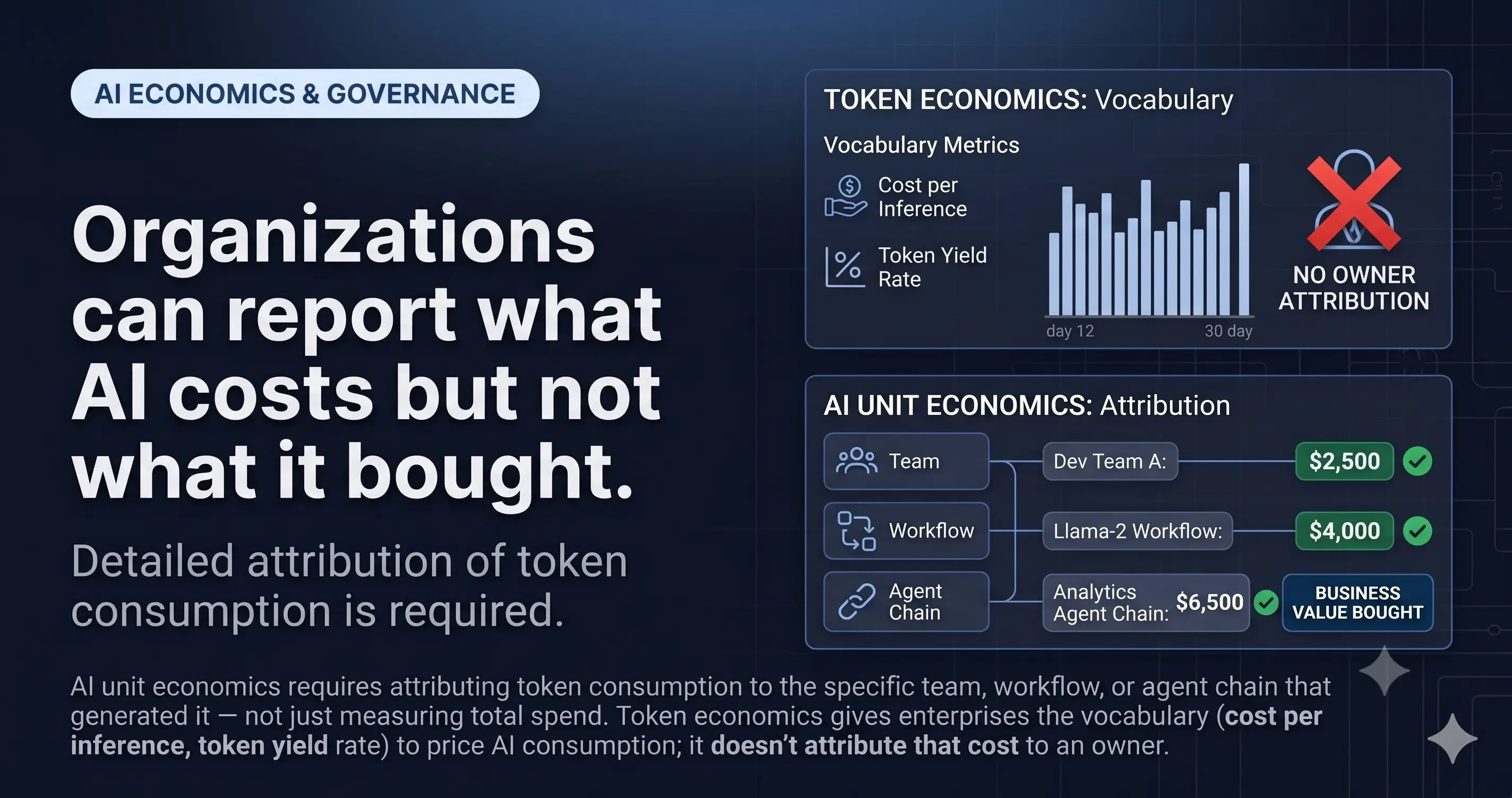
Token Economics Gave AI Spend a Vocabulary. It Still Has No Owner.
FinOps Foundation's token economics framework names the AI cost problem correctly. But naming a metric and attributing it to a team, workflow, or chain are two different disciplines — and most enterprises only have the first.