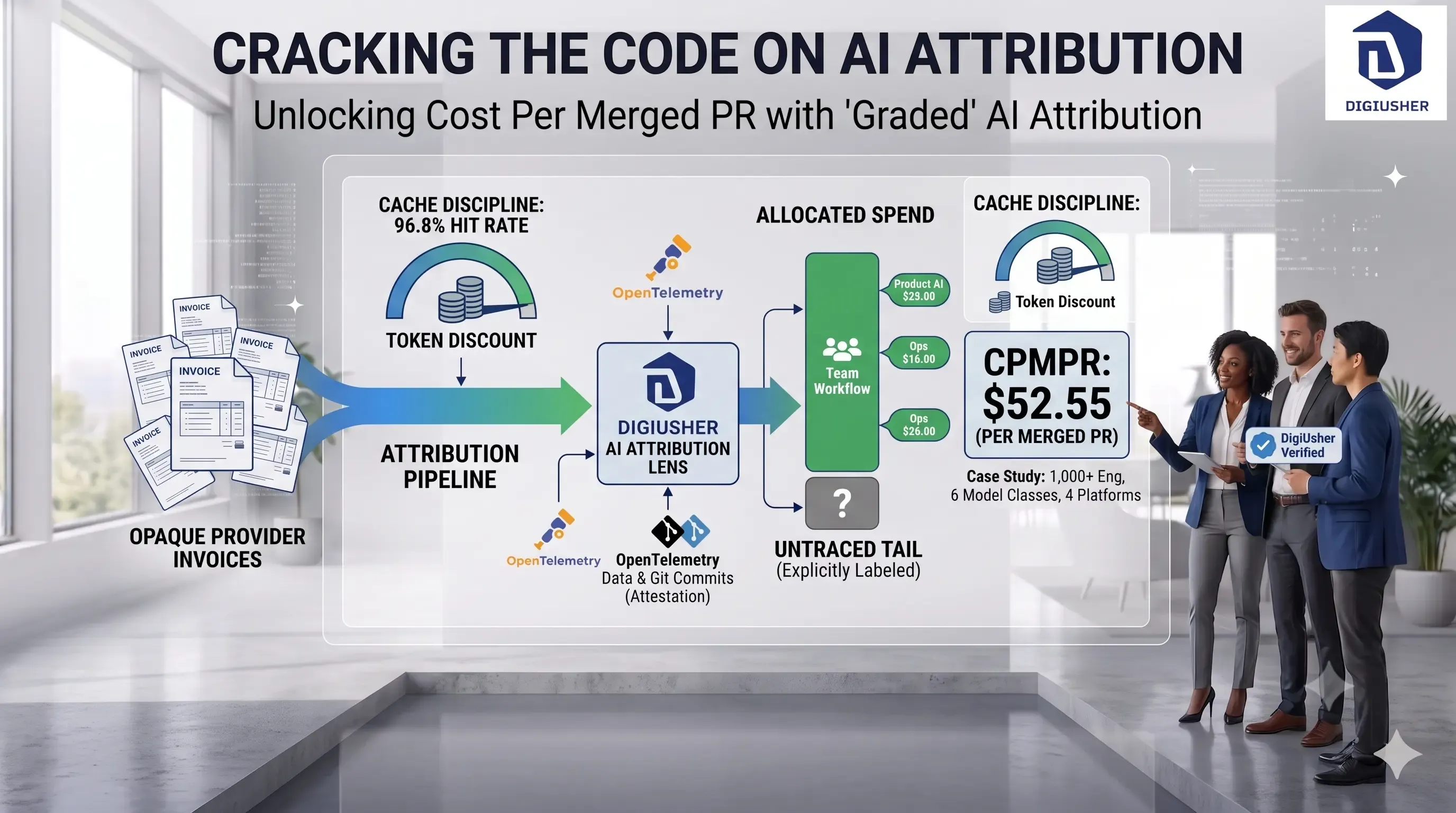
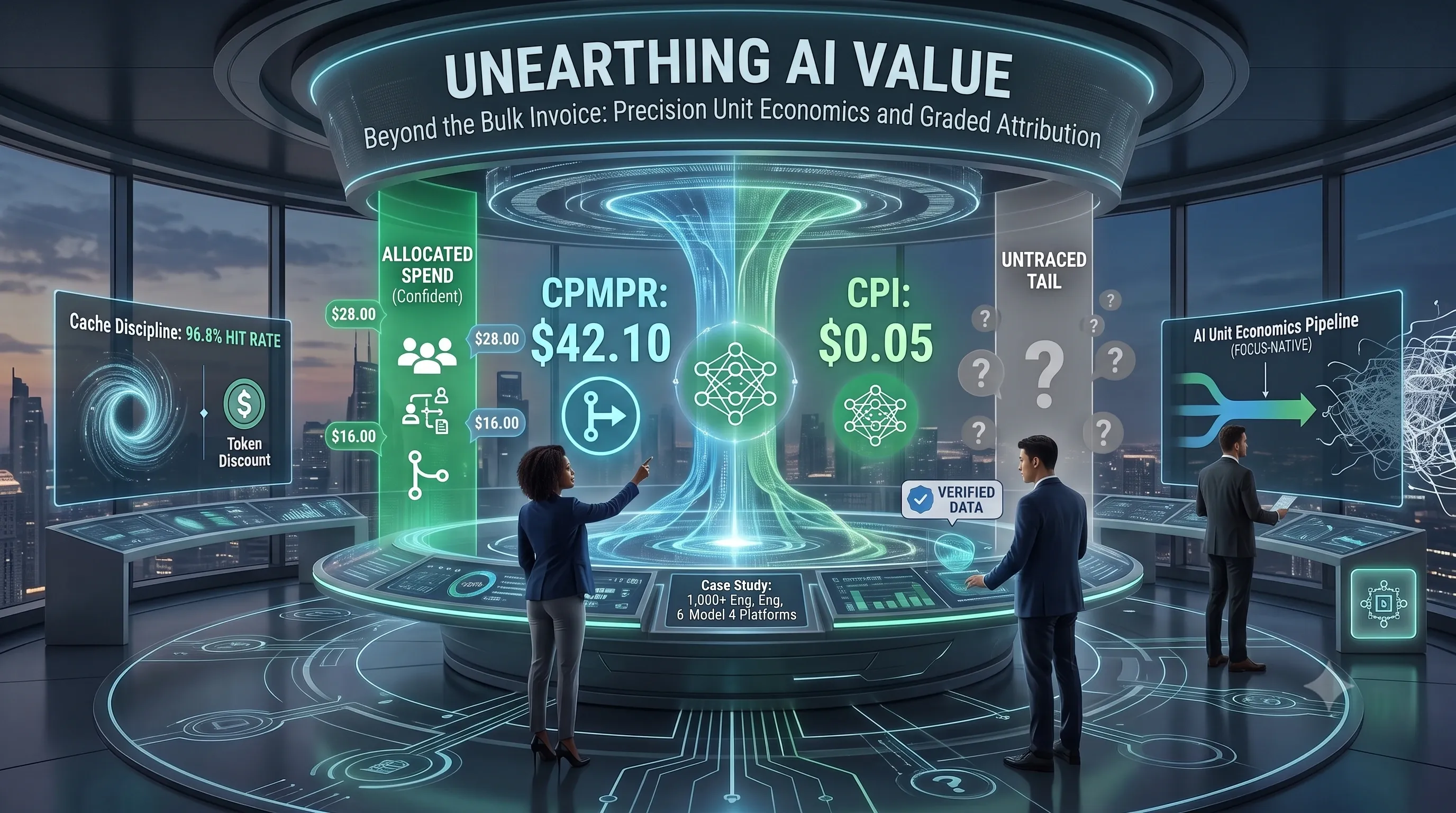
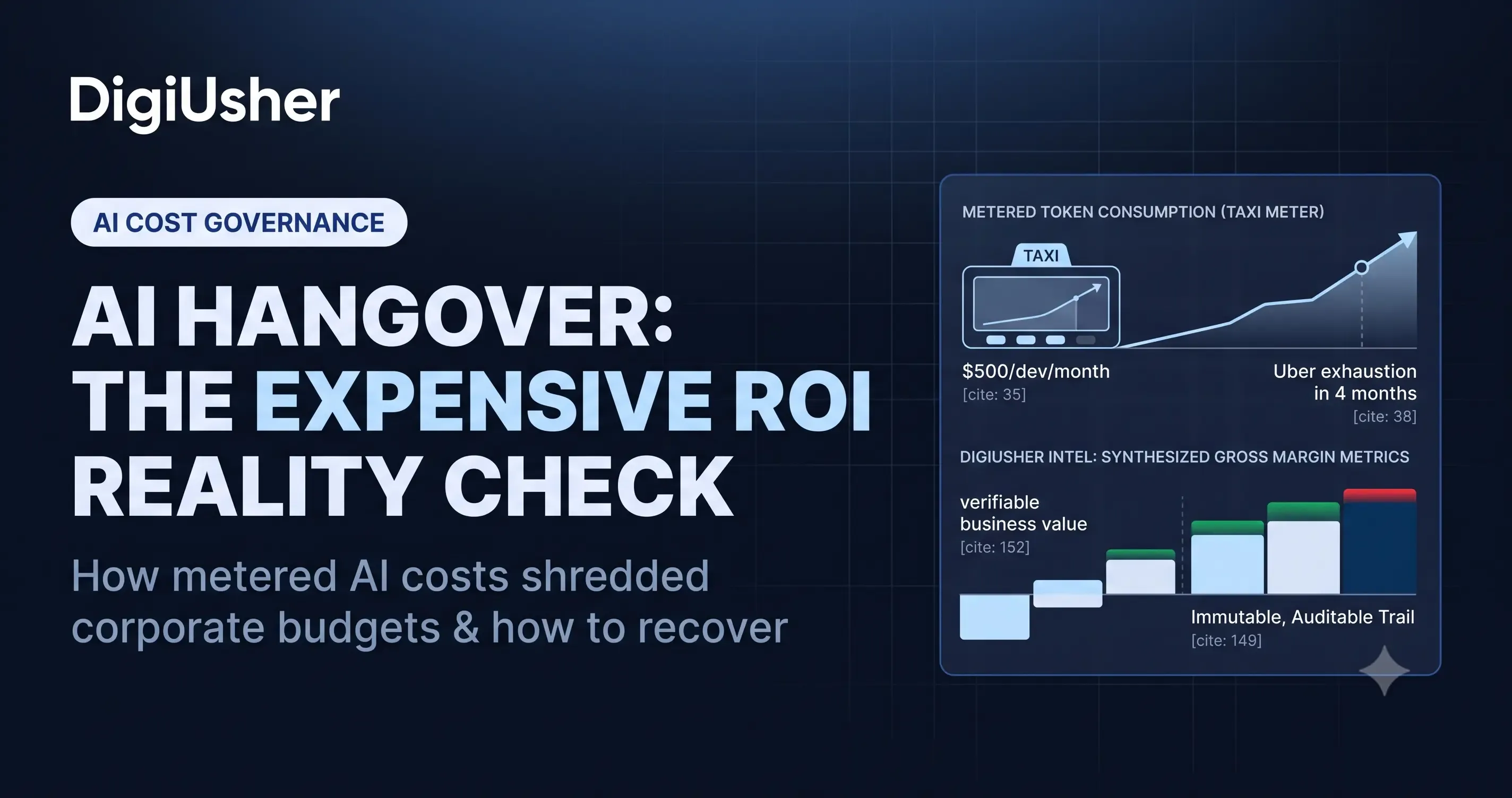
A public technology firm with 1,000+ engineers refused to run its AI spend on faith. Here's the ledger it built instead — $52.55 per merged PR, 96.8% cache-hit rate, and a blended cost of $0.75 per million tokens.
98% of FinOps teams now manage AI spend, but almost none can price a merged pull request. Here's the framework for AI unit economics in 2026 — and why the invoice alone can't answer the board's question.
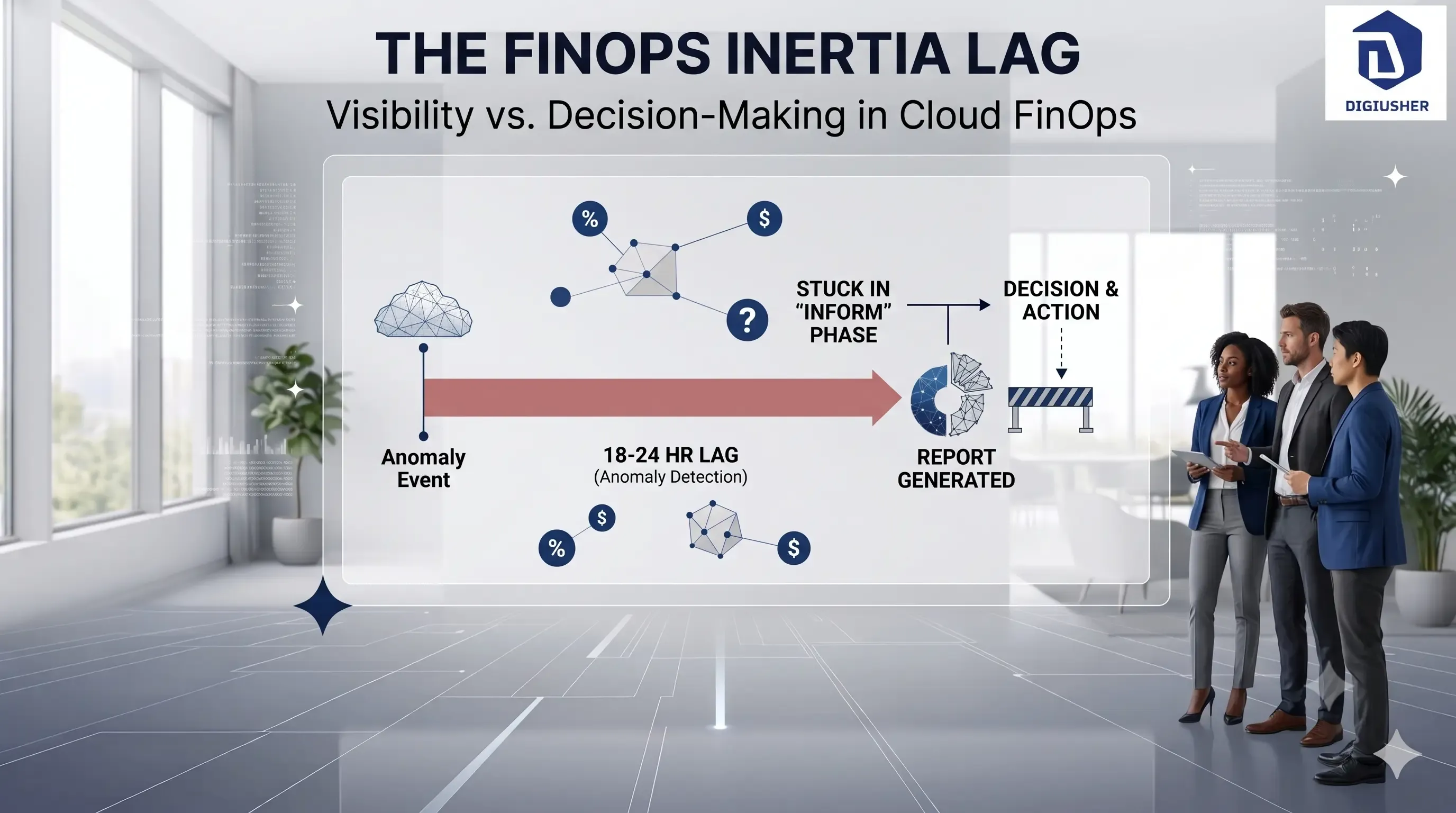
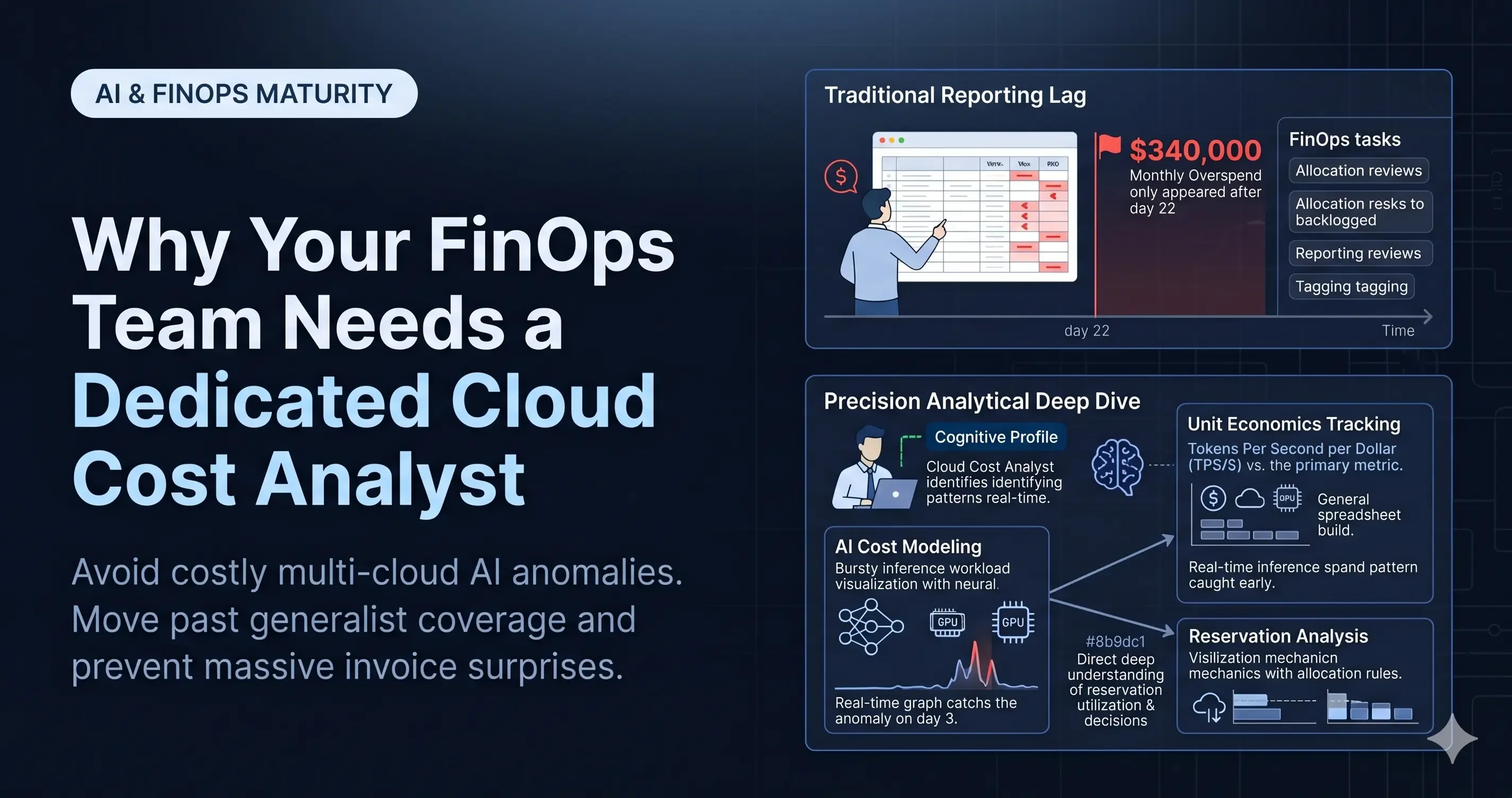
Visibility tools generate reports, not decisions. Legacy FinOps tools carry an 18-to-24-hour anomaly detection lag, according to the DigiUsher live TCO index — and that lag, not a lack of dashboards, is why most programs never leave the Inform phase.
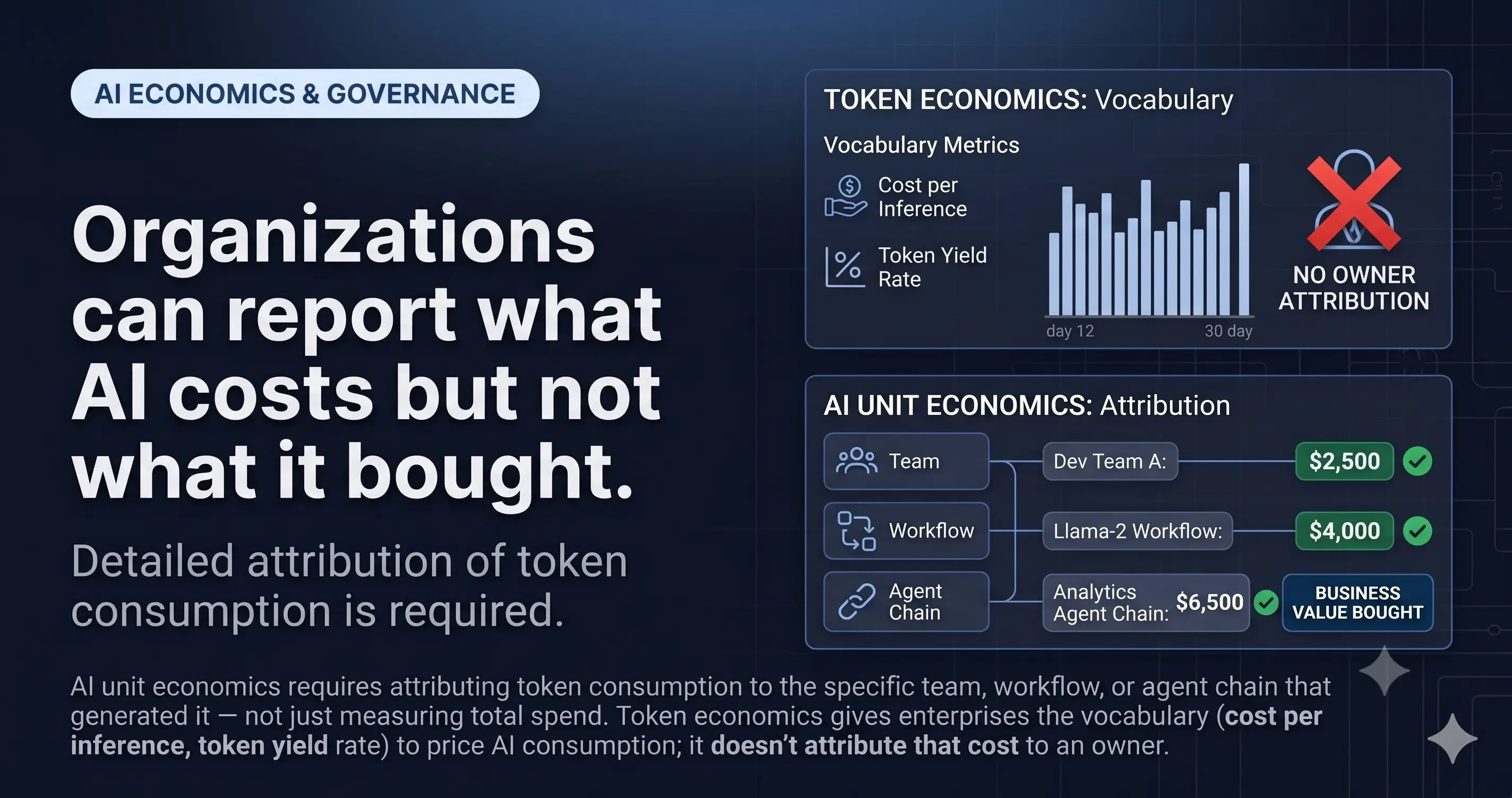
FinOps Foundation's token economics framework names the AI cost problem correctly. But naming a metric and attributing it to a team, workflow, or chain are two different disciplines — and most enterprises only have the first.
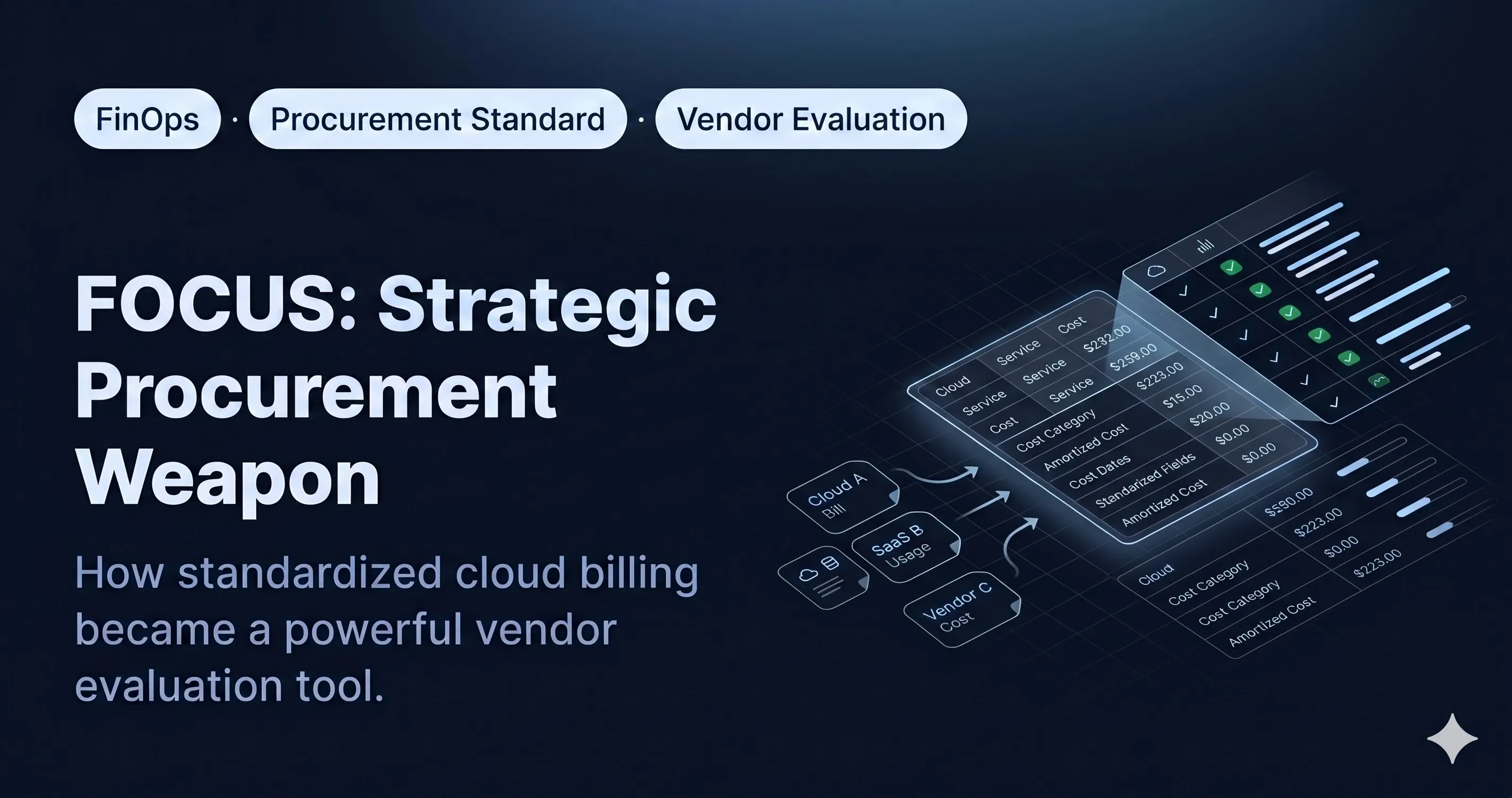
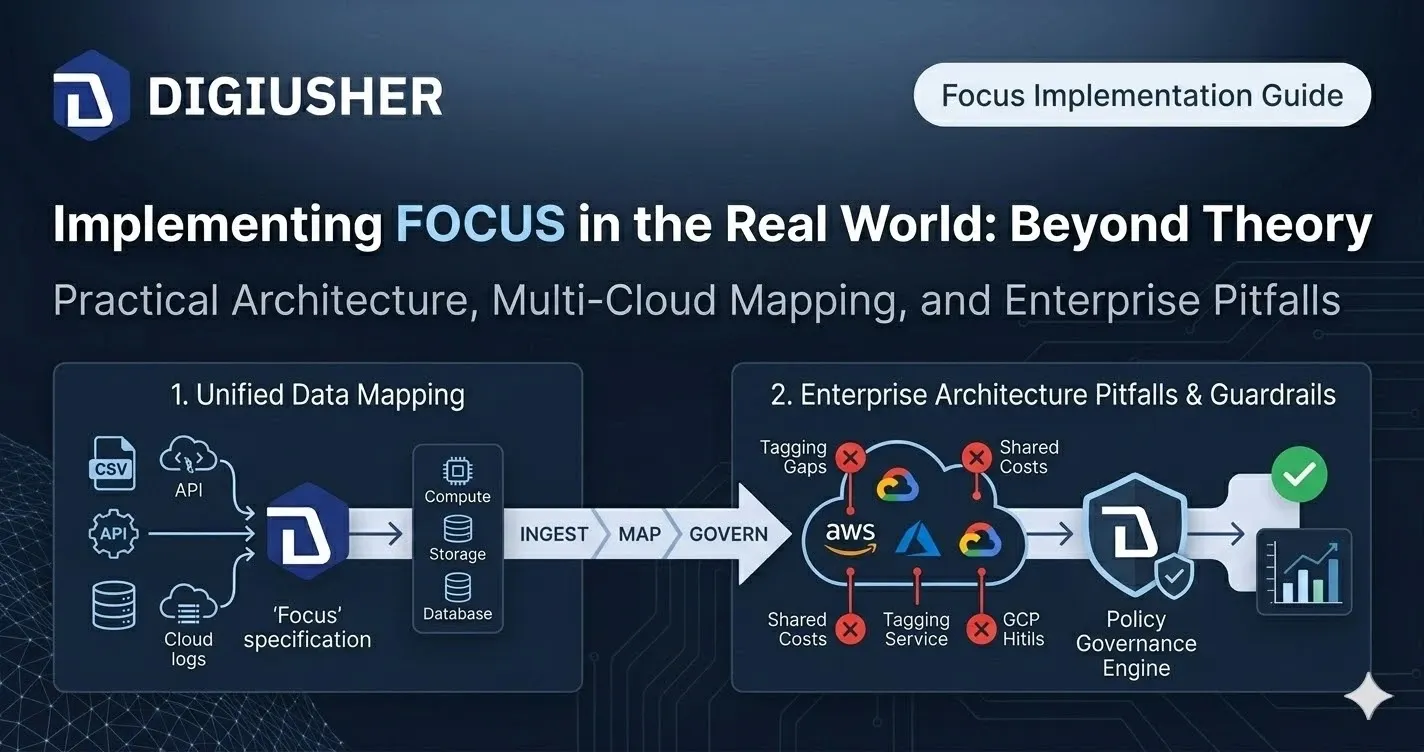
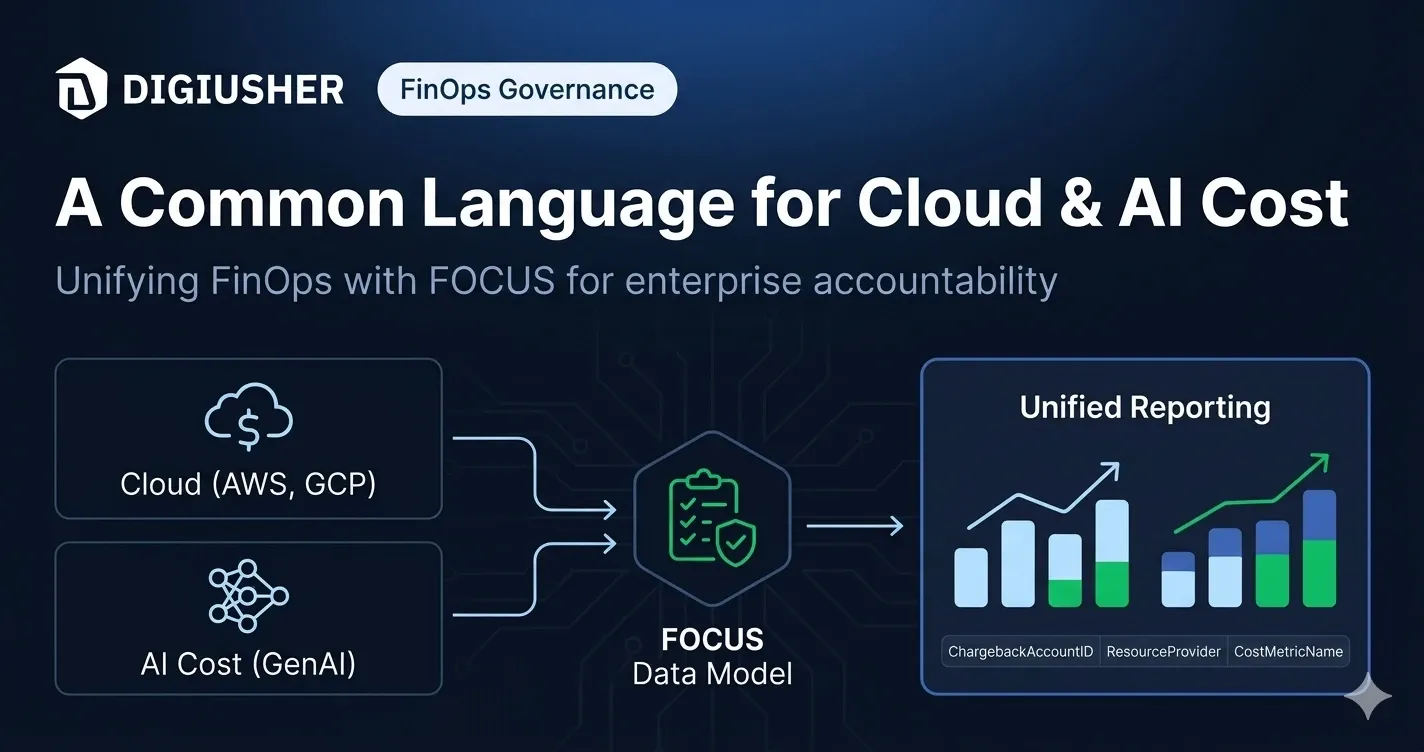
By end-2025, every major hyperscaler produced native FOCUS billing exports. When the data generators all speak the same schema, your platform either does too — or it doesn't.
A wrap-up of the May 2026 of DigiUsher releases — three new data sources (Anthropic, Databricks, Alibaba Cloud) went GA, 31 new AI-specific savings scenarios across Azure OpenAI and GCP Vertex AI, a predefined AI Dashboard, a guided setup checklist, deeper Kubernetes visibility with GPU and storage lenses, and a redesigned connector experience.
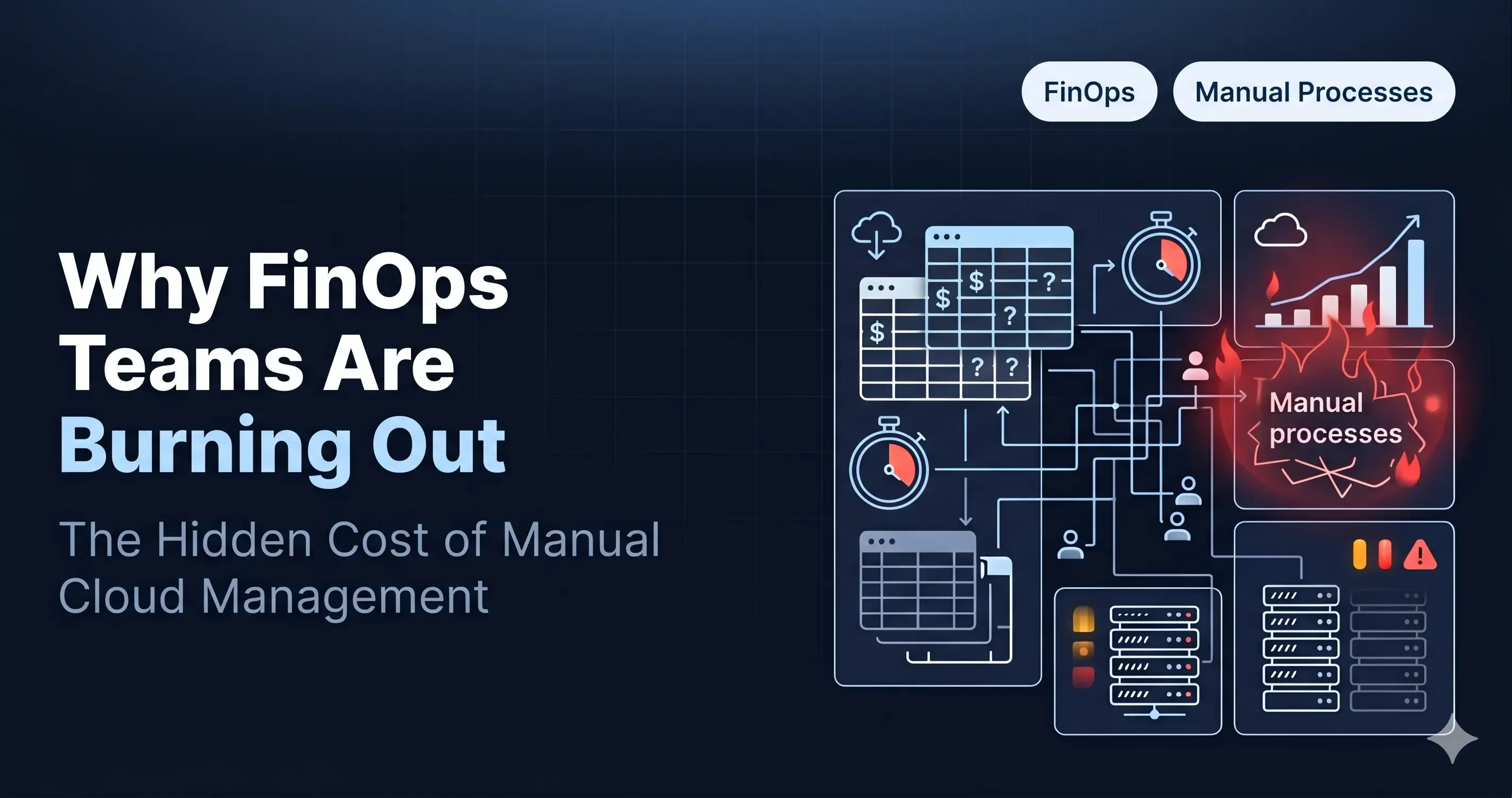
Addresses the growing burnout crisis in FinOps teams due to reactive, manual processes and constant fire-fighting, positioning automation and proactive governance as the solution
84% of enterprises report AI cost margin erosion. Only 14% achieve Kubernetes chargeback. FOCUS-native production architecture resolves both — here is the anatomy.
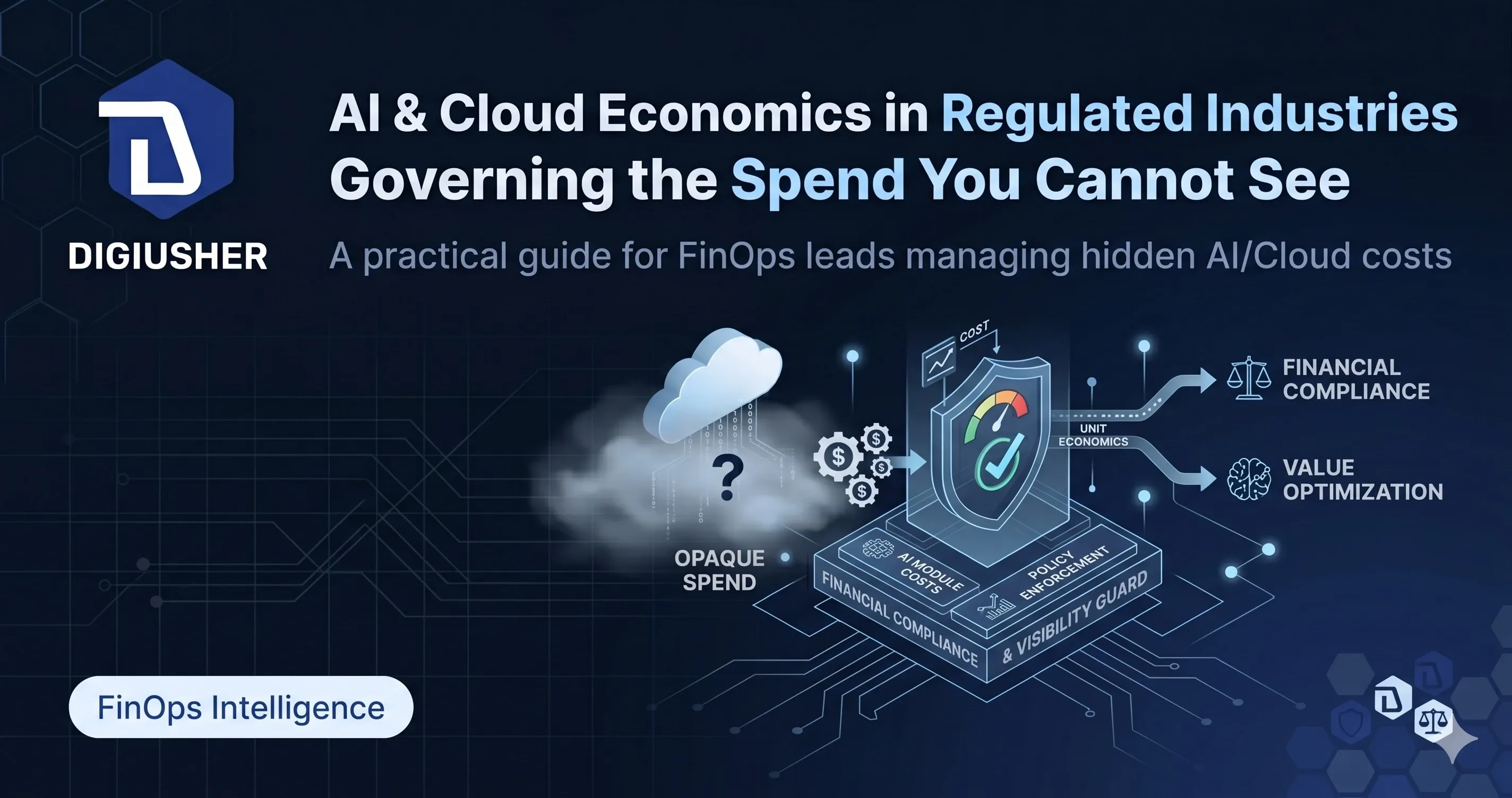
95% of GenAI pilots return nothing measurable, yet regulated industries are scaling AI fastest under the heaviest constraints. Why sovereignty and attribution now decide ROI.
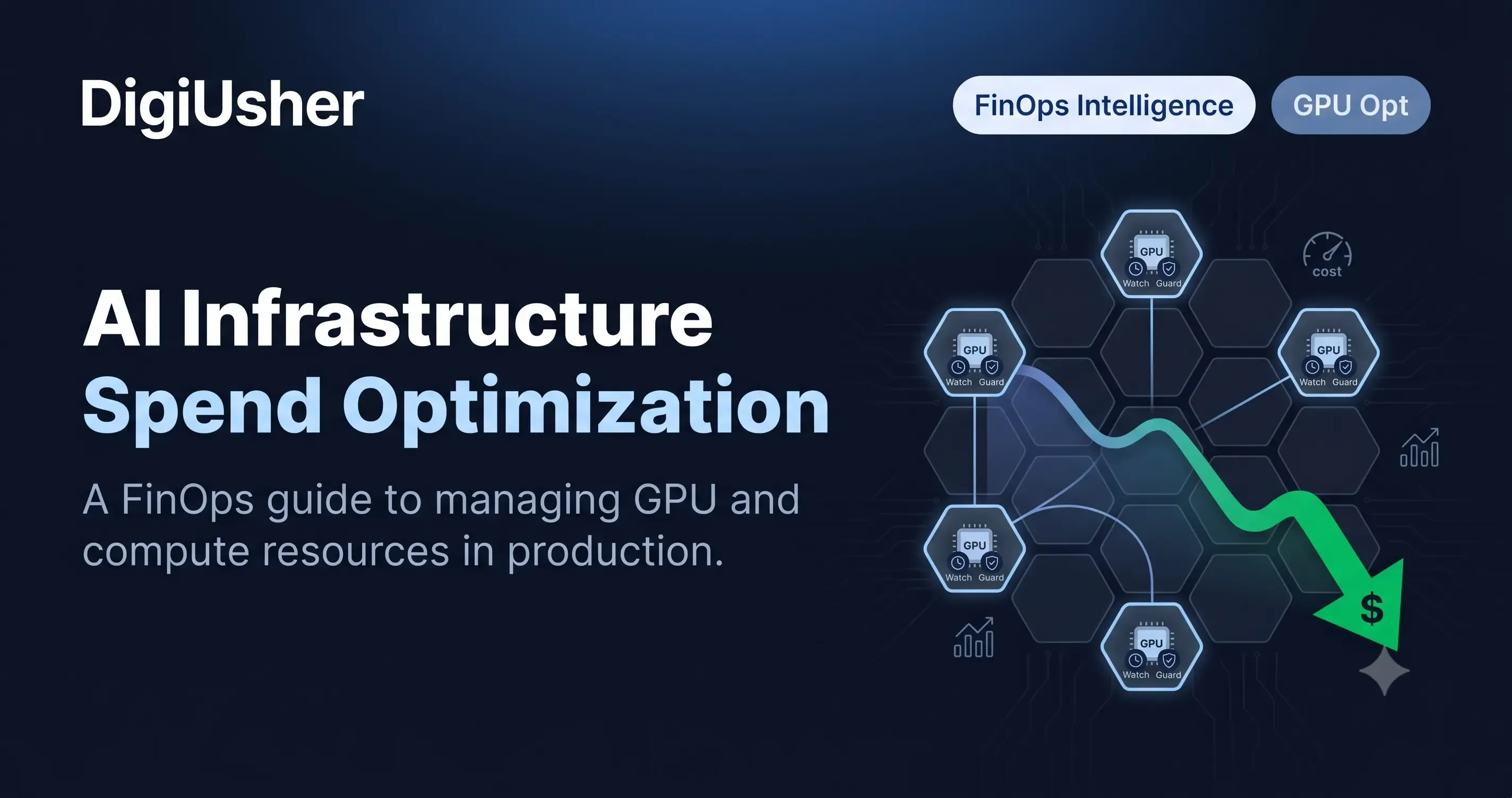
A practical guide for managing the explosive growth in AI/ML infrastructure costs, including GPU optimization strategies and multi-cloud AI spending visibility
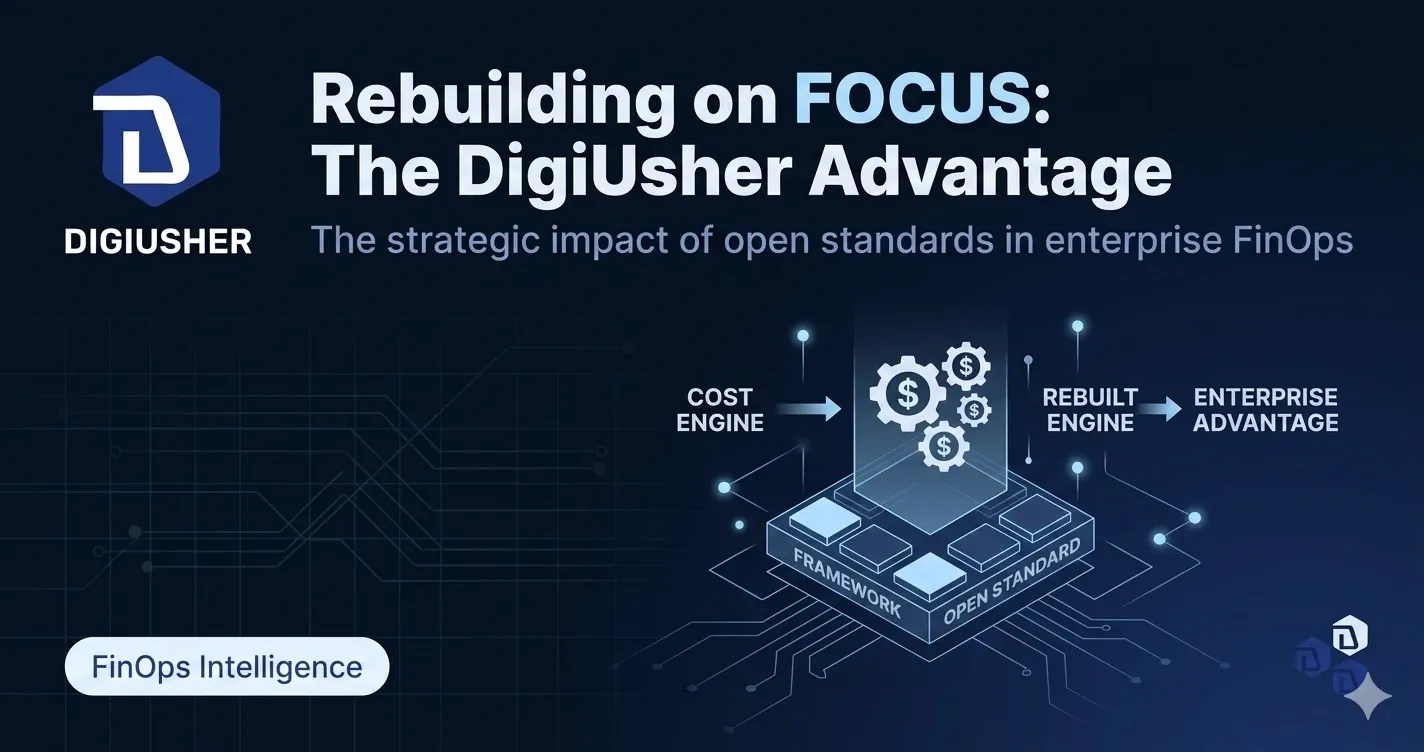
In 2023, DigiUsher bet its platform architecture on FOCUS before hyperscalers committed to it. Here is why that decision was made, what it cost, and what it delivers.
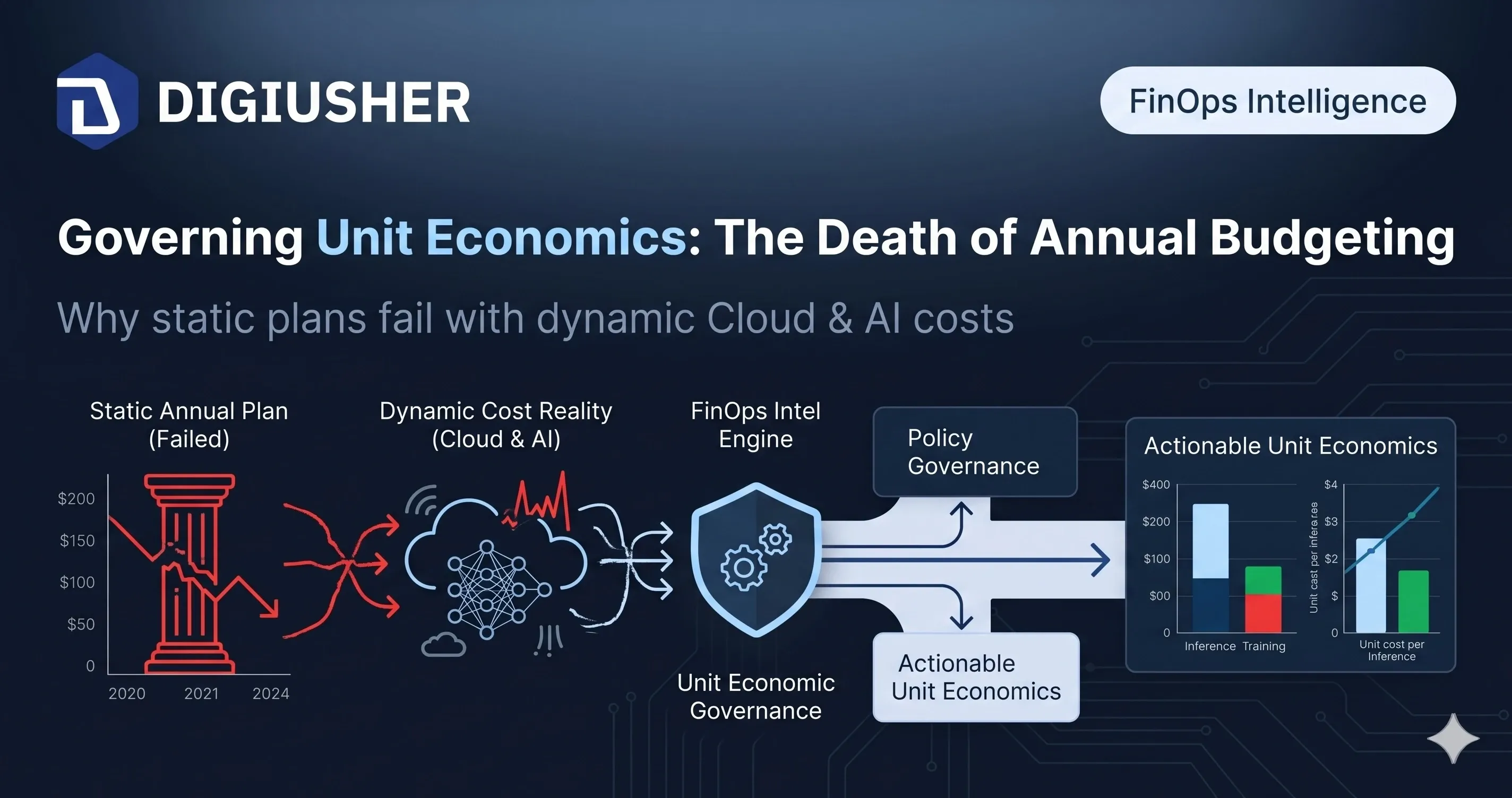
Annual planning was built for fixed assets. Cloud and AI spend is consumption-driven, non-linear, and breaks the 12-month budget cycle. Here is what replaces it.
FOCUS 1.3 solved three problems that have defeated enterprise FinOps teams for years: shared cost allocation, contract commitment tracking, and data freshness. Here is the complete technical guide.
Only 7% of CFOs see high ROI from AI despite $270B in enterprise spend forecast for 2026. Here's the governance framework boards are demanding — and why cost attribution is the missing layer.
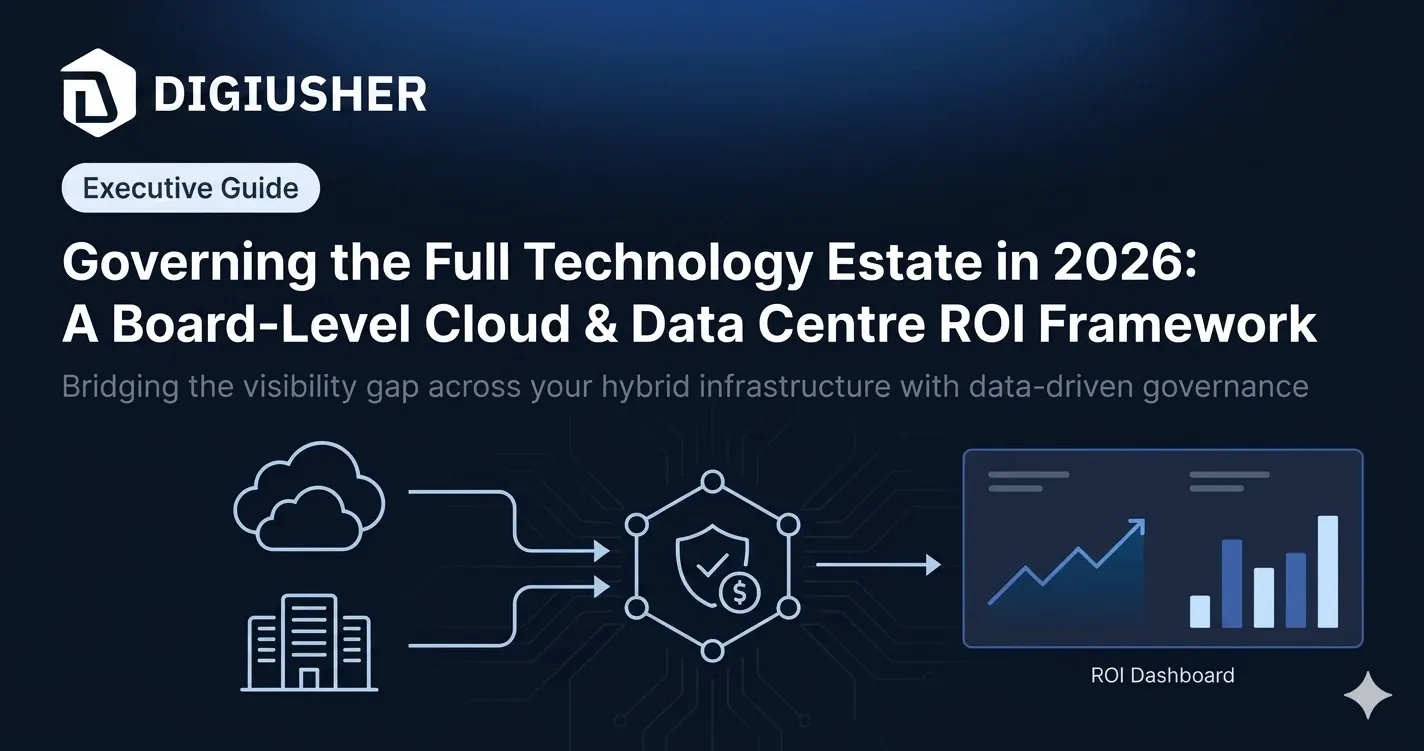
Cloud waste runs at 29-35% of spend. GPU idle time hits 30-60%. Data centre costs surpass $650B in 2026. Here is the board-level governance framework that connects every infrastructure dollar to measurable business value.
80% of enterprises can't track cloud spend accurately across providers. The reason isn't discipline — it's three incompatible billing schemas. FOCUS changes the equation.
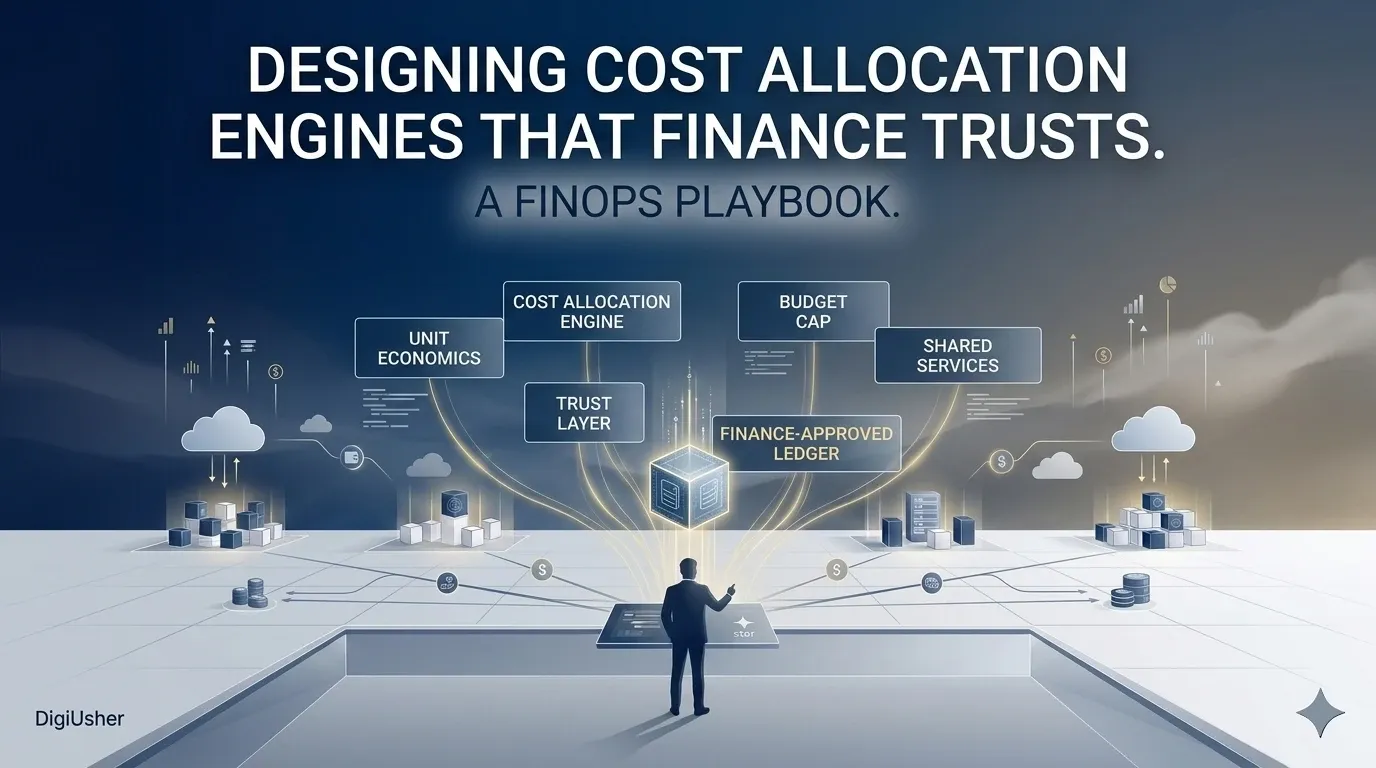
Only 43% of enterprises track cloud costs at unit level. Here's how to design a cost allocation engine that Finance will trust — across multi-cloud, Kubernetes, AI, and SaaS.
8% of FinOps teams now govern AI spend. Gartner forecasts $2.52T in global AI investment. The State of FinOps 2026 rewrites the rules for every CTO, CFO, and Head of FinOps.
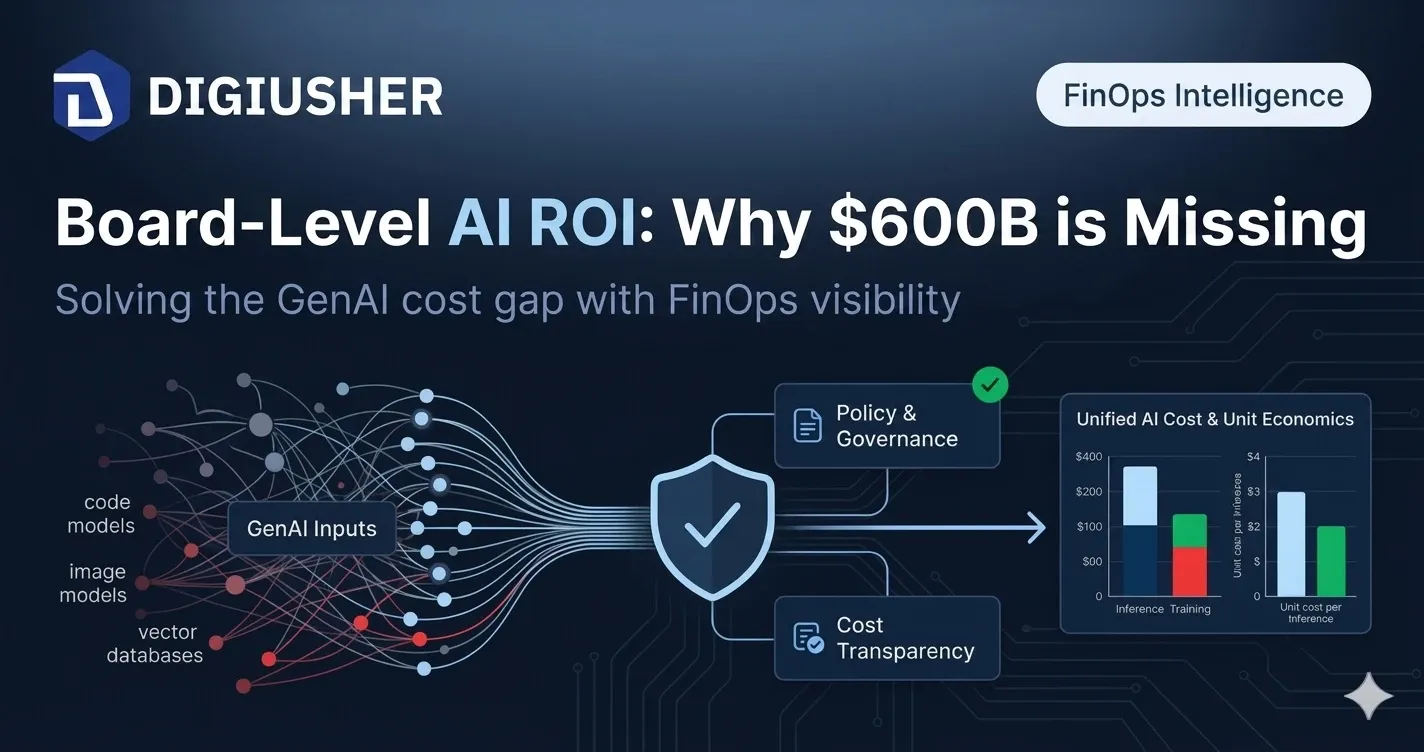
Worldwide AI spending is forecast to reach $2.52 trillion in 2026. Only 12% of CEOs say AI has delivered both cost and revenue benefits. 95% of enterprise AI initiatives fail. The ROI gap between capital deployed and value generated has ballooned to $600 billion. CFOs are now on the front lines — and the governance model that gets them there is not a cloud dashboard. This is the definitive CFO playbook for governing cloud and AI as capital allocation, not IT overhead.
One FinOps practitioner in 2026 reached 97% optimization in their Cost Optimization Hub — and intentionally left the remaining 3% unactioned for business reasons. The easy wins are gone. The 'big rocks' of cloud waste have been cleared. Optimization alone can no longer define the discipline. This is the strategic manifesto for FinOps in 2026 — what died, what replaced it, and why the new playbook is shift left, shift up, and govern the full technology estate.
A wrap-up of the last four weeks of DigiUsher releases. refreshed one-click remediation using Azure DevOps, new deep cost-saving scenarios across AWS, GCP and Google Workspace, full commitment utilization tracking across all cloud providers, smarter enhanced forecasting, and a refreshed navigation built so every FinOps role finds what they need faster.
Chargeback was built for a world of static servers, predictable workloads, and clear ownership boundaries. That world is gone. In 2026, shared Kubernetes clusters, ephemeral containers, and AI token costs have made traditional allocation models inaccurate, delayed, and politically toxic. This briefing explains the five failure modes destroying chargeback in modern infrastructure — and the five-capability model that replaces it.
80% of enterprises now have formal platform engineering initiatives. Platform teams own Kubernetes clusters, CI/CD pipelines, observability stacks, and AI infrastructure — making them the de facto financial decision-makers for the fastest-growing cost categories in enterprise cloud. But they are measured on deployment speed and reliability, not cost efficiency. This brief explains the five mechanisms turning platform teams into shadow cost centers, why traditional FinOps cannot govern at platform velocity, and how the transformation from cost center to financial control plane happens.
Platform teams running EKS, AKS, GKE, and OKE face radically different cost structures behind identical Kubernetes APIs. Control plane fees alone cost $8,760/year per 10-cluster estate on EKS versus zero on AKS. OKE runs serverless workloads at one-third the cost of EKS or AKS. This technical FinOps playbook breaks down real 2026 pricing, hidden cost drivers, platform-specific optimisation levers, and the unified governance model that no single native tool provides.
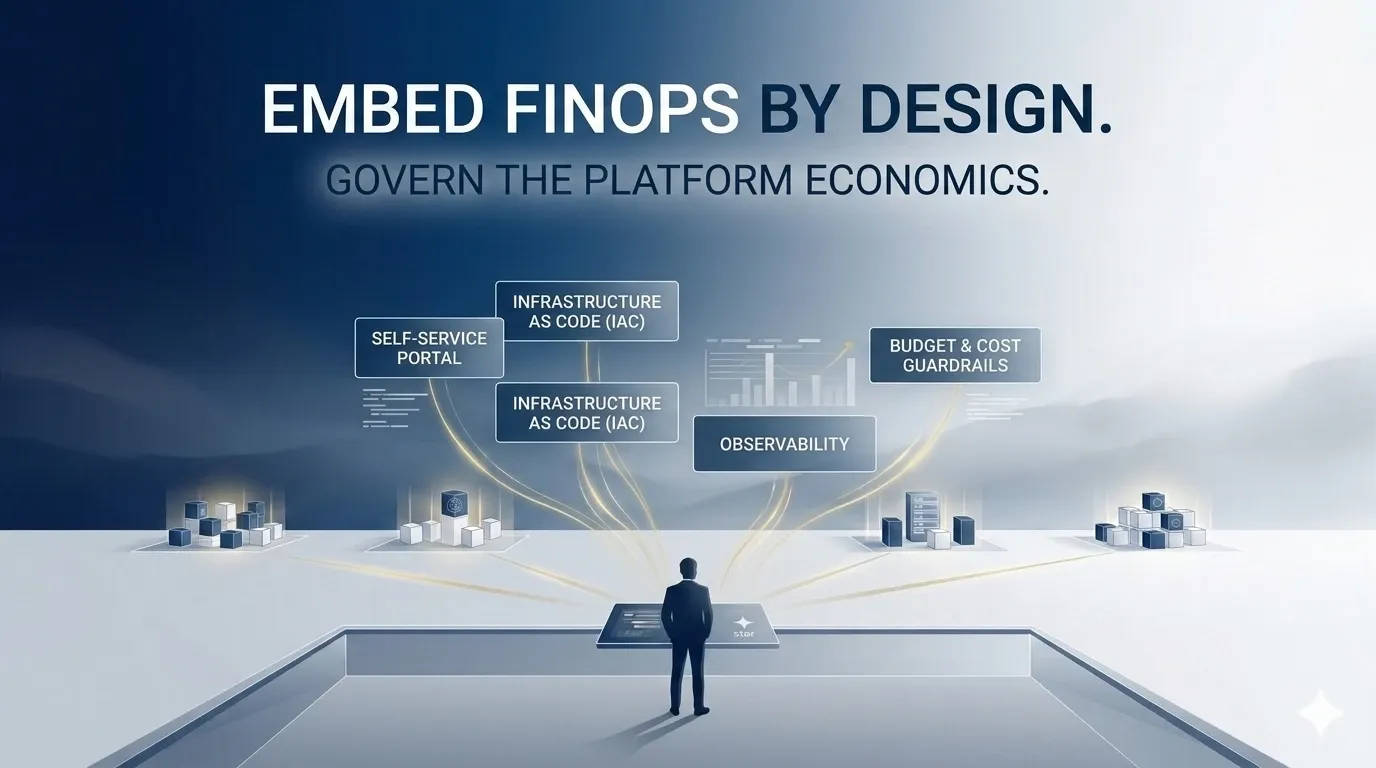
80% of software engineering organisations will have dedicated platform teams by 2026 — up from 45% in 2022. But Gartner's own data confirms the critical gap: Internal Developer Platforms optimise for speed, not cost. This briefing explains why FinOps embedded at the platform layer — not bolted on after deployment — is the only governance model that prevents frictionless self-service from becoming frictionless overspend
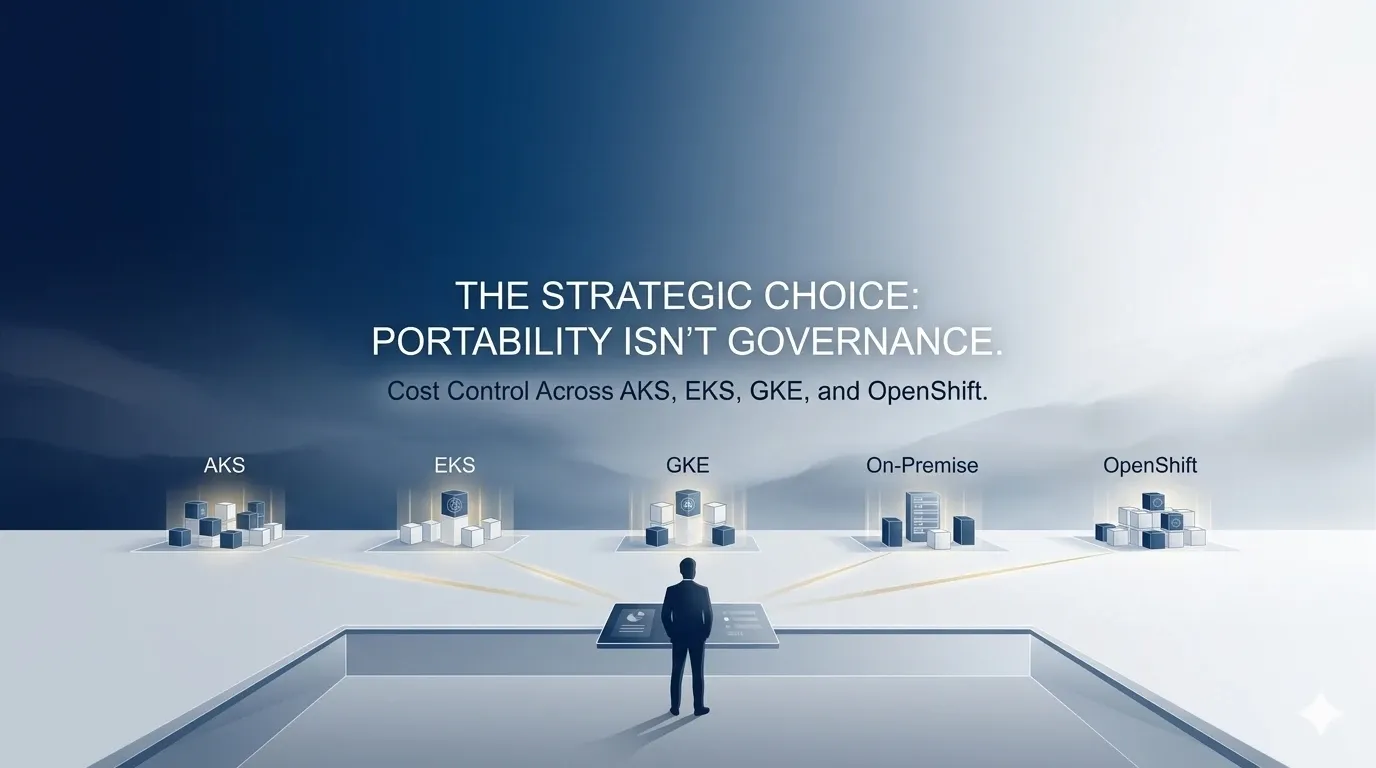
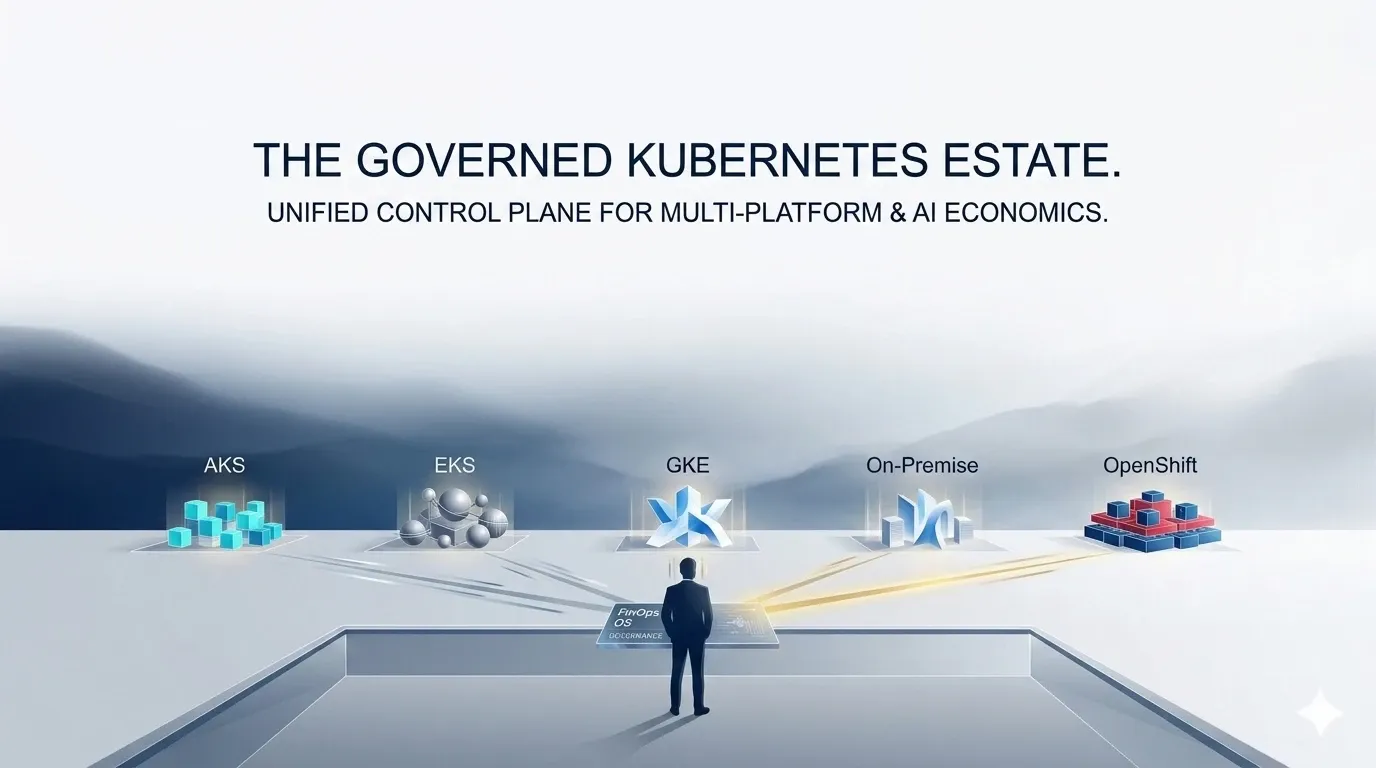
Multi-cloud Kubernetes delivers portability across AKS, EKS, GKE, and OpenShift — but portability does not solve economics. Discover the five ways cost fragmentation silently destroys multi-cloud ROI, how leading platform teams are building financial orchestration alongside workload orchestration, and why DigiUsher's FinOps OS outperforms IBM Cloudability, CloudZero, Vantage, and FinOut for Kubernetes cost governance.
Not all Kubernetes platforms are economically equal. This FinOps deep dive compares AKS, EKS, GKE, on-prem Kubernetes, and OpenShift across cost visibility, pricing structure, optimisation potential, and governance capability — with a practical framework for making Kubernetes platform economics a competitive advantage in 2026.
96% of enterprises run Kubernetes — yet only 13% of requested CPU is actually used. This ultimate FinOps guide covers workload rightsizing using P50/P95 percentiles, bin packing strategies for node efficiency, GPU optimisation with MIG and time-slicing, namespace cost attribution, and real-time policy enforcement — with concrete benchmarks, configuration patterns, and the DigiUsher FinOps OS layer that governs it all.
99% of Kubernetes clusters are overprovisioned. The average cluster wastes 47% of provisioned resources. At KubeCon Europe 2026, the industry admitted what FinOps practitioners already knew: Kubernetes solves deployment — it amplifies inefficiency. This deep dive explains the five hidden financial mechanisms behind Kubernetes waste, why traditional FinOps cannot fix them, and what a FinOps OS layer does that point tools cannot.
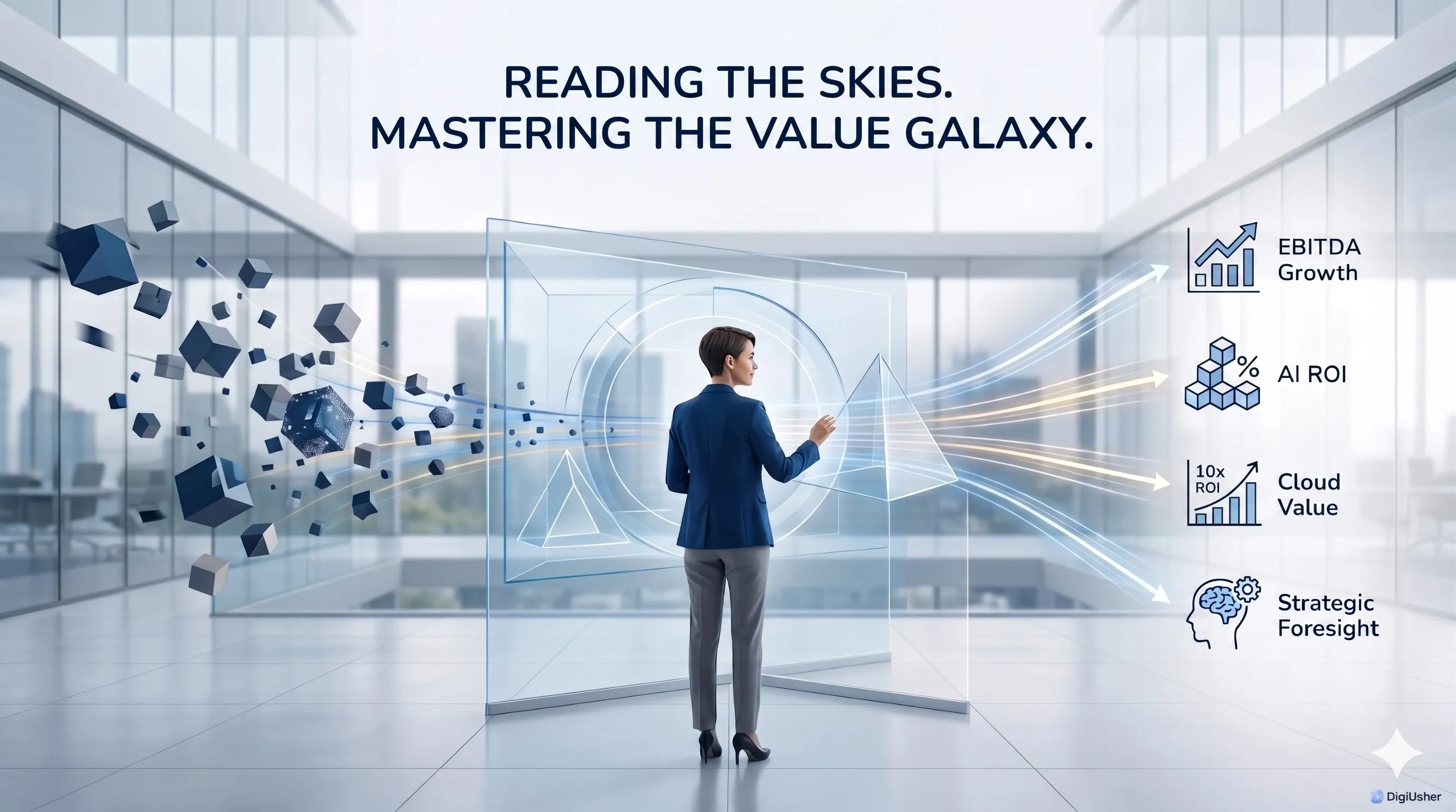
FinOps has moved from cloud cost control to enterprise value governance. Only 15% of AI decision-makers report an EBITDA lift from AI investment. Fewer than one in three can tie AI spend to P&L outcomes. This briefing explains the structural forces making FinOps a board-level discipline in 2026 — and what the CFO-CIO convergence requires of every enterprise managing cloud and AI at scale.
Hyperscalers will spend $602 billion on AI infrastructure in 2026 — 75% of it on AI. LLM inference costs have fallen 1,000× in three years, yet enterprise AI bills are skyrocketing. This briefing explains the stacked cost architecture of the AI economy, the margin compression problem destroying AI ROI, and why FinOps governance — not more compute — determines who captures the margin in the age of the Token Factory.
Enterprises are deploying GenAI across Azure OpenAI, AWS Bedrock, and Google Vertex AI simultaneously — three platforms with incompatible billing models, different governance capabilities, and hidden costs that erode AI ROI. This FinOps guide compares all three platforms on cost structure, attribution capability, optimisation levers, and governance gaps — with a practical cross-platform normalisation framework.
GPU infrastructure is now the fastest-growing cost driver in enterprise cloud — and 30–50% of that spend is wasted on idle capacity. This FinOps guide covers GPU pricing across Azure, AWS, and GCP, the five mechanisms through which AI compute costs spiral out of control, and the governance framework that stops GPU from becoming your largest and least-governed cost centre.
84% of enterprises report gross margin erosion from AI workloads. Only 15% can forecast AI costs within ±10%. AI inference now represents 85% of the enterprise AI budget — and the API pricing it is built on is subsidised. This executive briefing explains the five structural forces compressing enterprise AI margins, why LCOAI is the metric that changes everything, and how FinOps governance determines who keeps the profit.
30–40% of IT spending in large organisations is Shadow IT. 98% of executives admit to bypassing IT for technology purchases. Shadow AI adds $670,000 to average breach costs. This briefing reframes Shadow IT as a financial governance failure — explains the AI multiplier effect that turns ungoverned spending into enterprise margin risk — and sets out the FinOps operating model that replaces restriction with controlled accountability.
Enterprise software sales through cloud marketplaces will grow from $30 billion in 2024 to $163 billion by 2030. Cloud procurement is no longer a sourcing function — it has become a continuous financial operations discipline. This briefing explains the three forces reshaping enterprise cloud buying, why the CIO and CFO must act together, and what it means when FinOps shifts up from cost reporting to board-level technology investment strategy.
Learn how to build runtime-enforced cost guardrails on Azure Landing Zones with mandatory tagging, dynamic budget automation, and AI cost governance. DigiUsher's FinOps OS closes the gap that native Azure Policy leaves open
CIOs must now govern cloud and AI spend with the same rigour as CapEx. Learn the capital asset governance framework, hyperscaler trends, and how DigiUsher's FinOps OS operationalises ROI discipline across AWS, Azure, GCP, and AI workloads.
Cloud spend now averages ~10% of revenue and 89% of CFOs say rising costs are eroding profitability. This evidence-backed framework shows how finance leaders can move from reactive reporting to proactive cloud ROI governance using DigiUsher's FinOps OS
Cloud marketplaces have transformed enterprise software procurement — but governance has not kept pace. Discover why native cloud tools stop at visibility, why marketplace economics demands a FinOps OS layer, and how DigiUsher governs SaaS, AI APIs, and partner billing as first-class cost objects.
GenAI workloads are driving cloud bills 30% higher year-over-year and 72% of enterprises say AI costs are becoming unmanageable. This operational playbook covers token-level tagging, automated budget guardrails, multi-cloud AI cost normalisation, and GPU lifecycle automation — with concrete guidance for AWS Bedrock, Azure OpenAI, GCP Vertex AI, and third-party LLM APIs
Traditional FinOps tools deliver visibility. A FinOps Operating System delivers governance. Learn why the category shift from cost dashboards to a FinOps OS is the defining enterprise cloud decision of 2026 — and how DigiUsher built the control layer that CIOs, CFOs, and FinOps teams actually need.
Bessemer's State of AI defined the era's growth archetypes — Q2T3, Supernovas, Shooting Stars. Eight months on, 2026 has answered with a harder question: velocity produces waste as fast as it produces value. Average enterprise AI budgets grew from $1.2M to $7M in two years. 73% of FinOps teams report AI costs exceeded original projections. Inference now accounts for 85% of enterprise AI spend. This updated executive playbook translates the Bessemer framework into the financial discipline enterprises need now
Cloud was complex. AI made it explosive. Enterprise AI spend grew 5.8× in two years. A $400M collective leak in unbudgeted agentic AI spend hit Fortune 500 companies in Q1 2026 alone. 73% of FinOps teams report AI costs exceeded original projections. This is the definitive guide to what FinOps for AI actually requires — why legacy cost tools cannot govern it, what business clarity looks like when it is working, and how DigiUsher's FinOps OS turns AI cost chaos into measurable cloud ROI.
DealFlow — a Copenhagen-based fintech building the world's first autonomous AI financial assistant for founders and finance teams — had a paradox at its core: a platform purpose-built to give businesses financial clarity had no cost clarity over its own AWS infrastructure. This is how DigiUsher's FinOps OS transformed DealFlow's AWS governance from reactive invoice analysis to a proactive, engineering-embedded culture of cost accountability
InstaSafe — a Gartner-recognised Zero Trust Network Access provider protecting distributed workforces across multi-cloud environments — had no visibility into what serving each customer actually cost them. Costs were pooled, unallocated, and invisible. This is how DigiUsher transformed that opacity into 25% improved unit economics, 30% cloud cost reduction, and 100 hours per month returned to the engineering and finance teams.
DigiUsher has achieved Microsoft Azure ISV Co-Sell Ready status and is live on the unified Microsoft Marketplace — the platform that consolidated Azure Marketplace and AppSource in September 2025 and now hosts 6M+ monthly visitors. Microsoft sellers can co-sell DigiUsher to enterprise customers. Purchases are MACC-eligible, meaning they count 100% toward existing Azure Consumption Commitments. This is what Azure ISV Co-Sell Ready actually means, how MACC procurement works, and why this is the most commercially efficient way to purchase enterprise FinOps governance.
DigiUsher has achieved AWS ISV Accelerate Partner status and is listed on AWS Marketplace — meaning AWS account managers are now co-selling DigiUsher's FinOps OS directly to their enterprise customers. This is what AWS ISV Accelerate actually means, why it matters for enterprise FinOps buyers, and how purchasing DigiUsher through AWS Marketplace lets customers consume existing committed cloud spend rather than opening new budget cycles.
Cloud spending hit $723 billion globally in 2025. Enterprises without a structured FinOps programme waste 32–40% of every cloud dollar. Those with mature programmes recover that to under 15%. The difference is the Effective Savings Rate — the single metric that tells you whether your FinOps strategy is generating real financial efficiency or just producing optimisation reports. This definitive 2026 playbook covers the seven savings levers, the ESR benchmarks that define world-class performance, and how DigiUsher's FinOps OS operationalises them into continuous, measurable business value.
Since Broadcom acquired VMware in February 2024, CloudHealth has changed ownership, distribution model, branding, and pricing structure — while tightening MSP programme eligibility to $500,000/year in VMware revenue minimums. Enterprises and MSPs evaluating their FinOps platform strategy need a clear picture of what changed, what the 2026 requirements are, and what a modern FinOps OS offers that a legacy cost reporting tool cannot. This is that playbook
76% of enterprises now run workloads across two or more cloud providers. Multi-cloud should mean resilience and choice — but without a unified FinOps OS, it means fragmented billing, incompatible cost schemas, and governance gaps that compound into tens of millions in unattributed spend. This is DigiUsher: what it does, who it's built for, why FOCUS 1.x native architecture changes the game, and why 7 of 10 enterprise evaluation criteria favour a purpose-built FinOps OS over a single-cloud or single-category tool.