Why FinOps Is Now a Board-Level Responsibility
FinOps has moved from cloud cost control to enterprise value governance. Only 15% of AI decision-makers report an EBITDA lift from AI investment. Fewer than one in three can tie AI spend to P&L outcomes. This briefing explains the structural forces making FinOps a board-level discipline in 2026 — and what the CFO-CIO convergence requires of every enterprise managing cloud and AI at scale.

Executive Summary
For years, FinOps was a tactical function — focused on cloud cost optimisation, tagging compliance, and engineering accountability. That era is over.
The evidence in 2026 is unambiguous:
- Only 15% of AI decision-makers report an EBITDA lift from AI investment in the past 12 months — despite staggering capital flows into AI initiatives
- Fewer than one in three organisations can tie AI spend to P&L changes
- Forrester predicts 25% of planned AI spend will be delayed into 2027 — projects unable to demonstrate clear business value
- Public cloud spend reaches $1.03 trillion globally in 2026 — a number that demands board-level governance
FinOps is no longer about cost control. It is about financial governance of digital infrastructure at scale — governing the largest, fastest-growing, and most unpredictable cost category most enterprises carry.
This briefing explains the structural forces making FinOps a board-level discipline, the convergence between CFO and CIO accountability that governance requires, and what the new metrics of technology value governance look like for boards that intend to govern AI investment with the same rigour applied to capital allocation.
What Is Board-Level FinOps?
Board-level FinOps is the practice of governing cloud and AI technology investment with the same financial rigour applied to capital allocation decisions — including EBITDA impact tracking, ROI accountability, unit economics measurement, and executive oversight of technology spend as a material financial variable.
It represents a categorical evolution from the operational cost management function FinOps began as, to a strategic governance discipline that shapes technology investment decisions before commitments are made — not after costs appear in the billing system.
The FinOps Foundation formalised this in early 2026 when it changed its mission statement from “advancing the people who manage the value of cloud” to “advancing the people who manage the value of technology.” One word. Cloud became Technology. That single change reflects what mature FinOps practices are already doing in leading enterprises — governing AI, SaaS, licensing, private cloud, and data centre alongside public cloud in a unified technology value model.
“You need someone who is equally CTO and CFO at the same time. They must have a multi-disciplinary team, must sit across tech decisions and must be a part of technology decisions starting at the business case.”— Fortune 100 technology leader, FinOps Foundation, 2026
The Structural Shift: Cloud and AI as Capital Allocation Decisions
The fundamental change in enterprise technology economics has not been gradual. It has been a structural break that most governance models have not yet absorbed:
| Dimension | Historical Model | 2026 Reality |
|---|---|---|
| Procurement | Annual CapEx — centralised, predictable | Continuous OpEx — consumption-based, decentralised |
| Spend ownership | IT procurement — controlled, auditable | Engineering, product, data science, business units via APIs and marketplaces |
| Cost predictability | Linear — scales with headcount | Non-linear — AI tokens, GPU burst, marketplace scale independently |
| Financial classification | IT as overhead — support cost centre | Cloud and AI as digital manufacturing cost — direct input cost of every product |
The governance implication of each dimension is the same: traditional annual budget cycles, retrospective cost reports, and IT-owned cost management cannot govern a system that generates cost continuously, dynamically, and across every team in the organisation with cloud access.
McKinsey and BCG increasingly frame cloud and AI spending as strategic capital allocation decisions, not operational expenses. This framing shift is the correct one — and it arrives with a governance consequence: capital allocation decisions require board visibility, CFO accountability, and ROI tracking. Cloud economics, in the current model, frequently receives none of these.
Why the Board Is Getting Involved
Four forces have converged to push FinOps into the boardroom — and they are not temporary pressures. Each one is structural and accelerating.
Force 1 — Cloud and AI Spend Is Material to P&L
Cloud has become one of the largest line items in enterprise P&L, second only to payroll for many technology companies. At $1.03 trillion of global public cloud spend in 2026, the aggregate is a headline number — but the individual enterprise impact is the board concern.
When cloud infrastructure cost runs at 10% of revenue and AI workloads grow at 2–3× the rate of traditional cloud, the question is no longer whether technology economics affect the P&L. It is whether the board has the governance mechanisms to manage a cost category at this scale with the same discipline applied to capital expenditure.
The specific AI driver: Gartner projects AI infrastructure spend of $1.366 trillion in 2026 — more than half of total AI spending. 68% of organisations will increase cloud spending for GenAI. The velocity of AI cost growth has outpaced every governance model built for traditional cloud infrastructure.
The board question this force generates: What percentage of our cloud spend is generating measurable business value, and which portion is structural waste that can be recovered?
Force 2 — AI Investment Is Not Delivering Reported ROI
This is the most consequential board-level finding of 2026.
Only 15% of AI decision-makers report an EBITDA lift from AI investment in the past 12 months. Fewer than one in three organisations can tie the value of AI to P&L changes. Forrester predicts that enterprises will delay 25% of their planned AI spend into 2027 — projects that cannot demonstrate quantifiable business value being paused by CFOs demanding ROI evidence before approving next-wave capacity.
The failure is not technological. It is financial and governance. AI investments are being made without the attribution infrastructure to measure their return — no token-level cost tracking, no unit economics mapping inference cost to business outcomes, no framework connecting model training investment to revenue impact.
Forrester 2026: “Define measurable value paths by tying every AI initiative to a specific revenue, margin, or cost line. Instrument cost and utilisation by tracking model consumption, inference efficiency, and unit economics in real time.”
The enterprises benefiting from AI correction will not be the biggest spenders. They will be the ones treating AI as an economic engine with traceable inputs and measurable outputs — governed with the same financial rigour as any other capital investment.
The board question: Which of our AI investments are delivering measurable EBITDA impact, and which are consuming capital without traceable return?
Force 3 — Cost Volatility Introduces Financial Risk
Unlike traditional IT spend — predictable annual budgets, centralised procurement, hardware refresh cycles — cloud and AI costs are usage-driven, non-linear, and extremely sensitive to architectural decisions that seem trivial to engineering teams but generate large financial consequences.
- Longer prompts → higher token usage → higher monthly AI billing
- Inefficient model selection → higher inference cost → eroded AI margin
- Idle GPU clusters → wasted high-cost compute → invisible P&L drain
- One engineer’s API key → uncapped inference calls → enterprise-scale overspend
Individual AI resources can cost $100/hour or more. A single ungoverned training job or idle GPU cluster can consume weeks of budget in days — invisibly, until the next cloud invoice arrives. “We see customers where AI spend has exceeded their entire legacy data platform budget” — a direct quote from FinOps practitioners in the 2026 State of FinOps survey.
This volatility introduces a financial risk that boards recognise from other domains: the risk of surprise. Only 2% of CIOs report spending less on cloud than projected. Overspend is the structural norm. Boards are increasingly demanding the automated guardrails and real-time governance that prevent cost volatility from reaching the P&L as unplanned variance.
The board question: Do we have automated enforcement that prevents cost volatility from manifesting as financial surprise, or are we discovering overspend in quarterly reviews?
Force 4 — Accountability Is Fragmented Across the Organisation
Cloud and AI spending is no longer centralised. It is distributed across engineering teams, product teams, data science teams, and business units — each with independent access to cloud APIs, AI services, and marketplace procurement channels.
Costs are centralised in the cloud invoice. Decisions are decentralised across every team with a cloud account. The governance gap between them is the primary structural driver of cloud overspend in 2026.
Deloitte, PwC, and KPMG consistently identify lack of ownership and cost accountability as primary drivers of cloud and AI budget overruns. The specific mechanism: when the team that generates spend is not accountable for its financial consequences, and the team that receives the invoice cannot trace charges to owning teams, governance defaults to retrospective reporting rather than real-time control.
The board question: Can every line of cloud and AI spend be traced to a named owner, an approved business case, and a measurable outcome — or does our governance model accept ungoverned spend as a structural condition?
The FinOps Discipline Has Fundamentally Evolved
The 2026 State of FinOps report — based on 1,192 respondents representing more than $83 billion in annual cloud spend — documents a discipline that has structurally reorganised itself around strategic value management, not cost reduction:
Organisational Repositioning
78% of FinOps practices now report into the CTO or CIO organisation — up 18% from 2023. Reporting to the CFO has declined to just 8%. This is not simply a reporting line change. It signals a fundamental repositioning of FinOps from financial reporting and cost policing into a strategic technology capability.
FinOps leaders are now sitting in architecture review meetings. They participate in vendor selection. They shape multi-year provider commitments. They chair AI investment review councils. They are not explaining last month’s bill — they are shaping next year’s technology strategy before financial commitments are made.
Practitioners with VP or C-suite engagement show 2–4× more influence over technology selection decisions than those with only director-level sponsorship. The ROI of executive alignment in FinOps is measurable: 53% vs. 12% influence on cloud service selection.
Scope Expansion: FinOps Cloud+
| Technology Category | 2025 Adoption | 2026 Adoption | Trend |
|---|---|---|---|
| AI management | 63% | 98% | Near-universal — AI value attribution is the dominant challenge |
| SaaS governance | 65% | 90% | Rapid — 100+ SaaS apps per enterprise is the 2026 baseline |
| Private cloud | 39% | 57% | Accelerating — hybrid infrastructure needs unified cost model |
| Licensing | 49% | 64% | Growing — software licensing convergence with cloud FinOps |
| Data centre | 36% | 48% | Expanding — on-premises costs normalised alongside cloud |
The discipline has moved from governing public cloud to governing the full technology estate. For boards, this means FinOps reporting that stops at cloud infrastructure is now structurally incomplete — AI, SaaS, and data centre costs that sit outside the cloud bill are material and growing.
Priority Shift: Governance Over Optimisation
The large, obvious waste items have largely been addressed in mature practices. What remains is harder — smaller savings distributed across more workloads, more platforms, and more spend categories. The 2026 priority evolution reflects this maturity signal:
Old priority: How much did we save on cloud last month? New priority: What are we funding, and should we — a question requiring portfolio visibility across all technology categories.
“Dashboards are table stakes of yesterday — reactive. You have to move to proactive, real-time, automation.”— FinOps Foundation State of FinOps 2026
The CFO–CIO Convergence
One of the most consequential structural shifts in enterprise governance is the convergence of financial accountability (CFO) and technology strategy (CIO) around cloud and AI spend — the cost category that sits directly between their domains.
When CFO and CIO operate in separate reporting structures — finance tracking spend, technology managing infrastructure — the accountability gap between them is where the most expensive enterprise mistakes occur. Technology investments are made without financial constraint. Financial reports are produced without technical context. Neither role has the visibility required to govern the intersection.
What CFOs need from cloud governance in 2026:
- P&L-grade attribution — every pound of cloud spend traceable to a business unit, product, and outcome
- Forecast accuracy within ±10% — cloud economics that finance can plan and report confidently to investors
- AI ROI measurement — EBITDA impact of AI investment, not just the cost of AI infrastructure
- Commitment governance — ensuring reserved capacity generates committed ROI rather than locked-in waste
- Board-ready reporting — cloud economics in financial language, not infrastructure metrics
What CIOs need from cloud governance in 2026:
- Enforcement authority — policy controls that align engineering decisions with financial constraints, without slowing innovation velocity
- Technology selection influence — FinOps data that informs architecture and vendor decisions before commitments are made
- AI governance — token, GPU, and inference cost controls that prevent AI investment from becoming uncontrolled opex
- Cross-function accountability — cost ownership distributed to the teams generating spend, not centralised as a finance exercise
- Strategic vendor negotiation — commitment structure insights that optimise multi-year provider relationships
The convergence outcome: Organisations that align CFO and CIO accountability around shared technology value metrics achieve significantly better cloud cost outcomes and AI investment ROI. The mechanism is shared financial visibility at the workload level — a common language for technology investment decisions that both roles can act on, rather than two separate reporting systems that produce different answers about the same cost.
“FinOps has the insights into commitment strategy, and the structure of those commitments, at a technical level — it sits directly at the intersection of what CFOs and CIOs both need to govern.” — Virtasant, State of FinOps 2026 Analysis
The New Metrics Boards Care About in 2026
Boards are increasingly tracking technology value metrics that did not appear in board reporting five years ago. The shift is from cost centre reporting to investment portfolio governance:
Cost per Revenue Dollar
How efficiently cloud spend converts to revenue — cloud and AI infrastructure cost as a fraction of revenue generated. Tracks whether technology cost efficiency improves or degrades as the business scales. Directly impacts gross margin and EBITDA, making it the primary board-level technology value metric.
AI Unit Economics
Cost per inference, cost per AI feature, cost per user served by AI — translating model and GPU investment into business-legible outcomes. Only 15% of enterprises currently report this. The ability to produce AI unit economics is the 2026 competitive differentiator — it is the difference between AI that is a financial investment with measurable return and AI that is a cost of experimentation.
Emerging frameworks like the Levelised Cost of AI (LCOAI) standardise this measurement — calculating the total cost of producing one unit of AI output across the full investment lifecycle, enabling AI decisions to be evaluated with the same capital discipline applied to any other investment.
Commitment Utilisation Rate
ROI on cloud contracts across AWS, Azure, GCP, and OCI — reserved instances, savings plans, and committed use discounts utilised vs. purchased. Uncommitted spend on eligible workloads and underutilised reservations represent direct margin leakage that boards can quantify, govern, and improve quarter-on-quarter.
Technology Margin Impact
How cloud and AI cost changes affect gross and operating margins — the financial translation of every infrastructure decision. Connects engineering choices to financial outcomes in the language the CFO and investor relations team speak. Essential for board credibility when defending technology investment at scale.
Forecast Accuracy
Cloud and AI spend forecast vs. actual, within ±10% variance. Only 2% of CIOs currently achieve this. Forecast accuracy is a governance maturity signal that boards can benchmark — it is the metric that distinguishes enterprises that govern cloud economics from those that manage surprises.
What Forward-Looking Boards Are Doing in 2026
The enterprises with the most mature board-level FinOps governance in 2026 share five disciplines that distinguish them from organisations still treating FinOps as an operational IT function:
Elevating FinOps to executive and board visibility. Not merely as a reporting function, but as a strategic input to investment decisions — with FinOps leaders present in architecture review, vendor selection, and AI investment approval processes before commitments are made.
Integrating FinOps into financial planning cycles. Cloud and AI spend forecasts are integrated into the annual plan and quarterly reforecast alongside revenue, headcount, and capital deployment — not reconciled after the fact against IT actuals.
Governing AI spend from day one. AI unit economics tracking, token budget guardrails, and GPU lifecycle governance activated at AI project inception — not retrofitted when quarterly AI billing exceeds budget. Forrester is explicit: enterprises that delay 25% of AI spend into 2027 are those that started measuring ROI after investment rather than designing for it before.
Measuring technology ROI continuously. Monthly cost reporting replaced by continuous unit economics monitoring — cost per customer, cost per inference, cloud cost per revenue dollar updated in real time and surfaced to board audiences quarterly as investment performance metrics.
Aligning CIO and CFO accountability through shared KPIs. Joint ownership of cloud and AI financial outcomes, shared dashboards, and integrated governance models where technology decisions and financial constraints are resolved before commitments are made — not after invoices arrive.
DigiUsher: FinOps as a Financial Operating System
DigiUsher’s FinOps Operating System operationalises board-level governance as a continuous, automated, organisation-wide financial discipline — not a periodic cost management exercise.
Unified technology financial visibility — cloud, AI, SaaS, licensing, private cloud, and data centre normalised to FOCUS 1.x in a single attributable cost model. The consolidated view that makes board reporting possible without manual reconciliation across six billing portals.
Real-time cost governance — policy enforcement and automated guardrails that act before spend becomes unmanageable. Mandatory tagging enforced at provisioning. Budget caps that trigger automated actions. Governance that prevents the volatility from reaching the P&L rather than explaining it after.
AI unit economics — token-level cost attribution per model, team, and product. Cost per inference, cost per AI feature, and GPU utilisation surfaced as EBITDA-relevant metrics that CFOs can present alongside revenue and margin data. The infrastructure for AI ROI reporting that 85% of enterprises currently lack.
Executive-ready reporting — ROI attribution, forecast accuracy, commitment utilisation, and margin impact in the language of the CFO, not the infrastructure metrics of the cloud platform. Board-ready dashboards that connect technology investment to business financial outcomes.
Cross-functional accountability — P&L-grade chargeback automatically generated across all technology categories. Every line of spend traceable to a named owner, an approved business case, and a measurable outcome — continuously, not monthly.
Available as SaaS, Managed SaaS or BYOC for regulated industries with data sovereignty requirements. SOC 2® Type II and GDPR certified. Delivered globally through Infosys, Wipro, and Hexaware.
The future of enterprise profitability will be shaped not just by how much you invest in technology — but by how well you govern it.
A Self-Assessment Framework for Board-Level Readiness
Before your next board presentation on technology economics, apply this governance maturity test. Honest answers identify the specific governance gaps your FinOps programme needs to close.
Financial attribution:
- Can you trace every line of cloud and AI spend to a named owner, an approved business case, and a measurable outcome?
- Can your CFO produce cloud and AI cost-per-revenue-dollar for the last four quarters without manual reconciliation?
AI ROI governance:
- Can you report the EBITDA impact of your three largest AI investments — in financial terms, not infrastructure metrics?
- Do you track cost per inference and cost per AI feature in real time, or discover AI cost at month-end?
Governance posture:
- Do automated guardrails prevent cost volatility from reaching the P&L, or does your board discover overspend in quarterly reviews?
- Is cloud and AI spend governed at the point of provisioning, or managed retrospectively through monthly cost reports?
Organisational alignment:
- Do your CFO and CIO share FinOps KPIs and governance accountability, or operate separate reporting systems with incompatible metrics?
- Are FinOps leaders present in architecture review and vendor selection — or engaged after commitments are made?
Scope completeness:
- Does your board reporting include AI, SaaS, licensing, and private cloud alongside public cloud — or does it cover only the cloud infrastructure portion of total technology spend?
If the honest answer to any governance or attribution question is “no” or “we discover it after the fact” — your FinOps programme is operating at the visibility level while your board needs governance capability.
Frequently Asked Questions
Why is FinOps now a board-level responsibility rather than an IT cost management function?
FinOps has become board-level because cloud and AI spending are now material financial variables that directly impact EBITDA, gross margins, and shareholder value. Public cloud spend reaches $1.03 trillion in 2026. Only 15% of AI decision-makers report an EBITDA lift from AI investment, and fewer than one in three can tie AI spend to P&L changes. Boards demand predictability and governance over the largest controllable operating cost most technology enterprises carry. Without board-level oversight, cloud and AI economics default to engineering-driven consumption that generates financial risk without proportionate return.
What is the difference between traditional FinOps and board-level FinOps?
Traditional FinOps asked “how much did we spend on cloud?” Board-level FinOps asks “what business value did that spend generate?” Traditional FinOps produced monthly cost reports. Board-level FinOps operates with pre-deployment guardrails, real-time policy enforcement, and executive dashboards connecting spend to financial outcomes before commitments are made. Traditional FinOps was IT-owned. Board-level FinOps spans CFO, CIO, engineering, and product under a shared technology value framework covering cloud, AI, SaaS, licensing, private cloud, and data centre.
What metrics do boards track for cloud and AI governance in 2026?
Six metrics now appear in board-level technology governance: cost per revenue dollar (cloud spend as fraction of revenue, directly impacting EBITDA); AI unit economics (cost per inference, per AI feature, per user); commitment utilisation rate (ROI on cloud contracts and reserved capacity); technology margin impact (how cloud and AI cost changes affect gross and operating margins); innovation efficiency ratio (value delivered per unit of technology investment); and forecast accuracy (cloud and AI spend within ±10% variance — a governance maturity benchmark).
What is FinOps Cloud+ and why does it matter for boards?
FinOps Cloud+ is the expansion of FinOps from public cloud infrastructure to the full technology spending estate — AI, SaaS, licensing, private cloud, and data centre. The FinOps Foundation updated its mission in 2026 from “managing the value of cloud” to “managing the value of technology.” 98% of FinOps teams now manage AI costs (up from 63%), 90% manage SaaS. Board reporting that covers only cloud infrastructure is structurally incomplete — AI, SaaS, and private cloud costs are material and growing outside the cloud bill.
Why is AI investment ROI such a challenge for CFOs in 2026?
Only 15% of AI decision-makers report an EBITDA lift, and fewer than one in three can tie AI spend to P&L outcomes. Three structural causes: AI costs are non-linear and unpredictable (token billing, GPU burst); AI ROI requires business outcome attribution not compute metrics; and AI spend is decentralised across teams with independent marketplace access. Forrester predicts 25% of planned AI spend delayed into 2027 by CFOs demanding evidence before approving next-wave investment.
How does the CFO-CIO convergence change cloud governance?
CFO-CIO convergence creates shared accountability for technology investment ROI rather than siloed cost reporting and technical management. When they operate separately, the accountability gap between financial decisions and technical execution is where cloud overspend and ungoverned AI investment persist. Convergence governance operates on shared KPIs, joint pre-commitment decision-making, and integrated financial visibility at the workload level that gives both roles a common language for technology investment decisions. Organisations with CFO-CIO alignment achieve significantly better cloud cost outcomes and AI ROI.
What is LCOAI and why should boards track it?
Levelised Cost of AI (LCOAI) standardises AI investment measurement by calculating total cost per unit of AI output — one inference, one automated decision, one user interaction — across the full investment lifecycle. It makes AI investment decisions comparable to other capital allocation decisions: if AI-automated service costs £0.12 per interaction vs. £2.40 human-handled, LCOAI provides the financially defensible case for scale that CFOs need. Without LCOAI or equivalent unit economics, AI investment remains an article of faith rather than a governed capital decision.
How does DigiUsher enable board-level technology governance?
DigiUsher’s FinOps OS enables board-level governance through five capabilities: unified visibility across cloud, AI, SaaS, licensing, and private cloud normalised to FOCUS 1.x; real-time policy enforcement and automated guardrails that act before spend becomes unmanageable; AI unit economics providing token-level cost attribution per model and product as EBITDA-relevant board metrics; executive-ready reporting in financial language connecting spend to margin and ROI outcomes; and automated P&L-grade chargeback making every technology spend line traceable to a named owner and business outcome — continuously, not monthly.
References
- FinOps Foundation — State of FinOps 2026 Report
- FinOps Foundation — Mission Update: Cloud Becomes Technology (February 2026)
- FinOps Foundation — FinOps Enabled Executive: Two New Archetypes for Technology Leadership
- Forrester Predictions 2026 — AI Moves from Hype to Hard Hat Work
- Virtasant — State of FinOps 2026: Key Signals for Practitioners
- Softjourn — The State of FinOps 2026: FinOps Stats
- Forrester Public Cloud Market Outlook 2026 — $1.03 Trillion Projection
- Gartner — AI Infrastructure Spending Forecast 2026
- IDC — AI Cloud Spending Growth Rate Analysis
- McKinsey — Cloud and AI as Strategic Capital Allocation
- nOps — 25+ FinOps Statistics 2026
- FinOps Foundation — FOCUS Specification
DigiUsher in 30 min
Give your board a cost-to-outcome view they can actually act on.
DigiUsher connects cloud and AI spend to the outcomes it funds, in language finance already speaks.
Book a 30-min walkthroughNo hard pitch · tailored to your stack
Continue Reading
More from the DigiUsher editorial team.
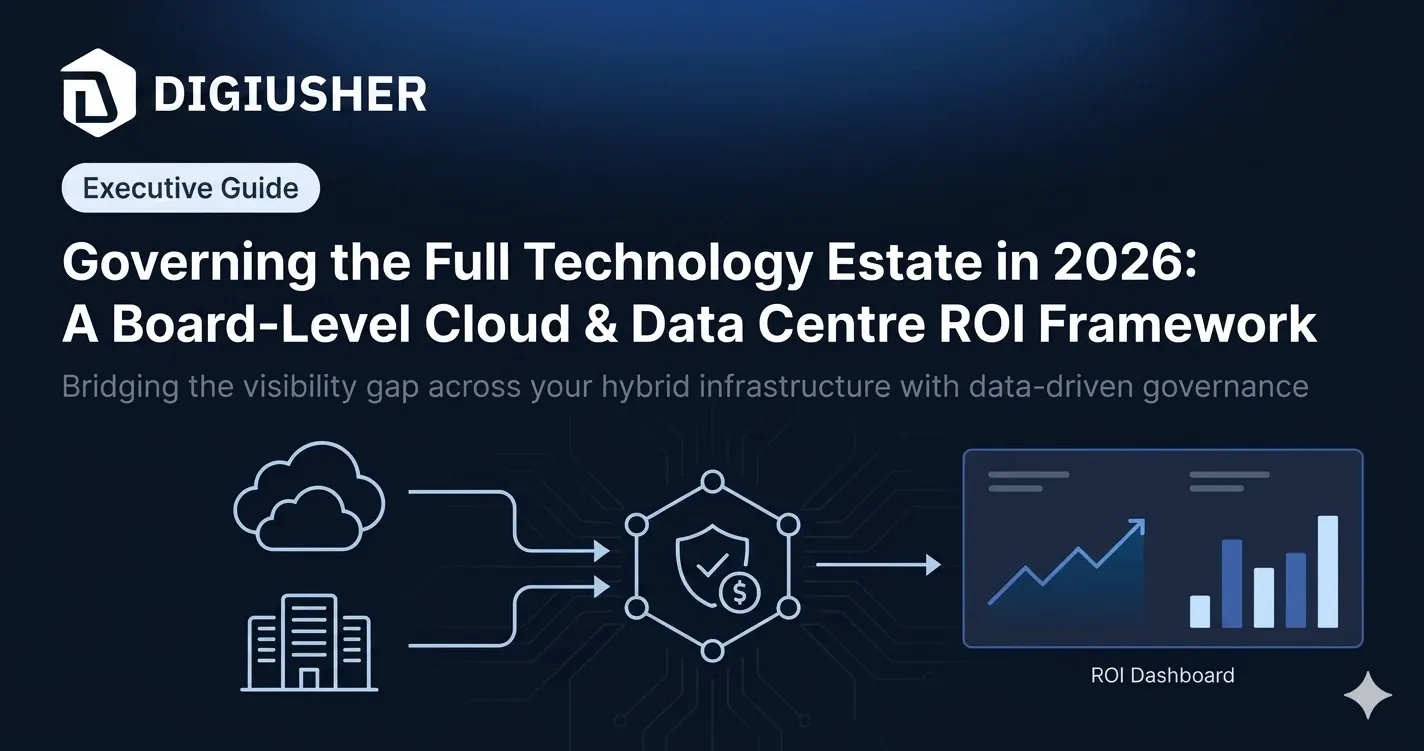
Board-Level Cloud and Data Centre ROI: Governing the Full Technology Estate in 2026
Cloud waste runs at 29-35% of spend. GPU idle time hits 30-60%. Data centre costs surpass $650B in 2026. Here is the board-level governance framework that connects every infrastructure dollar to measurable business value.

The Silent Transformation of Enterprise Cloud Buying
Enterprise software sales through cloud marketplaces will grow from $30 billion in 2024 to $163 billion by 2030. Cloud procurement is no longer a sourcing function — it has become a continuous financial operations discipline. This briefing explains the three forces reshaping enterprise cloud buying, why the CIO and CFO must act together, and what it means when FinOps shifts up from cost reporting to board-level technology investment strategy.
Why You Need a FinOps Operating System — Not Just Tools
Traditional FinOps tools deliver visibility. A FinOps Operating System delivers governance. Learn why the category shift from cost dashboards to a FinOps OS is the defining enterprise cloud decision of 2026 — and how DigiUsher built the control layer that CIOs, CFOs, and FinOps teams actually need.