The CFO's Guide to Governing Cloud and AI ROI in 2026
Worldwide AI spending is forecast to reach $2.52 trillion in 2026. Only 12% of CEOs say AI has delivered both cost and revenue benefits. 95% of enterprise AI initiatives fail. The ROI gap between capital deployed and value generated has ballooned to $600 billion. CFOs are now on the front lines — and the governance model that gets them there is not a cloud dashboard. This is the definitive CFO playbook for governing cloud and AI as capital allocation, not IT overhead.
Executive Summary
For years, cloud budgets sat with IT. AI budgets sat with innovation teams. Finance approved the numbers and received monthly invoices.
That operating model has broken — permanently.
The 2026 data does not suggest a trend. It confirms a structural shift:
- Worldwide AI spending is forecast to reach $2.52 trillion in 2026 — a 44% year-over-year increase (Gartner)
- The ROI gap between capital deployed and value generated has ballooned to $600 billion — the largest financial disconnect between technology investment and documented return in enterprise history
- Only 12% of CEOs say AI has delivered both cost and revenue benefits (PwC) — meaning 88% of AI capital is producing uncertain or negative dual-metric ROI
- 95% of enterprise AI initiatives fail (MIT) — while the successful 5% share a consistent governance profile
- 48% of CFOs now say they are ultimately responsible for ensuring AI delivers measurable value (RGP)
“The message for 2026 is clear: CFOs who lead boldly, modernize intentionally and build the cross-functional muscle for AI adoption will define the next decade of enterprise performance.” — Scott Rottman, President of Consulting Services, RGP
Deloitte’s most direct framing: CFOs are on the front lines of AI decisions. Not as cost approvers. As capital allocation strategists responsible for one of the most consequential investment portfolios their organisations have ever assembled.
The question is not whether cloud and AI are now a CFO problem. They are. The question is whether the financial governance infrastructure exists to govern them — and for most enterprises, the honest answer is no.
This is the playbook that changes that.
The $600 Billion ROI Gap: Why the Old Model Has Broken
In 2025, Big Tech companies alone projected over $500 billion in AI infrastructure investment. Enterprise spending on AI application software was expected to nearly triple to $270 billion in 2026. The aggregate capital deployed into cloud and AI infrastructure is, by any measure, one of the largest single-year investment surges in business history.
The return on that investment is, by the same measure, one of the most ambiguous.
The 2026 AI ROI Reality Check
──────────────────────────────────────────────────────────────
Capital deployed in AI (2025–2026):   $600B+ (infrastructure + software)
CEOs reporting dual cost+revenue ROI: 12% (PwC)
AI initiatives meeting ROI targets:   28% (Gartner)
Enterprise AI initiatives that fail:  95% (MIT)
──────────────────────────────────────────────────────────────
The ROI gap:  approximately $600 billion
The cause:    not insufficient technology
              not insufficient investment
              not insufficient talent
The cause:    insufficient governance
──────────────────────────────────────────────────────────────
Venky Ganesan of Menlo Ventures captured the industry inflection point precisely: “2026 is the ‘show me the money’ year for AI. Enterprises will need to see real ROI in their spend, and countries need to see meaningful increases in productivity growth to keep the AI spend and infrastructure going.”
CFOs are the executives who will be asked to show the money. And the financial governance model that most organisations are using — static budgets, monthly invoice reviews, aggregate cloud billing — was designed for a world where technology costs were predictable, bounded, and separable from business outcomes.
Cloud and AI costs are none of those things.
Why the Traditional Model Fails for Cloud and AI
Traditional IT financial management was built on three assumptions that cloud and AI have invalidated:
Traditional IT Financial Model vs. Cloud and AI Reality
──────────────────────────────────────────────────────────────
Traditional IT:              Cloud and AI:
──────────────────────────   ──────────────────────────────
Fixed hardware spend         Consumption-based, elastic
Predictable monthly costs    Non-linear, usage-driven
Annual depreciation          Real-time billing
Cost separate from output    Cost proportional to every
                             customer interaction
Quarterly variance reviews   Costs change 50+ times/day
Finance = budget approver    Finance = governance owner
──────────────────────────────────────────────────────────────
Say goodbye to predictable IT bills. From usage-based costs to R&D experimentation, AI spending is spread across teams and departments, creating the need for AI-specific profit-and-loss views and other measures to get the truest sense of ROI. AI allocations are primed to rise significantly in tech budgets over the next few years.
The implication: the financial governance infrastructure that worked for on-premises hardware, annual software licences, and predictable cloud commitments cannot govern the cloud and AI investment portfolio that enterprise CFOs are responsible for in 2026.
Five Financial Risks Every CFO Must Govern
Risk 1 — Consumption-Based Cloud Volatility
Engineering teams can provision EKS clusters, AKS workloads, GKE environments, and GPU node pools within minutes. Each provisioning event generates real-time charges at consumption rates that compound continuously until the resource is terminated. Finance leaders must track usage, plan for infrastructure and regulatory constraints, and enable rapid testing — but traditional financial controls operate at monthly cadence while cloud costs accumulate at engineering velocity.
CFOs are pragmatic thinkers. They evaluate value: how an initiative contributes to revenue, reduces cost, strengthens resilience, or improves forecasting. In 2026, they expect technology partners to think the same way — articulating how platforms affect capital efficiency rather than presenting features.
The governance gap: a cloud estate generating 50+ infrastructure changes per day is accumulating financial commitments faster than any monthly budget review can detect, evaluate, or reverse. By the time variance analysis surfaces a cost overrun, the architectural decisions that caused it are four sprints in the past.
What this requires: real-time financial controls at cloud velocity — anomaly detection within hours, budget threshold alerts before breach, and workload attribution that connects every infrastructure decision to a financial owner at provisioning time.
Risk 2 — AI Token Economics: The P&L Visibility Crisis
AI billing has introduced a cost model that traditional financial management frameworks were not built to govern. OpenAI, Anthropic, Mistral AI, and Hugging Face all bill on tokens, inference calls, context windows, and model routing — usage-driven, non-linear cost dynamics that scale with every customer interaction, every automated workflow, every agentic task chain.
Capturing the precise value of AI can be tricky. Some of the technology’s benefits can be intangible. And the technology continues to evolve at a speed which can outstrip the metrics they create.
Deloitte’s naming of this as “AI-specific P&L visibility” is precise. A shared Azure OpenAI endpoint accessed by 30 product teams generates one invoice line item. That invoice charge cannot be attributed to the business units consuming it, the use cases it serves, or the revenue impact it generates without an attribution infrastructure built specifically for AI billing data — not retrofitted from cloud infrastructure cost tools.
The CFO board risk: quarterly presentations that report aggregate AI spend without use-case-level ROI attribution are not financial governance. They are financial reporting. The board question — “what enterprise value are we generating from this investment?” — cannot be answered from aggregate billing data.
Risk 3 — GPU Economics and Margin Pressure
AI workloads increasingly depend on GPU infrastructure from AWS, Azure, and Google Cloud at costs that have no precedent in traditional cloud pricing:
GPU Cost Reality — Enterprise AI Infrastructure
──────────────────────────────────────────────────────────────
Single 8×H100 cluster (AWS P5.48xlarge): $98.32/hr
Same cluster running 24/7 for one month:  $70,790/month

Enterprise average GPU utilisation:       20–35%
Percentage of GPU budget wasted on idle:  65–80%

Monthly idle waste per 8-GPU cluster
at 30% utilisation:                       ~$49,550/month
──────────────────────────────────────────────────────────────
This idle waste does not appear as a distinct line item in any standard cloud billing report. It inflates the compute cost category while generating zero productive AI output — compressing gross margins invisibly until a forensic cost analysis reveals the structural inefficiency.
The CFO board risk: AI programme budgets approved on the assumption of efficient GPU utilisation are delivering programme costs 30–50% higher than projected — a margin pressure that finance cannot explain from standard billing data and cannot defend to boards without GPU-specific cost governance.
Risk 4 — AI ROI Ambiguity: The Measurement Failure
The most consequential financial risk in AI investment is not the cost. It is the inability to connect cost to return.
The boardroom reality, expressed directly by finance practitioners:
“I’m running out of runway on qualitative justifications.”
“Every quarter the board asks what are we actually getting back?”
CFOs will remain willing to invest in AI but will require clarity on how it’s tied to business outcomes like improved efficiency, productivity, or sustainable growth. There’s no universal metric for AI ROI, as success depends on the function and problem being solved. The era of buying AI for AI’s sake is over.
McKinsey’s research on top-performing AI organisations finds they see approximately $3 returned for every $1 invested in AI — but the same research is explicit: ROI comes from focus on measured outcomes, not experimentation at scale. The organisations that cannot demonstrate unit economics have made the same investment as those that can — and cannot show the return.
The CFO board risk: AI investment that cannot be connected to measurable business outcomes in 2026 will face board pressure to constrain. The governance failure is not the investment — it is the absence of the measurement infrastructure that makes the investment defensible.
Risk 5 — Shadow Cloud and Shadow AI: Hidden P&L Leakage
Finance leaders will want to increase governance of shadow AI deployments and reporting and feedback loops. Finance could leverage the capabilities of ‘citizen developers’ — which will require governance as well.
Business units are procuring AI copilots, SaaS automation tools, cloud experimentation environments, and direct AI API subscriptions outside centralised governance at accelerating rates. 47% of generative AI users access tools through personal accounts entirely bypassing enterprise controls. The average enterprise experiences 223 AI-related security incidents per month from ungoverned AI usage. Shadow AI adds $670,000 to average breach costs (IBM).
By the end of 2026, IDC projects enterprises will manage more than 2 billion AI agents — each one a procurement event and a financial governance requirement. The scale of autonomous procurement at machine speed makes Shadow AI the most rapidly compounding ungoverned cost category in enterprise history.
The CFO board risk: P&L leakage from ungoverned AI adoption accumulates in no budget line and generates compliance exposure that finance cannot explain from central IT governance alone. Shadow AI is now a CFO accountability, not an IT accountability.
The CFO Governance Framework: Six Capabilities
Moving from cost visibility to economic governance requires six specific capabilities — each representing a shift from the financial management model that worked for traditional IT to the governance model that cloud and AI require.
Capability 1 — Move Beyond Spend Reporting to Value Attribution
Native billing tools from AWS, Azure, and GCP provide cost visibility at the account and service level. They do not answer:
- Which workloads generate value proportionate to their cost?
- Which AI projects should receive increased investment?
- Which teams are generating disproportionate cost relative to business output?
The shift: from “what is our cloud bill?” to “what is our cloud and AI generating per unit of business value?”
Operational requirement: FOCUS-normalised cost attribution at the workload, team, product, and business outcome level — continuously, not monthly. Workload-level attribution is the technical prerequisite for the value question boards are asking.
Capability 2 — Govern by Unit Economics, Not Budget Totals
The metric set that changes CFO governance from retrospective reporting to prospective accountability:
| Old Metric | New Metric |
|---|---|
| Total cloud spend | Cost per customer served |
| AI programme budget | Cost per inference |
| Monthly cloud bill | Cost per transaction |
| Aggregate AI spend | Cost per product feature |
| Year-over-year variance | AI ROI by use case |
Boards increasingly expect CFOs to operate as enterprise strategists, interpreting complex data streams, guiding AI adoption responsibly, modeling downside scenarios, and communicating capital allocation clarity to investors.
Unit economics translate infrastructure investment into the language of capital allocation that boards and investors understand. Cloud cost as a percentage of revenue is a gross margin statement. Cost per AI feature is a product investment statement. Cost per inference is a product economics statement. These are not FinOps metrics — they are CFO metrics.
Capability 3 — Build AI-Specific Profitability Models
AI P&L should be measured by:
- Model: which foundation model generates the best cost-per-output for each use case
- Use case: which AI applications generate revenue or cost avoidance proportionate to their infrastructure cost
- Business unit: which teams are generating AI ROI versus which are generating AI cost without documented return
- Revenue impact: which AI investments can be connected to measurable business outcomes within a defined measurement window
Leading organisations are ‘anchoring AI initiatives to measurable business outcomes, designing modular architectures for flexibility, and redefining talent strategies around human-machine collaboration.’ The CFO plays an instrumental role in that organisational transformation.
The AI-specific P&L model is the governance infrastructure that makes this anchoring measurable rather than aspirational.
Capability 4 — Align CFO, CIO, and Platform Teams on Shared KPIs
The CFO, CTO, and business leaders must agree on how AI success will be measured and over what timeframe. Kyndryl found that 65% of organisations lack this alignment. Without it, every AI initiative becomes a political battleground.
The CIO–CFO–Platform Engineering alignment model requires:
Shared KPI Architecture for Cloud and AI ROI
──────────────────────────────────────────────────────────────
Executive Level:
  CFO → Capital discipline: AI ROI by use case, cloud cost
         as % of revenue, total technology investment ROI
  CIO → Architecture strategy: capability development,
         platform reliability, governance framework

Operating Level:
  Platform Engineering → Execution control: workload
  attribution, cost per deployment, GPU utilisation,
  AI token governance, real-time cost-per-service

Shared Metrics:
  Cost per customer
  Cloud cost as % of revenue
  AI ROI by use case
  Effective Savings Rate (ESR)
──────────────────────────────────────────────────────────────
Without this alignment:
  Engineering scales spend faster than finance scales control
──────────────────────────────────────────────────────────────
Capability 5 — Shift From Quarterly Reviews to Real-Time Governance
Monthly spreadsheets and quarterly variance analysis fail structurally in AI and cloud-native environments. Cloud costs accumulate at engineering velocity; quarterly reviews arrive 90 days after the architectural decisions that generated the variance.
Finance teams in 2026 need:
- Anomaly detection — surfacing cost deviations within hours of emergence, not in the next billing cycle
- Budget thresholds — automated alerts at 80% of monthly budget before breach, not post-breach reporting
- Predictive forecasting — workload-based cost projection that anticipates cost trajectory from current deployment patterns
- Workload-level attribution — cost by service, product, team, and business outcome continuously, not assembled from monthly billing exports
CFOs will ‘use AI to assess policy impacts and sector-specific risk’ and ‘support scenario planning, enabling CFOs to run multiple forecasts and stay flexible amid uncertainty.’ This capability requires real-time data, not monthly retrospectives.
Capability 6 — Govern Shadow AI Explicitly
The governance of shadow AI deployment is not optional for CFOs who own AI ROI accountability. An inventory of every AI tool, API key, and model subscription in use across the enterprise — with financial ownership assigned and budget limit enforced — is the prerequisite for meaningful AI cost control.
CFOs should fund AI-aligned cybersecurity and partner with CISOs to govern shadow and citizen-built AI as threats evolve. But the financial governance of shadow AI is distinct from and prior to the security governance: financial owners must exist before security policies can be enforced against them.
What Winning CFOs Are Doing in 2026
PwC found that AI leaders generate 7.2× greater AI-driven outcomes than peers because they treat AI as a business transformation engine — not isolated pilots. McKinsey reports top-performing organisations are seeing approximately $3 returned for every $1 invested in AI — but the same research confirms that ROI comes from focus on measured outcomes, not experimentation at scale.
The governance differentiators that separate CFOs generating AI ROI from those generating AI spend:
They treat AI as an investment portfolio. Stage-gate funding based on demonstrated ROI milestones. Unit economics per use case defined before investment is approved. Return expectations established at programme design, not programme completion.
They own AI-specific P&L. Separate financial models for AI infrastructure segmented by model, use case, and business unit. The governance infrastructure that makes ‘we invested $X in use case Y and generated $Z in return’ a measurable statement rather than an estimate.
They operate at engineering velocity. Real-time cost attribution, budget threshold alerts before breach, and anomaly detection within hours — not quarterly variance analysis that arrives after architectural decisions are locked.
They have resolved the alignment gap. CFO, CIO, and platform engineering working from shared KPIs and a shared attribution model — eliminating the accountability gap between the engineering decisions that generate cost and the financial governance that must account for it.
They govern Shadow AI as a financial risk. 100% AI tool inventory with financial ownership assigned. Zero ungoverned AI spend in any quarterly P&L presented to the board.
Hewlett Packard Enterprise’s CFO framed the mandate precisely: ‘In 2026 CFOs need to shift from financial gatekeepers to transformational architects who drive strategy and shape decisions. Success will hinge on strong governance, human oversight, ROI discipline, and building digital acumen.‘
The Board Question That Cannot Be Deferred
Boards are no longer asking: “How much are we spending on cloud and AI?”
They are asking: “What enterprise value are we generating for every pound invested?”
2026 will reveal which organisations have genuine AI strategies and which have been running expensive experiments. The financial governance infrastructure that answers the board’s value question — not the cost question — is the distinguishing capability between those two categories.
CFOs who lead technology investment governance in 2026 are not doing so because technology is interesting. They are doing so because:
- The capital at stake is too large to delegate to technical governance
- The board accountability is unambiguous
- The governance infrastructure that produces the ROI answer does not exist without CFO mandate to build it
That governance infrastructure is a FinOps Operating System — not a cloud dashboard, not a billing report, not a quarterly variance analysis. A continuous, real-time, workload-attributed, AI-aware financial control plane that governs cloud and AI spend as the capital allocation portfolio it has become.
DigiUsher: The FinOps OS for CFO-Grade Cloud and AI Governance
DigiUsher’s FinOps Operating System provides the financial governance infrastructure that CFOs need to govern cloud and AI as capital allocation — answering the board’s value question with data rather than approximation.
Unified multi-cloud and AI attribution — AWS, Azure, GCP, Kubernetes, Databricks, Azure OpenAI, Bedrock, Vertex AI, and direct AI API providers normalised to FOCUS 1.x in a single cost model. The unified view that makes cross-domain ROI analysis possible.
AI-specific P&L dashboards — cost by model, use case, business unit, and revenue impact. The segmentation Deloitte identified as the prerequisite for meaningful AI ROI measurement — produced continuously rather than assembled manually for quarterly board presentations.
Unit economics reporting — cost per customer, cost per transaction, cost per inference, cost per product feature. The metrics that connect infrastructure investment to the business outcomes that justify continued capital allocation.
Real-time governance controls — budget threshold alerts before breach, anomaly detection within hours of deviation, workload attribution continuous rather than monthly. Governance that operates at cloud velocity rather than billing cadence.
Shadow AI inventory and attribution — every AI tool, API key, and model subscription mapped to a financial owner with budget enforcement. The P&L visibility that eliminates ungoverned AI procurement from the CFO’s financial blind spots.
Board-ready ROI reporting — cloud ROI per AI initiative, AI investment return by use case, technology investment as percentage of revenue. The capital allocation reporting format that answers the board question CFOs cannot defer.
Available as SaaS or BYOC for regulated financial services industries. SOC 2® Type II and GDPR certified. AWS ISV Accelerate Partner and Azure ISV Co-Sell Ready — purchasable from existing cloud committed budgets. Delivered globally through Infosys, Wipro, and Hexaware.
Cloud and AI are no longer operating expenses. They are enterprise investment portfolios. The CFOs who govern them like capital assets — with real-time attribution, AI-specific P&L, and unit economics connecting infrastructure to business outcomes — will be the ones who answer the board’s value question with confidence. Those who govern them like IT overhead will answer with silence.
Frequently Asked Questions
Why have cloud and AI costs become a CFO responsibility rather than an IT responsibility?
Three structural shifts: scale ($2.52 trillion AI spending in 2026), ROI accountability (48% of CFOs now own ensuring AI delivers measurable value), and board mandate (the permanent shift from ‘how much are we spending?’ to ‘what enterprise value are we generating?’). Finance leaders now influence more than 60% of digital transformation decisions (McKinsey). The structural elevation is irreversible.
What is AI-specific P&L and why do CFOs need it?
AI-specific P&L segments AI infrastructure costs — model licensing, inference compute, token consumption, GPU infrastructure — from general cloud spend and maps them to the business units, use cases, and revenue streams they serve. Required because aggregate cloud billing cannot answer the board’s ROI question. Deloitte formally recommended it as the prerequisite for meaningful AI ROI measurement.
What is the $600 billion AI ROI gap?
The gap between capital deployed in AI ($600B+ in 2025) and documented revenue value generated. Only 12% of CEOs say AI has delivered both cost and revenue benefits (PwC); 95% of enterprise AI initiatives fail (MIT); 28% meet ROI expectations (Gartner). The gap is a governance failure — insufficient measurement infrastructure to connect investment to return.
What are the five financial risks CFOs must govern?
Consumption-based cloud volatility (costs accumulate at engineering velocity, reviewed monthly); AI token economics requiring AI-specific P&L; GPU economics compressing margins at idle rates; AI ROI ambiguity from absent measurement frameworks; Shadow AI creating ungoverned P&L leakage and compliance exposure.
How should CFOs measure cloud and AI ROI?
Five unit economics metrics replace spend tracking: cost per customer, cost per transaction, cost per inference, cost per product feature, and AI ROI by use case. McKinsey finds top organisations see $3 returned per $1 invested — but only with measured outcomes, not experimentation at scale.
How does DigiUsher’s FinOps OS address the CFO governance mandate?
Through five integrated capabilities: unified multi-cloud and AI attribution to FOCUS 1.x; AI-specific P&L dashboards by model, use case, and business unit; unit economics reporting connecting infrastructure to business outcomes; real-time governance controls at engineering velocity; and Shadow AI inventory with budget enforcement. The financial control infrastructure that governs cloud and AI as capital allocation.
References
- Deloitte — CFO Insights for AI: Cost, Risk, and ROI (March 2026)
- Deloitte — CFO Guide to Tech Trends 2026
- ChatFin — CFO Evolution 2026: Strategic Architecture and AI Governance (February 2026)
- CFO Dive — Top 5 AI Adoption Challenges Facing CFOs in 2026 (January 2026)
- CFO.com — So Far, Few CFOs See Substantial ROI from AI Spending (December 2025)
- Fortune — AI in 2026: CFOs Predict Transformation, Not Just Efficiency Gains (January 2026)
- WEF / Cognizant — How CFOs Can Secure Solid ROI from Business AI Investments
- Wndyr — 2026: The Year AI ROI Gets Real and Forces a Strategic Fork (April 2026)
- TrueLogic — Data, AI & Finance: What CFOs Should Demand From Tech Partners in 2026
- McKinsey & Company — The CFO’s Expanding Role in Digital Transformation
- PwC — AI Leaders Generate 7.2× Greater AI-Driven Outcomes (2026)
- FinOps Foundation — State of FinOps 2026
- FinOps Foundation — FOCUS Specification
- Gartner — Enterprise AI Application Software Spending to Triple to $270B in 2026
Govern Cloud and AI Like the Capital Asset They Have Become
The board question has changed permanently. CFOs who answer “what enterprise value did we generate?” with financial data — not qualitative narratives — will define AI investment governance for the decade ahead.
DigiUsher’s FinOps OS provides the unit economics, AI-specific P&L, and real-time governance infrastructure that turns the board question from a CFO liability into a CFO capability.
DigiUsher in 30 min
Give your board a cost-to-outcome view they can actually act on.
DigiUsher connects cloud and AI spend to the outcomes it funds, in language finance already speaks.
Book a 30-min walkthroughNo hard pitch · tailored to your stack
Continue Reading
More from the DigiUsher editorial team.
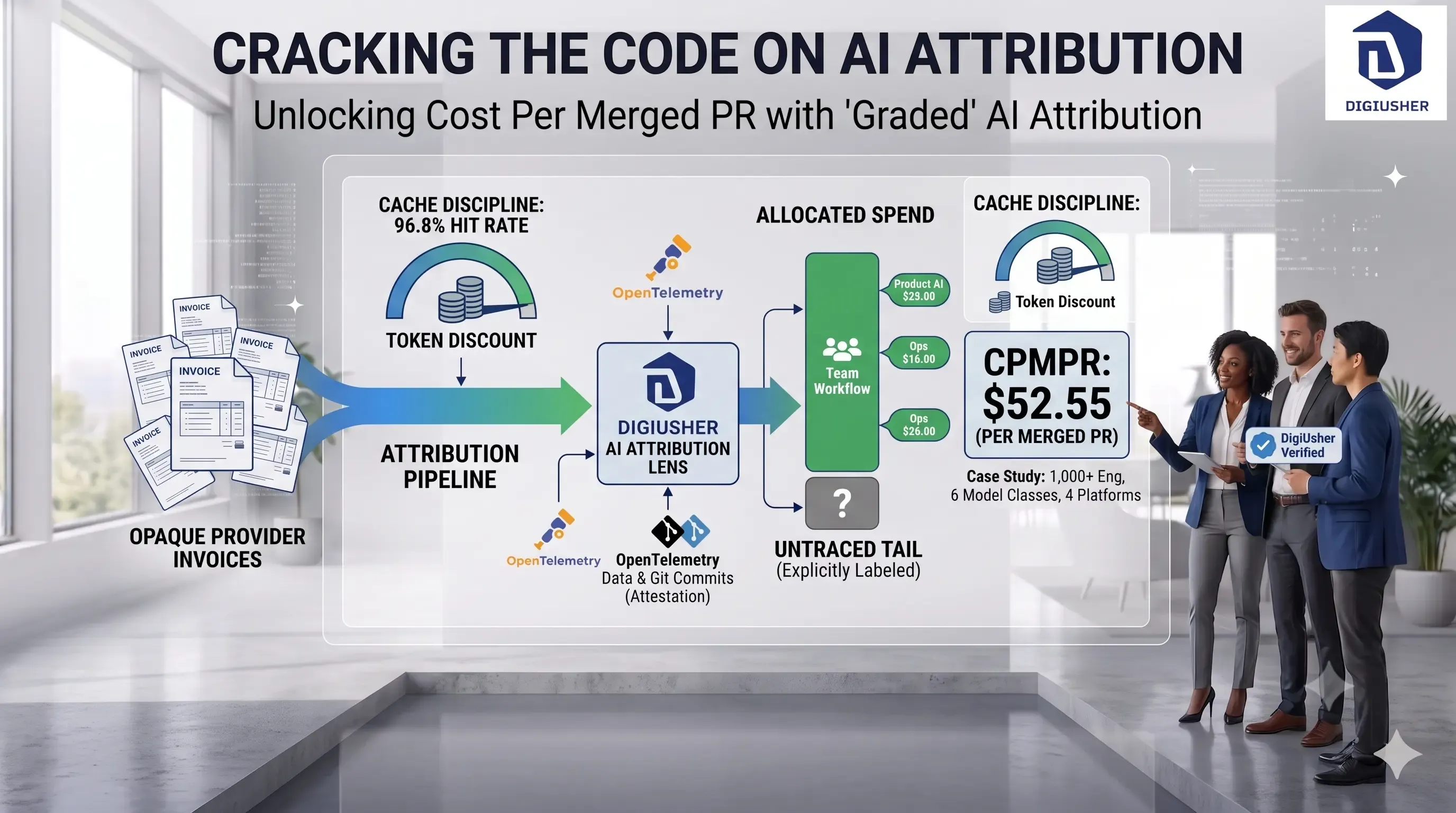
$52.55 Per Merged Pull Request: How One 1,000-Engineer Firm Priced Its Own AI Spend
A public technology firm with 1,000+ engineers refused to run its AI spend on faith. Here's the ledger it built instead — $52.55 per merged PR, 96.8% cache-hit rate, and a blended cost of $0.75 per million tokens.
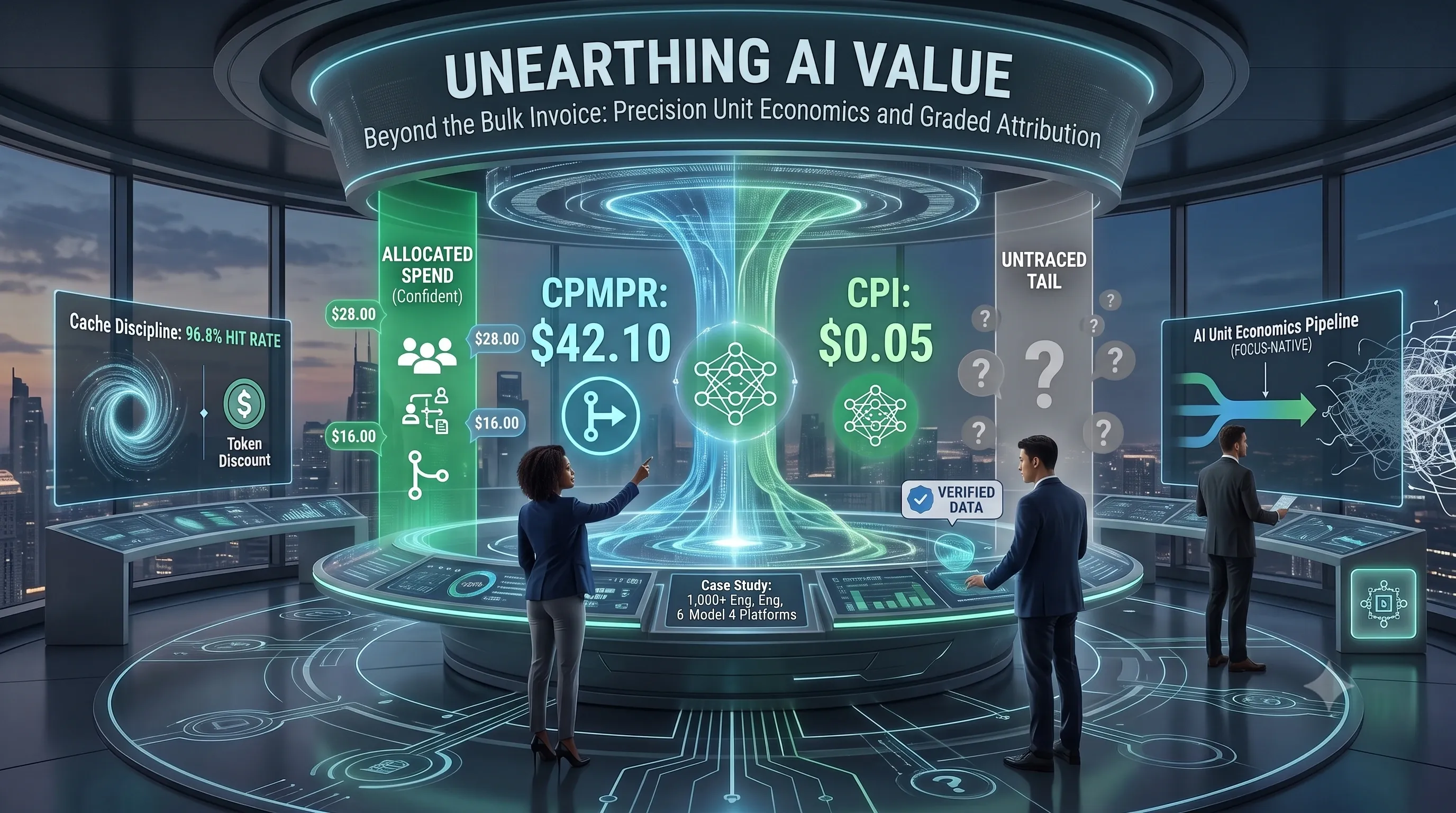
AI Unit Economics: Why Your AI Invoice Can No Longer Answer the Board’s Question
98% of FinOps teams now manage AI spend, but almost none can price a merged pull request. Here's the framework for AI unit economics in 2026 — and why the invoice alone can't answer the board's question.
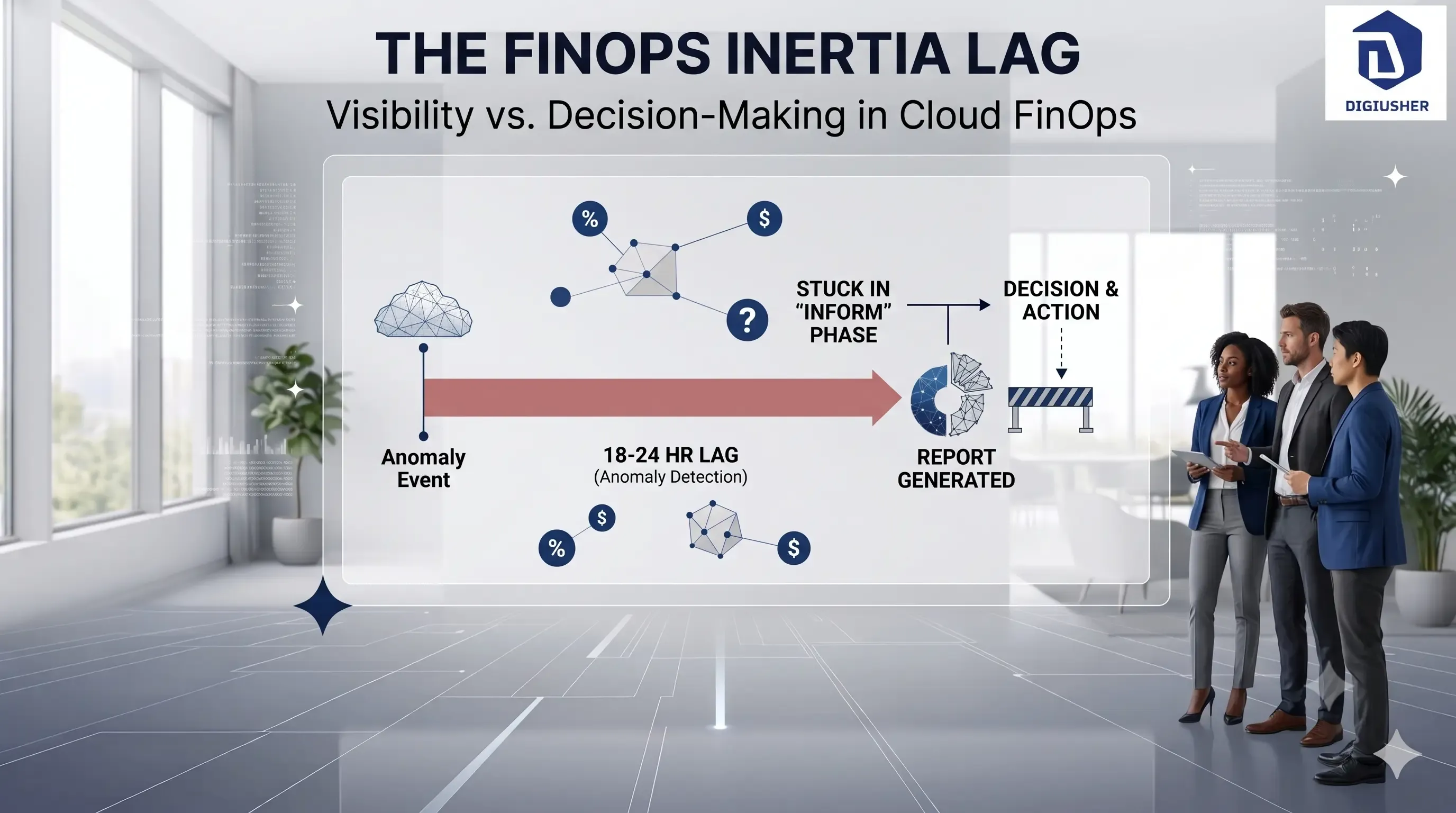
Most FinOps Programs Stall at "Inform" — and Never Reach Optimize
Visibility tools generate reports, not decisions. Legacy FinOps tools carry an 18-to-24-hour anomaly detection lag, according to the DigiUsher live TCO index — and that lag, not a lack of dashboards, is why most programs never leave the Inform phase.