Cloud Cost Optimization Is Dead. Long Live Technology Value Management
One FinOps practitioner in 2026 reached 97% optimization in their Cost Optimization Hub — and intentionally left the remaining 3% unactioned for business reasons. The easy wins are gone. The 'big rocks' of cloud waste have been cleared. Optimization alone can no longer define the discipline. This is the strategic manifesto for FinOps in 2026 — what died, what replaced it, and why the new playbook is shift left, shift up, and govern the full technology estate.
What Died and What Replaced It
Here is the sentence that changed the FinOps discipline in 2026:
The FinOps Foundation updated its mission from:
“Advancing the People who manage the Value of Cloud”
to:
“Advancing the People who manage the Value of Technology.”
One word. Cloud became Technology. And that small lexical change carries one of the most consequential strategic shifts in the history of enterprise technology governance.
The data behind the mission change confirms it is not aspirational:
- 98% of FinOps practitioners now manage AI spend — up from 31% in 2024, the fastest category expansion in FinOps history
- 90% manage SaaS — up from 65% in 2025
- 64% manage software licensing, 57% private cloud, 48% data centre
- 78% report to the CTO or CIO — up 18% since 2023
- One practitioner team reached 97% optimisation in their Cost Optimization Hub and intentionally left the remaining 3% unactioned for business reasons
That last data point is the most revealing. Not because it represents failure — it represents maturity. When the marginal cost of capturing the remaining 3% of optimisation opportunity exceeds the business value of the saving itself, the traditional optimisation playbook has run its course. The ‘big rocks’ of waste have been cleared. Diminishing returns have set in.
“We have hit the ‘big rocks’ of waste and now face a high volume of smaller opportunities that require more effort to capture.” — FinOps Foundation State of FinOps 2026 practitioner
This is not the death of optimisation. Optimisation remains a core activity. What has died is the era when optimisation alone could define the practice — when “reduce the bill” was a sufficient strategic mandate for a FinOps team.
What replaced it is Technology Value Management: a proactive, executive-aligned discipline that governs the full technology cost surface and connects every technology investment to the measurable business outcome it funds.
Three Waves of FinOps Evolution
Understanding where FinOps is going requires understanding where it has been. The discipline has evolved in three distinct waves — each building on the previous but requiring fundamentally different capabilities.
Wave 1: Cost Visibility (2018–2021) — See the Bill, Understand the Waste
The first wave was about seeing what cloud cost actually looked like. Before 2018, many enterprises had no consolidated view of cloud spend at all. Cloud billing arrived as raw provider data — incompatible schemas, incomplete attribution, no tagging discipline, no normalisation.
Wave 1 FinOps created the infrastructure to see the bill: tagging initiatives, cost allocation tools, reserved instance analysis, basic rightsizing, and the first generation of FinOps platforms that made cloud spend visible. The primary question: where is our cloud spend going?
Its limitation: visibility is a prerequisite, not a destination. Seeing waste does not automatically generate the will, tooling, or culture to address it.
Wave 2: Cost Optimisation (2021–2025) — Reduce the Bill, Chase the Savings
Wave 2 was the era the original FinOps playbook was built for. Systematic rightsizing. Commitment coverage management. Idle resource elimination. Non-production environment scheduling. Chargeback and showback programmes. The question: how do we spend less?
This wave delivered real results. Capital One saved over $100 million through resource optimisation, vendor negotiation, and financial process automation. Enterprises implementing complete FinOps frameworks achieved 30–50% cost reductions. The optimisation playbook worked.
And then, for the most mature programmes, it reached its limit.
The Wave 2 Ceiling
──────────────────────────────────────────────────────────────
97% of obvious optimisation opportunities captured
Remaining 3% intentionally not actioned (disruption > saving)
Commitment coverage: at or near target for stable workloads
Idle resources: systematically eliminated
Rightsizing: automated and continuous

What's left:
  Smaller, harder savings distributed across more workloads
  AI costs growing faster than optimisation can address
  SaaS, licensing, private cloud: in scope but ungoverned
  Unit economics: desired but unmeasured
  Executive influence: possible but not structurally achieved
──────────────────────────────────────────────────────────────
Conclusion: Optimisation alone cannot define the next chapter
──────────────────────────────────────────────────────────────
Wave 3: Technology Value Management (2025–present) — Govern the Full Estate, Connect Cost to Value
Wave 3 is where the leading edge of FinOps practice is now. The question has shifted from “how do we spend less?” to “are our technology investments generating value proportionate to their cost — and how do we govern the full estate to ensure they do?”
Wave 3 is defined by:
- Pre-deployment architecture costing embedded in engineering workflows — before infrastructure ships
- AI and GPU cost governance with token-level attribution and agentic kill-switches
- SaaS, licensing, private cloud, and data centre in unified governance scope
- Executive Strategy Alignment — FinOps shaping technology investment decisions, not explaining them retrospectively
- Unit economics connecting infrastructure spend to the product and business outcomes it funds
- FOCUS 1.x normalisation enabling the single source of truth across all technology categories
The FinOps Foundation formalised Wave 3 in the 2026 Framework update with two structural changes: the mission update from cloud to technology, and the introduction of Executive Strategy Alignment as a new formal capability. This matters because the Foundation does not add capabilities casually. Adding Executive Strategy Alignment is the institutional recognition that the most impactful FinOps work now happens before technology commitments are made — in the conversations that shape strategy, not the reports that explain spend.
Why Optimisation Is No Longer Enough: Four Structural Breaks
Optimisation was designed for a specific set of architectural assumptions. Those assumptions have been invalidated by the 2026 technology estate.
Break 1 — Kubernetes Abstracted Infrastructure Cost
Kubernetes is now the default operating environment for containerised workloads across EKS, AKS, GKE, and OKE. It abstracts infrastructure into pods, services, and namespaces — and in doing so, abstracts cost from the billing systems that optimisation tools were built to read.
Cloud billing reports EC2 compute charges, or Azure VM charges, or GCP Compute Engine charges. It does not report checkout-service compute charges, or recommendation-engine compute charges, or Team Beta’s Kubernetes namespace charges. The abstraction that makes Kubernetes operationally powerful makes it financially opaque to traditional optimisation tools.
Reserved instance and rightsizing tools designed for discrete infrastructure units cannot govern cost that accumulates at the pod level across dynamic, ephemeral workloads. The optimisation instruments of Wave 2 cannot reach the cost level where Kubernetes actually generates it.
Break 2 — Multi-Cloud Multiplied Complexity Without Normalisation
AWS calls compute “EC2”. GCP calls it “Compute Engine”. Azure calls it “Virtual Machines”. These are the same resource type with three incompatible billing schemas, three different discount structures, and three separate attribution models. Multi-cloud optimisation without FOCUS normalisation requires three separate optimisation models applied to three incompatible data formats — and the cross-provider insights that would enable optimal workload placement cannot be produced from individual provider data alone.
“FinOps will be a core cloud operating discipline, not just a cost-optimisation exercise, as AI workloads introduce volatile, usage-based spend.” — Varun Raj, Cloud and AI Engineering Executive, TechTarget FinOps 2026
The multi-cloud reality demands a unified normalisation layer — FOCUS 1.x — that converts all provider billing to a single schema. Optimisation tools designed before FOCUS cannot operate at the cross-provider level that modern technology estates require.
Break 3 — AI Introduced Non-Linear, Usage-Driven Costs That Have No Optimisation Precedent
AI billing models — tokens, inference requests, GPU-hours, DBUs — have no mapping to the optimisation logic built for hourly compute rates. A reserved instance analysis that identifies opportunities to commit 70% of compute for a 40% saving cannot be applied to token-based Azure OpenAI or Bedrock inference costs, which scale with prompt length, model selection, and agentic chain depth in ways that have no stable baseline to commit against.
AI cost management is now the #1 sought-after skill that FinOps teams plan to add over the next 12 months — because 98% of teams manage AI spend, but most are doing so with optimisation frameworks designed for infrastructure billing. The governance gap is structural: AI requires prevention mechanisms (token budget caps, agentic kill-switches, GPU idle detection) that operate in real time, not optimisation mechanisms that identify savings opportunities in retrospective billing data.
Break 4 — Infrastructure Became Ephemeral, Eliminating the Optimisation Window
Traditional optimisation assumed a stable optimisation window: resources are provisioned, run for a meaningful period, generate usage data, and can be analysed for savings opportunities before the next billing cycle.
Modern cloud-native infrastructure eliminates this window. Containers start and stop in seconds. Kubernetes scales workloads automatically. Spot instances run and terminate unpredictably. AI inference is bursty by nature. The infrastructure that was optimisation’s subject has become too dynamic for periodic optimisation cycles to govern effectively.
The infrastructure changes 50+ times per day in modern cloud-native environments. Monthly optimisation reviews operate at 1,000× lower cadence than the infrastructure they attempt to govern.
The New Playbook: Six Pillars of Technology Value Management
The new FinOps playbook does not replace optimisation — it subsumes it within a broader governance model that addresses what optimisation alone cannot. Six pillars define the shift.
Pillar 1 — From Optimisation to Prevention
The highest-leverage FinOps intervention in 2026 is not fixing expensive infrastructure after it ships. It is preventing expensive infrastructure from shipping in the first place.
Pre-deployment architecture costing — projecting the monthly cost of an architecture before resources are provisioned — is the single most desired tooling capability in the 2026 FinOps survey. The reason is economic: catching a cost issue at the Terraform plan stage costs nothing. Catching it after three sprints of development and two weeks in production costs the architectural refactoring, the engineering time, and the infrastructure bill for the period it ran unoptimised.
This shift is already technologically achievable. GitOps practices are common. CI/CD pipelines integrate infrastructure-as-code. Infrastructure provisioning is largely automated. The additional capability required is a cost estimation layer that translates IaC into projected billing — so the engineer reviewing a pull request sees the cost impact the same way they see the security scan result.
The behaviour change when this is implemented: engineers make different architectural choices. Not because they are told to. Because cost has become a decision input rather than a post-decision consequence.
Pillar 2 — From Reporting to Real-Time Visibility
Monthly cost reports are not a FinOps capability. They are a FinOps starting point. By 2026, the gap between when costs are incurred and when reports surface them has become the primary reason FinOps governance cannot influence engineering behaviour.
Real-time cost visibility at engineering velocity means cost surfaced in developer dashboards at operational cadence — updated hourly, not monthly — alongside DORA metrics, SLOs, and application performance data. When a service’s cost-per-transaction spikes at 14:32 Tuesday, the engineering team sees it at 14:32 Tuesday. Not in the next monthly billing review.
AI and agentic workloads make this non-optional. A recursive agent loop can generate thousands of pounds in inference costs before any human knows the process is running. Governance that operates at monthly cadence cannot govern infrastructure that generates cost at millisecond cadence.
Pillar 3 — From Allocation to Attribution
Allocation is the practice of dividing costs across teams after the billing cycle. Attribution is the practice of understanding exactly which workload, product, and business activity generated the cost — automatically, at provisioning time, continuously.
The distinction is architectural. Allocation requires retrospective analysis of billing data to apportion shared costs across teams. Attribution requires attribution metadata enforced at resource creation — so every workload enters the billing system with complete financial ownership from its first second of existence.
The 2026 State of FinOps confirms: practitioners are now prioritising governance and attribution over pure optimisation. The question has shifted from “how much did we spend?” to “what are we funding, and should we?” — and attribution is what makes the second question answerable.
Pillar 4 — From Savings to Unit Economics
The metric “cloud savings this quarter” answers a question that is becoming less strategically meaningful as FinOps practices mature. A team that has already captured 97% of optimisation opportunities cannot report meaningful savings without engineering increasingly disruptive changes. The savings narrative runs out of road.
Unit economics — cost per active user, cost per API call, cost per inference, cost per resolved interaction, cost per AI feature — never run out of road. These metrics connect infrastructure investment to product economics in a form that is directly actionable by engineering, product, and finance simultaneously.
Cloud unit economics climbed five places in the 2026 FinOps priority rankings. The discipline is recognising that the question boards actually want answered is not “did we save money on cloud?” but “is our technology investment generating business value proportionate to its cost?” Unit economics are the metric set that makes this question answerable.
Pillar 5 — From Periodic Reviews to Continuous Governance
Quarterly optimisation reviews. Monthly chargeback cycles. Annual commitment refresh. These cadences were appropriate when infrastructure was relatively stable and change velocity was measured in weeks.
Modern technology estates change 50+ times per day. AI costs compound in real time. Kubernetes autoscaling decisions happen in seconds. A governance model operating at quarterly cadence is governing last quarter’s infrastructure with next quarter’s recommendations.
Continuous governance means automated policy enforcement, automated commitment management, automated rightsizing recommendations, automated anomaly detection — operating continuously as a background function of the platform, not as a periodic human exercise that competes with delivery priorities for engineering bandwidth.
The FinOps Foundation’s 2026 Framework specifically calls out automation as a priority: teams that have automated the most common governance actions are the ones moving from Wave 2 to Wave 3 capability. Automation is not a premium feature — it is the mechanism that makes continuous governance operationally feasible.
Pillar 6 — From Cloud Cost Management to Technology Value Governance
The final and most consequential pillar: FinOps scope is no longer cloud infrastructure. It is the full technology estate.
The 2026 FinOps Governance Scope
──────────────────────────────────────────────────────────────
Technology Category    % of FinOps Teams Managing (2026)
──────────────────────────────────────────────────────────────
Public Cloud           100% (definitional)
AI Workloads           98%  (up from 31% in 2024)
SaaS                    90%  (up from 65% in 2025)
Software Licensing      64%  (up 15% year-on-year)
Private Cloud           57%  (up 18% year-on-year)
Data Centre             48%
──────────────────────────────────────────────────────────────
FinOps is no longer cloud financial management.
It is technology financial management, full stop.
──────────────────────────────────────────────────────────────
Managing each of these categories independently — separate tools, separate teams, separate billing schemas — produces what the FinOps Foundation identifies as the reconciliation failure mode: multiple tools with incompatible taxonomies, month-end reconciliation consuming weeks of analyst time, and allocation models that lag organisational reality.
The solution is a unified FOCUS-normalised cost model that governs all categories from a single data foundation. This is what “Technology Value Management” operationally requires — not separate optimisation programmes for cloud, AI, SaaS, and data centre, but a single governance model that spans all of them with consistent attribution, consistent policy enforcement, and consistent business-outcome mapping.
Shift Left and Shift Up: The Two Directions of the New FinOps
The FinOps Foundation’s 2026 Framework update formalised the two simultaneous directional evolutions that Wave 3 requires.
Shift Left — Earlier in the Delivery Lifecycle
Shift left means catching cost issues before infrastructure ships. At architecture design. At IaC review. At CI/CD cost gate. At the IDP provisioning interface where developers commit to configuration choices.
The challenge the Foundation explicitly acknowledges: proving the value of prevention. When a cost issue is caught at the pull request stage, the expensive architecture is never built. There is no “before and after” bill to point to. The saving is invisible because it prevented a cost that never accumulated.
“Once you fix it early, it’s gone — so teams still struggle with how to measure shift-left impact and how to give developers credit for cost-prevention work.” — FinOps Foundation State of FinOps 2026
This is the cultural and measurement challenge the discipline must solve: creating recognition structures for engineering decisions that prevent cost, not just optimise it. Cost prevention is more valuable than cost reduction — but less visible in the metrics that governance programmes typically report.
Shift Up — To Executive Strategic Partnership
Shift up means FinOps participating in technology investment decisions before they become commitments — not explaining costs after commitments have been made.
78% of FinOps teams now report to the CTO or CIO. Teams with VP/C-suite alignment have 2–4× more influence over technology selection, cloud provider negotiations, and AI programme governance. The new FinOps Foundation capability — Executive Strategy Alignment — formalises this: it provides guidance for FinOps practitioners and executive leaders on how to build and sustain the partnership that makes strategic FinOps possible.
The practical implication: FinOps leaders who bring accurate data, consistent attribution models, and clear value narratives across cloud, AI, SaaS, and licensing earn executive trust. And executive trust enables the participation in pre-commitment decisions — AI infrastructure strategy, hyperscaler commitment sizing, SaaS licence negotiation — where FinOps has its highest leverage.
The Role of Platform Engineering in the New Playbook
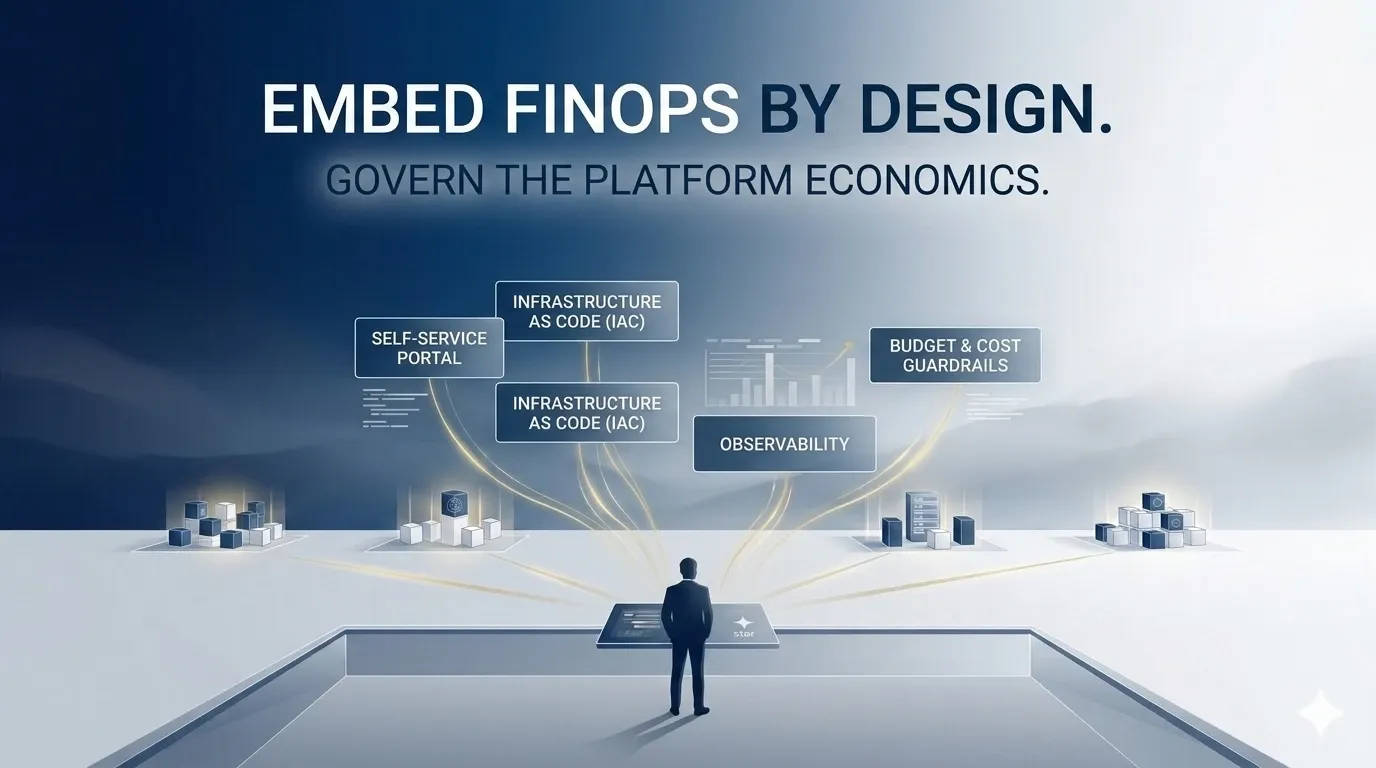
Platform teams sit at the centre of the Wave 3 transition. They control Kubernetes environments, AI infrastructure, CI/CD pipelines, and developer platforms — making them the execution layer for both shift-left and Technology Value Management governance.
Without embedded FinOps, platform engineering is a cost multiplier: frictionless self-service provisioning at scale, without cost context at decision time, generates infrastructure waste proportional to developer velocity. The faster the platform, the more expensive the ungoverned consumption.
With embedded FinOps, platform engineering is a financial control plane: every self-service action surfaces a cost estimate, every provisioned resource carries mandatory attribution metadata, and automated governance enforces financial policies at platform layer rather than through retrospective FinOps team intervention.
“FOCUS standardization, executive alignment and shift-left costing suggest a future where financial intelligence operates as a parallel control plane alongside observability and security.” — theCUBE Research, FinOps 2026 Analysis
The platform is not where FinOps is applied to. The platform is where FinOps governance must live.
What Winning Organisations Are Doing Differently
The organisations building Wave 3 capability in 2026 share six operational characteristics that distinguish them from those still operating Wave 2 governance on Wave 3 infrastructure:
They ask “are we funding the right things?” not “can we spend less?” The strategic question generates different actions, different metrics, and different executive conversations than the optimisation question.
They have FinOps at the technology leadership table. Not as a reporting function that explains costs — as a strategic partner that shapes decisions before commitments are made. 78% of mature practices have achieved this positioning.
They measure cost per business outcome. Cost per customer served. Cost per AI feature. Cost per transaction. The unit economics that connect infrastructure investment to product economics — not just cost-per-cloud or cost savings versus last quarter.
They have pre-deployment cost governance. Every infrastructure change includes a cost impact estimate, reviewed the same way security risk is reviewed. Architecture decisions include cost as a design criterion, not a post-deployment discovery.
They govern AI with purpose-built mechanisms. Token budget caps. Agentic kill-switches. GPU idle detection. The real-time enforcement that AI billing dynamics require — not optimisation tools retrofitted from cloud infrastructure governance.
They have a single source of truth across all technology categories. FOCUS-normalised cost data covering cloud, AI, SaaS, Kubernetes, and licensing in one attribution model. The unified view that makes cross-domain governance, unit economics, and Executive Strategy Alignment operationally possible.
DigiUsher: Built for Technology Value Management
DigiUsher’s FinOps Operating System is the platform built for Wave 3 — governing the full technology cost surface in a single FOCUS-normalised model, with the pre-deployment costing, real-time attribution, AI governance, and unit economics that Technology Value Management requires.
Pre-deployment cost visibility — projected monthly cost estimates in IDP workflows and CI/CD pipelines, surfacing financial context before architectural decisions are committed. The #1 desired capability in the 2026 FinOps survey, delivered as a platform feature.
Real-time attribution across the full estate — FOCUS 1.x normalised cost from AWS, Azure, GCP, Kubernetes, Databricks, Snowflake ML, Azure OpenAI, Bedrock, Vertex AI, and direct API providers updated continuously at the workload, service, and team level.
AI and GPU cost governance — token budget caps, agentic kill-switches, GPU idle detection, and per-chain inference attribution. Real-time enforcement for the cost category that optimisation tools cannot govern.
Unit economics in board-ready format — cost per AI product, cost per customer interaction, cost per transaction, and cloud efficiency ratio. The business-outcome reporting that shifts FinOps from “here is what we spent” to “here is the value it generated.”
Technology scope coverage — cloud, AI, SaaS, marketplace, Kubernetes, and data platforms in a single governance model. The unified cost view that Technology Value Management requires.
Executive Strategy Alignment support — ROI reporting, commitment strategy modelling, and AI programme economic analysis in the format that executive technology investment decisions require.
Available as SaaS or BYOC for regulated industries. SOC 2® Type II and GDPR certified. AWS ISV Accelerate Partner listed on AWS Marketplace. Delivered globally through Infosys, Wipro, and Hexaware.
Cloud cost optimisation is not wrong. It is incomplete. In a world of AI, Kubernetes, and multi-cloud complexity, “spend less” is no longer a sufficient mandate for the discipline that governs how technology investment creates business value. The organisations that answer the harder question — are our technology investments worth what they cost? — will define the next decade of competitive advantage. Those that are still chasing the last 3% of infrastructure savings will find themselves governing a shrinking fraction of an increasingly expensive technology estate.
Frequently Asked Questions
Is cloud cost optimisation really dead, or is this claim overstated?
Deliberately provocative, but accurately directional. Optimisation remains necessary — but one practitioner reached 97% optimisation and left the remaining 3% intentionally unactioned because disruption cost exceeded saving. The ‘big rocks’ are cleared in mature programmes. What remains is harder, smaller, and requires different capabilities. The 2026 State of FinOps confirms: governance, forecasting, scope expansion, and unit economics now collectively outweigh pure optimisation for the first time. Optimisation is a subset of what FinOps must do — not its defining purpose.
What is Technology Value Management and how does it differ from cloud cost optimisation?
Technology Value Management governs the full technology estate — cloud, AI, SaaS, licensing, Kubernetes, private cloud, data centre — and connects investment to measurable business outcomes. The FinOps Foundation formalised it with a mission update from “Value of Cloud” to “Value of Technology.” The defining question shifts: cloud cost optimisation asks “how do we spend less on cloud?” Technology Value Management asks “are our technology investments generating value proportionate to their cost across the entire estate?”
What does the FinOps Foundation’s 2026 mission change mean for enterprise FinOps?
It reflects operational reality. 98% of FinOps teams manage AI, 90% manage SaaS, 64% manage licensing. The 2026 Framework added Executive Strategy Alignment as a new capability — formalising FinOps as a strategic partner shaping technology investment decisions before commitments are made. The discipline is no longer a cloud cost reporting function. It is a technology financial governance capability with executive authority.
What is Shift Left and Shift Up in FinOps?
Two simultaneous directional evolutions. Shift Left: embed FinOps earlier in the delivery lifecycle — at design, IaC review, and CI/CD — so cost issues are caught before infrastructure ships. Pre-deployment architecture costing is the primary mechanism. Shift Up: elevate FinOps to executive strategic partnership — from retrospective cost reporting to proactive participation in technology investment decisions. Both directions are simultaneously required in 2026.
How does AI specifically require a new FinOps playbook?
Four structural reasons. Cost non-linearity: token costs scale with query complexity, not provisioned compute. Billing incompatibility: token, GPU-hour, and DBU pricing have no mapping to traditional optimisation logic. Agentic multiplication: agentic workflows consume 15× more tokens per task than chatbots. Governance velocity: a recursive agent loop generates thousands per hour before monthly reviews would surface it. AI requires real-time prevention mechanisms — not optimisation tools designed for infrastructure billing.
What are the six pillars of the new FinOps playbook?
Prevention over optimisation (pre-deployment cost gates); real-time visibility over monthly reporting; attribution over allocation; unit economics over savings metrics; continuous governance over periodic reviews; technology value governance over cloud cost management. Each pillar represents a directional shift from the Wave 2 model to the Wave 3 capability that the 2026 technology estate requires.
How does DigiUsher support Technology Value Management?
Through six aligned capabilities: pre-deployment cost estimates in IDP and CI/CD workflows; real-time FOCUS 1.x normalised cost attribution across all cloud, AI, and data platforms; AI and GPU governance with token budget caps and agentic kill-switches; unit economics connecting infrastructure spend to business outcomes; full technology scope coverage; and board-ready Executive Strategy Alignment reporting. The platform built for Wave 3.
References
- FinOps Foundation — State of FinOps 2026: 1,192 Respondents, $83B+ Annual Cloud Spend
- FinOps Foundation — 2026 FinOps Framework Update: Executive Strategy Alignment, Shift Left and Up
- CloudKeeper — State of FinOps 2026: Key Trends, Insights, and What Comes Next
- nOps — The State of FinOps 2026: Recap and Key Takeaways
- theCUBE Research — FinOps 2026: Shift Left and Up as AI Drives Technology Value
- Flexera — FinOps Enters Its Technology Value Era: State of FinOps 2026
- Finout — State of FinOps 2026: Key Trends, Insights, and What Comes Next
- FinOps Foundation — FinOps Enters Technology Value Era (April 2026)
- USU — 6 Takeaways from the State of FinOps Report 2026
- TechTarget — 3 FinOps Trends to Look Out for in 2026
- byteiota — FinOps 2026 Implementation Guide: Cut Cloud Costs 30–50%
- FinOps Foundation — FOCUS Specification
Build the Next Generation of FinOps — Before Optimisation Runs Out of Road
The organisations building Wave 3 capability now — Technology Value Management, pre-deployment governance, AI cost control, unit economics — will have a structural advantage when the last 3% of optimisation opportunity is gone and the question becomes “what are we funding, and is it worth it?”
DigiUsher’s FinOps OS is the platform built for that question. FOCUS-normalised technology cost governance across the full estate — with the pre-deployment costing, real-time attribution, AI governance, and executive ROI reporting that Technology Value Management requires.
DigiUsher in 30 min
Give your board a cost-to-outcome view they can actually act on.
DigiUsher connects cloud and AI spend to the outcomes it funds, in language finance already speaks.
Book a 30-min walkthroughNo hard pitch · tailored to your stack
Continue Reading
More from the DigiUsher editorial team.
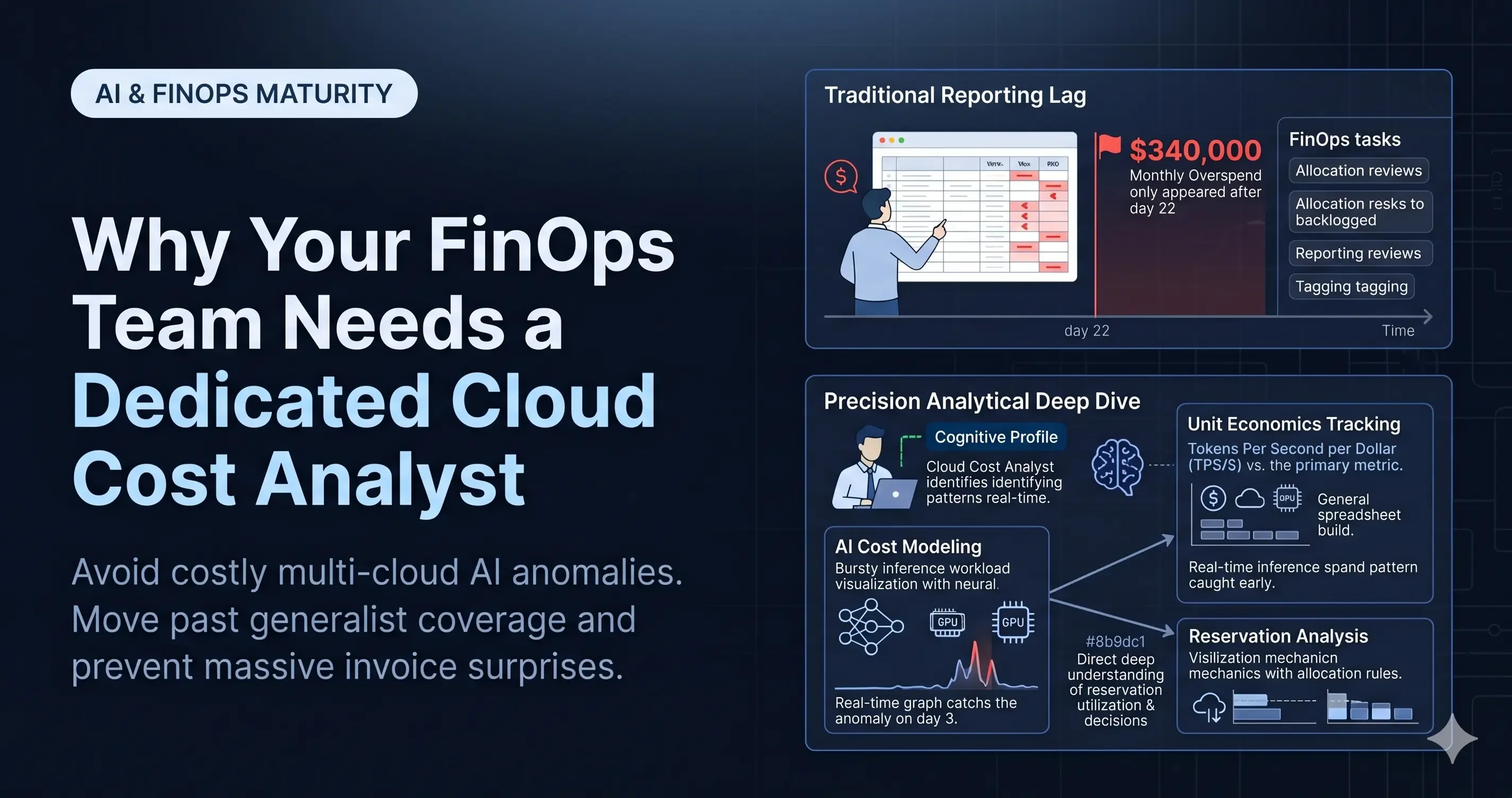
Why Your FinOps Team Needs a Dedicated Cloud Cost Analyst in 2026
Explores the emerging role of specialized cloud cost analysts and how they differ from traditional financial analysts in driving FinOps success
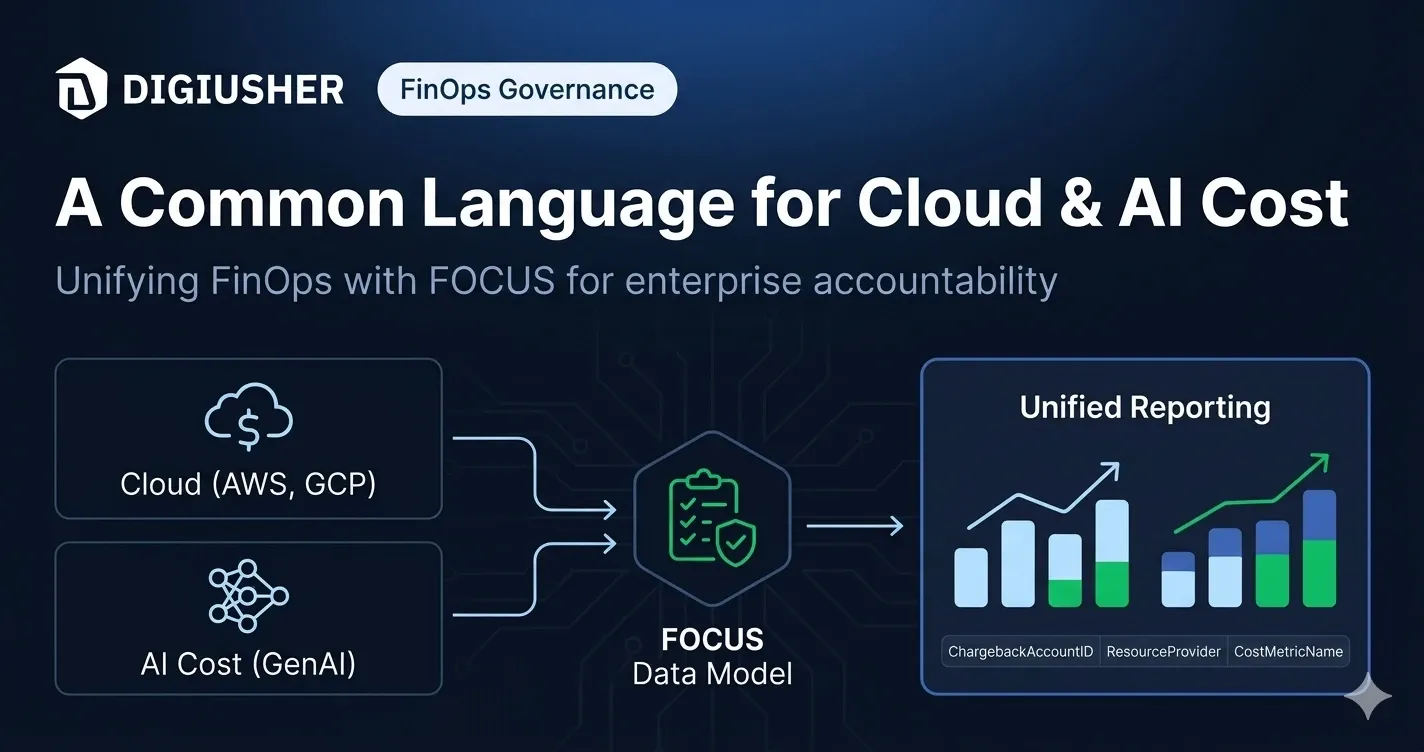
The Broken Cost Schema Problem: Why Every FinOps Team Is Solving the Same Problem from Scratch (Blog 1/5 Series)
80% of enterprises can't track cloud spend accurately across providers. The reason isn't discipline — it's three incompatible billing schemas. FOCUS changes the equation.
Seven Signals from the State of FinOps 2026: Why Technology Value Management Is Now a Board-Level Mandate
8% of FinOps teams now govern AI spend. Gartner forecasts $2.52T in global AI investment. The State of FinOps 2026 rewrites the rules for every CTO, CFO, and Head of FinOps.