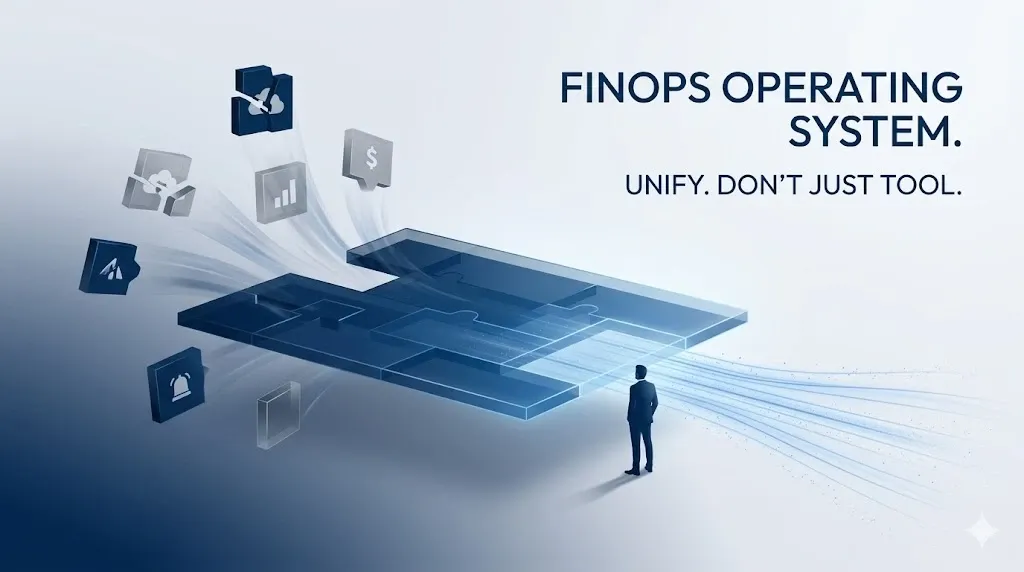
Why You Need a FinOps Operating System — Not Just Tools
Traditional FinOps tools deliver visibility. A FinOps Operating System delivers governance. Learn why the category shift from cost dashboards to a FinOps OS is the defining enterprise cloud decision of 2026 — and how DigiUsher built the control layer that CIOs, CFOs, and FinOps teams actually need.
Executive Summary
Cloud adoption has exploded. AI workloads are skyrocketing. Enterprises now run multiple clouds, marketplaces, data platforms, and AI API providers simultaneously — and the bills are growing faster than any governance process built around traditional FinOps tools can track.
The result: visibility without control. Dashboards that show what was spent. Alerts that fire after budgets are breached. Manual tagging that engineers bypass. Chargeback reports that arrive too late to change decisions.
Visibility alone no longer cuts it. Enterprises need a FinOps Operating System to enforce policies, govern spend, and protect margins — not another dashboard.
This briefing defines the FinOps OS category, explains why the shift from tools to operating system is the defining enterprise cloud decision of 2026, and lays out exactly what DigiUsher’s FinOps OS delivers that no collection of point tools can replicate.
The Problem with FinOps Tools Alone
Traditional FinOps tools were designed to solve a visibility problem. They succeeded. Enterprises can now see, in remarkable detail, what they spent on cloud infrastructure last month.
That is no longer the problem.
The problem in 2026 is governance at runtime — the ability to enforce financial policy before spend occurs, not report on it afterward. Traditional tools have four structural failure modes in this environment:
Fragmented dashboards — Each cloud provider offers its own cost reporting portal. AWS Cost Explorer does not see Azure spend. Azure Cost Management does not see GCP. Neither sees OpenAI API invoices, Snowflake credits, or Databricks DBUs. Finance teams reconcile across six billing portals manually, and the consolidated number is always stale.
Manual tagging enforcement — Tools can report on untagged resources. They cannot prevent them. Engineers provision resources without attribution tags, tagging compliance campaigns run quarterly, and the gap between “tagged” and “governed” never closes.
Reactive reporting — Every tool alert is a post-fact notification. The spend has already occurred. The budget has already been breached. The bill is already in transit. Reactive reporting produces excellent post-mortems and negligible prevention.
Disconnected procurement workflows — When a product team subscribes to an OpenAI API key through the Azure Marketplace, traditional tools see a line item on the next invoice. They cannot intercept, attribute, or enforce policy at the moment of procurement.
Deloitte: Most enterprises lack real-time enforcement mechanisms for cloud cost policies.
This is not a configuration failure. It is a category failure. Tools were never built to enforce — and that gap cannot be closed by adding more tools.
Why Cloud Economics Must Become an Operating Model
Cloud spend is no longer IT cost. It is digital manufacturing cost — the variable cost of production for every digital product, AI feature, and customer interaction a modern enterprise delivers.
The cost categories that define this shift:
- AI and ML workloads — token billing, GPU clusters, inference endpoints
- SaaS and marketplace subscriptions — procured by product teams without central oversight
- Multi-cloud infrastructure — AWS, Azure, GCP, OCI running simultaneously
- Data cloud platforms — Snowflake credits, Databricks DBUs, BigQuery slot reservations
- Platform engineering cost centres — Kubernetes clusters, service meshes, observability stacks
- On-premises and hybrid — hosted datacentre costs that must be normalised alongside public cloud
Each of these cost categories has a different billing model, a different owner, and a different governance requirement. No single cloud cost tool was designed to handle all of them. No collection of point tools can govern them coherently.
The equation is simple: Visibility ≠ Governance. Reporting ≠ Runtime Enforcement.
Gartner: By 2027, cloud cost governance will be considered a critical business capability for enterprise competitiveness.
The FinOps OS emerges to fill this gap — enforce, allocate, and optimise cloud economics end-to-end, across every cost category, in real time.
What Is a FinOps Operating System? {#what-is-a-finops-operating-system}
A FinOps Operating System is the control layer over cloud economics.
Where a FinOps tool reports on cost, a FinOps OS governs cost. The distinction is not incremental — it is architectural:
| Dimension | FinOps Tools | FinOps OS |
|---|---|---|
| Primary output | Reports costs after they occur | Governs economics before they become problems |
| Waste handling | Detects waste in dashboards | Prevents leakage at provisioning |
| Tagging | Manual — engineers opt in | Enforced taxonomy — no tag, no deployment |
| Visibility scope | Siloed per cloud provider | Unified across all clouds, AI, SaaS, and on-premises |
| Ownership model | IT-owned reporting function | Cross-functional: CFO, CIO, Product, FinOps |
| Response posture | Reactive — alerts after breach | Predictive and preventative — acts before the bill |
| AI workloads | Infrastructure view only | Token economics, GPU lifecycle, inference attribution |
| Marketplace spend | Visibility only | Billing normalisation and procurement governance |
| Budget enforcement | Email alerts | Automated throttle, suspend, decommission |
| Business alignment | Cost centre reporting | P&L-grade chargeback and ROI attribution |
A FinOps OS does not replace cloud provider cost tools — it operates above them, consuming their data, normalising it to a common schema (FOCUS), and applying enforcement, allocation, and optimisation logic that no individual provider tool can deliver.
Unlike point tools, a FinOps OS automates enforcement, governs marketplaces, and controls AI spend in real time— making cloud economics a managed operating model rather than a reporting function.
The Six Layers of DigiUsher’s FinOps OS
Layer 1 — Policy Engine
The enforcement backbone. Budget guardrails, spend caps, and governance rules are encoded as machine-enforceable policies — not email alerts. When a budget threshold is approached, the Policy Engine triggers automated actions: throttle, suspend, decommission, or escalate. Rules operate across AWS, Azure, GCP, and AI APIs simultaneously from a single governance plane.
What this replaces: Manual budget monitoring, reactive alert triage, end-of-quarter spending retrospectives.
Layer 2 — Tagging OS
Mandatory taxonomy enforcement at the provisioning layer. Resources cannot be deployed — cloud, AI, or marketplace — without complete attribution metadata. The Tagging OS enforces a unified tag schema across every environment, eliminating the gap between “tagging policy exists” and “tagging compliance is real.”
What this replaces: Quarterly tagging compliance campaigns, unattributed spend, disputed chargeback reports.
Layer 3 — Allocation Engine
P&L-grade chargeback with dynamic, usage-based cost distribution. Shared service costs — networking, centralised databases, platform engineering — are automatically allocated to the business units and product lines that consumed them, using configurable allocation rules rather than manual spreadsheet formulas.
What this replaces: Monthly finance reconciliation exercises, approximated cost centre allocations, chargeback disputes between engineering and finance.
Layer 4 — Marketplace OS
Procurement governance for AWS Marketplace, Azure Marketplace, and GCP Marketplace spend. The Marketplace OS ingests partner and reseller billing, normalises invoice structures, attributes charges to owning teams, and enforces procurement policies at subscription time — before ungoverned spend reaches the monthly invoice.
What this replaces: Shadow IT from decentralised marketplace procurement, manual partner billing reconciliation, SaaS spend that finance cannot attribute.
Layer 5 — AI Economics
Token-level governance for Azure OpenAI, AWS Bedrock, GCP Vertex AI, and third-party AI APIs (OpenAI, Anthropic, Hugging Face, Mistral, Perplexity). GPU lifecycle automation — idle cluster scale-down, training job SLA enforcement, inference endpoint termination. Unit economics that translate AI infrastructure cost into business metrics: cost per inference, cost per active user, cost per feature.
What this replaces: AI spend that engineering teams control with no finance visibility, GPU clusters billing while idle, month-end AI cost surprises.
Layer 6 — Executive Control Plane
Board-ready dashboards for CFOs and CIOs. ROI attribution, variance analysis, forecast accuracy, and unit economics — presented in the language of finance rather than infrastructure. Connects cloud spend to business outcomes: revenue per cloud dollar, margin impact of AI investment, forecast vs. actual variance by business unit.
What this replaces: Manually assembled executive cost reports, cloud cost that cannot be connected to business ROI, quarterly board surprises.
The Leadership Impact: What Changes for Each Role
For CIOs
Before FinOps OS: Shadow IT from marketplace purchases is invisible until the invoice. AI spend is growing faster than any governance process can track. Multi-cloud cost is fragmented across incompatible billing portals with no unified view.
After FinOps OS:
- Shadow IT becomes measurable — every marketplace subscription attributed to an owner at provisioning
- AI economics become predictable — token budgets enforced, GPU lifecycle automated, inference costs attributed
- Multi-cloud spend unified — one control plane, one enforcement model, one source of truth
For CFOs
Before FinOps OS: Cloud forecasts miss actuals by >20% quarterly. Board reporting cannot connect cloud spend to business ROI. Cloud is a financial risk with no governance equivalent to CapEx controls.
After FinOps OS:
- ROI is enforceable through automated guardrails — not estimated in spreadsheets
- Board reporting is audit-ready with P&L-grade attribution and variance analysis
- Cloud spend becomes a strategic lever — forecast accuracy within ±10%, investment decisions backed by unit economics
For Heads of FinOps
Before FinOps OS: Manual tagging enforcement is a full-time job that still fails at scale. Chargeback reports take days to produce and are always disputed. Governance authority depends on engineering team cooperation rather than platform enforcement.
After FinOps OS:
- Tagging enforced at provisioning — no manual chasing, no untagged resources
- Chargeback reports generated automatically with P&L-grade accuracy
- Policy authority embedded in the platform — governance acts without needing anyone’s permission
For VP Product and Platform Engineering
Before FinOps OS: Product-level margins are invisible until end-of-month cost allocation. AI and GPU platforms are optimised manually — expensive, unreliable, and always behind. Marketplace and cloud costs are not broken down to feature level.
After FinOps OS:
- Product-level margins visible in real time, tied to business targets
- GPU and AI platforms optimised automatically — lifecycle rules run continuously
- Cloud and marketplace costs attributed to features and products, enabling true build vs. buy decisions
Why 2026 Is the Tipping Point for FinOps OS Adoption
Five converging forces are making the shift from FinOps tools to FinOps OS unavoidable in 2026:
1. Hyperscaler AI Billing Acceleration
AWS, Azure, GCP, and OCI are all shifting to consumption-heavy AI billing — token pricing, GPU on-demand, PTU reservations. These models compound faster than traditional compute costs and break every budget model built around predictable infrastructure pricing.
2. Data Cloud Cost Complexity
Snowflake credits and Databricks DBUs introduce billing semantics that neither cloud native tools nor traditional FinOps platforms were designed to normalise alongside infrastructure costs. Enterprises running both need a FOCUS-native layer that can ingest and attribute all of them coherently.
3. GSI Co-Selling at Enterprise Scale
Global System Integrators — including Infosys, Wipro, and Hexaware — are co-selling cloud economics solutions at enterprise scale, making FinOps OS a standard line item in cloud transformation programmes rather than a specialist purchase.
4. Forrester’s Autonomy Prediction
Forrester predicts autonomous cloud governance platforms will dominate FinOps adoption by 2026 — shifting the category definition from reporting tools to enforcement systems. Enterprises that adopt now build a durable governance capability; those that wait retrofit governance onto cost structures that have already drifted.
5. Gartner’s Competitive Classification
Gartner forecasts cloud cost governance becomes a critical business capability for enterprise competitiveness by 2027. The implication for 2026: building FinOps OS capability now is a competitive investment, not a cost-saving exercise.
Forrester: Autonomous cloud governance platforms will dominate FinOps adoption by 2026.
DigiUsher: Defining and Leading the FinOps OS Category
DigiUsher’s FinOps Operating System is the platform that defines this category. Built on a FOCUS 1.x native engine, it normalises cost data from AWS, Azure, GCP, Snowflake, Databricks, Kubernetes, on-premises, and AI APIs into a single interoperable financial model — the foundation on which all six OS layers operate.
Proven outcomes within 90 days:
- 18–47% reduction in cloud cost leakage
- Forecast accuracy within ±10% variance
- P&L-grade chargeback reporting replacing manual reconciliation
- AI spend attributed to teams and features — not aggregated to “cloud”
Deployment options:
- Multi-tenant SaaS for enterprises prioritising speed to value
- BYOC (Bring Your Own Cloud) single-tenant deployment for regulated industries requiring data sovereignty — ICICI Bank and other regulated-industry deployments use this model
Certifications: SOC 2® Type II and GDPR certified.
SI partner delivery: Infosys, Wipro, and Hexaware deliver DigiUsher globally for enterprises that want FinOps OS embedded in broader cloud transformation programmes.
Partner ecosystem: AWS ISV Accelerate, available in Azure Marketplace, Google Cloud Partner, Microsoft Co-Sell Ready.
Evaluating FinOps Platforms: A Buyer’s Framework
If you are evaluating whether to upgrade from FinOps tools to a FinOps OS, these are the questions that determine the decision:
Enforcement questions:
- Does it enforce mandatory tagging at provisioning — or report on untagged resources after the fact?
- Does it trigger automated budget actions (throttle, suspend, decommission) — or send email alerts?
- Does it block marketplace procurement without cost attribution — or show marketplace spend in a dashboard?
Coverage questions:
- Does it normalise cost data from all your clouds, AI APIs, data platforms, and on-premises environments in one model?
- Does it govern AI spend at the token and inference level — or see AI workloads only as compute?
- Does it handle partner and reseller billing normalisation — or show aggregated marketplace line items?
Business alignment questions:
- Does it produce P&L-grade chargeback automatically — or require monthly manual reconciliation?
- Does it connect cloud spend to business outcomes (cost per customer, cost per feature) — or report cost centre totals?
- Does it give your CFO and CIO board-ready ROI metrics — or give your FinOps team infrastructure dashboards?
If the honest answer to any enforcement or business alignment question is “no” or “partially”, you have a visibility tool — not a FinOps OS.
Frequently Asked Questions
What is a FinOps Operating System and how does it differ from FinOps tools?
A FinOps Operating System is the control layer over cloud economics — a unified platform that enforces financial policy, automates cost attribution, governs AI and marketplace spend, and delivers predictive ROI intelligence. It differs from FinOps tools in one fundamental way: tools provide visibility into what has already been spent; a FinOps OS governs what is about to be spent through automated policy enforcement, mandatory tagging at provisioning, and runtime budget guardrails. Where tools report, a FinOps OS acts.
Why are traditional FinOps tools no longer sufficient for enterprises in 2026?
Traditional FinOps tools were designed for single-cloud infrastructure with predictable compute billing. In 2026, enterprises run AI workloads with token-based billing, multi-cloud deployments, SaaS procurement through marketplace channels, and data cloud platforms. Each introduces cost behaviours that reporting dashboards cannot govern. Deloitte notes most enterprises lack real-time enforcement mechanisms for cloud cost policies — the gap tools cannot close. Gartner predicts cloud cost governance will be a critical competitive capability by 2027, elevating FinOps from reporting function to strategic operating model.
What does a FinOps OS do that FinOps tools cannot?
A FinOps OS does six things tools cannot: enforces tagging at provisioning; executes automated budget actions (throttling, suspending, decommissioning) not email alerts; governs AI spend at the token level across all LLM providers; normalises marketplace billing including partner and reseller structures; produces P&L-grade chargeback automatically; and delivers predictive forecasting connecting cloud trajectories to business outcomes before overspend occurs.
Which enterprise roles benefit most from a FinOps Operating System?
A FinOps OS serves four roles simultaneously. CIOs gain a unified control plane making shadow IT measurable, AI economics predictable, and multi-cloud spend governable. CFOs gain ROI enforceability, audit-ready board reporting, and forecast accuracy. Heads of FinOps gain platform-level policy authority without depending on engineering team cooperation. VP Product and Platform teams gain real-time product-level margin visibility and automated GPU optimisation.
What is the FinOps OS category and who defined it?
The FinOps OS category describes enterprise cloud financial management platforms that operate as governance and enforcement layers over cloud economics — distinct from traditional FinOps reporting tools that provide visibility without control. DigiUsher defines and leads this category, building on a FOCUS 1.x native engine normalising cost data from AWS, Azure, GCP, Snowflake, Databricks, Kubernetes, and AI APIs. The category is validated by Forrester’s prediction that autonomous cloud governance platforms will dominate FinOps adoption by 2026.
How quickly do enterprises see results from deploying a FinOps OS?
DigiUsher customers achieve measurable results within 90 days of deployment: 18–47% reduction in cloud cost leakage, improved forecast accuracy within ±10% variance, and P&L-grade chargeback reporting replacing manual monthly reconciliation. The speed of impact comes from mandatory tagging enforcement and automated budget guardrails activating immediately at provisioning — governance that acts from day one.
How does a FinOps OS govern AI workloads differently from cloud cost tools?
Cloud cost tools view AI as infrastructure. A FinOps OS governs AI at the economic layer: token consumption per team, inference cost per feature, GPU utilisation rate, model tier policy compliance, and third-party API spend attributed to owners. DigiUsher integrates token billing from OpenAI, Anthropic, Hugging Face, Mistral, and Perplexity alongside AWS Bedrock, Azure OpenAI, and GCP Vertex AI — normalising all AI cost data and enforcing budget caps with automated throttle and suspend triggers.
What makes DigiUsher’s FinOps OS different from other FinOps platforms?
DigiUsher differentiates on five dimensions: FOCUS 1.x native engine for genuine multi-cloud interoperability; full-stack coverage spanning cloud, AI, Kubernetes, data cloud, SaaS, and on-premises; runtime enforcement through mandatory Tagging OS, Policy Engine, and automated remediation; BYOC deployment for regulated industry data sovereignty; and a proven 18–47% leakage reduction benchmark within 90 days — not a projected estimate.
References
- Gartner — Cloud Cost Governance Trends
- Forrester — Autonomous Cloud Governance Platforms FinOps Report
- Deloitte — Cloud Cost Management and Real-Time Enforcement
- Tangoe — GenAI and AI Drive Cloud Expenses 30% Higher
- FinOps Foundation — FOCUS Specification
- PwC — Cloud Cost Optimisation and FinOps
- AWS ISV Accelerate programme
- Azure Marketplace — DigiUsher listing
DigiUsher in 30 min
See which team owns every dollar — in real time.
DigiUsher turns raw billing data into allocation finance trusts — chargeback, showback, and guardrails included.
Book a 30-min walkthroughNo hard pitch · tailored to your stack
Continue Reading
More from the DigiUsher editorial team.
The New CIO Mandate: Governing Cloud and AI ROI Like Capital Assets
CIOs must now govern cloud and AI spend with the same rigour as CapEx. Learn the capital asset governance framework, hyperscaler trends, and how DigiUsher's FinOps OS operationalises ROI discipline across AWS, Azure, GCP, and AI workloads.

AI Cost Governance: How to Prevent Runaway GenAI Spend
GenAI workloads are driving cloud bills 30% higher year-over-year and 72% of enterprises say AI costs are becoming unmanageable. This operational playbook covers token-level tagging, automated budget guardrails, multi-cloud AI cost normalisation, and GPU lifecycle automation — with concrete guidance for AWS Bedrock, Azure OpenAI, GCP Vertex AI, and third-party LLM APIs
Designing Azure Landing Zone Cost Guardrails
Learn how to build runtime-enforced cost guardrails on Azure Landing Zones with mandatory tagging, dynamic budget automation, and AI cost governance. DigiUsher's FinOps OS closes the gap that native Azure Policy leaves open