InstaSafe: From Multi-Cloud Opacity to 100% Unit Economics Visibility in 90 Days
InstaSafe — a Gartner-recognised Zero Trust Network Access provider protecting distributed workforces across multi-cloud environments — had no visibility into what serving each customer actually cost them. Costs were pooled, unallocated, and invisible. This is how DigiUsher transformed that opacity into 25% improved unit economics, 30% cloud cost reduction, and 100 hours per month returned to the engineering and finance teams.
At a Glance
| Customer | InstaSafe Technologies |
| Headquarters | Bengaluru, India |
| Industry | Cybersecurity / Zero Trust Network Access |
| Category | Cloud-First B2B SaaS |
| Cloud estate | Multi-cloud: AWS, Azure, GCP |
| Use case | Per-customer unit economics, multi-cloud cost governance |
Results at a Glance
| Metric | Before DigiUsher | After DigiUsher |
|---|---|---|
| Customer unit economics visibility | 0% | 100% |
| Cloud cost optimisation | Baseline | 30% reduction |
| Unit economics performance | Baseline | 25% improvement |
| Manual analysis overhead | 100+ hours/month | Eliminated |
About InstaSafe
InstaSafe Technologies is a Gartner-recognised Zero Trust Network Access (ZTNA) provider — one of India’s pioneering cybersecurity companies since 2012. Founded by a team of cybersecurity experts including CEO Sandip Kumar Panda, InstaSafe built a cloud-native security platform that enables enterprise organisations to grant secure remote access to applications, systems, and data without the complexity and risk of legacy VPN infrastructure.
InstaSafe’s product is the antithesis of the perimeter security model. Rather than extending network access to authenticated users, InstaSafe’s Zero Trust architecture uses a software-defined trust broker to mediate connections between specific applications and authorised users — verifying identity, device health, and context before any connection is established. The result: application access without network access, with applications masked from the open internet entirely.
The product is delivered as a cloud-native SaaS platform serving enterprise customers across India and the United States. InstaSafe operates across AWS, Azure, and GCP simultaneously — the multi-cloud estate that is both the source of the product’s resilience and the origin of its cost governance challenge.
Investors include: Citrix, ABM Knowledgeware, HP Enterprise, NetApp, Microsoft, IBM, and Indian Angel Network.
The Challenge
InstaSafe faced a problem that is definitionally common to cloud-first SaaS companies — and almost universally underestimated until it directly constrains growth.
They could not see what it cost to serve each customer.
In a zero trust platform where each enterprise customer connects to applications through InstaSafe’s cloud infrastructure, the cost of serving that customer — compute, network tunnelling, authentication processing, data storage, managed service fees — was real, ongoing, and proportional to usage. But the cloud bill did not disaggregate it that way.
AWS, Azure, and GCP returned aggregated charges. Compute was compute. Network was network. Storage was storage. The bills arrived monthly, pooled across all customers, with no mechanism to answer the questions that actually mattered for the business:
- What does it cost us to serve Enterprise Customer X each month?
- Is Customer Y profitable at their current pricing tier?
- Which features have the highest infrastructure cost-to-value ratio?
- Are we pricing our product to recover cloud costs as we scale?
Without answers to these questions, InstaSafe was scaling a cloud-native SaaS business on estimated unit economics — and estimation in cloud cost management is another word for acceptable inaccuracy that compounds with every new customer acquired.
Three Critical Gaps
Gap 1 — Unit Economics Were Invisible in a Multi-Tenant Architecture
InstaSafe’s infrastructure served multiple enterprise customers simultaneously across shared resources on three cloud providers. The cloud bill arrived as:
The Cloud Bill Reality vs. the Business Need
──────────────────────────────────────────────────────────────
Cloud bill showed:        What InstaSafe needed to know:
─────────────────         ──────────────────────────────────
EC2: £X,XXX/month         Customer A infrastructure: £?
Azure VMs: £X,XXX/month   Customer B infrastructure: £?
GCP Compute: £X,XXX/month Customer C infrastructure: £?
S3 Storage: £XXX/month    Feature X cost per customer: £?
Egress: £XXX/month        Gross margin by customer tier: £?

Native cloud billing:     ANSWER TO NONE OF THE ABOVE
──────────────────────────────────────────────────────────────
This is not an InstaSafe-specific failure. It is a structural characteristic of multi-tenant SaaS on shared cloud infrastructure. Native cloud billing was designed to answer “what did you spend?” — not “what did it cost to serve each customer?” The two questions require fundamentally different attribution architectures.
Gap 2 — Technical and Business Teams Had No Shared Cost Intelligence
Two distinct audiences needed cost data for entirely different purposes — and neither had access to data that was reliable enough to act on.
Engineering teams needed operational cost intelligence: which services were overprovisioned, which environments were idle, which infrastructure decisions were generating disproportionate cost relative to the workload they served. This data would enable resource rightsizing, architecture optimisation, and efficient infrastructure decision-making.
Business leaders needed financial cost intelligence: cost per customer, cost per product feature, gross margin by pricing tier, and unit economic trends as the customer base scaled. This data would enable pricing decisions, customer profitability analysis, and investment prioritisation.
One cloud infrastructure. Two audiences. Zero shared visibility. The inevitable result: infrastructure decisions made without cost signal, and pricing decisions made without cost reality.
Gap 3 — No Accountability Created Compounding Inefficiency
The absence of cost ownership is not a neutral condition in cloud infrastructure. It is a cost generator.
When no team is accountable for a specific slice of cloud spend:
- Development environments persist through weekends without pressure to terminate them
- Overprovisioned instances run at 15% utilisation without prompting rightsizing
- Idle services accumulate across accounts without triggering cleanup
- New features are deployed without cost estimation because there is no governance mechanism to require it
Each individual inefficiency is small. Their aggregate — across a multi-cloud estate serving enterprise customers — is the 30% cloud waste that DigiUsher’s governance programme ultimately recovered.
The DigiUsher Solution
DigiUsher’s FinOps OS integrated with InstaSafe’s multi-cloud estate across AWS, Azure, and GCP — delivering the three capabilities that the three gaps required.
Capability 1 — Granular Customer-Level Cost Attribution
DigiUsher mapped InstaSafe’s multi-tenant infrastructure to individual customer contexts. The FOCUS-normalised attribution model connected:
- Shared Kubernetes cluster costs → proportional to per-customer workload consumption
- Dedicated compute resources → directly attributed to the customer context they serve
- Network egress → attributed to the customer traffic generating it
- Managed service fees → allocated to consuming customers
- Storage costs → per-customer data volumes
The output: per-customer cost visibility updated continuously across all three cloud providers — from aggregate billing that obscured every cost to disaggregated attribution that made every customer’s infrastructure cost legible.
The cloud bill that previously showed “AWS Compute: £X,XXX/month” now showed the per-customer breakdown that made pricing, profitability, and architecture decisions financially grounded rather than estimated.
Capability 2 — Dual-Audience Real-Time Dashboards
DigiUsher surfaced the same attributed cost dataset through role-appropriate visualisations — one unified source of truth, two audience-specific views:
Engineering dashboard: cost per service, cost per namespace, cost per environment, idle resource alerts, rightsizing signals. The operational cost intelligence that enables engineers to make better infrastructure decisions in real time — not in response to the next monthly invoice.
Business dashboard: cost per customer, unit economics trends, gross margin by pricing tier, cost per product feature, cloud cost as a percentage of customer revenue. The financial cost intelligence that enables pricing, product investment, and customer profitability decisions grounded in actual cost reality.
The collaboration impact: for the first time, when InstaSafe’s engineering team and business leadership were in the same room discussing product investment or pricing strategy, they were working from identical cost data. The conversation changed from “approximately how much does this cost?” to “here is exactly what it costs.”
Capability 3 — Proactive Cost Governance and Anomaly Detection
DigiUsher replaced monthly invoice analysis with real-time cost monitoring across InstaSafe’s full multi-cloud estate.
Automated anomaly detection triggered alerts when cost trajectories deviated from expected patterns — surfacing the idle environment, the unexpected egress spike, the overprovisioned instance that was accumulating cost without generating proportionate value. These signals arrived within hours of the anomaly emerging — not 25 days later when the invoice arrived.
The operational consequence: InstaSafe’s engineering team stopped spending 100+ hours per month manually reconciling cloud bills and hunting cost anomalies through native billing consoles. That time was recovered and returned to engineering and product work.
The Results
25% Improvement in Customer Unit Economics
With per-customer cost attribution in place, InstaSafe’s leadership could see — for the first time — the economics of each customer relationship. Product investment decisions were made with cost reality as an input. Pricing was evaluated against actual infrastructure cost. Infrastructure choices were optimised with customer economics as the accountability metric.
The compounding effect of these cost-aware decisions — across product development, pricing strategy, and infrastructure configuration — delivered a 25% improvement in customer unit economics over the measurement period.
30% Cloud Cost Reduction
Granular cost visibility enables specific optimisation that aggregate billing cannot. Once InstaSafe could see exactly what was generating cost at the service, customer, and use-case level, the path to cost reduction became specific rather than speculative:
- Idle environments identified and terminated rather than persisting through weekends
- Overprovisioned resources rightsized from actual utilisation data rather than estimated capacity requirements
- Cost anomalies detected and addressed within hours rather than discovered monthly
- Shared infrastructure optimised against per-customer consumption data rather than aggregate billing
The combined effect: 30% reduction in total cloud spend.
100 Hours Per Month Returned to the Business
Manual cloud cost analysis — billing reconciliation across three cloud providers, anomaly hunting through native consoles, per-customer cost estimation from aggregate data — consumed more than 100 hours of engineering and finance time each month before DigiUsher.
DigiUsher’s automated attribution, real-time dashboards, and proactive anomaly detection replaced this manual work with automated governance. The 100+ hours per month was returned — to engineering, product development, and the analytical work that actually advances the business.
100% Visibility on Customer Unit Economics
The most fundamental result: complete transformation from zero to full per-customer cost visibility. InstaSafe moved from being unable to answer “what does it cost to serve this customer?” to having that answer updated continuously, across all three cloud providers, for every enterprise customer in the portfolio.
This visibility is not an operational convenience. For a cloud-first SaaS company, it is the financial foundation of a profitable, scalable business model.
In Their Words
“DigiUsher is like having X-ray vision into every corner of our cloud infrastructure. The unit economics feature is a total game-changer for any cloud-first profitable SaaS company.”
— Sandip Kumar Panda, Co-Founder and CEO, InstaSafe Technologies
The “X-ray vision” framing is precise. Not approximation. Not sampling. Not monthly retrospectives. Real, granular, per-customer cost visibility — the kind that makes a cloud-first SaaS CEO confident in pricing conversations, product investment decisions, and the gross margin story they tell investors.
And the “total game-changer for any cloud-first profitable SaaS company” is a product insight that applies far beyond InstaSafe. Every multi-tenant SaaS company serving enterprise customers across shared cloud infrastructure faces this same unit economics opacity problem. Most are navigating it with estimated economics. InstaSafe navigated out of it with DigiUsher.
Why This Matters for Cloud-First SaaS Leaders
InstaSafe’s challenge — multi-cloud opacity, absent unit economics visibility, disconnected technical and business audiences — is not unique to cybersecurity. It is the defining FinOps challenge of cloud-first SaaS companies at every scale and in every vertical.
The universal pattern:
- SaaS company builds a cloud-native product serving enterprise customers in a multi-tenant architecture
- Cloud costs scale as the customer base grows — but billing remains aggregate
- Unit economics are estimated, not measured — making pricing and investment decisions financially imprecise
- Technical and business teams operate from different, incompatible pictures of cloud spend
- No accountability for specific cost → no signal to improve efficiency → costs compound
The DigiUsher resolution:
- FOCUS-normalised attribution disaggregates shared cloud costs to the customer level
- Real-time dashboards surface the same attributed data to both technical and business audiences
- Proactive governance replaces monthly invoice analysis
- Unit economics become a measured financial metric, not an estimated approximation
- Cost accountability drives behaviour change that compounds as improvement
The 25% improvement in unit economics, the 30% cloud cost reduction, the 100 hours recovered per month, and the 100% visibility achievement — these are not outcomes that required a large engineering organisation or an advanced FinOps programme. They required the right attribution infrastructure, applied to a multi-cloud estate that was already generating costs the business could not fully see.
Frequently Asked Questions
What specific challenge did InstaSafe face before DigiUsher?
Three interconnected gaps: no per-customer cost visibility in a multi-tenant multi-cloud architecture (cloud bills arrived aggregated, not disaggregated by customer); disconnected audiences (technical and business teams had no shared cost data); and no cost accountability (absent attribution meant no team owned specific cost, creating compounding inefficiency). All three gaps shared one root cause: cloud billing designed to show total spend rather than per-customer unit economics.
What results did InstaSafe achieve?
25% improvement in customer unit economics; 30% cloud cost reduction; 100 hours per month saved from manual analysis; 100% visibility on customer unit economics — achieved from a starting baseline of zero per-customer cost visibility.
How does DigiUsher solve the multi-tenant attribution problem?
FOCUS-normalised attribution across all cloud providers connects Kubernetes namespace costs, shared cluster charges, network egress, and managed services to the customer tenants consuming each resource — based on actual consumption metrics. Per-customer cost data updated continuously, not assembled through monthly manual billing reconciliation. Both engineering and business audiences work from the same attributed dataset through role-appropriate dashboards.
Why is unit economics visibility critical for cloud-first SaaS?
Cloud-first SaaS carries proportional infrastructure cost for every customer and every feature. Without per-customer unit economics, pricing decisions are estimated rather than grounded, product investment is prioritised by instinct rather than economics, and profitability problems are discovered after they have already compounded. InstaSafe’s CEO described it as “a total game-changer for any cloud-first profitable SaaS company” — not because it is a nice-to-have capability, but because it is the financial foundation of a profitable, scalable business model.
How long did results take to materialise?
The core attribution infrastructure — per-customer cost visibility across AWS, Azure, and GCP — was delivered in the initial implementation phase. The 100% visibility and the 100 hours/month saving began accruing immediately. The 30% cost reduction and 25% unit economics improvement were measured outcomes from the governance decisions enabled by attribution visibility. Contact DigiUsher for current implementation benchmarks for your estate size and configuration.
Is DigiUsher suitable for scale-up SaaS companies or only large enterprises?
InstaSafe’s profile — 44–48 employees, ₹16.1Cr revenue, multi-cloud architecture — is exactly the scale where DigiUsher delivers its highest relative ROI. Cloud costs are material to the business model; manual governance is time-consuming and inaccurate; unit economics opacity directly constrains pricing and investment decisions. DigiUsher’s flat enterprise licensing makes it commercially accessible for growth-stage SaaS companies where percentage-of-spend pricing would create a fee structure that scales against the company’s own growth.
The DigiUsher Difference for Cloud-First SaaS
DigiUsher’s FinOps OS is not a cloud cost reporting dashboard bolted onto InstaSafe’s existing billing data. It is the attribution infrastructure that answered the questions that cloud billing cannot — what does it cost to serve each customer, and is that cost proportionate to the value the customer generates?
For cloud-first SaaS companies — whether Zero Trust security platforms like InstaSafe or any other multi-tenant architecture serving enterprise customers across shared cloud infrastructure — the same attribution challenge exists. The same unit economics opacity constrains the same pricing and investment decisions. And the same governance transformation is achievable.
Unified multi-cloud attribution across AWS, Azure, and GCP — per-customer, per-feature, per-use-case cost data updated continuously.
Dual-audience cost intelligence — one FOCUS-normalised dataset presented to engineering and business teams through role-appropriate dashboards that serve both audiences simultaneously.
Proactive anomaly detection — cost deviations surfaced within hours rather than discovered monthly.
Unit economics as a business metric — cost per customer, cost per product feature, gross margin by pricing tier, cloud cost as a percentage of customer revenue — in the board-ready format that investor and pricing conversations require.
Available as SaaS or BYOC for regulated industries. SOC 2® Type II and GDPR certified. Available on AWS Marketplace (ISV Accelerate Partner) and Azure Marketplace (ISV Co-Sell Ready). Delivered globally through Infosys, Wipro, and Hexaware.
Explore the InstaSafe Outcomes for Your Multi-Cloud Estate
Request a 30-min FinOps OS Walkthrough →
Related Customer Insights and Technical Guidance
- Unlocking Financial Efficiency with FinOps: The 2026 Savings Playbook — 23 Apr 2026 — The seven savings levers behind InstaSafe’s 30% cloud cost reduction
- The Death of Chargeback: Why Cost Allocation Is Failing in the Kubernetes and AI Era — 28 Apr 2026 — Why per-customer attribution outperforms chargeback for multi-tenant SaaS
- DigiUsher: The FinOps Operating System for Multi-Cloud Cost Management — 24 Apr 2026 — The full eight-capability platform that delivered InstaSafe’s results
- Platform Teams Are Becoming Cost Centers — And What To Do About It — 28 Apr 2026 — The engineering accountability model that unlocks the behaviour change InstaSafe achieved
- AI Cloud Margins: The New Battlefield for Enterprise Profitability — 4 Mar 2026 — The gross margin economics that make unit economics visibility strategically essential
DigiUsher in 30 min
See which team owns every dollar — in real time.
DigiUsher turns raw billing data into allocation finance trusts — chargeback, showback, and guardrails included.
Book a 30-min walkthroughNo hard pitch · tailored to your stack
Continue Reading
More from the DigiUsher editorial team.
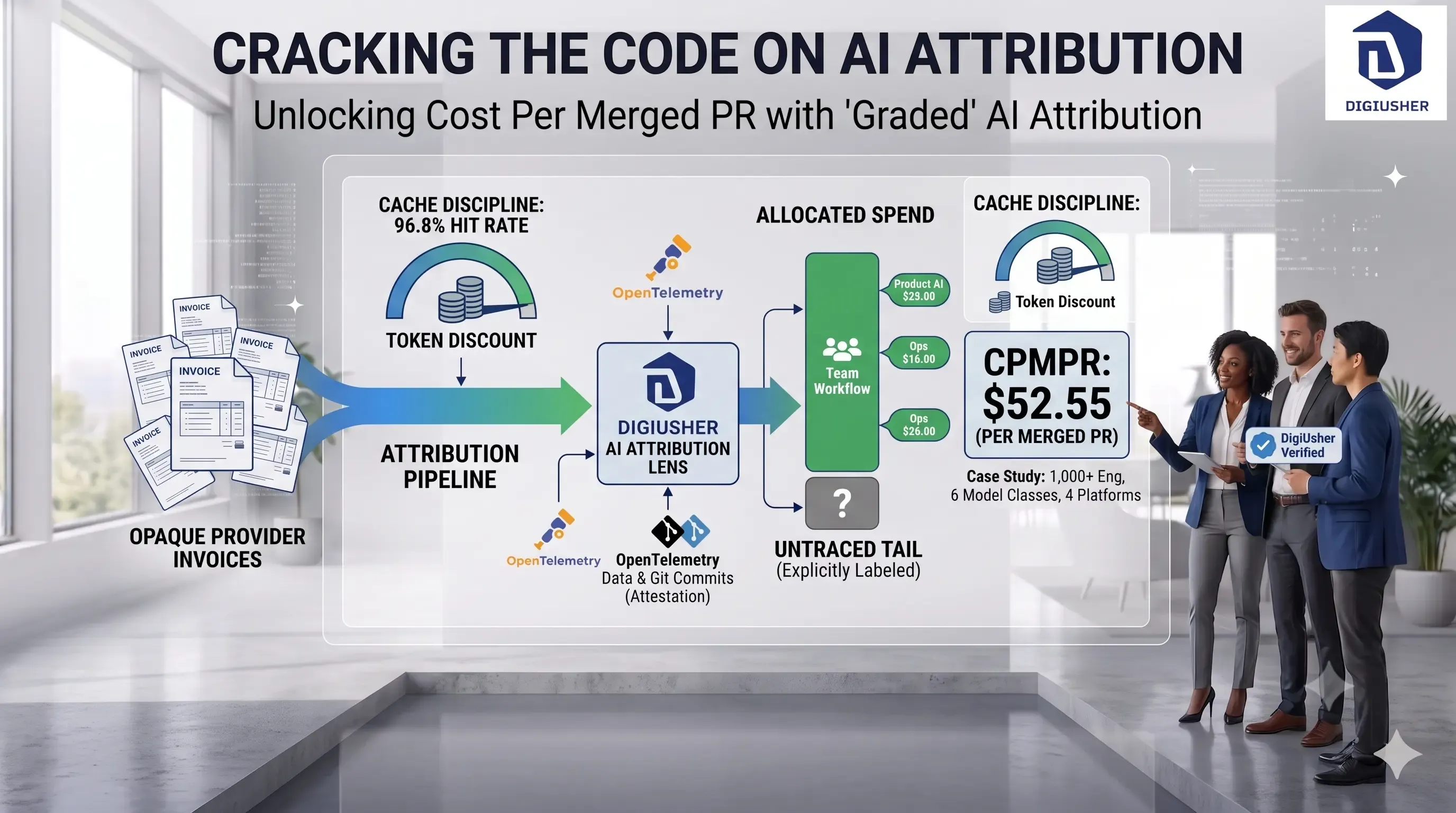
$52.55 Per Merged Pull Request: How One 1,000-Engineer Firm Priced Its Own AI Spend
A public technology firm with 1,000+ engineers refused to run its AI spend on faith. Here's the ledger it built instead — $52.55 per merged PR, 96.8% cache-hit rate, and a blended cost of $0.75 per million tokens.

AI Unit Economics: Why Your AI Invoice Can No Longer Answer the Board’s Question
98% of FinOps teams now manage AI spend, but almost none can price a merged pull request. Here's the framework for AI unit economics in 2026 — and why the invoice alone can't answer the board's question.
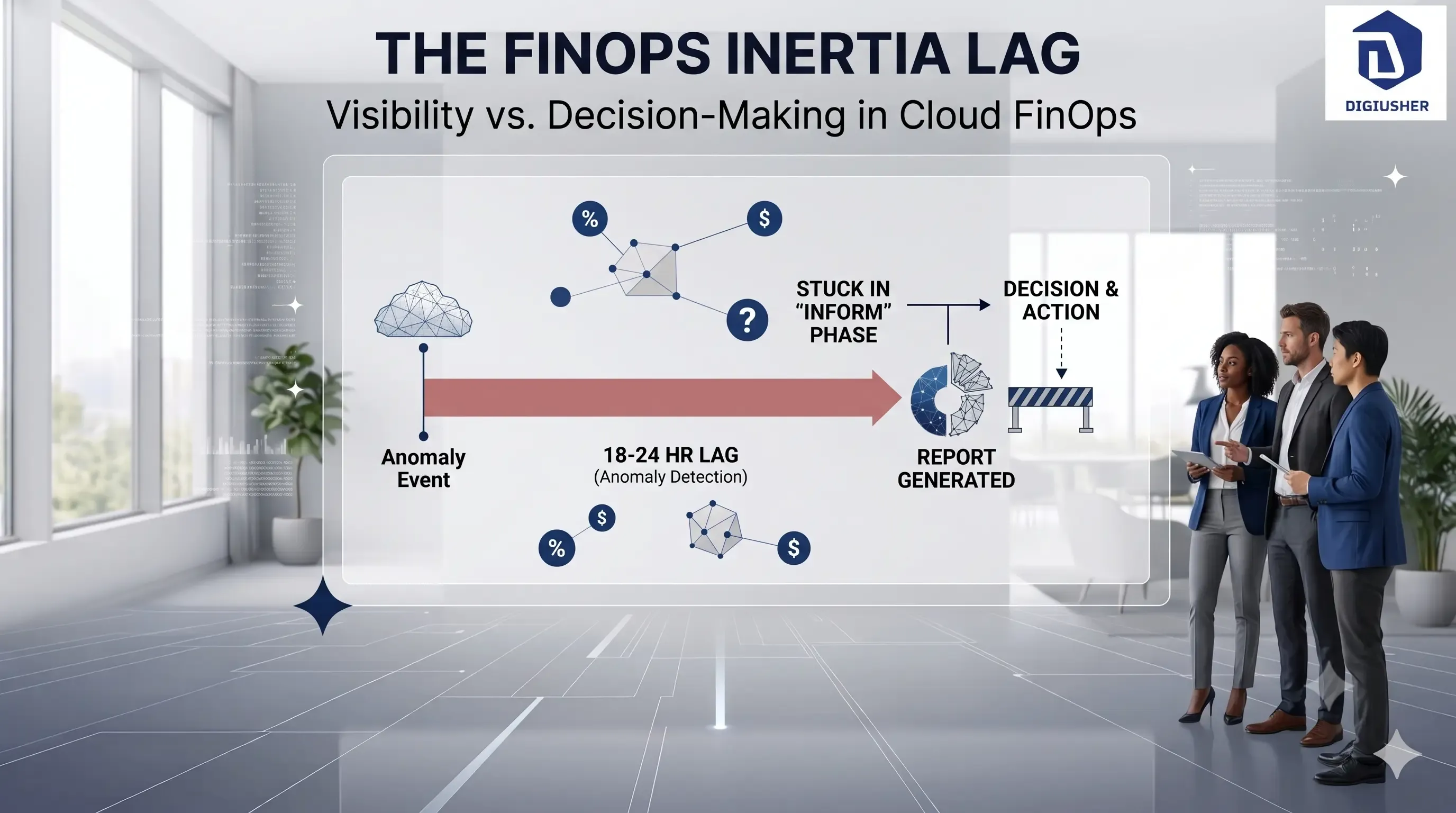
Most FinOps Programs Stall at "Inform" — and Never Reach Optimize
Visibility tools generate reports, not decisions. Legacy FinOps tools carry an 18-to-24-hour anomaly detection lag, according to the DigiUsher live TCO index — and that lag, not a lack of dashboards, is why most programs never leave the Inform phase.