EKS vs AKS vs GKE vs OKE: Cost Governance for Platform Teams
Platform teams running EKS, AKS, GKE, and OKE face radically different cost structures behind identical Kubernetes APIs. Control plane fees alone cost $8,760/year per 10-cluster estate on EKS versus zero on AKS. OKE runs serverless workloads at one-third the cost of EKS or AKS. This technical FinOps playbook breaks down real 2026 pricing, hidden cost drivers, platform-specific optimisation levers, and the unified governance model that no single native tool provides.

Executive Summary
Kubernetes has become the default platform layer for cloud and AI workloads. Platform teams are running estates across Amazon EKS, Azure AKS, Google GKE, and increasingly Oracle OKE — each offering essentially the same Kubernetes API while presenting radically different cost structures, financial governance models, and optimisation pathways underneath.
The cost differences are not marginal. They are structural:
- EKS charges $0.10/hr per cluster regardless of size — a 10-cluster platform estate pays $8,760/year in pure control plane overhead before a single pod runs. AKS eliminates this entirely on standard tier.
- OKE virtual nodes cost ~$4,512/month for a 20-pod production workload. EKS Fargate and AKS Virtual Nodes cost approximately $13,945–$13,954 for the same configuration. GKE Autopilot costs $15,282. OKE is one-third the price.
- 40–60% of compute spend is wasted across Kubernetes clusters due to overprovisioning — on every platform, regardless of which managed Kubernetes service is chosen.
- 65–70% of non-production compute hours are idle during nights and weekends on EKS, AKS, and GKE alike.
By 2029, Gartner projects that more than 95% of organisations will run containerised workloads in production — making Kubernetes cost governance a permanent enterprise financial discipline, not a temporary optimisation exercise.
At KubeCon Europe 2026 Platform Engineering Day, the message from practitioners was unambiguous: “We’ve solved developer experience. Now we must solve economic efficiency.” Platform teams are now measured on cost per workload, cluster efficiency, and GPU utilisation — alongside the traditional metrics of reliability and deployment frequency.
This playbook provides the real 2026 pricing data, hidden cost analysis, platform-specific optimisation levers, and the unified governance model needed to govern Kubernetes economics as a continuous financial discipline across all four platforms.
The Kubernetes Cost Problem — A Platform Engineering Lens
The foundational misunderstanding that generates most Kubernetes cost waste: Kubernetes abstracts infrastructure operations but does not abstract infrastructure cost.
When developers provision a namespace and deploy workloads through an IDP or kubectl, they interact with a consistent Kubernetes API that looks identical on EKS, AKS, GKE, and OKE. Behind that API, radically different billing architectures are generating costs across multiple independently billed dimensions:
Kubernetes Cost Components — What's Actually on Your Invoice
────────────────────────────────────────────────────────────
Component           EKS              AKS           GKE           OKE
────────────────────────────────────────────────────────────
Control Plane       $73/mo           Free           Free*         Free
Compute             EC2 instances    Azure VMs      GCE / Pods    OCI instances
Block Storage       EBS gp3          Managed Disk   PD SSD        OCI Block
Egress              $0.09/GB out     $0.025/hr LB   $0.085/GiB   Aggressive
Observability       CloudWatch       Azure Monitor  Cloud Logging External
Networking          NAT GW + AZ      VNet peering   Cloud NAT     Included
────────────────────────────────────────────────────────────
*GKE: free zonal cluster; $0.10/hr for regional/Autopilot
This fragmentation means platform teams making a workload placement decision — should this service run on EKS, AKS, or GKE? — are making a financial decision they may not have the data to evaluate correctly. The financial consequence of the wrong choice is measured in hundreds of thousands of pounds annually at enterprise scale.
Platform Cost Model Deep Dives
Amazon EKS: Flexibility at a Price
The headline: EKS delivers the deepest AWS ecosystem integration available in Kubernetes — and charges accordingly for the privilege of managing that complexity.
Control Plane Economics
EKS charges $0.10/hr per cluster (~$73/month) regardless of cluster size. Three nodes or three hundred nodes: same price. This flat fee has a compounding effect for platform teams operating multi-cluster architectures:
| Cluster Count | Monthly Control Plane Cost (EKS) | Annual Overhead | AKS Equivalent |
|---|---|---|---|
| 5 clusters | $365 | $4,380 | $0 |
| 10 clusters | $730 | $8,760 | $0 |
| 20 clusters | $1,460 | $17,520 | $0 |
| 50 clusters | $3,650 | $43,800 | $0 |
For a platform team running 10 clusters — production, staging, QA, per-team sandbox environments — AKS eliminates $8,760/year in pure control plane overhead that EKS charges before compute, storage, or networking costs a single dollar.
EKS also now offers an extended support tier for older Kubernetes versions that carries an additional charge — teams running version-stable enterprise applications face higher EKS bills if they maintain older control plane versions beyond standard support periods.
Compute and Storage
EKS compute runs on EC2 instances with pricing effectively identical to equivalent Azure VMs and GCE instances for on-demand capacity. The EKS advantage is in storage: EBS gp3 at $0.08/GB/month is the cheapest block storage of the three hyperscalers — approximately 53% cheaper than GCP Persistent Disk SSD ($0.17/GB/month) and approximately 30% cheaper than Azure Premium SSD ($0.113/GB/month) for a given capacity.
For data-heavy stateful workloads, the storage cost difference alone can justify EKS selection over GKE for large persistent volume estates.
The Hidden Cost Fragmentation Problem
EKS’s deepest FinOps challenge: cost spreads across multiple independently billed AWS services that native Kubernetes cost tools cannot attribute at the workload level.
A typical EKS production cluster bill:
- EC2 compute (primary cost)
- EBS volumes (persistent storage)
- Application Load Balancer or Network Load Balancer (one per Service by default)
- NAT Gateway (outbound traffic from private nodes)
- Cross-AZ data transfer (nodes to control plane, pod-to-pod cross-AZ)
- CloudWatch metrics and logs (observability)
- VPC Endpoints (if used for private cluster configuration)
One practitioner community insight that recurs consistently: “We’re spending more on the AWS ecosystem around EKS than on EKS compute itself.” The cluster compute is the visible cost. The ecosystem overhead is the actual financial driver.
EKS Optimisation Levers
Spot + Karpenter — Karpenter’s node autoprovisioner combined with Spot instances delivers the most cost-effective EKS configuration for fault-tolerant workloads. Spot discounts of 60–90% off on-demand rates, with Karpenter dynamically selecting the cheapest available instance type that satisfies workload requirements.
Graviton (ARM) — Graviton3 instances deliver approximately 20% better price-performance than equivalent x86 EC2 instances for compatible workloads. Platform teams migrating stateless microservices to ARM consistently report 15–25% compute cost reduction.
Savings Plans — Compute Savings Plans cover EC2, Fargate, and Lambda under a single commitment — more flexible than Reserved Instances. 1-year commitments deliver ~40% discount; 3-year commitments approach 72%.
Ingress consolidation — replacing per-Service Load Balancers with a shared ALB Ingress Controller eliminates per-LB hourly charges and can reduce networking cost by 40–60% on service-dense clusters.
Azure AKS: Enterprise Governance, Zero Control Plane Cost
The headline: AKS eliminates the control plane tax that EKS charges, integrates deeply with Microsoft enterprise governance tooling, and delivers the highest single commitment discount of the four platforms through Azure Hybrid Benefit.
Control Plane Economics
AKS standard tier: free control plane. Enterprise-grade Kubernetes cluster management with no per-cluster overhead. The standard tier is production-viable for most enterprise workloads — it lacks the guaranteed uptime SLA and advanced feature set of the premium tier ($0.60/hr, ~$438/month), but the majority of production platform estates run standard tier successfully.
The financial implication for multi-cluster estates is direct: the $8,760/year control plane overhead that a 10-cluster EKS estate generates disappears entirely on AKS standard tier. For a 50-cluster platform — common in large enterprises with per-team or per-environment cluster strategies — the annual saving is $43,800 before any compute optimisation.
Compute Discounts: The Azure Hybrid Benefit Advantage
AKS compute runs on Azure VMs with pricing comparable to equivalent EC2 and GCE instances at on-demand rates. The differentiation is in discounting:
- Azure Reservations: up to 72% discount for 3-year commitments — the highest headline commitment discount of the three hyperscalers for stable production workloads
- Azure Hybrid Benefit: organisations with existing Windows Server or SQL Server licences can apply those licences to Azure VMs, reducing effective compute cost by 40–50% without any additional commitment. For Microsoft-stack enterprises, this single benefit makes AKS compute materially cheaper than equivalent EKS workloads.
AKS Virtual Nodes (backed by Azure Container Instances) support burst capacity without node provisioning overhead — but at ~$13,954/month for a 20-pod workload, Virtual Nodes carry the same premium as EKS Fargate. OKE virtual nodes achieve the same serverless pattern at one-third the cost.
Hidden AKS Costs
Azure Monitor Container Insights is the most consistently underestimated AKS cost. Log ingestion is billed by data volume to Log Analytics — a microservices cluster with verbose logging can generate Monitor costs that rival compute. Teams accepting the default Azure Monitor configuration without ingestion controls routinely discover Monitor costs of $5,000–$15,000/month on large clusters.
Recommended mitigation: set Log Analytics workspace retention policies, configure sampling on verbose log sources, and use Azure Monitor workspace capacity reservations for high-volume clusters.
AKS Optimisation Levers
KEDA (Kubernetes Event-Driven Autoscaling) — scale workloads on application-specific metrics (queue depth, message count, HTTP request rate) rather than CPU/memory. For event-driven microservices, KEDA consistently achieves better cost efficiency than HPA on resource metrics.
Vertical Pod Autoscaler (VPA) — AKS native VPA support for workload rightsizing. Combined with Azure Monitor data, VPA recommendation mode surfaces rightsizing opportunities without requiring manual resource request analysis.
Node pool cost tiering — separate node pools for spot (fault-tolerant workloads), standard (general production), and GPU (AI workloads) with independent scaling and pricing policies per pool.
Google GKE: Efficiency-First, Two Pricing Philosophies
The headline: GKE has the most advanced Kubernetes autoscaling and bin-packing capabilities of the four platforms, but presents two fundamentally different cost models (Standard vs. Autopilot) that require explicit architectural decisions — not defaults.
Control Plane Economics
GKE Standard mode: one free zonal cluster per billing account. Additional zonal or regional clusters: $0.10/hr (~$73/month). For production estates requiring high availability through regional clusters, most clusters carry the $0.10/hr charge — equivalent to EKS.
GKE Autopilot: $0.10/hr per cluster plus pod-level billing ($0.0445/vCPU-hr, $0.0049225/GiB-hr). Autopilot eliminates node management overhead but creates forecast complexity: pod resource requests directly determine compute billing, making cost prediction sensitive to over-requested workloads.
For the Oracle benchmark workload (20 pods × 16vCPU × 64GiB, 31 days):
GKE Autopilot: $15,282/month
EKS Fargate:   $13,945/month  (~9% cheaper than GKE Autopilot)
AKS VirtualN:  $13,954/month  (~9% cheaper than GKE Autopilot)
OKE VirtualN:   $4,512/month  (~3.4× cheaper than GKE Autopilot)
The Storage Cost Reality
GKE’s most significant hidden cost: Persistent Disk SSD at $0.17/GB/month — 112% more expensive than EBS gp3 ($0.08/GB/month) for the same capacity. For a cluster with 10 nodes each running 100GB persistent volumes:
Annual storage cost comparison (10 × 100GB PVs):
GKE Persistent Disk SSD:  $2,040/year
Azure Premium SSD:         $1,356/year
AWS EBS gp3:               $960/year
Δ GKE vs EKS per cluster: +$1,080/year — pure storage overhead
GKE’s Hyperdisk Balanced ($0.084/GB/month) closes most of this gap with EBS, but requires explicit configuration — teams accepting the default Persistent Disk SSD provisioner pay the premium automatically.
GKE Optimisation Levers
Committed Use Discounts (CUDs) — up to 57% — GKE CUDs apply to the underlying GCE compute, reducing per-vCPU and per-GB costs for stable production workloads. Unlike Reserved Instances on AWS, CUDs are more flexible — they apply across all instances in a region, not to specific instance types. The additional advantage: sustained use discounts apply automatically to instances running more than 25% of the month with no reservation required.
GKE Standard + aggressive bin-packing — the canonical GKE cost optimisation pattern. Standard mode with the Cluster Autoscaler configured for aggressive scale-down, balanced with CUDs on the stable compute baseline. Autopilot for burst workloads that require rapid scale-out without managing node pools.
Preemptible/Spot VMs — 60–91% off on-demand for fault-tolerant batch workloads (ML training jobs, data processing pipelines). GKE’s integration with Vertex AI workloads makes this particularly effective for AI training cost reduction.
MIG (Multi-Instance GPU) partitioning — GKE has the most mature native GPU governance of the four platforms: MIG partitioning allows a single A100 GPU to serve multiple independent inference workloads simultaneously, directly addressing the 20–35% average GPU utilisation problem.
Oracle OKE: The Cost Disruptor
The headline: OKE is the most aggressive cost position in managed Kubernetes — serverless workloads at one-third the price of EKS/AKS and 3.4× cheaper than GKE Autopilot — with real trade-offs in ecosystem maturity that enterprise platform teams must evaluate explicitly.
The Serverless Cost Case
The Oracle Cloud Infrastructure benchmark for 20 pods × 16vCPU × 64GiB × 31 days:
| Platform | Monthly Cost | vs. OKE |
|---|---|---|
| OKE Virtual Nodes | ~$4,512 | — |
| EKS + Fargate | ~$13,945 | 3.1× more expensive |
| AKS Virtual Nodes | ~$13,954 | 3.1× more expensive |
| GKE Autopilot | ~$15,282 | 3.4× more expensive |
Note: Oracle uses OCPU pricing (1 OCPU = 2 vCPUs) — these comparisons reflect equivalent compute capacity, not equivalent instance type names.
The OKE advantage is consistent across all OCI regions — a meaningful distinction from AWS and GCP, where regional pricing variation can be dramatic:
- AWS Fargate prices in São Paulo are 72% higher than US East (Northern Virginia)
- AKS Virtual Node CPU prices in Brazil South are 100% higher than East US
- OKE: consistent pricing across all regions — no regional premium penalty
The Ecosystem Maturity Trade-off
OKE’s lower total cost comes with ecosystem constraints that enterprise platform teams must evaluate honestly:
Where OKE is production-ready: core Kubernetes workloads, Oracle database integration, cost-sensitive applications where ARM compute compatibility is achievable, and workloads with no dependency on AWS/Azure/GCP-specific managed services.
Where OKE requires investment: enterprise observability tooling (no native equivalent to CloudWatch, Azure Monitor, or Cloud Logging at production scale), ISV and partner ecosystem integrations, GPU workload governance maturity, and enterprise marketplace distribution.
For platform teams evaluating OKE as a cost reduction strategy, the relevant question is not “is OKE cheaper?” (it is, materially) but “what is the engineering cost of the ecosystem maturity gap?” For many workloads, the answer makes OKE economically compelling. For workloads deeply integrated with hyperscaler managed services, the migration investment may exceed the compute saving.
OKE Optimisation Levers
ARM compute (Ampere A1) — OCI Ampere A1 cores are among the most cost-effective ARM compute available in any cloud. For compatible workloads, Ampere A1 delivers 50%+ cost reduction versus x86 OCI compute. Combined with OKE’s already-low pricing, ARM workloads on OKE can achieve economics unavailable on any other platform.
Simplified pricing model — OKE’s pricing simplicity is itself an optimisation lever: fewer billing dimensions mean fewer places for untracked costs to accumulate. Platform teams spending significant FinOps effort reconciling EKS service fragmentation find OKE’s model dramatically reduces governance overhead.
Comparative Cost Governance Matrix
| Dimension | EKS | AKS | GKE | OKE |
|---|---|---|---|---|
| Control Plane Cost | $73/mo per cluster | Free (Standard) | Free / $73/mo | Free |
| 10-Cluster Annual Overhead | $8,760 | $0 | $0–$8,760 | $0 |
| Block Storage Rate | $0.08/GB/mo (gp3) | $0.113/GB/mo | $0.17/GB/mo | Competitive |
| Serverless Workloads | ~$13,945/mo† | ~$13,954/mo† | ~$15,282/mo† | ~$4,512/mo† |
| Max Commitment Discount | 72% (RI 3yr) | 72% (Reservations) | 57% (CUDs) | Universal Credits |
| Ecosystem Maturity | Highest | High | High | Lower |
| FinOps Complexity | High | Medium | Medium-High | Low |
| GPU Governance | Strong | Integrated | Most Advanced | Emerging |
| AI Platform Integration | Bedrock | Azure OpenAI | Vertex AI | Limited |
| Best For | AWS-native depth | Enterprise/Microsoft | Efficiency/ML | Cost-first |
GKE: 1 free zonal cluster/account; regional clusters $0.10/hr †Based on Oracle benchmark: 20 pods × 16vCPU × 64GiB × 31 days, US East lowest published rates
Hidden Cost Drivers Platform Teams Systematically Miss
Five cost categories consistently surprise platform teams across all four managed Kubernetes services — and none of them appear in initial architecture cost models.
1 — Overprovisioning: 40–60% of Compute Spend
The most expensive Kubernetes mistake is not platform selection. It is operating clusters at 40–60% efficiency by default and never measuring or correcting it.
CPU and memory requests set at project inception persist for the lifetime of the workload unless actively reviewed. A service that requested 4 CPUs at launch runs on 4 CPUs at production scale even if actual peak usage is 1.2 CPUs. Multiplied across hundreds of services in a microservices estate, overprovisioning generates the equivalent of running 40–60% of the cluster for free — for someone else.
The fix is not platform migration. The fix is workload-level utilisation measurement and VPA-driven rightsizing, deployed as a platform capability rather than a periodic FinOps review exercise.
2 — Idle Non-Production Compute: 65–70% of Non-Prod Hours
Staging, QA, and development clusters run 24 hours per day, 7 days per week on EKS, AKS, GKE, and OKE alike. Developers work 8 hours per day, 5 days per week. The math: 65–70% of non-production compute hours generate cost with no corresponding developer productivity.
This waste pattern is universal — it does not change between platforms. Switching from EKS to AKS eliminates the $73/month control plane charge per idle cluster. It does not eliminate the compute running on idle nodes.
The saving from non-production scheduling (automated shutdown at 18:00, restart at 08:00, no weekends) typically exceeds the saving from commitment discount optimisation. It is also easier to implement: a platform-level CronJob or environment TTL controller, deployed once, saves continuously.
3 — Networking: The Second-Largest Cost Nobody Models
Network costs are systematically absent from initial Kubernetes architecture cost estimates and systematically present in production invoices. Three mechanisms:
Cross-AZ data transfer (EKS-specific, but AKS/GKE have equivalents): pods on different availability zones generate data transfer charges for every inter-pod call. A microservices architecture making 10,000 service-to-service calls per minute, with 30% crossing AZ boundaries, accumulates cross-AZ charges that rival compute cost at scale.
Load balancer proliferation: Kubernetes defaults to provisioning one cloud load balancer per Service of type LoadBalancer. A cluster with 50 services has 50 load balancers, each with an hourly minimum charge. Ingress consolidation — one shared Ingress controller routing to all services — can eliminate 80% of per-LB charges.
Observability data volume: CloudWatch on EKS, Azure Monitor on AKS, and Cloud Logging on GKE all bill by data ingested. Default verbosity settings on verbose microservices can generate observability costs exceeding $10,000/month on large clusters — routinely identified as the largest surprise cost on Kubernetes platform invoices.
4 — GPU Underutilisation: AI Is Breaking Cost Models
The fastest-growing cost driver across all four platforms: GPU node pools provisioned for AI workloads running at 20–35% average utilisation — meaning 65–80% of expensive GPU capacity ($3–12/GPU-hr at hyperscaler rates) is idle at any given moment.
Platform teams that governed CPU workload cost effectively for years are discovering that the same governance frameworks do not apply to GPU-accelerated AI inference. Token-based pricing for Azure OpenAI, Bedrock, and Vertex AI running on Kubernetes generates non-linear cost growth that CPU cost models cannot predict or govern.
GKE has the most mature native response: MIG (Multi-Instance GPU) partitioning allows a single A100 or H100 GPU to run multiple independent inference workloads simultaneously, directly addressing the underutilisation problem. AKS provides integrated Azure ML and OpenAI governance. EKS requires more manual governance configuration but has strong GPU support. OKE is in emerging phase for production AI GPU governance.
Why Native Platform Tools Are Not Enough
Each platform provides cost visibility within its own billing ecosystem:
- AWS Cost Explorer + Cost Allocation Tags — strong for AWS-native attribution, but requires significant tag governance discipline; cannot attribute Kubernetes workload cost below the node level without third-party tooling
- Azure Cost Management + Container Insights — strong integration with Azure Monitor; Monitor ingestion costs can exceed governance value for large clusters
- GKE Cost Attribution — per-namespace cost breakdown available natively; cross-cluster visibility requires third-party integration
- OCI Cost Analysis — relatively straightforward due to simpler pricing model; limited Kubernetes-specific cost tooling
What none of them provide:
Native Tool Capability Gaps
─────────────────────────────────────────────────────────────────
Capability                    EKS        AKS        GKE        OKE
─────────────────────────────────────────────────────────────────
Cross-cloud normalisation      ✗          ✗          ✗          ✗
Pod-level cost attribution     Partial    Partial    Partial    ✗
AI token cost attribution      ✗          ✗          ✗          ✗
Real-time GPU utilisation/cost ✗          Partial    Partial    ✗
Cross-platform commit mgmt     ✗          ✗          ✗          ✗
FOCUS 1.x normalisation        ✗          ✗          ✗          ✗
Business outcome mapping       ✗          ✗          ✗          ✗
─────────────────────────────────────────────────────────────────
Platform teams operating across two or more of these platforms — the typical enterprise multi-cloud pattern — face a fragmented cost view that requires manual reconciliation across incompatible billing schemas. A FinOps team producing a monthly cross-cluster cost report from four platforms is spending engineering time on data normalisation that should be automated.
The FinOps Model for Platform Teams
Leading platform teams in 2026 are implementing five governance capabilities across their Kubernetes estate — regardless of which platforms they operate on:
1 — Workload-Level Cost Attribution
Cost attribution at the namespace, service, and team level — not just the cluster level. A cluster-level cost of $50,000/month is a billing number. A namespace-level breakdown showing which team and which product is generating each portion of that cost is actionable intelligence.
Implementation: consistent labelling taxonomy (team, product, environment, cost-centre) enforced at namespace creation through IDP admission controls or GitOps policy. Labels applied at provisioning time — not as a retrospective cleanup campaign.
2 — Cross-Cloud Cost Normalisation to FOCUS 1.x
EKS generates EC2, EBS, Load Balancer, NAT Gateway, and CloudWatch billing in separate AWS Cost and Usage Report line items. AKS generates VM, Managed Disk, Monitor, and networking billing in Azure Cost Management. GKE generates GCE, PD, Cloud Logging, and Autopilot pod billing in GCP billing exports.
FOCUS (FinOps Open Cost and Usage Specification) normalises all four schemas into a unified cost model enabling cross-platform comparison, unified attribution, and consistent forecasting. Without FOCUS normalisation, cross-platform cost comparison is a manual reconciliation exercise — not a governance capability.
3 — Cost-Aware Scheduling and Placement
Workload placement decisions informed by platform cost data: which cluster and which node pool minimises cost for a given workload’s requirements? Integrating platform-normalised cost signals into IDP service templates surfaces cost implications of placement decisions at provisioning time — when the decision is made — rather than in monthly billing reports.
4 — GPU Cost Governance
Per-GPU-node-pool utilisation monitoring with automated scale-down at configurable idle thresholds. Token budget enforcement for AI API workloads running on Kubernetes. MIG partitioning recommendations for underutilised A100/H100 nodes. Agentic AI workflow attribution per chain.
GPU governance cannot be retrofitted from general Kubernetes cost governance. It requires AI-specific telemetry, non-linear cost modelling, and governance triggers that operate at minutes-of-idle granularity — not monthly billing review.
5 — Real-Time Continuous Optimisation
Rightsizing recommendations surfaced continuously — not as a quarterly report that competes with delivery priorities for engineering bandwidth. Non-production environment scheduling enforced as a platform capability, not as an advisory. Commitment coverage optimised across EKS Savings Plans, AKS Reservations, GKE CUDs, and OKE Universal Credits from a unified commitment management view.
DigiUsher: A Unified FinOps Layer Across EKS, AKS, GKE, and OKE
Platform teams need a single source of truth for Kubernetes cost that spans platforms, operates in real time, and produces the workload-level attribution that board-ready ROI reporting requires. Native billing tools, one per platform, do not provide this. Switching between EKS cost dashboards, Azure Cost Management, GKE cost attribution, and OCI Cost Analysis is four separate governance workflows that produce four incomparable data formats.
DigiUsher’s FinOps Operating System provides the unified Kubernetes cost governance layer:
Multi-platform unified visibility — EKS, AKS, GKE, and OKE cost data normalised to FOCUS 1.x in a single attributed view. Cross-platform cost comparison, cluster efficiency benchmarking, and workload-level attribution across all four platforms without manual reconciliation.
Workload-level cost attribution — namespace, service, and team-level cost attribution across all platforms — not just cluster-level billing aggregation. The attribution granularity that enables FinOps chargeback, engineering accountability, and product-level ROI analysis.
AI and GPU cost governance — GPU utilisation monitoring per node pool with automated scale-down triggers. Token budget enforcement for Azure OpenAI, Bedrock, and Vertex AI workloads running on Kubernetes. Per-workflow agentic cost attribution. The governance layer that native Kubernetes cost tools do not provide for AI economics.
Platform-specific optimisation intelligence — Spot + Karpenter signals for EKS, Azure Hybrid Benefit analysis for AKS, GKE CUD coverage recommendations, OKE ARM compute compatibility analysis — all surfaced from a unified cost governance interface.
Real-time anomaly detection and alerts — cost patterns diverging from baselines trigger alerts before they appear in monthly invoices. Idle resource detection. Non-production environment scheduling opportunities. Commitment coverage gaps.
Available as SaaS or BYOC for regulated industries. SOC 2® Type II and GDPR certified. Delivered globally through Infosys, Wipro, and Hexaware. AWS ISV Accelerate Partner listed on AWS Marketplace.
Kubernetes standardises how infrastructure is consumed. It does not standardise what that consumption costs. Platform choice influences financial outcomes more than most teams realise — but overprovisioning, idle compute, and ungoverned AI workloads cost more than platform differences on any single cloud. The winning platform teams in 2026 are not just multi-cloud. They are multi-cloud, cost-governed, and FinOps-driven.
Frequently Asked Questions
What is the real cost difference between EKS, AKS, GKE, and OKE in 2026?
The differences are structural and material. Control plane: EKS $73/month per cluster, AKS free, GKE free for standard zonal, OKE free. Serverless workloads (20 pods × 16vCPU × 64GiB): OKE ~$4,512/month, EKS Fargate ~$13,945, AKS Virtual Nodes ~$13,954, GKE Autopilot ~$15,282. Block storage: EBS gp3 $0.08/GB/month, Azure Premium SSD $0.113/GB/month, GCP Persistent Disk SSD $0.17/GB/month (112% more than EBS). Universal waste: 40–60% compute overprovisioning and 65–70% idle non-production hours apply to all four platforms equally.
Which Kubernetes platform is cheapest?
Cheapest depends on workload type. For serverless workloads: OKE at approximately one-third the cost of EKS/AKS and 3.4× cheaper than GKE Autopilot. For multi-cluster estates: AKS eliminates $8,760/year control plane overhead per 10 clusters vs. EKS. For storage-heavy workloads: EKS with EBS gp3 at $0.08/GB/month significantly undercuts GKE at $0.17/GB/month. For Microsoft-stack enterprises: AKS with Azure Hybrid Benefit delivers the highest effective discount. For AI/ML: GKE with Vertex AI integration and MIG GPU partitioning. Overprovisioning and idle compute savings universally exceed platform switching savings.
What hidden costs do platform teams miss on Kubernetes?
Five categories: cross-AZ and cross-region network egress; load balancer proliferation (one per Service rather than shared Ingress); observability data volume (CloudWatch, Azure Monitor, Cloud Logging billed per GB ingested, can exceed compute cost); non-production idle compute (65–70% of non-prod hours wasted nights/weekends); and GPU underutilisation on AI workloads (20–35% average utilisation means 65–80% idle at hyperscaler GPU rates).
What did KubeCon Europe 2026 reveal about platform team cost accountability?
Three shifts: platform teams are now measured on cost per workload, cluster efficiency, and GPU utilisation alongside reliability and deployment frequency. AI workloads are breaking traditional cost governance models — GPU-driven inference costs are non-linear and unpredictable in ways CPU cost models cannot govern. The community is explicitly moving from portability as the primary multi-cloud value proposition toward efficiency — “multi-cloud portability is easy; cost efficiency is not” was a recurring theme.
What optimisation discounts are available on EKS, AKS, GKE, and OKE?
EKS: EC2 Savings Plans and Reserved Instances up to 72%, Spot instances 60–90% off. AKS: Azure Reservations up to 72%, Azure Hybrid Benefit (bring existing Windows/SQL licences) 40–50% additional. GKE: CUDs up to 57%, sustained use discounts automatic, Spot/Preemptible 60–91% off. OKE: Universal Credits, Ampere A1 ARM compute 50%+ reduction for compatible workloads, consistent pricing across all regions.
How should platform teams implement cost attribution across multiple Kubernetes platforms?
Five requirements: consistent namespace labelling taxonomy enforced at provisioning (not applied retrospectively); FOCUS 1.x normalisation converting all four billing schemas to a unified model; pod and namespace-level attribution beyond cluster billing aggregation; automated showback and chargeback without FinOps team manual effort; and real-time anomaly detection surfacing cost deviations before monthly invoices.
How does DigiUsher’s FinOps OS govern Kubernetes across EKS, AKS, GKE, and OKE?
Unified FOCUS 1.x normalisation of all four platforms’ billing into a single cost view; workload-level attribution at namespace, service, and team level across all platforms; AI and GPU governance with per-node-pool utilisation monitoring, automated scale-down triggers, and token budget enforcement; platform-specific optimisation signals (Karpenter/Spot for EKS, Azure Hybrid Benefit for AKS, CUD coverage for GKE, ARM analysis for OKE); and real-time anomaly detection across the full multi-cloud Kubernetes estate.
References
- Oracle Cloud Infrastructure — Serverless Kubernetes Costs: EKS, AKS, GKE, OKE Benchmark
- Zop.dev — AWS vs Azure vs GCP Pricing in 2026: Compute, Storage, and Network Compared
- Sedai — Kubernetes Pricing 2026: EKS vs AKS vs GKE Comparison Guide
- AWS — Amazon EKS Pricing (official)
- Intercept.cloud — The True Cost of Managed Kubernetes: AKS vs EKS vs GKE
- OneUptime — How to Compare Managed Kubernetes Pricing Across AWS, GCP, Azure (2026)
- PolicyAsCode.dev — Kubernetes Cost: AWS vs GCP vs Azure
- Naviteq.io — Managed Kubernetes Compared: OKE vs EKS vs GKE vs AKS
- Sealos — Calculating Kubernetes Costs: EKS, GKE, and AKS Pricing Models
- Microsoft Learn — Cost Management: EKS to AKS Migration
- Gartner — Containerised Workloads: 95% Adoption Forecast by 2029
- CNCF — Platform Engineering Day Europe 2026 Proceedings
- FinOps Foundation — FOCUS Specification
Govern Your Kubernetes Estate Across All Four Platforms
Platform choice shapes financial outcomes more than most platform teams realise. But the overprovisioning waste, idle non-production compute, and ungoverned AI workloads that drain 40–60% of Kubernetes spend exist on every platform — and fixing them delivers more value than switching providers.
DigiUsher’s FinOps OS gives platform teams the unified cost governance layer across EKS, AKS, GKE, and OKE that no single native billing tool provides — real-time workload attribution, AI and GPU governance, cross-platform commitment optimisation, and board-ready ROI reporting from a single source of truth.
DigiUsher in 30 min
Track every namespace cost without a spreadsheet.
DigiUsher attributes shared cluster spend down to the namespace and workload, across every cloud you run.
Book a 30-min walkthroughNo hard pitch · tailored to your stack
Continue Reading
More from the DigiUsher editorial team.
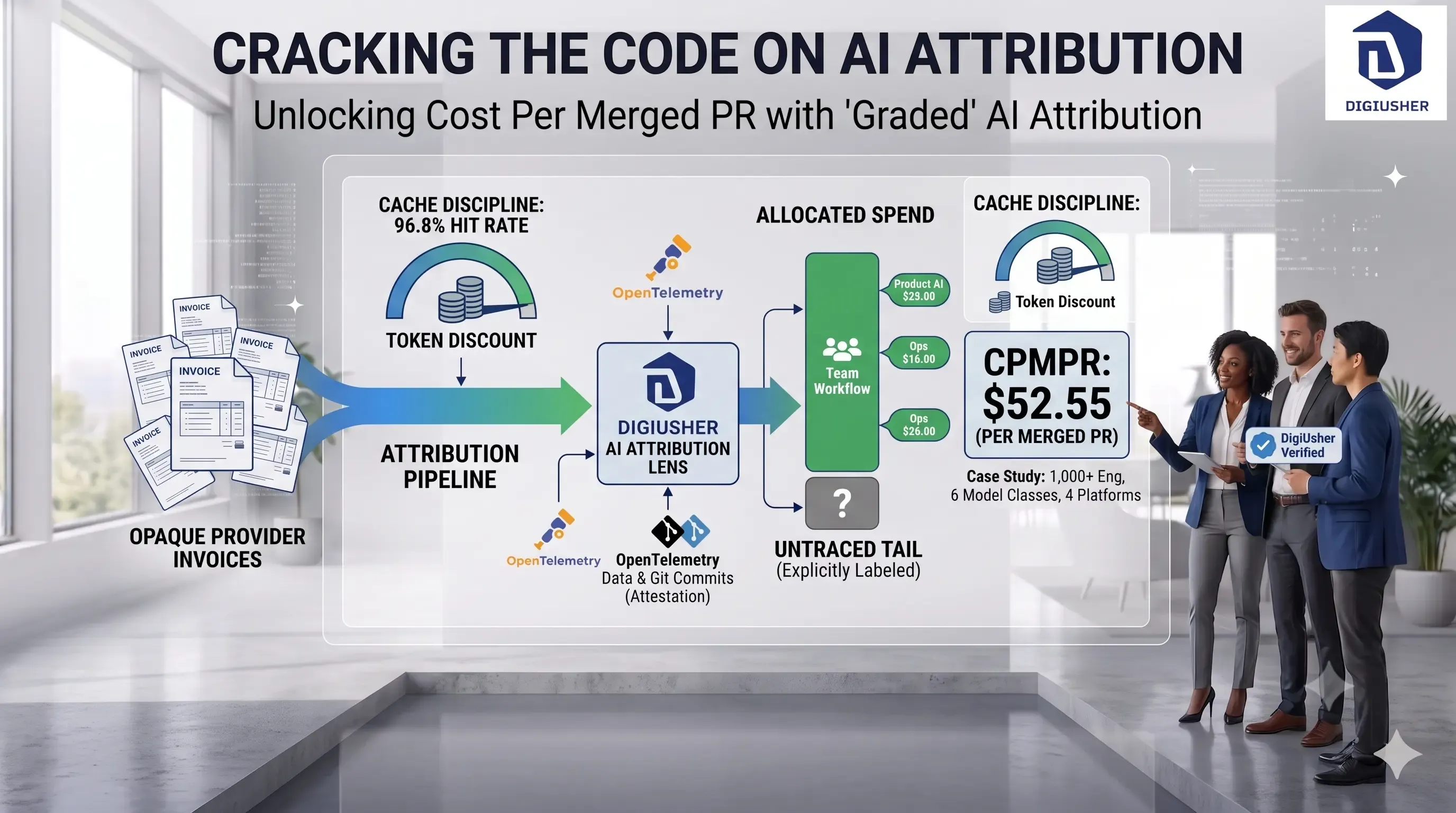
$52.55 Per Merged Pull Request: How One 1,000-Engineer Firm Priced Its Own AI Spend
A public technology firm with 1,000+ engineers refused to run its AI spend on faith. Here's the ledger it built instead — $52.55 per merged PR, 96.8% cache-hit rate, and a blended cost of $0.75 per million tokens.

AI Unit Economics: Why Your AI Invoice Can No Longer Answer the Board’s Question
98% of FinOps teams now manage AI spend, but almost none can price a merged pull request. Here's the framework for AI unit economics in 2026 — and why the invoice alone can't answer the board's question.
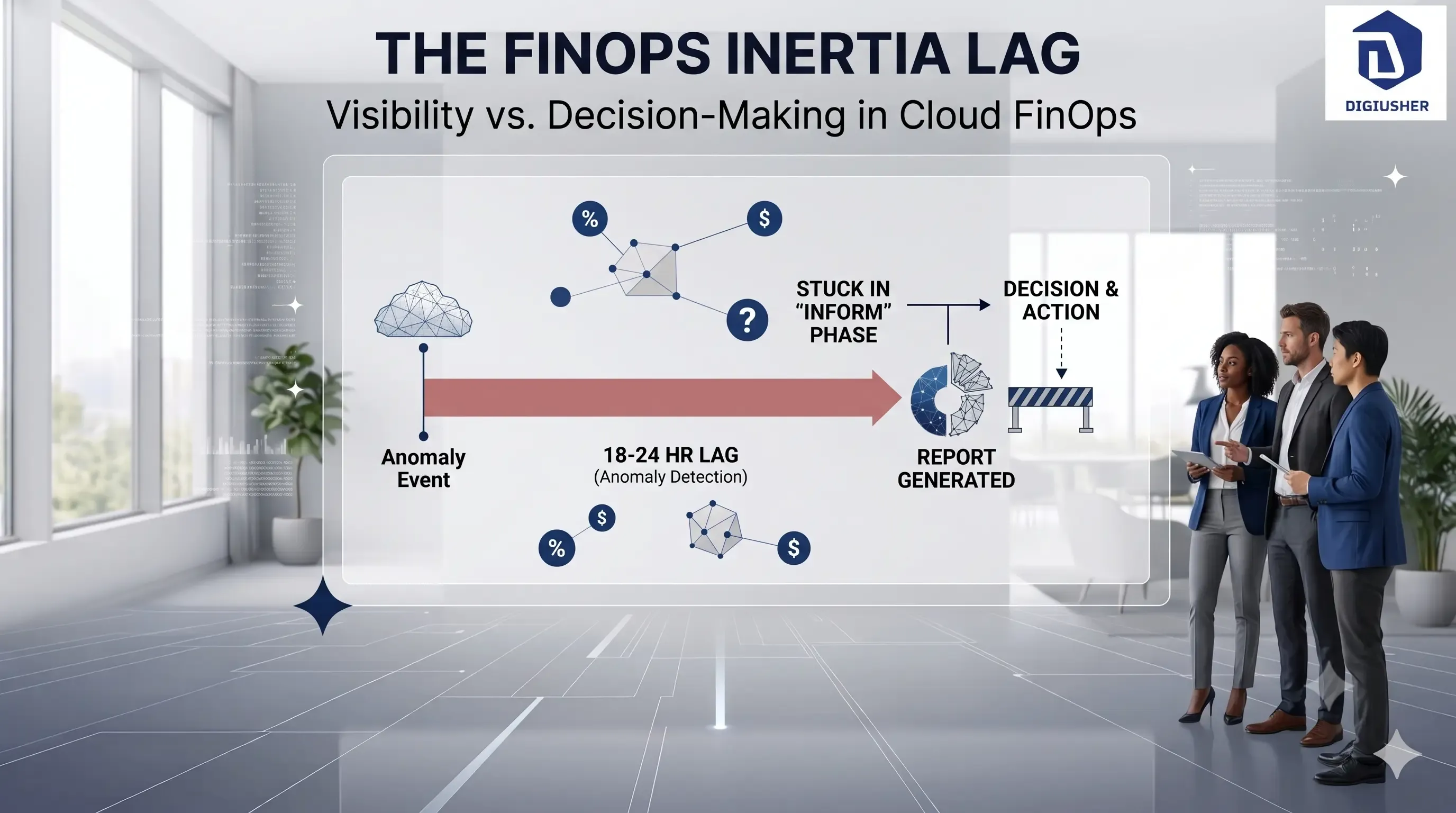
Most FinOps Programs Stall at "Inform" — and Never Reach Optimize
Visibility tools generate reports, not decisions. Legacy FinOps tools carry an 18-to-24-hour anomaly detection lag, according to the DigiUsher live TCO index — and that lag, not a lack of dashboards, is why most programs never leave the Inform phase.