DealFlow: From Reactive AWS Cost Management to a Proactive Culture of Accountability
DealFlow — a Copenhagen-based fintech building the world's first autonomous AI financial assistant for founders and finance teams — had a paradox at its core: a platform purpose-built to give businesses financial clarity had no cost clarity over its own AWS infrastructure. This is how DigiUsher's FinOps OS transformed DealFlow's AWS governance from reactive invoice analysis to a proactive, engineering-embedded culture of cost accountability
At a Glance
| Customer | DealFlow |
| Headquarters | Copenhagen, Denmark |
| Industry | Fintech / Financial SaaS |
| Founded | 2021 |
| Cloud estate | AWS (primary) |
| Use case | AWS cost governance, developer cost visibility, proactive anomaly detection |
| CTO | Siddharth Mudgal, Co-Founder |
| CEO | Seb Haugeto, Co-Founder |
Results at a Glance
| Dimension | Before DigiUsher | After DigiUsher |
|---|---|---|
| Cost attribution | Aggregate monthly billing | Granular service-level and feature-level attribution tied to business KPIs |
| Developer visibility | No cost access | Real-time dashboards and anomaly alerts in engineering workflow |
| Anomaly detection | Monthly invoice review | Proactive continuous monitoring with real-time alerts |
| Cost management posture | Reactive | Proactive |
| Team accountability | Absent | Culture of accountability embedded in engineering |
About DealFlow
DealFlow is a Copenhagen-based fintech startup on a mission to give business owners financial superpowers.
Founded in 2021 by CEO Seb Haugeto and CTO Siddharth Mudgal, DealFlow is building one of the most ambitious fintech visions in the Nordic startup ecosystem: the world’s first autonomous AI financial assistant — a digital employee that can assist entrepreneurs, CFOs, and finance teams with any financial task from day one.
The platform already delivers tangible financial infrastructure for global online businesses: free international transfers, instant payouts, cashflow automation, integrated accounting reconciliation, and payment flow orchestration — all in a single cloud-native product that competes with incumbent invoicing platforms on simplicity and global reach.
The ambition behind the product matches the market opportunity. After their €500K seed round in June 2024, DealFlow’s waitlist grew by 14,000%. More than 100 companies signed up to disclose the monthly transaction volume they intended to process through the platform before it launched. Investors who backed DealFlow at one of the highest pre-seed valuations in the Nordics described the founders as possessing “the necessary qualities to establish a disruptive, globally relevant fintech venture.”
DealFlow’s goal is to eventually become the world’s first autonomous financial assistant — a digital employee based on artificial intelligence that can assist entrepreneurs, CFOs, and companies with any conceivable financial task from day one.
This ambition creates a specific internal challenge: a team building proactive financial intelligence tools for others must govern its own cloud infrastructure with the same proactive discipline its product promises to deliver.
The Challenge: A Financial Platform With No Visibility Into Its Own Cloud Costs
There is a pointed irony at the centre of DealFlow’s pre-DigiUsher situation.
DealFlow’s product exists to give business owners real-time financial clarity — instant visibility into cashflow, automated reconciliation, proactive payment intelligence. The founding thesis is that financial opacity is a solvable problem, and that solving it creates competitive advantage for every business that achieves it.
Before DigiUsher, DealFlow’s own AWS infrastructure was financially opaque.
Monthly AWS invoices arrived as aggregated charges. The engineering team — the same team building an AI-powered financial assistant — made infrastructure decisions without cost signal. Cost anomalies accumulated invisibly until the monthly billing cycle surfaced them, too late to address at the moment they could have been prevented.
The paradox was not lost on DealFlow’s CTO.
Three Governance Gaps
Gap 1 — Limited Visibility Into AWS Costs and Their Relation to Business KPIs
DealFlow’s AWS infrastructure serves every financial transaction the platform processes — every invoice, every cross-border payment, every automated reconciliation. The cost of serving that infrastructure is real, ongoing, and proportional to product usage. But the AWS bill did not make that relationship legible.
The Visibility Problem DealFlow Faced
──────────────────────────────────────────────────────────────
What the AWS bill showed:    What DealFlow needed to know:
────────────────────────     ─────────────────────────────────
EC2: £X,XXX/month            Payment processing cost per
RDS: £XXX/month              transaction volume: £?
Lambda: £XXX/month           Invoice generation pipeline cost: £?
S3: £XXX/month               Customer onboarding cost per user: £?
Data Transfer: £XXX/month    Cloud cost as % of revenue: £?

AWS native billing:          ANSWERS NONE OF THE ABOVE.
──────────────────────────────────────────────────────────────
For a fintech startup where every product decision is simultaneously an infrastructure decision, this attribution gap meant that the cost implications of product choices were invisible at the time the choices were made.
Gap 2 — Developers Lacked Clear Access to Cost Information
DealFlow’s engineering team built and operated the AWS infrastructure. Every code commit, every service configuration, every environment decision had a cost consequence. But the engineers making these decisions had no mechanism to see those consequences at decision time.
The structural problem: AWS Cost Explorer, the native billing tool, is a finance dashboard — not an engineering tool. It is accessed by whoever reviews the monthly invoice, not by the developers making the architectural decisions that determine what that invoice contains.
When cost information lives in finance dashboards and arrives in monthly reports, it cannot influence engineering decisions that were made three weeks earlier.
A lean startup team cannot afford the dedicated FinOps analyst who would traditionally translate billing data into engineering-readable cost intelligence. Without DigiUsher, DealFlow’s engineers built without a cost signal — not because they did not care, but because no cost signal reached them.
Gap 3 — No Accountability for Cloud Resource Usage, Resulting in Inefficiencies
The third gap is the consequence of the first two: when no individual or team has clear visibility into a specific slice of AWS cost, no individual or team has clear accountability for improving it.
Accountability without visibility is governance theatre. Engineers cannot be held accountable for cost they cannot see. Founders cannot make cost-aware product decisions without cost-aligned data. The absence of accountability in cloud resource governance is not a cultural failure — it is a data availability failure that culture alone cannot compensate for.
The operational consequence: the inefficiencies that granular cost visibility would surface and eliminate — idle test environments running through weekends, overprovisioned Lambda memory configurations, unoptimised data transfer patterns — accumulated invisibly through repeated billing cycles.
The DigiUsher Solution
DigiUsher’s FinOps OS integrated with DealFlow’s AWS estate, delivering three capabilities that addressed the three gaps directly.
Capability 1 — Granular Cost Allocation: From Aggregate to Attributable
DigiUsher mapped DealFlow’s AWS infrastructure to the product features and business objectives it served — translating aggregate monthly billing into service-level, feature-level, and business-outcome-aligned cost attribution.
The practical output: instead of “EC2: £X,XXX this month”, DealFlow’s team could see what the payment processing service cost, what the invoice generation pipeline cost, what the customer authentication layer cost — each attribution tied to the product activity and business KPI it served.
For a fintech managing runway against a VC-backed growth trajectory, this granularity answers the question that matters: which product features generate disproportionate infrastructure cost relative to the business value they deliver?
That question is the foundation of cost-efficient product development — and it is only answerable with attribution data, not aggregate billing.
Capability 2 — Developer-Facing Cost Visibility: Cost as a First-Class Engineering Signal
DigiUsher surfaced AWS cost data to DealFlow’s engineering team in the format and at the cadence they operate at — not in a monthly finance report delivered after the relevant decisions have already been committed to production.
Real-time cost dashboards exposed per-service and per-environment spend alongside the operational metrics engineers already monitored. Anomaly alerts reached the engineers responsible for the infrastructure generating the anomaly at the moment of deviation — not in the next billing cycle.
The behaviour change this enabled: engineers making infrastructure decisions with cost as an explicit input — not because cost had been added to their job description, but because cost had been added to their dashboard. The discipline emerged from visibility rather than mandate.
“When engineers see cost alongside latency and error rate, cost becomes a first-class engineering concern.” — FinOps practitioner, State of FinOps 2026
For DealFlow’s lean team where engineers are the infrastructure governance function, this is not a secondary benefit. It is the FinOps programme.
Capability 3 — Proactive Cost Management: Detection Before Accumulation
DigiUsher replaced DealFlow’s reactive billing review cycle with continuous proactive monitoring across the AWS estate.
Budget thresholds trigger alerts before monthly limits are breached — not when the invoice reveals the breach. Anomaly detection surfaces cost deviations from established baselines within hours of emergence — not three weeks later in the monthly review. Automated governance replaces manual analysis — returning the time previously spent investigating billing reports to the engineering and product work that advances the business.
The posture shift: from a governance model that explains costs that have already accumulated to one that prevents costs from accumulating unnecessarily.
The Transformation
The before-and-after at DealFlow is not measured in a single headline metric — it is measured in a governance posture shift that compounds in value as the company scales.
Before DigiUsher
DealFlow's AWS Governance: Before
──────────────────────────────────────────────────────────────
Billing:         Monthly aggregate — no service-level attribution
Developer data:  None — engineers build without cost signal
Anomaly signal:  Monthly invoice review — 25+ days after spend
Accountability:  Absent — no team owns a specific cost slice
Management:      Reactive — cost discovered after accumulation
Culture:         Undefined — cost is a finance concern
──────────────────────────────────────────────────────────────
After DigiUsher
DealFlow's AWS Governance: After DigiUsher
──────────────────────────────────────────────────────────────
Billing:         Granular attribution — service, feature, KPI level
Developer data:  Real-time dashboards + anomaly alerts in workflow
Anomaly signal:  Hours after deviation — before spend accumulates
Accountability:  Team-level ownership through shared visibility
Management:      Proactive — continuous governance
Culture:         Cost accountability embedded in engineering
──────────────────────────────────────────────────────────────
The outcomes:
Enhanced AWS cost accuracy and governance — from aggregate monthly billing to granular, business-aligned cost attribution that connects every pound of AWS spend to the product activity generating it and the business KPI it serves.
Streamlined processes for developers and analysts — cost intelligence delivered to the right audiences in the right format, eliminating the manual reconciliation overhead that previously consumed engineering time.
A culture of accountability — the outcome that DealFlow’s CTO named as the most valuable. When cost visibility is embedded in engineering workflows, cost discipline becomes self-governing rather than externally enforced. The team owns the cost because the team can see the cost.
In Their Words
“DigiUsher has empowered us to take a proactive approach to cost management. This shift in mindset has been invaluable.”
— Siddharth Mudgal, Co-Founder and CTO, DealFlow
The “shift in mindset” framing is precise. The CTO did not say DigiUsher saved a specific percentage of AWS spend. He said the mindset changed — from reactive to proactive. That is the more durable outcome.
Cost savings are bounded — there is a finite amount of inefficiency to eliminate. A mindset shift toward proactive cost governance is unbounded — it shapes every future infrastructure decision, every new feature deployment, every capacity planning conversation. As DealFlow scales from a 1–10 person team toward the fintech platform it is building toward, the proactive governance culture established now compounds into increasingly valuable cost discipline at scale.
Why DealFlow’s Story Matters for Fintech Founders and CTOs
DealFlow’s challenge — AWS cost opacity, absent developer cost visibility, reactive governance posture — is not a fintech-specific problem. It is the standard early-stage cloud-native startup problem.
The universal pattern:
- Startup builds cloud-native product on AWS (or multi-cloud)
- AWS bills arrive monthly as aggregate charges — no feature-level attribution
- Engineering team makes infrastructure decisions without cost signal
- Cost anomalies accumulate invisibly between billing cycles
- Founder-CTO discovers costs after they have been incurred, when changing them requires competing with delivery priorities
- Cloud costs scale with the product — but the governance model does not
The DealFlow resolution:
- FOCUS-normalised attribution connects AWS billing to product features and business KPIs
- Developer dashboards surface cost at engineering velocity, not billing cycle cadence
- Anomaly detection catches cost deviations within hours
- Shared cost intelligence creates team-wide accountability without a dedicated FinOps function
- Governance becomes proactive — embedded in engineering workflow rather than retrospective in monthly finance review
The transformation does not require a large team. It requires the right attribution infrastructure applied to the AWS estate a startup is already operating.
DigiUsher for Cloud-Native Fintech Startups
DealFlow’s governance transformation — from aggregate billing opacity to proactive, engineering-embedded cost accountability — represents the FinOps programme a lean fintech team can actually operate.
DigiUsher delivers this without requiring a dedicated FinOps headcount, without adding tools that compete with delivery priorities for engineering attention, and without pricing that scales as a percentage of the very cloud spend it is designed to govern.
Granular AWS cost attribution — service-level, feature-level, and business-KPI-aligned cost data that translates aggregate billing into product-aligned intelligence.
Developer-facing cost visibility — real-time dashboards and anomaly alerts that reach engineers in their existing workflow at the cadence where cost signal is actually useful.
Proactive anomaly detection — budget threshold alerts and real-time deviation detection that surface cost issues before they accumulate to invoice level.
Cross-functional shared intelligence — one attributed cost dataset, presented to founders and engineers through role-appropriate views, connecting infrastructure decisions to business financial implications without requiring a finance-to-engineering translation layer.
Flat enterprise licensing — a pricing model that does not scale as a percentage of cloud spend, making DigiUsher commercially viable for growth-stage startups where proportional pricing would create a fee that penalises the very growth the platform protects.
Available on AWS Marketplace (ISV Accelerate Partner) — purchasable from existing AWS committed spend. SOC 2® Type II certified and GDPR compliant. Available also on Azure Marketplace (ISV Co-Sell Ready) and Google Cloud Marketplace.
The mindset shift from reactive to proactive cloud cost management is not a governance luxury for mature enterprises. For early-stage startups where cloud costs directly determine runway, it is a survival discipline. DealFlow adopted that discipline. The culture of accountability that followed is the compound return on the governance investment.
Frequently Asked Questions
What was DealFlow’s primary AWS cost governance challenge?
Three gaps: no granular cost visibility (aggregate billing with no feature-level attribution); developers without cost access (engineers making infrastructure decisions without cost signal); and reactive management posture (cost anomalies discovered monthly rather than detected as they emerge). Combined, they created a fintech startup making AWS infrastructure decisions without financial signal — the opposite of the proactive financial intelligence DealFlow’s own product delivers.
What is DealFlow and why did AWS cost governance matter for them?
DealFlow is a Copenhagen fintech founded in 2021, building the world’s first autonomous AI financial assistant. They raised €1.1M and achieved 14,000%+ waitlist growth post-seed. As a venture-backed startup, every cloud dollar has direct runway implications. As a fintech building financial clarity tools, their internal governance should reflect their external product promise.
What did DealFlow’s CTO identify as the most valuable outcome?
The mindset shift from reactive to proactive cost management — described as “invaluable.” This posture shift matters more than specific cost savings because it is unbounded: it shapes every future infrastructure decision as DealFlow scales, compounding in value rather than being exhausted by a one-time efficiency gain.
How does DigiUsher work for lean startup teams without dedicated FinOps resources?
DigiUsher embeds cost governance in engineering workflows — real-time dashboards alongside operational metrics, automated anomaly alerts that reach engineers directly, budget threshold triggers that act before spend accumulates. For a lean team, this eliminates the need for a dedicated FinOps analyst by making every engineer a participant in cost governance through visibility rather than mandate.
Is DigiUsher suitable for early-stage startups?
DealFlow — a 1–10 person team at implementation — is exactly the profile where DigiUsher delivers its highest relative impact. Cloud costs are material to runway; manual governance is time-consuming; developer cost visibility is the FinOps programme. DigiUsher’s flat licensing makes it commercially accessible where percentage-of-spend pricing would scale against growth.
How quickly can DealFlow-scale startups see results?
Granular cost attribution and developer dashboard visibility are delivered in the initial implementation phase. Anomaly detection begins surfacing insights immediately. The cultural shift — from reactive to proactive cost management — builds over the first weeks as the engineering team develops the habit of cost-aware infrastructure decisions. Contact DigiUsher for current implementation benchmarks for your AWS estate size.
References
- EU-Startups — Copenhagen-based Dealflow secures €500k to build next-gen invoicing platform (June 2024)
- EU-Startups — Copenhagen-based fintech Dealflow secures €660k to reinvent invoicing for online businesses (October 2023)
- Tracxn — Dealflow Company Profile: Seed fintech, Copenhagen, founded 2021, $1.23M raised
- The Org — Siddharth Mudgal: Co-Founder and CTO, Dealflow — building a financial assistant for founders and finance teams
- FinOps Foundation — State of FinOps 2026: Developer cost visibility as first-class engineering metric
Build DealFlow’s Proactive Governance Model for Your AWS Estate
DigiUsher in 30 min
See which team owns every dollar — in real time.
DigiUsher turns raw billing data into allocation finance trusts — chargeback, showback, and guardrails included.
Book a 30-min walkthroughNo hard pitch · tailored to your stack
Continue Reading
More from the DigiUsher editorial team.
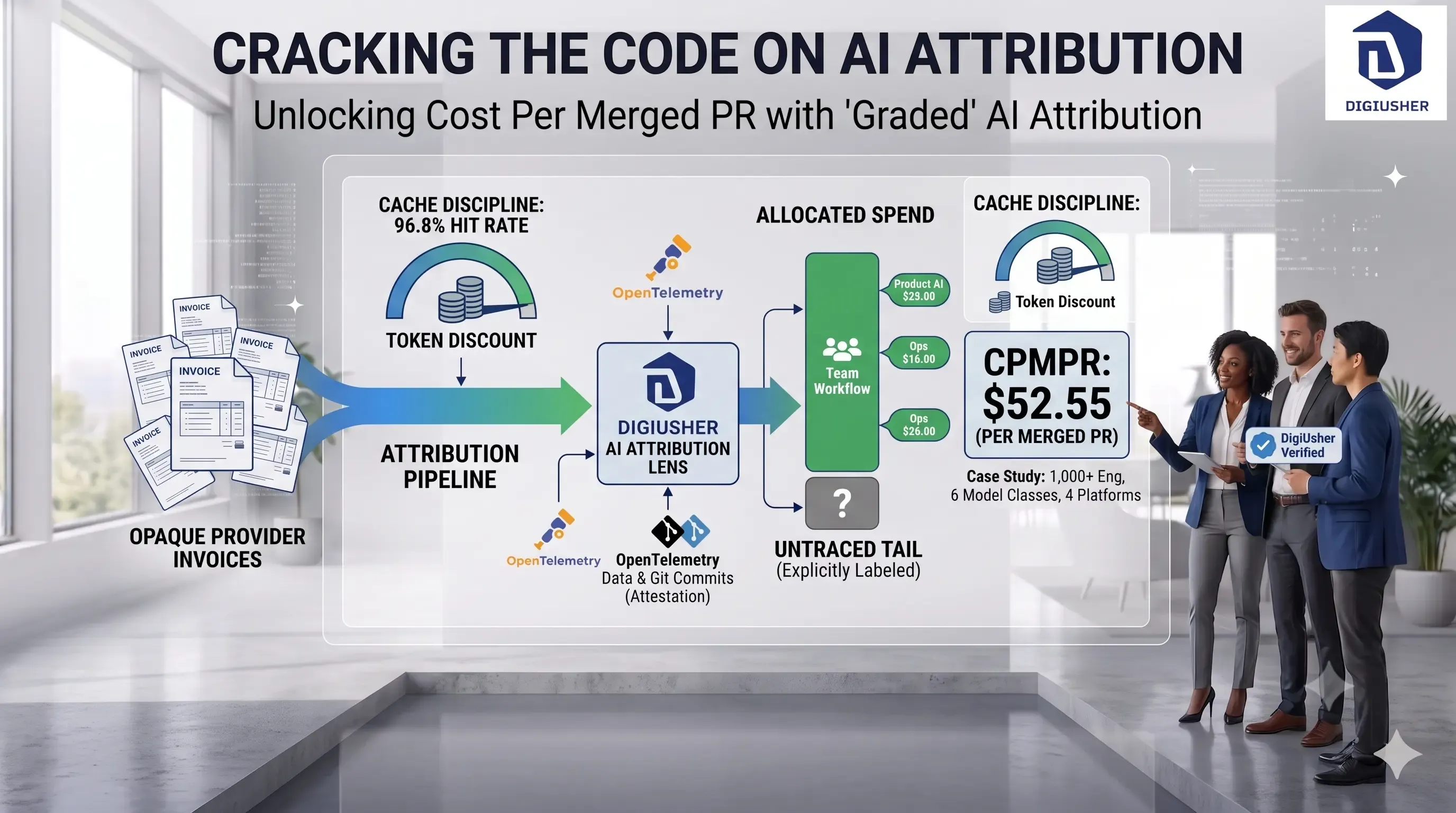
$52.55 Per Merged Pull Request: How One 1,000-Engineer Firm Priced Its Own AI Spend
A public technology firm with 1,000+ engineers refused to run its AI spend on faith. Here's the ledger it built instead — $52.55 per merged PR, 96.8% cache-hit rate, and a blended cost of $0.75 per million tokens.

AI Unit Economics: Why Your AI Invoice Can No Longer Answer the Board’s Question
98% of FinOps teams now manage AI spend, but almost none can price a merged pull request. Here's the framework for AI unit economics in 2026 — and why the invoice alone can't answer the board's question.
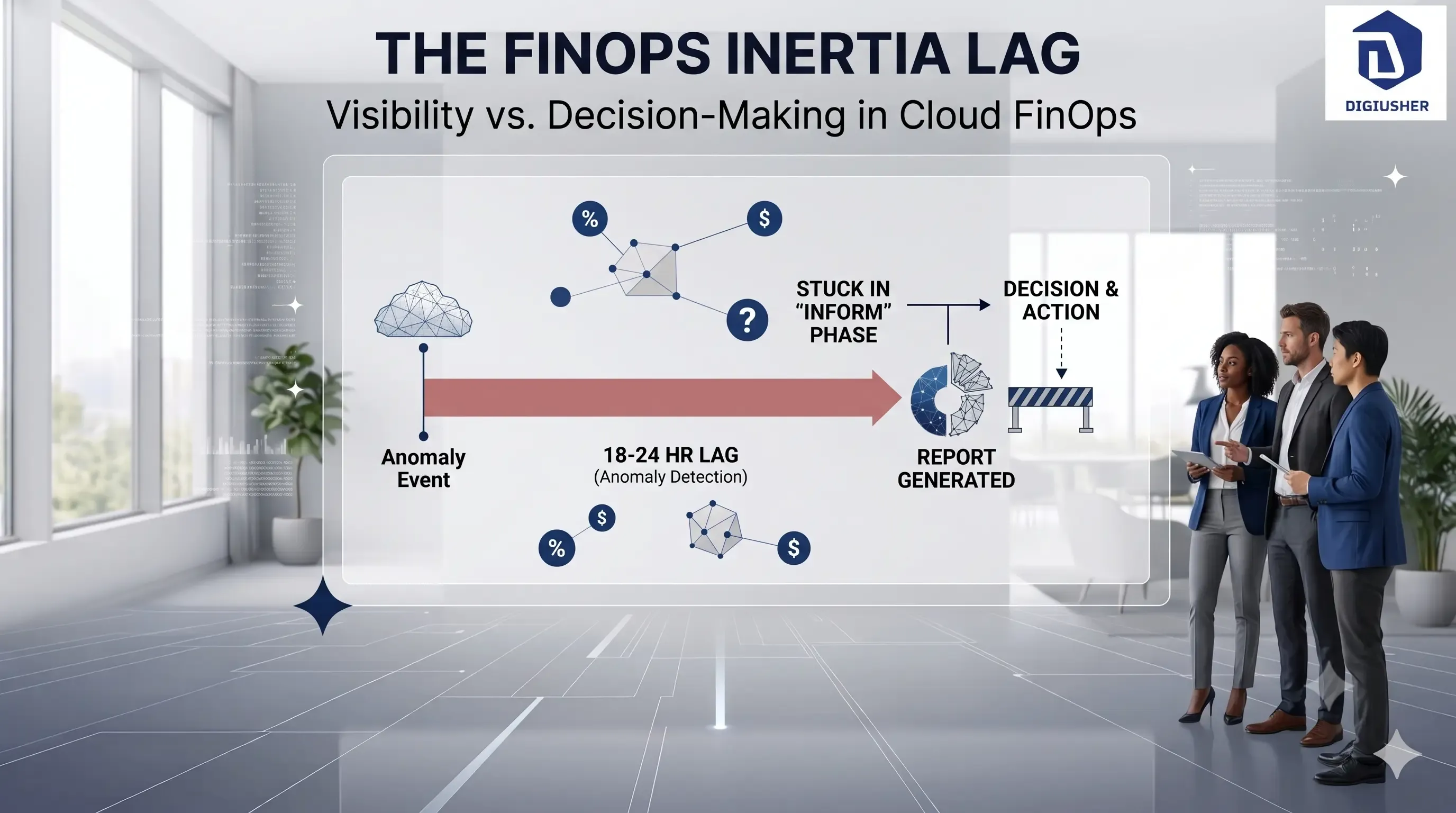
Most FinOps Programs Stall at "Inform" — and Never Reach Optimize
Visibility tools generate reports, not decisions. Legacy FinOps tools carry an 18-to-24-hour anomaly detection lag, according to the DigiUsher live TCO index — and that lag, not a lack of dashboards, is why most programs never leave the Inform phase.