$52.55 Per Merged Pull Request: How One 1,000-Engineer Firm Priced Its Own AI Spend
A public technology firm with 1,000+ engineers refused to run its AI spend on faith. Here's the ledger it built instead — $52.55 per merged PR, 96.8% cache-hit rate, and a blended cost of $0.75 per million tokens.
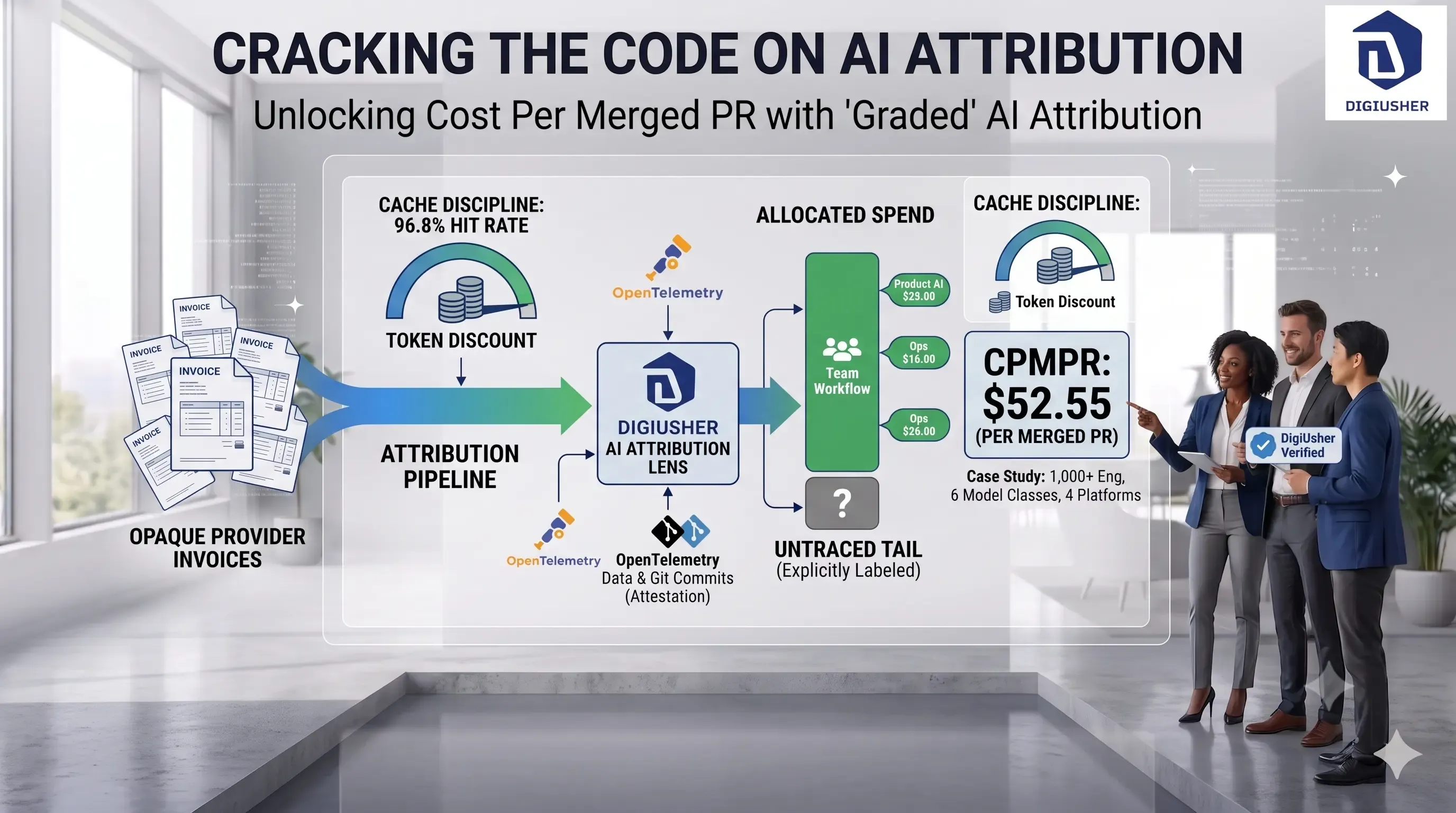
A public technology firm running more than 1,000 engineers refused to run its AI spend on faith. Its agent invoice was growing every month across six model classes and four platforms. No one could say whether the premium model was earning its keep, or whether cache discipline was holding.
So the customer pointed DigiUsher’s AI Attribution Lens at its own OpenTelemetry and commit data and asked for the ledger instead of the invoice. What came back was three numbers a CFO can actually defend: $52.55 per merged pull request, a 96.8% cache-hit rate, and a blended rate of $0.75 per million tokens.
At a Glance
| Customer | Public technology firm (name withheld) |
| Scale | 1,000+ engineers |
| AI stack | Claude Code, Codex, Cursor, OpenAI, Anthropic, GitHub, Amazon Bedrock, Google Gemini, Google Vertex |
| Use case | AI coding-agent cost attribution across a multi-provider engineering organization |
| Key contact | Head of FinOps |
Results at a Glance
| Metric | Before | After |
|---|---|---|
| Cost per merged pull request | Unattributed — invoice with no link to output | $52.55 fully allocated |
| Cache discipline | Unmeasured | 96.8% cache hit — top-decile |
| Blended token cost | No blended view across model classes | $0.75 per million tokens |
| Time to first ledger | No prior attribution mechanism | 14 days from connection to report |
About the Customer
The customer is a public multinational technology company running more than 1,000 engineers across a modern, multi-provider AI coding stack: Claude Code, Codex, and Cursor as coding agents, direct API relationships with both Anthropic and OpenAI, and infrastructure spanning Amazon Bedrock and Google Vertex. This is not an unusual stack in 2026 — recent developer-tooling survey data finds that most engineers now run 2.3 AI coding tools simultaneously, and that pattern holds across company sizes, from startups defaulting to Claude Code to large enterprises defaulting to GitHub Copilot alongside it.
What made this customer’s situation notable was not the stack itself but the honesty of its question. Rather than accepting a rising monthly invoice as the unavoidable cost of staying competitive on engineering velocity, the FinOps team asked a harder question: was the premium-tier model spend actually earning its keep, or was it quietly subsidizing routine work a cheaper model or a cache hit could have handled for a fraction of the cost?
That question could not be answered from the invoice alone, because the invoice reported total spend by provider and model, not spend by outcome. The customer needed a second data stream — one describing what engineering work the spend actually produced — joined to the first.
This is the same gap the FinOps Foundation’s State of FinOps 2026 report identifies as the leading challenge practitioners face when they extend FinOps principles into AI: visibility into AI cost is the top-cited difficulty, followed closely by allocating that cost to a business unit and determining AI ROI. A multi-provider coding-agent stack makes that gap wider than a single-model deployment would, because six model classes across four platforms each bill differently, and a spend total that blends all six tells a FinOps team nothing about which model, which team, or which workflow is driving the number up.
The Challenge
The customer’s challenge had three concrete dimensions, each familiar to any FinOps team managing a modern multi-provider AI coding stack.
A rapidly growing invoice with zero connection to output. Spend across six model classes and multiple providers was rising, but no system existed to say which portion of that spend corresponded to a merged pull request versus an abandoned experiment or a runaway agent loop. Industry data suggests this pattern is common rather than unusual: Anthropic’s own published figures put average Claude Code spend at $150 to $250 per developer per month, with power users running well above that, and public reporting has documented per-engineer bills reaching $500 to $2,000 a month at other large technology employers running agentic coding tools without attribution.
An unanswered question about model efficiency. Was the organization’s premium-tier model spend concentrated on genuinely hard reasoning tasks, or diluted across routine code formatting that a lightweight model would have handled identically? Without session-level attribution, this was not an answerable question — only a suspicion.
An unverified assumption about cache discipline. Prompt caching is the cheapest lever available in AI cost governance, typically discounting cached input tokens by roughly 90%, but a cache-hit rate that is not measured is a cache-hit rate that cannot be trusted to be holding. The customer had no visibility into whether its cache discipline was strong, degrading, or simply unknown.
Underlying all three was a genuine business risk that a recent developer-tooling survey confirms is now the top-ranked pain point among engineering organizations running agentic workflows: cost volatility, with monthly bills capable of swinging two to three times quarter over quarter with no attribution mechanism to explain why.
The Solution
The customer deployed DigiUsher’s AI Attribution Lens across its full stack, joining two independent data streams into a single FOCUS 1.x native schema.
On the cost side, DigiUsher ingested OpenTelemetry data and invoice truth across every layer of the customer’s stack: managed platforms (Amazon Bedrock, Google Vertex), direct model APIs (Anthropic, OpenAI), and engineering agents (Claude Code, Cursor, Codex), capturing tokens, models, and session identity. Prompt and response payload content was structurally dropped at ingestion by design, never stored, so the resulting dataset carried no privacy liability even as it captured granular per-session cost.
On the work side, DigiUsher tracked commit attestation, merged pull requests, and repository identity through the open git-ai standard, joining every measured agent session to the shipped code it actually produced. The result was a graded attribution model: allocated spend plus an honestly labeled untraced tail, together equalling total spend — an auditable chargeback rather than a suspiciously perfect one.
This attribution ran silently in the background from the moment the customer connected its stack, requiring no change to how engineers actually used their coding agents day to day.
Because the attribution schema is FOCUS 1.x native rather than adapted to it after the fact, the customer’s engineering team never had to reconcile two separate reporting systems — one for cloud and Kubernetes spend, another for AI spend. The same normalized data model that produced cost-per-merged-PR also fed the customer’s existing FinOps reporting, so the AI Attribution Lens extended an attribution practice the FinOps team already trusted rather than introducing a parallel one it had to learn from scratch.
The Verified Numbers
Fourteen days after connecting its stack, the customer had three defensible, unit-economics numbers where it previously had only a total.
$52.55 fully allocated cost per merged pull request. This is the ultimate engineering AI unit metric: whether AI spend compounds into shipped software. Across the measurement window, 77 agent sessions joined flawlessly to shipped code within seven days, and the fully allocated cost of the AI spend behind that output came to $52.55 per merged PR. Recent research on AI coding-tool ROI has found that vendor productivity claims of three-times gains are not consistently matched in practice — a 400-plus organization study tracking engineering velocity over 14 months found a median PR throughput gain of only 7.76% — which is exactly the gap a genuine unit-economics number closes. $52.55 per merged PR is not a claim about productivity; it is a measured, auditable cost the customer can defend to its own board.
96.8% cache-hit rate. Described internally as top-decile cache discipline, this meant prompt-side tokens were served from cache at close to one-tenth of base price across the large majority of the customer’s measured sessions. Provider-native prompt caching now enforced as a system floor rather than a best-effort setting is what allowed the organization’s premium-tier model spend to concentrate specifically where deep reasoning paid off, rather than leaking into routine work a cached response or a cheaper model tier would have handled just as well.
$0.75 per million tokens, blended. This is the blended rate across six model classes, a figure that only becomes meaningful once multi-provider spend is normalized into a single comparable unit. Tracking this figure over time lets the customer see efficiency improve as token prices deflate and consumption scales, independent of any single provider’s list price.
Outlier sessions and slow endpoints were caught in flight throughout the measurement window, right-sizing models before the invoice arrived rather than requiring a retrospective audit after the fact.
Why This Story Matters
This customer is not an edge case. It is a preview of where every enterprise running a multi-provider AI coding stack is heading, whether or not it has built the ledger yet.
The pressure this customer was responding to is now measurable at the industry level. CloudZero’s 2026 survey of 260 finance executives found that 87% must tie AI spend to business outcomes within the year, but only 22% can do so today, and finance leaders unable to prove AI ROI are more than twice as likely to have an initiative paused or cancelled. Reporting has already documented the downstream consequence at scale: large technology employers discontinuing agentic coding-tool access entirely after per-engineer bills reached $500 to $2,000 a month with no attribution mechanism available to determine whether that spend was justified.
The distinction between those organizations and this customer is not the size of the invoice. It is whether a ledger existed underneath it. A rising AI bill read against an unattributed total looks identical whether it reflects growing engineering output or growing waste — and an organization that cannot tell the difference has exactly one lever available: cut the spend and hope the right thing gets cut. This customer built the second option instead: a defensible number for what its AI spend actually bought.
The generalizable pattern sits in the sequence, not the specific numbers. Every enterprise running a multi-provider AI coding stack accumulates the same three unknowns this customer started with: whether premium-model spend is earning its keep, whether cache discipline is actually holding at scale, and whether the invoice’s growth tracks shipped output or something else entirely. None of those three questions require a new tool budget or a migration project to answer — they require joining data the organization already generates. The FinOps teams closing this gap fastest are not the ones with the largest AI budgets. They are the ones willing to point their own attribution lens at their own invoice before the board asks them to.
Where DigiUsher Fits
DigiUsher’s AI Attribution Lens is the same FOCUS 1.x native attribution layer behind every number in this case study, and it is built to run across the full technology estate an enterprise like this customer actually operates — not AI spend in isolation. Because DigiUsher is FOCUS-native rather than translated into FOCUS after the fact, this same attribution model extends to cloud, Kubernetes, and data platforms including Databricks and Snowflake in a single normalized schema, so AI unit economics does not require a second reporting system alongside the rest of a FinOps program.
For regulated industries, DigiUsher deploys via BYOC Secure Relay Proxy, with the collector running inside the customer’s own perimeter — the same architecture ICICI Bank uses for regulated-industry cost governance at institutional scale, and the model a European energy utility used to realize €1M in savings across a Databricks estate in 45 days. DigiUsher’s flat enterprise licensing means the platform cost does not rise as a percentage of AI spend, so as this customer’s agentic workloads scale further, the cost of measuring them does not scale in proportion. DigiUsher is SOC 2 Type II certified, GDPR compliant, and delivered globally through Infosys, Wipro, and Hexaware, alongside AWS ISV Accelerate, Azure ISV Co-Sell Ready, and GCP Partner marketplace status.
The invoice shows the cost. It does not show the ledger. This customer pointed the AI Attribution Lens at its own data and got the ledger back.
See your own numbers in fourteen days. Start with one team, one repository: connect your AI stack on day one, let the AI Attribution Lens accumulate session and commit data silently through day seven, and receive your own cost-per-merged-pull-request, cache-hit-rate, and blended-token-cost numbers by day fourteen. Book a 30-minute walkthrough to see what your own ledger looks like.
DigiUsher in 30 min
Give your board a cost-to-outcome view they can actually act on.
DigiUsher connects cloud and AI spend to the outcomes it funds, in language finance already speaks.
Book a 30-min walkthroughNo hard pitch · tailored to your stack
Continue Reading
More from the DigiUsher editorial team.
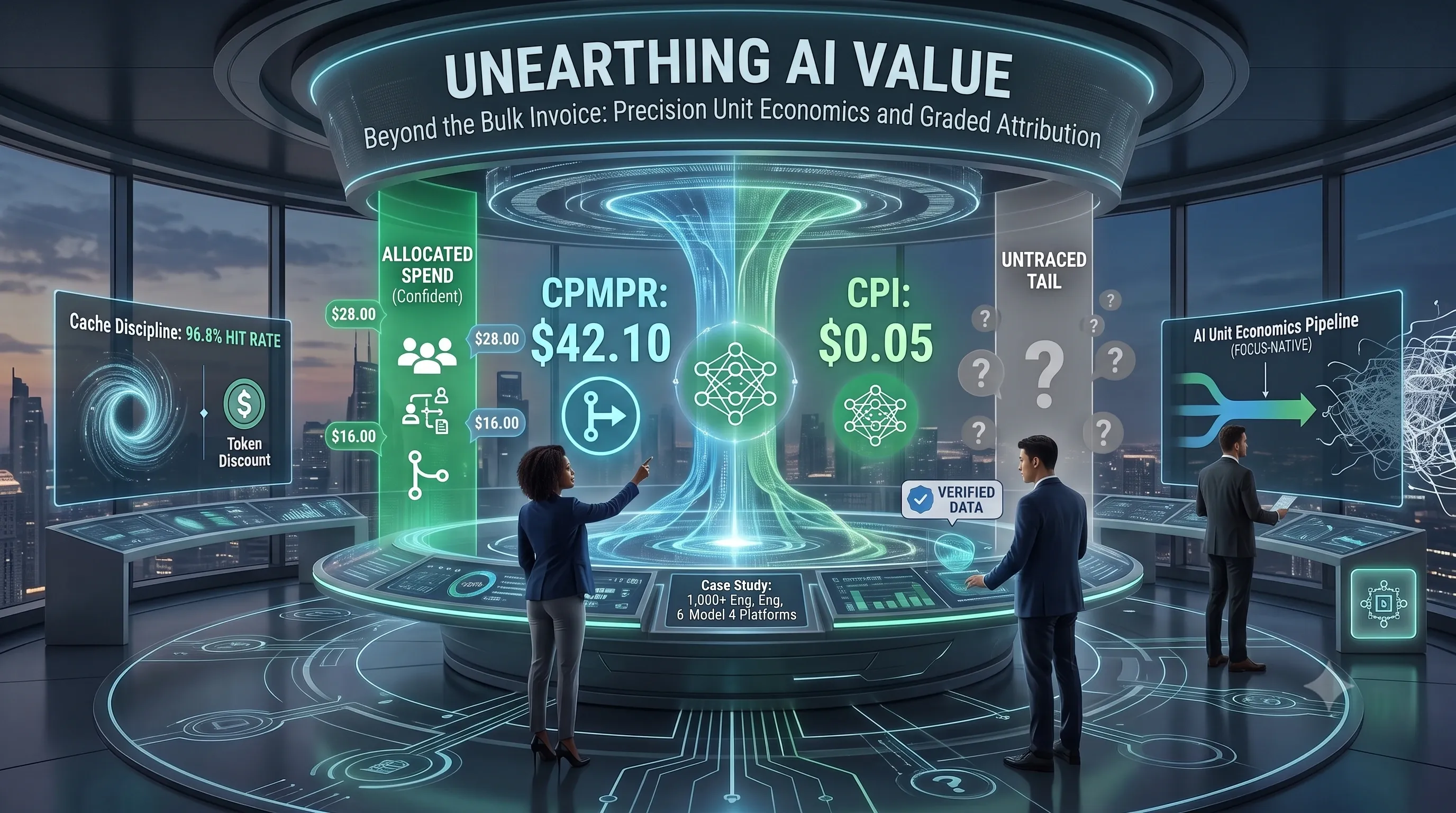
AI Unit Economics: Why Your AI Invoice Can No Longer Answer the Board’s Question
98% of FinOps teams now manage AI spend, but almost none can price a merged pull request. Here's the framework for AI unit economics in 2026 — and why the invoice alone can't answer the board's question.
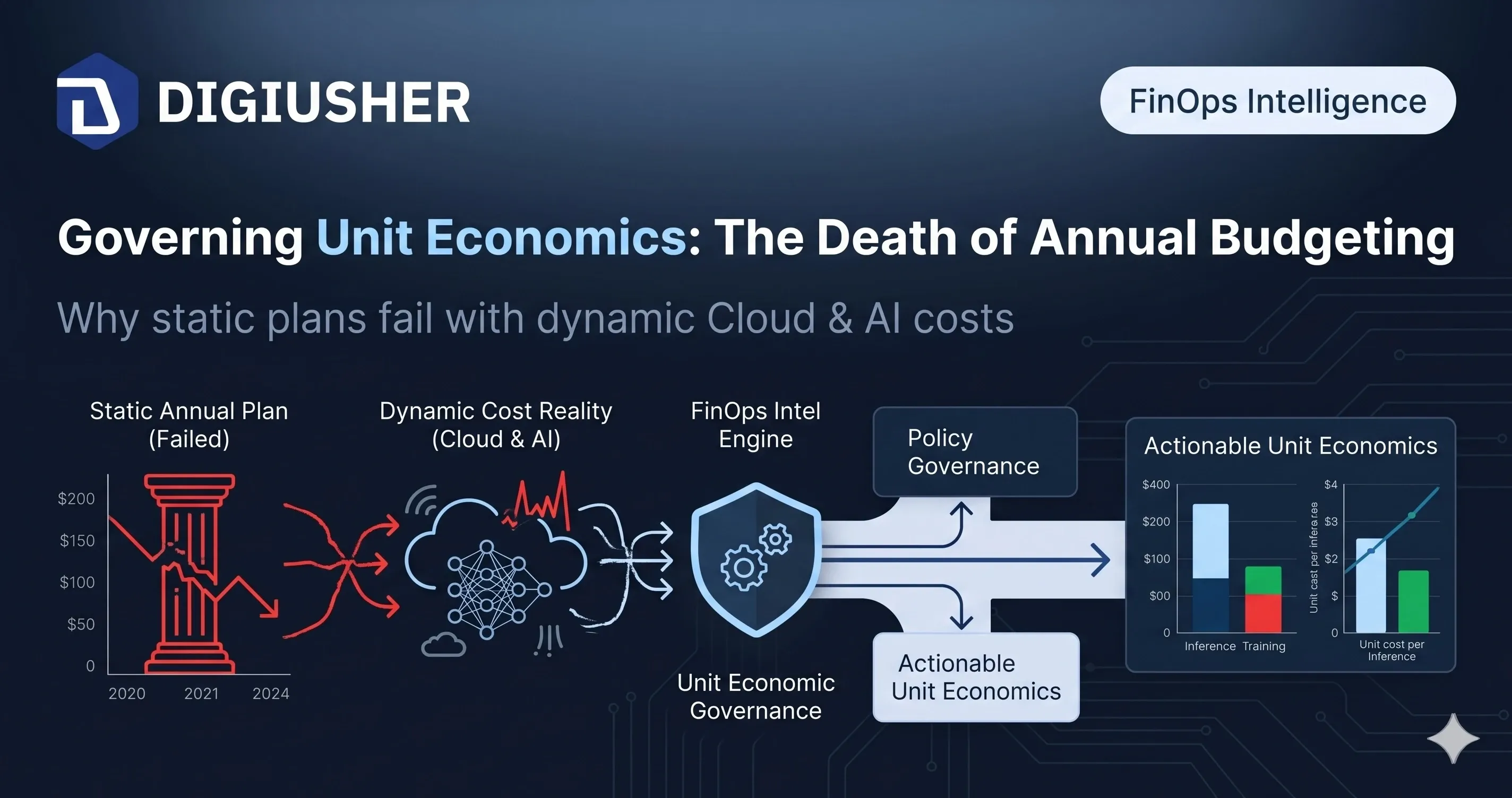
Why Cloud and AI Budgets Fail Annual Planning
Annual planning was built for fixed assets. Cloud and AI spend is consumption-driven, non-linear, and breaks the 12-month budget cycle. Here is what replaces it.
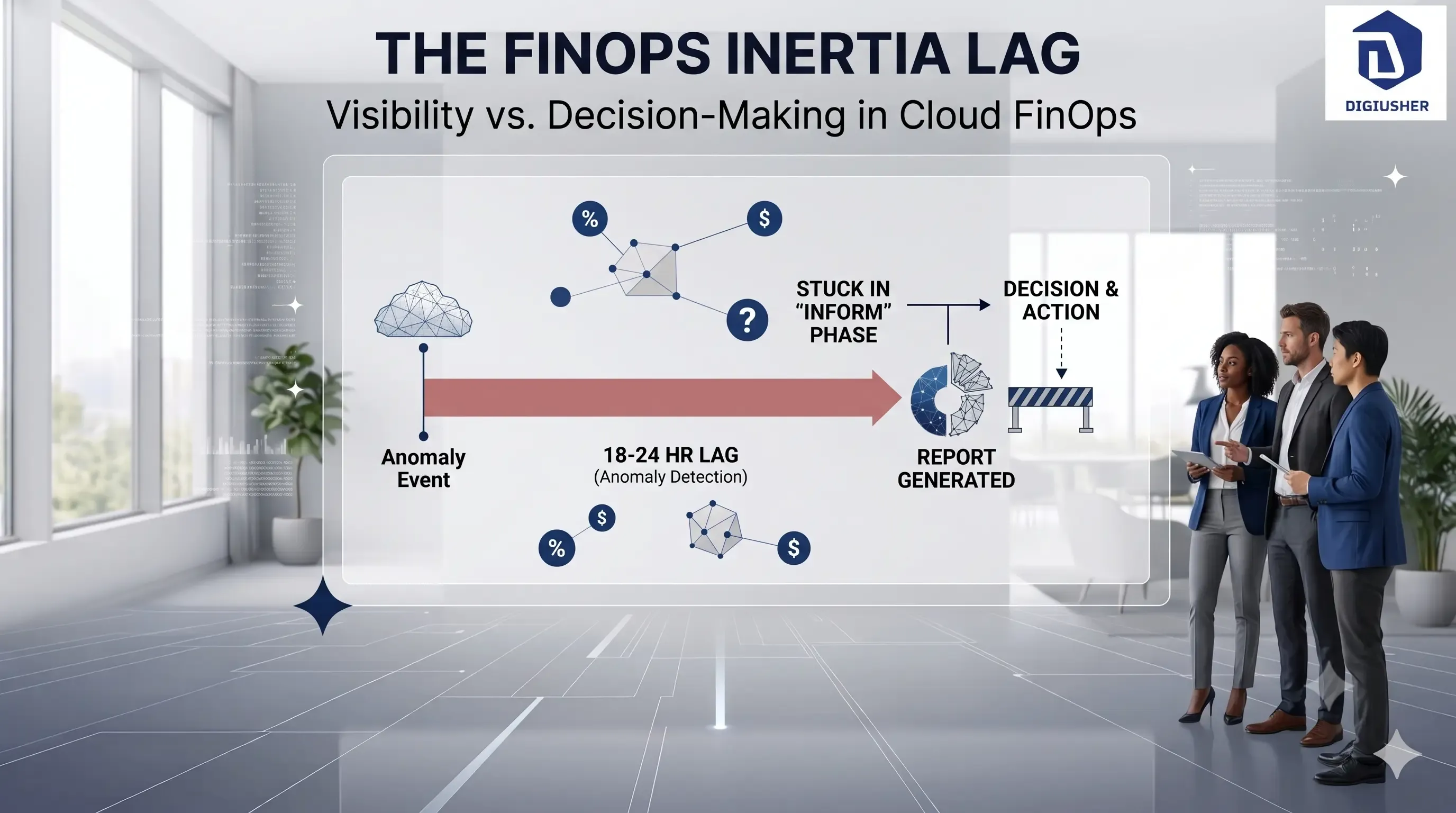
Most FinOps Programs Stall at "Inform" — and Never Reach Optimize
Visibility tools generate reports, not decisions. Legacy FinOps tools carry an 18-to-24-hour anomaly detection lag, according to the DigiUsher live TCO index — and that lag, not a lack of dashboards, is why most programs never leave the Inform phase.