AI Unit Economics: Why Your AI Invoice Can No Longer Answer the Board’s Question
98% of FinOps teams now manage AI spend, but almost none can price a merged pull request. Here's the framework for AI unit economics in 2026 — and why the invoice alone can't answer the board's question.

Ninety-eight percent of FinOps teams now manage AI spend. Two years ago, that number was 31%. No metric in the history of the FinOps discipline has moved this fast, and almost none of the teams managing that spend can tell their board what a single unit of it actually cost to produce.
That gap is not a measurement inconvenience. It is the reason a rapidly growing AI invoice now reads to a CFO as a risk rather than an investment. A total spend figure cannot distinguish between a premium model earning its keep on genuinely hard reasoning and the same premium model quietly formatting routine code. Both show up as the same line item. Only one of them is worth what it costs.
Executive Summary
- AI spend management jumped from 31% to 98% of FinOps teams in two years, the fastest scope expansion the discipline has recorded, according to the FinOps Foundation’s State of FinOps 2026 report.
- Seventy-three percent of enterprises exceeded their AI cost projections in the past year, and the overrun is structural: agentic workloads consume five to thirty times the tokens of equivalent chatbot interactions.
- A monthly AI invoice, on its own, is an invitation to cut the wrong thing, because it shows total cost without showing which spend produced shipped software and which spend produced nothing.
- AI unit economics resolves this by dividing total AI spend by delivered business or engineering output — cost per merged pull request, cost per inference, value per token — using a FOCUS-native attribution layer that joins cost telemetry to production telemetry.
- Boards have already moved past asking whether AI spend grew. PwC’s 2026 CEO Survey found 56% of CEOs report no revenue or cost benefit from AI in the past year, and CloudZero’s 2026 survey found 87% of finance leaders must now prove AI spend ties to outcomes, with only 22% able to do so today.
What Is AI Unit Economics?
AI Unit Economics is the discipline of measuring enterprise artificial intelligence cost against the specific unit of delivered business or engineering work it produces — a merged pull request, a completed inference, a resolved customer ticket — rather than against a monthly invoice total. Unlike traditional cloud cost management, which allocates spend to infrastructure categories, AI Unit Economics requires joining cost telemetry (tokens, model calls, GPU-hours) with production telemetry (commits, merged pull requests, completed tasks) into a single attributable ratio.
In the maturity model the FinOps Foundation uses to describe the discipline’s progression, this represents the shift from Run-stage cost reporting to value-stage unit measurement. Legacy FinOps answers what was spent, domain by domain: this much on Bedrock, this much on direct API calls, this much on GPU infrastructure. AI Unit Economics answers what that spend bought.
The enterprise implication is direct. Without it, a rising AI invoice cannot be distinguished from rising AI value, and a board that cannot make that distinction has only one lever left to pull: cut the spend and hope the right thing gets cut. Nine times out of ten, that is not what happens.
Why AI Unit Economics Matters in 2026
Two forces converged in 2026 to make unit-level attribution non-optional rather than aspirational: the speed of AI’s expansion into FinOps scope, and the unpredictability of the spend once it arrived.
On expansion: the FinOps Foundation’s State of FinOps 2026 report, based on 1,192 respondents representing more than $83 billion in annual cloud spend, found that AI spend management is now nearly universal among FinOps teams, up from 63% in 2025 and 31% in 2024. AI cost management is simultaneously the single most-requested skillset practitioners want to add over the next 12 months, ahead of every other capability in the survey.
On unpredictability: 73% of enterprises exceeded their AI cost projections in the past year, according to the same report, and separate Gartner analysis found some enterprises have overrun AI budgets by four to eleven times within 90 days of an agentic rollout. The mechanism behind both numbers is the same. Global AI spending is forecast to reach $2.59 trillion in 2026, a 47% year-over-year increase, with AI infrastructure alone accounting for more than 45% of that total as providers build capacity ahead of demand they expect rather than demand they have already measured.
None of this is manageable with a spreadsheet and a monthly invoice review. The scale has outrun the tooling that most FinOps teams inherited from the cloud-only era, and the teams closing that gap fastest are the ones instrumenting unit economics before the next budget cycle forces the question.
The Chatbot Era Gave Way to the Agentic Era, and the Math Changed With It
Chatbot-era AI spend was linear and largely predictable: a human sent a prompt, a model returned a response, and the cost of that exchange was easy to forecast against historical usage. It was manageable within the cloud budgets FinOps teams already governed, because it behaved like every other line item they had priced before.
Agentic AI does not behave that way. An agent plans, calls tools, spawns sub-agents, reasons in the background, and iterates without a human in the loop for every step. Gartner analysis puts the token consumption of agentic tasks at roughly five to thirty times the equivalent chatbot interaction, and the reason is architectural rather than incidental: autonomous loops and multi-agent coordination replace a single request-response pair with dozens or hundreds of internal exchanges the end user never sees.
IDC’s forecast makes the trajectory explicit, projecting a ten-fold increase in agent usage and a thousand-fold increase in inference demand by 2027. An enterprise that budgets for 2027 the way it budgeted for 2025 is not making a small error. It is applying a chatbot-era forecasting model to an agentic-era consumption curve, and the FinOps Foundation’s own data on 73% of enterprises exceeding projections suggests most of the market is currently doing exactly that.
Why Total Monthly Invoice Is the Wrong Number to Manage
A total monthly AI invoice collapses two entirely different questions into one number: how much did we spend, and what did we get for it. Executives reading that invoice are not naturally asking whether it grew. They are asking what the spend produced, who owns it, and whether it is compounding into shipped software or evaporating into unattributed usage.
Legacy FinOps reporting was built to answer the first question well. It was not built to answer the second, because cloud infrastructure cost and infrastructure output were never separated the way AI spend and AI output now need to be. The result is a genuine risk: an executive who cannot see the ledger behind the invoice treats the invoice itself as the thing to cut, and cuts indiscriminately across genuinely valuable premium-model usage and pure waste alike.
The fix is not a better dashboard of the same number. It is a different number entirely — one that divides the invoice by the work it produced.
The AI Unit Economics Formula
The formula is simple to state and hard to build: Total AI Spend divided by Delivered Business Unit equals AI Unit Economics. Each side of that equation requires its own data discipline.
The numerator (cost) requires OpenTelemetry intake joined to invoice truth — every token, every model, every API key, reconciled against what providers actually billed rather than what usage dashboards estimate.
The denominator (work) requires an open, git-native standard for engineering output: commits, merged pull requests, and delivered tasks, measured the same way regardless of which model or coding agent produced them.
The ledger (value) is what emerges once the two sides are joined: cost per merged pull request, cost per inference, and value per token, tracked over time as a genuine unit-economics metric rather than a one-time snapshot.
The AI Unit Economics Formula
──────────────────────────────────────────────────────────
[Total AI Spend]        ÷    [Delivered Business Unit]
──────────────────────────────────────────────────────────
OpenTelemetry intake +        The open git-ai standard:
invoice truth. Every           commits, merged pull
token, model, API key.         requests, delivered tasks.
──────────────────────────────────────────────────────────
                    = [AI Unit Economics]
     Cost per merged PR · Cost per inference · Value per token
──────────────────────────────────────────────────────────
Building this ratio at enterprise scale requires privacy-preserving attribution: prompt content, response content, and payload data are structurally dropped at ingestion and never stored, while metadata — tokens, models, session identity, commit attestation, repository identity — is retained and joined into what a graded attribution model calls allocated spend plus an honestly labeled untraced tail, together equalling total spend. That honesty about the untraced portion is what makes the resulting chargeback auditable rather than aspirational.
The Four Categories of AI Waste Enterprises Are Actually Fighting
Once cost and work are joined, waste stops being a vague sense that the bill is too high and becomes four specific, addressable categories.
Model rightsizing waste shows up as premium-tier tokens spent on routine work — a reasoning-tier model formatting code that a lightweight model would handle identically. The remedy is cross-provider price comparison paired with automated downgrade recommendations for low-complexity tasks, and it is consistent with what cost-optimization research across the industry has found: routing 60% to 80% of routine requests to a cheaper model tier typically cuts weighted-average cost by 40% to 70% without any quality loss on the tasks that actually need it.
Cache and batch discipline waste shows up as cache-hit ratios falling below an acceptable floor. This is the cheapest lever available in AI cost governance, because provider-native prompt caching typically discounts cached input tokens by roughly 90%, and batch-API adoption adds a further 50% discount on eligible asynchronous workloads — the two stack on providers that support both, reaching combined savings in the 75% range on qualifying traffic. The only real engineering work is prompt structure: static content ordered before dynamic content, so the cache actually hits instead of silently missing.
Agent governance waste shows up as runaway autonomous loops burning budget overnight, invisible until the invoice arrives. The remedy is run-cost concentration alerts and flight-time budget thresholds that catch spikes before month-end, treating agent spend the same way mature platform teams already treat runaway compute jobs.
GPU economics waste shows up as premium accelerators serving fractional workloads, or forgotten training clusters left running after a job completes. The remedy is utilisation-threshold alerting and auto-termination on idle capacity, closing the gap between what GPU infrastructure is provisioned for and what it is actually doing.
How Enterprises Should Evaluate AI Cost Platforms in 2026
Five criteria separate a genuine AI unit economics platform from a cost dashboard wearing new branding.
| Evaluation Criterion | Why It Matters in 2026 |
|---|---|
| Unit-level attribution | Cost per merged pull request and cost per inference, not just a domain-level spend total |
| FOCUS 1.x native architecture | Normalises cost data across every technology layer using the open specification, not a translation layer bolted on afterward |
| Privacy-preserving ingestion | Prompt, response, and payload content structurally dropped at ingestion — never stored, never a liability in a breach or audit |
| Full-stack coverage | Managed platforms, direct model APIs, engineering agents, and GPU infrastructure joined into one schema |
| Pricing model | Flat enterprise licensing that does not rise as a percentage of the AI spend the platform is meant to help reduce |
FOCUS-native architecture is no longer a forward-looking requirement. The FinOps Foundation’s State of FinOps 2026 report found that 68% of organizations spending $100 million or more annually on cloud are already using or piloting FOCUS-formatted billing data, with AI workload data named as one of the top categories practitioners want the specification to cover next. A platform still translating proprietary schemas into FOCUS after the fact is already behind where the largest spenders in the market have moved.
Where DigiUsher Fits
DigiUsher’s AI Attribution Lens is built to answer exactly the question a raw invoice cannot. It ingests OpenTelemetry cost data and invoice truth across managed platforms, direct model APIs, engineering agents, and GPU infrastructure into a single FOCUS 1.x native schema, dropping prompt and response payload content at ingestion by design rather than as an afterthought. On the work side, it joins commit attestation and merged-pull-request data through the open git-ai standard, producing a graded attribution model where allocated spend plus an honestly labeled untraced tail always equal total spend.
Because DigiUsher is FOCUS-native rather than translated into FOCUS, this attribution composes with the rest of an enterprise’s technology estate — cloud, Kubernetes, and data platforms including Databricks and Snowflake — in the same normalized view, rather than requiring a second reporting system for AI. DigiUsher’s flat enterprise licensing means the platform cost does not scale as a percentage of AI spend, so the more an enterprise’s AI usage grows, the more that flat-fee structure pays for itself relative to percentage-of-spend alternatives. For regulated industries, DigiUsher deploys via BYOC Secure Relay Proxy, with the collector running inside the customer’s own perimeter — the same architecture ICICI Bank uses for regulated-industry cost governance at institutional scale, and the same model a European energy utility used to realize €1M in savings across a Databricks estate in 45 days. DigiUsher is SOC 2 Type II certified, GDPR compliant, and delivered globally through Infosys, Wipro, and Hexaware, alongside AWS ISV Accelerate, Azure ISV Co-Sell Ready, and GCP Partner marketplace status.
The invoice shows the cost. It does not show the ledger. AI unit economics is what turns an invoice into a ledger a board can actually read.
See your own AI unit economics in fourteen days. DigiUsher’s measurement window starts with one team, one repository: connect on day one, let the AI Attribution Lens accumulate session and commit data silently through day seven, and receive your own cost-per-merged-pull-request, cache-hit-rate, and model-mix numbers by day fourteen — no migration project, no rip-and-replace. Book a 30-minute walkthrough to see what your own ledger looks like.
DigiUsher in 30 min
Give your board a cost-to-outcome view they can actually act on.
DigiUsher connects cloud and AI spend to the outcomes it funds, in language finance already speaks.
Book a 30-min walkthroughNo hard pitch · tailored to your stack
Continue Reading
More from the DigiUsher editorial team.
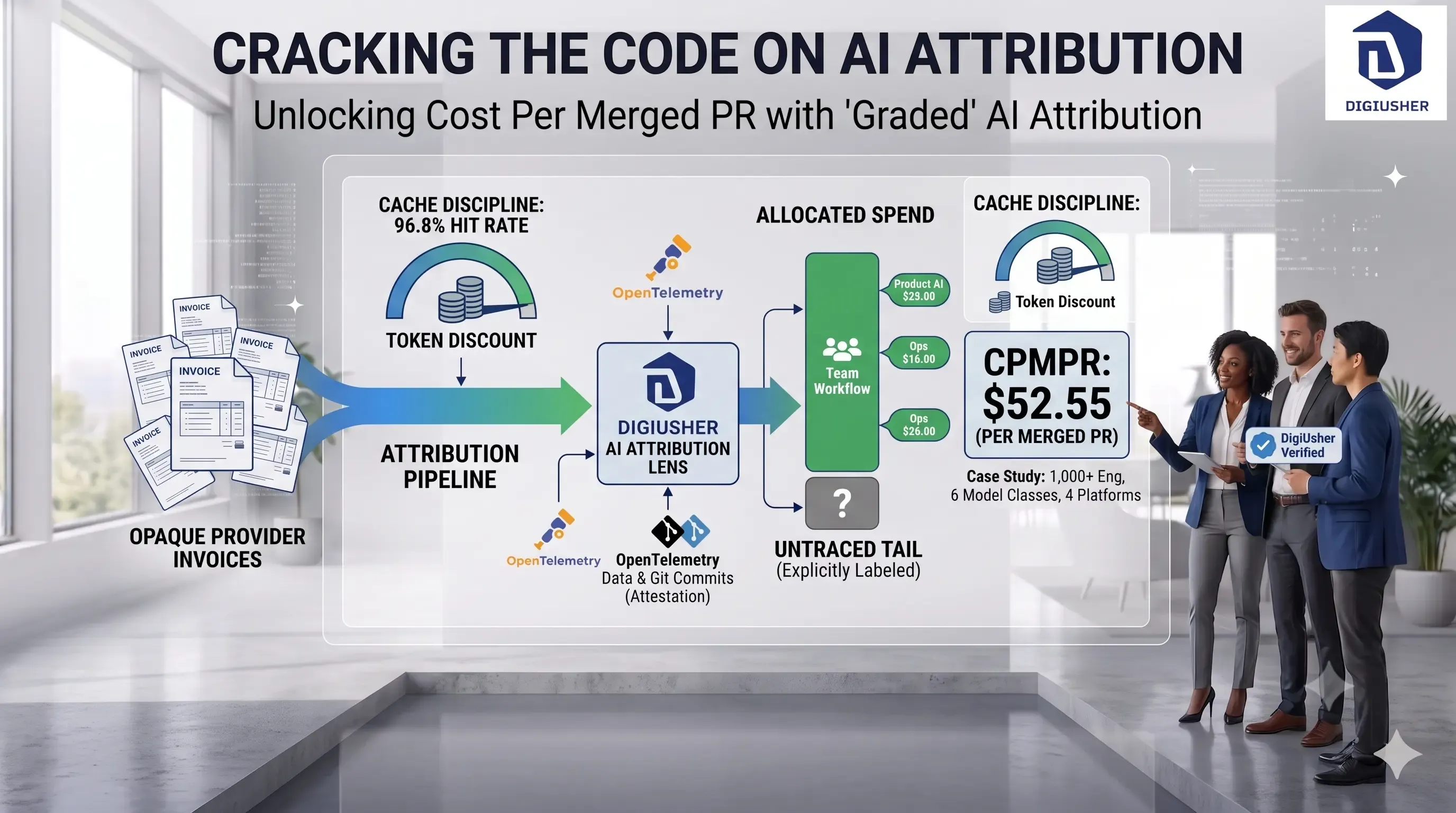
$52.55 Per Merged Pull Request: How One 1,000-Engineer Firm Priced Its Own AI Spend
A public technology firm with 1,000+ engineers refused to run its AI spend on faith. Here's the ledger it built instead — $52.55 per merged PR, 96.8% cache-hit rate, and a blended cost of $0.75 per million tokens.
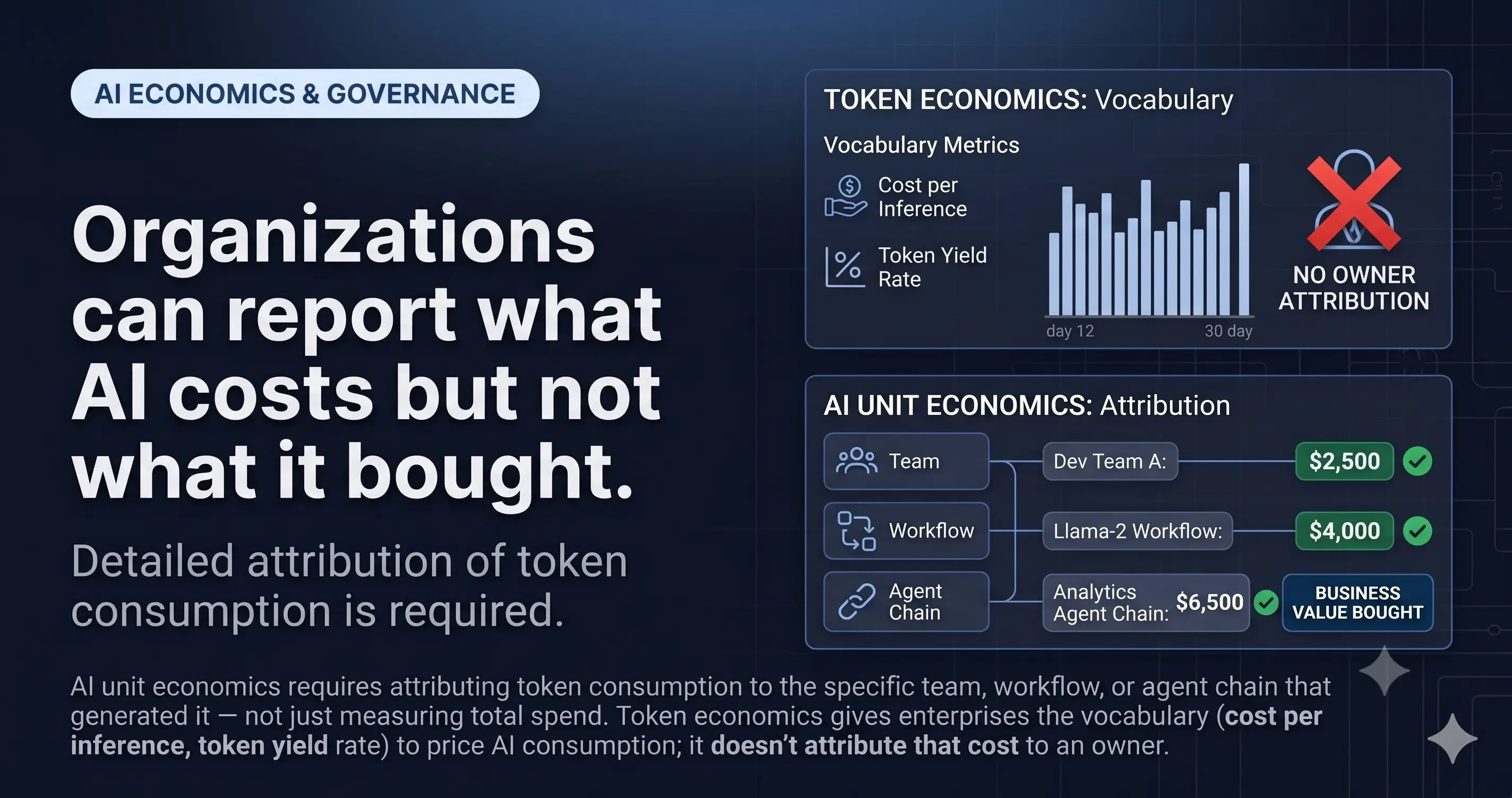
Token Economics Gave AI Spend a Vocabulary. It Still Has No Owner.
FinOps Foundation's token economics framework names the AI cost problem correctly. But naming a metric and attributing it to a team, workflow, or chain are two different disciplines — and most enterprises only have the first.
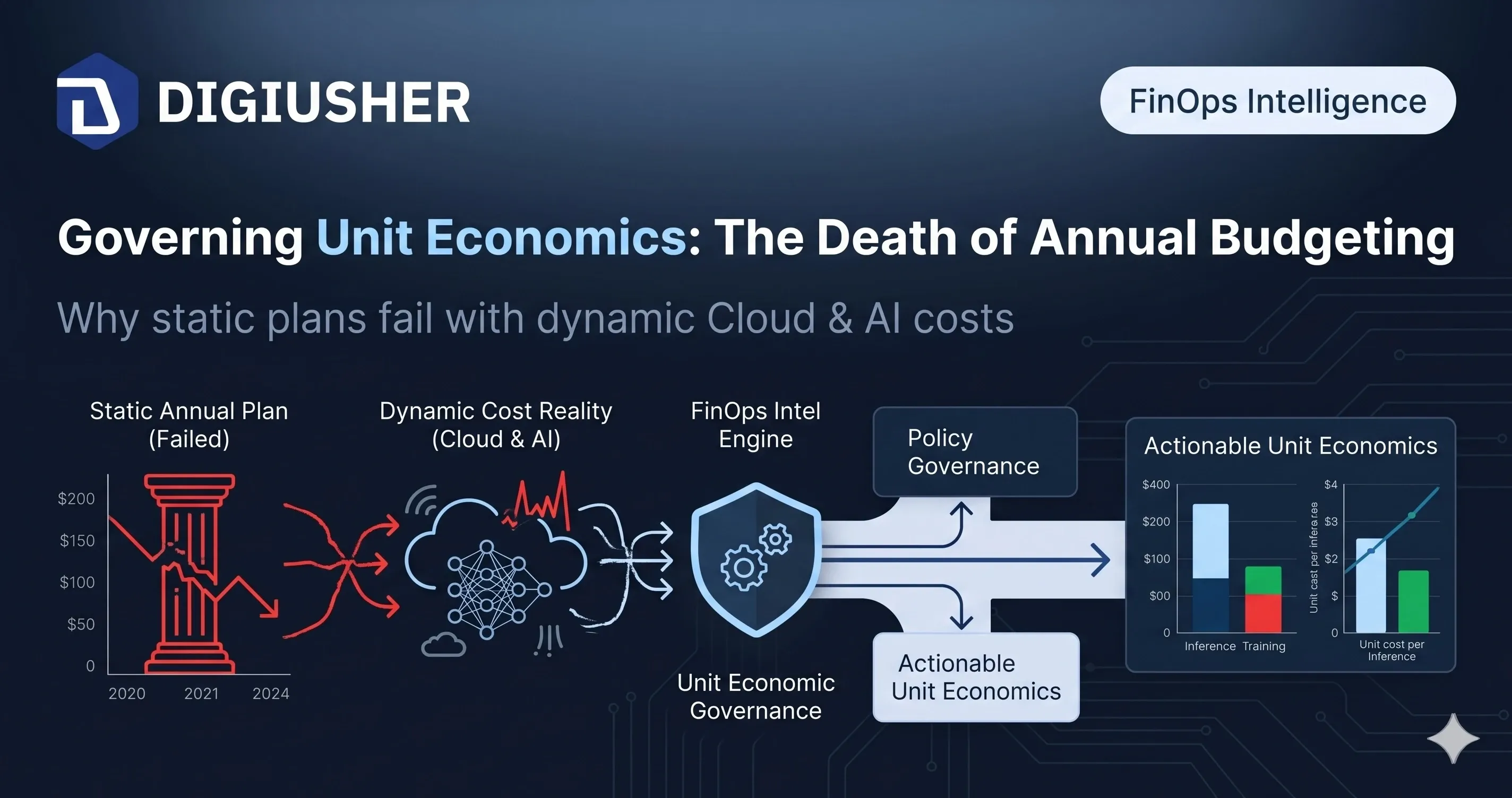
Why Cloud and AI Budgets Fail Annual Planning
Annual planning was built for fixed assets. Cloud and AI spend is consumption-driven, non-linear, and breaks the 12-month budget cycle. Here is what replaces it.