Token Economics Gave AI Spend a Vocabulary. It Still Has No Owner.
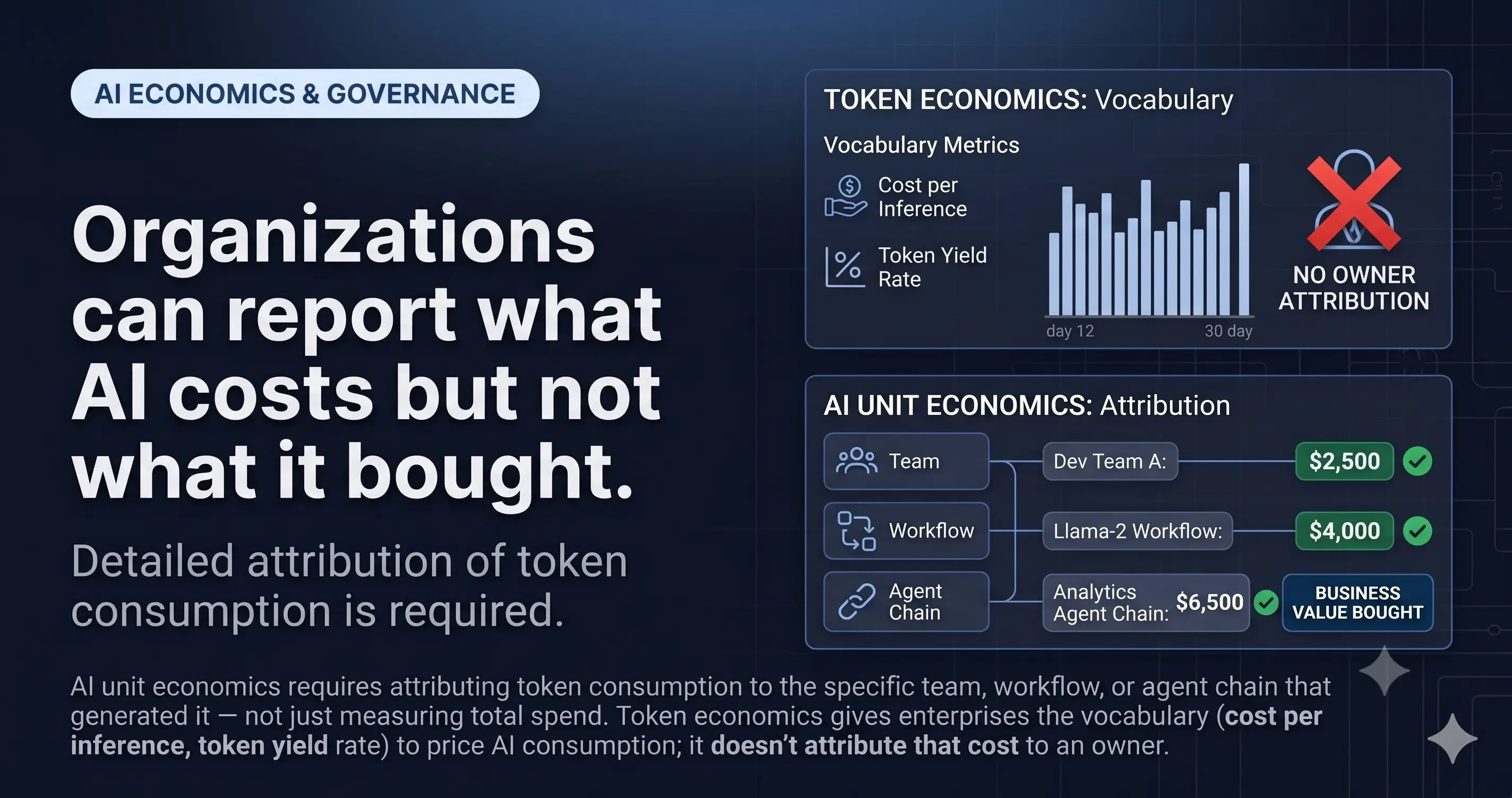
FinOps Foundation's token economics framework names the AI cost problem correctly. But naming a metric and attributing it to a team, workflow, or chain are two different disciplines — and most enterprises only have the first.
Enterprise generative AI spend grew 3.2x year over year between 2023 and 2025, the fastest software category expansion on record. Eighty-eight percent of organizations now use AI in at least one business function. Six percent can attribute more than five percent of EBIT to it.
That gap — near-universal adoption, near-absent attribution — is the actual AI ROI problem. Not whether AI is expensive. Whether anyone can say what a given dollar of AI spend produced, and who is accountable for that answer.
Token Economics Named It
The FinOps Foundation’s recent token economics framework did something the industry needed: it gave AI cost a proper vocabulary. Cost per inference. Goodput versus raw throughput. Token yield rate — the share of generated tokens that actually reach a usable outcome, after retries and abandoned sessions are stripped out. These are the right metrics. They correctly separate token volume from token value, which matters because unit prices per million tokens keep falling while aggregate enterprise spend keeps rising. Google’s monthly token processing grew roughly 130-fold in a year. AT&T scaled from eight billion to twenty-seven billion tokens a day after deploying multi-agent systems. A cheaper token is not a cheaper bill.
The framework also correctly widens the cost surface beyond the API invoice: GPU and TPU compute, data center power, networking, and — critically — SaaS tools that embed token consumption behind a flat subscription price while the actual metered obligation rises through every renewal. Naming that surface accurately is real progress. Most finance functions were still budgeting AI the way they budgeted a SaaS line item as recently as last year.
But Naming a Metric Isn’t Attributing It
Here is where the vocabulary runs out. Token yield rate tells you what fraction of tokens produced value. It does not tell you which team’s agent chain produced the tokens that didn’t. Cost per inference tells you the unit cost of a request. It does not tell you whether that request came from a customer-facing workflow worth protecting or an internal tool nobody audited after the pilot.
This is the same problem FinOps solved for cloud infrastructure roughly a decade ago, and enterprises are re-learning it in real time for AI. A cloud bill without tag-level attribution tells finance the total was $4M and nothing about which product line, team, or environment generated it. An AI bill without chain-level attribution has the identical shape — a defensible total, an unassignable cause. The FinOps community’s answer to the first problem wasn’t a better invoice. It was a normalization layer — FOCUS — that made cost traceable to an owner regardless of provider. AI spend needs the same layer, and it needs it to sit on the same normalized model as the cloud and Kubernetes spend it already coexists with, because in practice it does coexist: a single agentic workflow can touch a foundation model API, a vector database, GPU compute, and three SaaS tools with unexposed meters, often across more than one cloud, inside a single business action.
What Ownership Actually Requires
Attribution at the chain level requires three things most cost tools weren’t built to do simultaneously. First, it requires treating a token as a resource with the same accounting rigor as a compute-hour or a storage byte — priced, timestamped, and tied to a request ID, not aggregated into a monthly provider total. Second, it requires tracing that request back through the orchestration layer — the tool calls, retries, and agent-to-agent handoffs that a single user action can trigger — to the workflow and team that initiated it. Third, it requires putting that trace on the same normalized cost model as the multi-cloud and Kubernetes spend sitting next to it, so that “cost per outcome” for an AI-augmented product feature is one number, not three reports from three tools that finance has to reconcile by hand.
This is the layer DigiUsher was built around before “AI unit economics” was a phrase anyone used. The same per-chain attribution model that traces Kubernetes spend to namespace, pod, and label — architecturally FOCUS-native rather than a compatibility layer bolted on after the fact — extends to token consumption from foundation model APIs, GPU idle time, and the SaaS tools quietly aggregating token spend behind a seat price. Because it’s one model rather than three, cost per outcome for an AI workflow sits next to cost per outcome for the Kubernetes cluster it’s deployed on, comparable in the same terms finance already uses for the rest of the estate.
The Question That Actually Matters
Token economics gave the CFO a defensible way to talk about AI spend as a category. It did not, by itself, give anyone in the organization a name to put next to a line item. The six percent of firms McKinsey identifies as attributing measurable EBIT impact to AI are not the six percent spending the least. They’re the six percent that closed the attribution gap — that can trace a dollar of token spend to the workflow that spent it and the outcome it produced, on demand, without a quarterly reconciliation project.
That’s the discipline sitting one layer past token economics. Cost per token is an accounting unit. Cost per outcome, owned by a name, is a governance capability. Most enterprises have the first. Very few have the second — and the gap between them is exactly where AI ROI conversations currently stall.
> Token economics answers what AI cost. AI unit economics answers who spent it and what it bought — and that second question is the one finance is actually asking.
See what per-chain AI attribution looks like on your own estate. DigiUsher traces token spend, GPU utilization, and cloud cost to the same FOCUS-native model — no separate AI cost report to reconcile. Book my 15-min discovery call and bring last month’s AI invoice; we’ll show you where it maps to a workflow.
DigiUsher in 15 min
Give your board a cost-to-outcome view they can actually act on.
DigiUsher connects cloud and AI spend to the outcomes it funds, in language finance already speaks.
Book my 15-min discovery callNo hard pitch · tailored to your stack
Continue Reading
More from the DigiUsher editorial team.
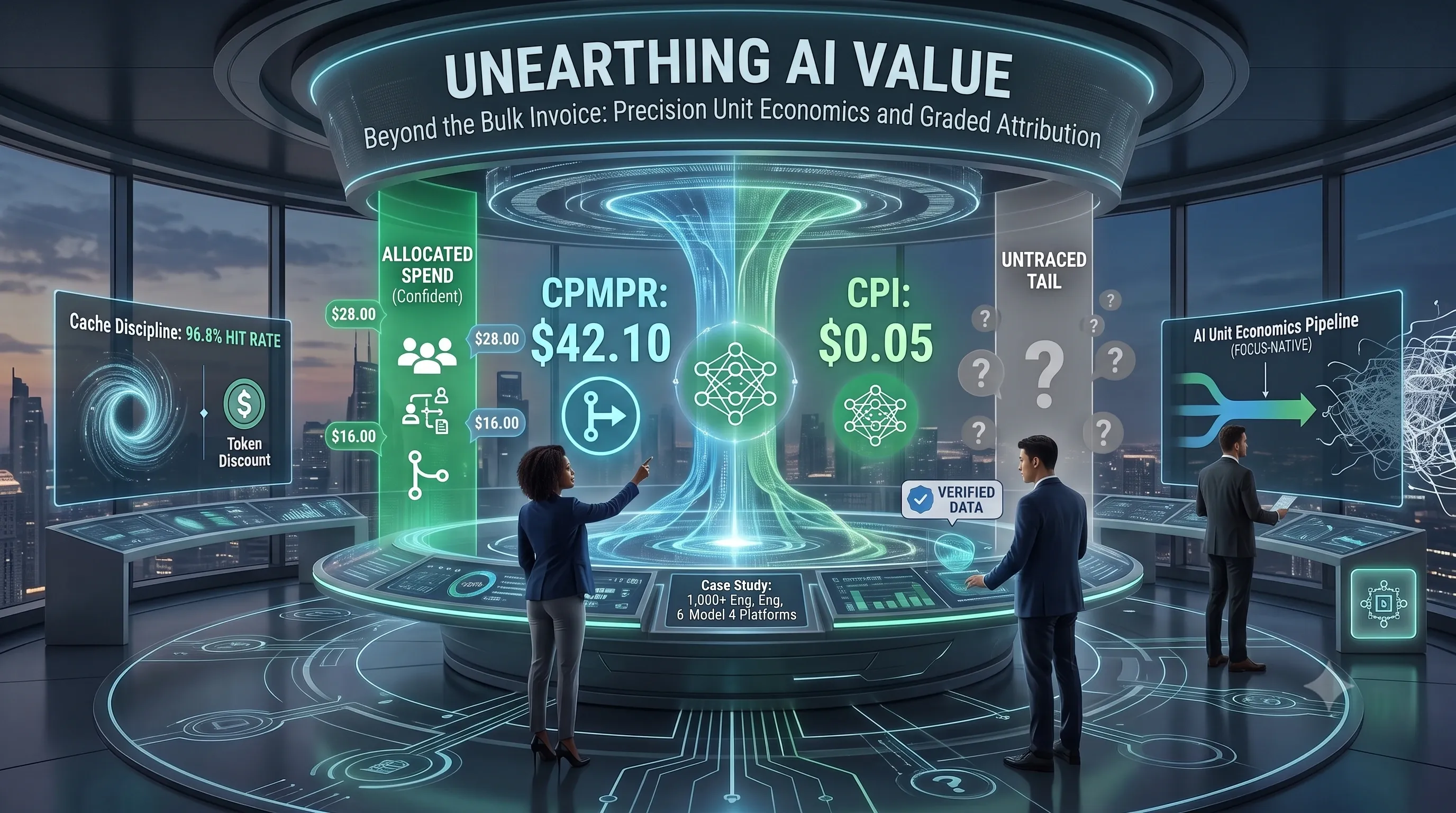
AI Unit Economics: Why Your AI Invoice Can No Longer Answer the Board’s Question
98% of FinOps teams now manage AI spend, but almost none can price a merged pull request. Here's the framework for AI unit economics in 2026 — and why the invoice alone can't answer the board's question.
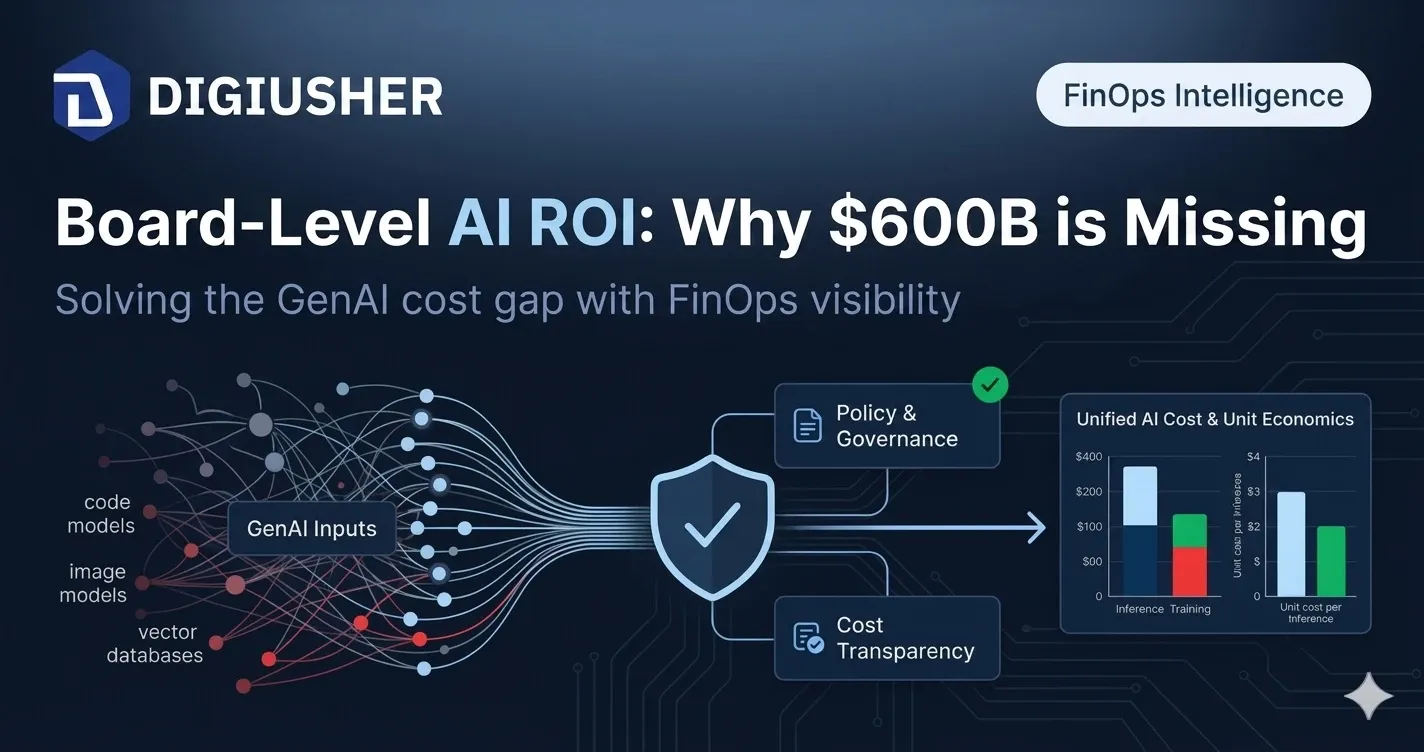
Board-Level AI ROI: Why $600B in Investment Is Delivering Single-Digit Returns — and What Fixes It
Only 7% of CFOs see high ROI from AI despite $270B in enterprise spend forecast for 2026. Here's the governance framework boards are demanding — and why cost attribution is the missing layer.
Seven Signals from the State of FinOps 2026: Why Technology Value Management Is Now a Board-Level Mandate
8% of FinOps teams now govern AI spend. Gartner forecasts $2.52T in global AI investment. The State of FinOps 2026 rewrites the rules for every CTO, CFO, and Head of FinOps.