Seven Signals from the State of FinOps 2026: Why Technology Value Management Is Now a Board-Level Mandate
8% of FinOps teams now govern AI spend. Gartner forecasts $2.52T in global AI investment. The State of FinOps 2026 rewrites the rules for every CTO, CFO, and Head of FinOps.
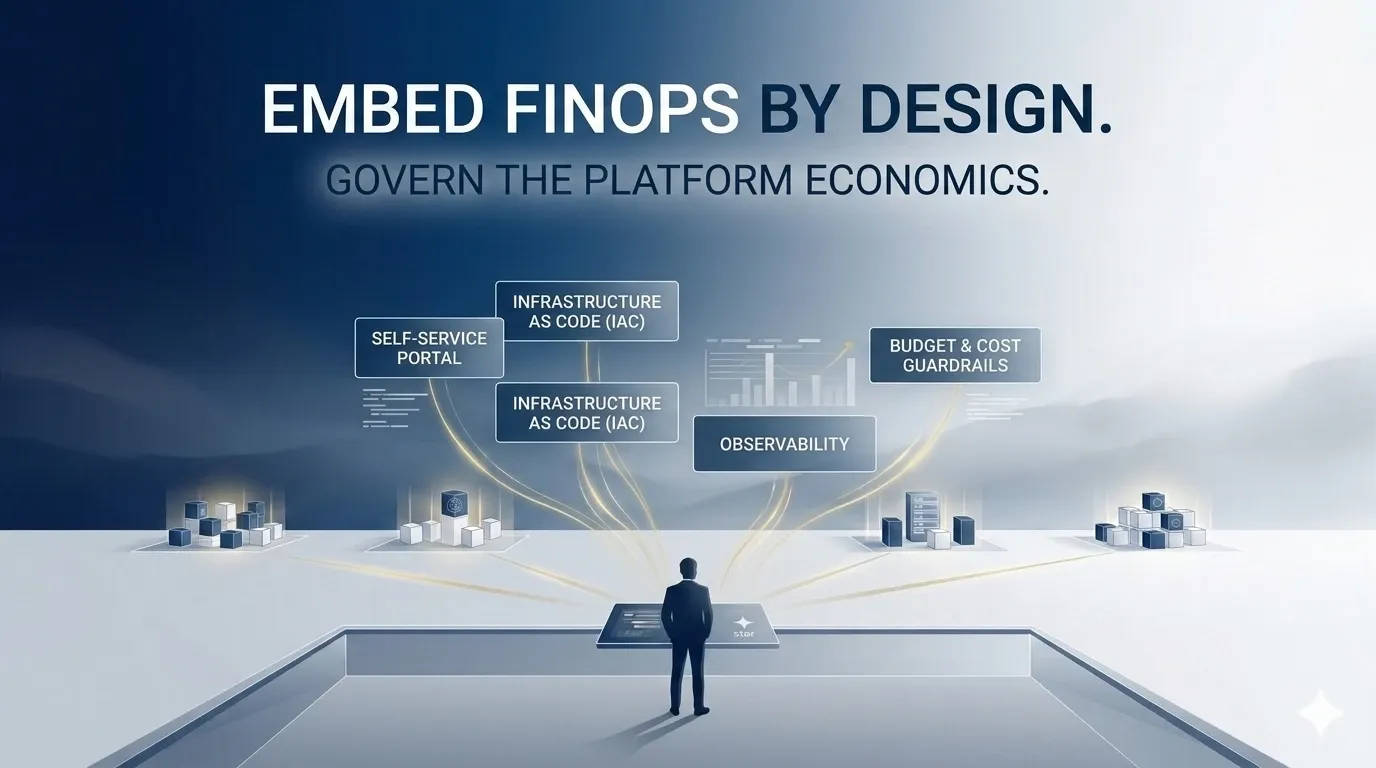
Two years ago, 31% of FinOps practitioners governed AI spend. Today, 98% do. No technology category in the history of the discipline has moved from emerging concern to universal scope that fast. Not Kubernetes. Not SaaS. Not reserved instances.
The FinOps Foundation’s State of FinOps 2026 — drawn from 1,192 practitioners representing over $83 billion in annual cloud spend — does not merely track a maturing practice. It documents a structural reinvention. FinOps has moved from a cloud cost management function to a board-level Technology Value Management discipline. The scope has expanded beyond cloud. The reporting line has migrated from Finance to Technology. The mission has shifted from reducing cost to governing value.
And the technology estate it must govern is expanding at a rate that makes 2023’s challenges look manageable. Gartner projects $2.52 trillion in global AI spending in 2026, a 44% year-over-year increase. Total global IT spending is expected to reach $6.31 trillion. Data centre systems spending alone is projected to grow 55.8%. The technology estate is compounding. The governance frameworks available to most enterprises are not.
This is not a FinOps trend report. It is a strategic analysis of what the 2026 data means for every CTO, CFO, and Head of FinOps who needs to answer a question the report confirms no one is yet answering well: what business value did our technology investment actually generate?
Executive Summary
- 98% of FinOps practitioners now govern AI spend, up from 31% two years ago — the fastest scope expansion the FinOps Foundation has recorded (State of FinOps 2026).
- 78% of FinOps practices report to the CTO/CIO organisation, up 18% from 2023. Reporting to the CFO has fallen to 8%.
- Practitioners with VP/C-suite engagement are 2-4x more likely to influence technology selection decisions than those engaging only at Director level.
- 90% of FinOps teams now manage SaaS or plan to within 12 months — up 25 percentage points in a single year.
- Traditional cloud optimisation is delivering diminishing returns: scope expansion, governance, organisational alignment, and forecasting now collectively outweigh optimisation as a priority.
- Only 21% of organisations have a mature governance model for autonomous AI agents, even as 40% of agentic AI projects face cancellation risk by 2027 (Deloitte / Gartner).
- The FinOps Foundation has formally updated its mission from “advancing the value of cloud” to “advancing the value of technology” — the most significant definitional shift in the discipline’s history.
Signal 1: AI Is No Longer Optional Scope
The 2026 survey result that demands the most immediate strategic attention is not the headline percentage. It is the trajectory. In 2024, 31% of FinOps practitioners managed AI spend. In 2025, 63%. In 2026, 98%. That is not gradual adoption. That is a category crossing the universality threshold in 24 months.
The commercial reality behind that number is equally striking. Gartner now forecasts $2.52 trillion in global AI spending for 2026 alone — a 44% year-over-year increase. GenAI model spending is projected to grow 80.8%. Building AI infrastructure is expected to drive a 49% increase in spending on AI-optimised servers. This is not technology investment at the margins. It is capital reallocation at a scale that rewrites enterprise cost structures.
AI Spend Governance: The Two-Year Arc
──────────────────────────────────────────────────────────────
Year        FinOps Practitioners Governing AI Spend
────────    ─────────────────────────────────────────
2024        31%
2025        63%    (+32pp — fastest prior growth)
2026        98%    (+35pp — governance reaches near-universality)
──────────────────────────────────────────────────────────────
Conclusion: AI is no longer a FinOps subspecialty.
            It is the core FinOps challenge.
──────────────────────────────────────────────────────────────
What makes this scope expansion categorically different from prior expansions is the nature of AI cost structures. Kubernetes costs were complex but predictable at the cluster level. SaaS costs were distributed but bounded by licence counts. AI costs are non-linear, non-deterministic, and capable of compounding autonomously. A single agentic workflow can trigger inference chains, tool calls, retrieval operations, and model retries that generate costs without any human decision point in the chain.
The State of FinOps 2026 identifies this clearly in its tooling priorities. The top capability request from practitioners is granular monitoring of AI spend: tokens, LLM requests, and GPU utilisation. This is not a dashboard enhancement request. It is evidence that the fundamental visibility requirements for AI governance do not yet exist in most enterprise environments.
One practitioner’s observation in the survey frames the challenge precisely: “Is your AI providing value? No one can answer that question yet.” At $2.52 trillion in global AI investment, that unanswered question is the most expensive knowledge gap in enterprise technology.
Signal 2: FinOps Has Shifted Up
In 2023, roughly 60% of FinOps practices reported into the CTO or CIO organisation. In 2026, 78% do. The CFO reporting line, once a natural home for a cost management function, has fallen to 8%. The shift has happened, and it is not reversing.
The strategic implication is not primarily organisational. It is about what FinOps can now accomplish. The State of FinOps 2026 provides a quantification that every FinOps leader should carry into their next executive conversation.
Practitioners who engage at the VP/SVP/EVP/C-suite level versus those engaging only at Director level show dramatically different influence over technology decisions:
| Decision Domain | VP/C-Suite Engagement | Director-Only Engagement |
|---|---|---|
| Cloud service selection | 53% influence | 24% influence |
| Cloud provider selection | 47% influence | 16% influence |
| Cloud vs. data centre placement | 28% influence | 12% influence |
The multiplier is not incidental. FinOps that operates at Director level retrospectively explains costs. FinOps that operates at VP/C-suite level shapes the technology architecture before commitments are made. The value difference between those two positions is the difference between optimising what was decided and influencing what gets decided.
This is the operational definition of FinOps shifting up — not a change in reporting structure but a change in where FinOps sits in the technology decision cycle. Practices that remain at the Director level in 2026 are not under-positioned politically. They are structurally excluded from the highest-value FinOps work: technology selection, multi-year commitment strategy, and pre-deployment investment governance.
For CIOs reading the data: the practices reporting into your organisation are 2-4x more strategically valuable when engaged at your leadership level than when confined to cost centre reviews. The return on executive engagement in FinOps is not qualitative goodwill. It is measurable influence over investment decisions worth hundreds of millions of dollars.
Signal 3: Optimisation Alone Is No Longer the Mission
The most telling passage in the State of FinOps 2026 comes not from the data but from the practitioners. One senior leader at a large enterprise describes reaching 97% optimisation in their Cost Optimisation Hub, with the remaining 3% intentionally not actioned for business reasons. Another describes having cleared the “big rocks” of cloud waste and now facing a high volume of smaller opportunities requiring more effort to capture.
These are not failure statements. They are maturity statements. Classic cloud optimisation — right-sizing, reserved instance coverage, waste elimination — has been so thoroughly executed by mature FinOps programmes that it now produces diminishing returns at the margin. The value floor has been reached.
The 2026 data reflects this transition in the priority landscape. When scope expansion, governance and policy, organisational alignment, and forecasting are combined, they collectively outweigh workload optimisation as the dominant priority of the practice. The centre of gravity has shifted from reducing cost to governing value.
This distinction matters enormously for platform evaluation. A FinOps platform designed primarily for cloud cost optimisation — one whose core value proposition is committed spend coverage, rightsizing recommendations, and waste detection — delivers excellent value on a problem that mature enterprises have largely solved. The capability gaps that matter in 2026 are different: unit economics attribution, AI value quantification, pre-deployment cost governance, and the ability to connect technology spend to business outcomes at a level that finance and board audiences can act on.
The report’s conclusion is direct: mature practices focus on value capabilities, not cost capabilities. The enterprise that evaluates FinOps platforms against a 2021 requirement set will select a platform optimised for a problem it has already solved.
Signal 4: The Measurement Crisis Is Real, and It Is Getting Worse
The State of FinOps 2026 surfaces a governance paradox that becomes more acute as FinOps shifts left. Practitioners are embedding financial requirements earlier in engineering and product lifecycles — pricing calculators, pre-deployment cost estimates, architecture costing gates — with measurable success in preventing expensive infrastructure choices before they are deployed. But the incentive structures have not caught up.
One practitioner frames the paradox precisely: “Once you fix it, it’s gone. How do we give developers credit for shift-left activities?” The cost that was not incurred does not appear in any dashboard. The waste that was prevented generates no saving on the month-end report. Pre-deployment governance is invisibly valuable and invisibly executed.
This measurement problem extends to AI governance in a compounded form. AI ROI is the most discussed and least resolved question in enterprise technology in 2026. Deloitte’s State of AI in the Enterprise, drawn from 3,235 senior leaders, finds that only 34% of organisations are truly reimagining their business with AI — the rest are deploying tools without the value attribution framework to demonstrate whether those tools are working.
The commercial consequence is concrete: 40% of agentic AI projects are at risk of cancellation by 2027, per Gartner, not primarily because the technology fails but because organisations cannot demonstrate the value it generates. The ROI question that one FinOps practitioner says no one can answer yet is the same question that will determine whether enterprise AI investments survive their first board-level review.
Pre-deployment architecture costing — the #2 tooling request in the State of FinOps 2026 — is the practitioner community’s proposed solution to the left-side measurement gap. The request is clear: build the cost estimate before the commitment is made, make it attributable to a business outcome, and give engineers a way to demonstrate the economic impact of their architecture choices before deployment makes those choices irreversible.
Signal 5: The Multi-Technology Estate Is Here, and the Platform Has to Match
The scope expansion data in the State of FinOps 2026 is not a trend. It is a redefinition.
Technology Scope Under FinOps Governance: 2025 vs 2026
──────────────────────────────────────────────────────────────
Technology Category   2025 Coverage   2026 Coverage   Change
──────────────────    ─────────────   ─────────────   ──────
AI                    63%             98%             +35pp
SaaS                  65%             90%             +25pp
Licensing             49%             64%             +15pp
Private Cloud         39%             57%             +18pp
Data Centre           36%             48%             +12pp
Labour Costs          —               28%             Emerging
──────────────────────────────────────────────────────────────
Source: FinOps Foundation — State of FinOps 2026
──────────────────────────────────────────────────────────────
A practitioner quoted in the report describes the progression with characteristic directness: “First they asked us to fix cloud. Then fix the software mess. Now it’s fix the contract and license mess, now fix the data centre…” Each mandate arrives faster than the last. Each requires a different billing model, a different attribution approach, and a different optimisation playbook.
The #3 tooling request in the State of FinOps 2026 is a “single pane of glass” for different technology spend categories. This is not a UX preference. It is an architectural requirement that the current FinOps tool landscape cannot meet for most enterprises. The majority of FinOps platforms were designed for public cloud. SaaS governance was added as a product extension. AI governance is being retrofitted from cloud infrastructure tooling. Data centre coverage is a roadmap item.
The consequence is a tooling stack that grows in direct proportion to scope — one tool for cloud, one for SaaS, one for Kubernetes, one for AI — producing exactly the fragmented, multi-system landscape that makes unified attribution impossible and executive reporting a manual exercise. The practitioners asking for a single pane of glass are not asking for a better dashboard. They are asking for a platform architecture designed to govern the full estate from the outset.
The FinOps OS concept — a platform whose architecture spans the complete technology cost surface, with a unified data model, shared attribution framework, and consistent policy enforcement across every spending domain — is the architectural response to this demand. Not a point solution. Not a cloud tool with extensions. A technology value operating system.
Signal 6: FOCUS Becomes the Governance Foundation
The FinOps Open Cost and Usage Specification (FOCUS) is growing in adoption in direct proportion to scope expansion — and this relationship is structural, not coincidental.
When FinOps governed a single cloud provider, normalising billing data was a configuration challenge. When it governs AWS, Azure, GCP, OCI, Azure OpenAI, AWS Bedrock, Snowflake ML, Databricks, and data centre infrastructure simultaneously, normalising billing data is an architectural requirement. Without a common schema, cross-technology attribution is impossible, unit economics cannot be computed, and the single pane of glass practitioners are requesting cannot be built.
The State of FinOps 2026 shows FOCUS adoption growing across the community, with the top expansion requests concentrated in exactly the domains where scope is growing fastest: AI workloads, data centre, and broader SaaS/PaaS support. Practitioners are not asking for FOCUS because it is technically elegant. They are asking because they cannot govern a multi-technology estate without it.
The distinction between FOCUS-native and FOCUS-compatible is not a marketing differentiation. It is an architectural one with direct operational consequences. A FOCUS-compatible platform applies the specification as an export format — normalising data into FOCUS schema for reporting purposes while maintaining a proprietary internal data model. A FOCUS-native platform builds the specification as the foundational data architecture, meaning every provider integration, every attribution model, and every governance policy operates on a consistent FOCUS schema from the point of ingestion.
As FinOps scope expands to AI tokens, SaaS licence consumption, and data centre power units alongside cloud compute and storage, the FOCUS-native architecture is the only model that can deliver consistent attribution across all domains without custom integration work for each new technology category. Platforms that are not FOCUS-native will require increasing engineering investment to extend governance as scope expands — precisely at the moment when lean teams cannot afford that overhead.
Signal 7: The Agentic Frontier Changes Everything
Agentic AI — autonomous systems that make decisions, execute workflows, and call external tools without human checkpoints — is not a future concern. It is a 2026 deployment reality, and the State of FinOps 2026 data confirms that governance has not kept pace.
Gartner forecasts that 40% of enterprise applications will embed task-specific AI agents by the end of 2026, up from less than 5% in 2025. The global AI agents market is projected to reach $12 billion in 2026. And yet only 21% of organisations have a mature governance model for autonomous AI agents. Forty per cent of agentic AI projects face cancellation risk by 2027 — not because the technology fails but because the business cannot demonstrate ROI and cannot control cost.
The structural challenge that agentic AI introduces to FinOps is the one the report points at without fully resolving: machine-speed economic decisions cannot be governed by human-speed review. When an agentic system can generate thousands of inference events, API calls, and tool invocations before the morning standup, the governance model that relies on monthly billing review or weekly anomaly reports is not a methodology. It is an absence of governance dressed as a methodology.
Teams managing $100M+ estates with 8-10 practitioners — the median configuration in the State of FinOps 2026 — cannot manually govern agentic AI at scale. The only viable governance model is automated: budget caps enforced at the infrastructure level, agentic kill-switches that pause or terminate workflows exceeding cost envelopes, real-time anomaly detection that identifies unexpected spend patterns before they compound, and per-chain attribution that traces every economic event back to the business decision that authorised it.
This is the FinOps requirement that the current generation of platforms was not designed to meet. It requires governance architecture that operates in the hot path of AI execution — not after the fact, not in retrospect, not through manual review — but as a control plane embedded in the AI infrastructure itself.
What the FinOps OS Must Do in 2026
The State of FinOps 2026 is, read carefully, a platform requirements document. Seven signals across scope, organisational position, tooling demand, and governance architecture define what an enterprise FinOps platform must deliver in 2026 to be fit for purpose. Not aspirationally fit for purpose — operationally fit for purpose for the practice as it exists today.
2026 FinOps OS Capability Requirements
──────────────────────────────────────────────────────────────
Requirement                     Minimum Specification
────────────────────            ─────────────────────────────
Technology Coverage             Multi-cloud + Kubernetes + AI
                                workloads + SaaS + DC + licensing
Data Architecture               FOCUS-native (not compatible)
AI Governance                   Token caps, GPU idle detection,
                                agentic kill-switches,
                                per-chain attribution
Pre-deployment Costing          Architecture cost estimation
                                before infrastructure provisioning
Unit Economics                  Business-outcome attribution,
                                not just spend reporting
Executive Reporting             Board-ready technology value
                                metrics, AI ROI quantification
Deployment Flexibility          SaaS, Managed SaaS, BYOC for
                                regulated industries
Licensing Model                 Flat enterprise pricing — no
                                percentage-of-spend exposure
──────────────────────────────────────────────────────────────
Platforms that were designed for public cloud optimisation and extended toward AI coverage cannot meet this specification natively. The data model limitations, the single-cloud architecture assumptions, and the retrospective optimisation orientation create structural constraints that feature additions cannot resolve.
The FinOps OS is not a rebrand of a cloud cost management tool. It is a distinct architectural category: a platform designed from the ground up to govern the full technology estate, built on a FOCUS-native data model, with AI governance architecture that operates at machine speed, and business value attribution that connects infrastructure investment to measurable commercial outcomes.
DigiUsher is built as that FinOps Operating System. The platform governs multi-cloud infrastructure across AWS, Azure, GCP, OCI, and Alibaba Cloud; Kubernetes across EKS, AKS, GKE, and OKE; AI workloads across Azure OpenAI, AWS Bedrock, Google Vertex AI, Databricks, and Snowflake ML; SaaS, marketplace transactions, licensing, and data centre — through a single FOCUS-native architecture. AI governance capabilities — token budget caps, agentic kill-switches, GPU idle detection, and per-chain attribution — are built natively, not retrofitted from cloud infrastructure tooling.
DigiUsher’s flat enterprise licensing model means governance costs do not scale as a percentage of cloud spend. As the technology estate grows — and the State of FinOps 2026 confirms it will — the platform cost remains predictable. For enterprises managing $100M+ estates with lean teams, percentage-of-spend pricing at ~3% of cloud spend creates a governance cost exposure that grows in proportion to the exact investments those teams are trying to govern.
For regulated industries — banking, insurance, healthcare, government — DigiUsher’s self-hosted BYOC deployment option delivers the same FinOps OS capability within the organisation’s own infrastructure boundary. A leading private bank has deployed DigiUsher at institutional scale on this basis, meeting the data sovereignty requirements that cloud-only platforms structurally cannot meet.
DigiUsher is listed on AWS Marketplace as an ISV Accelerate Partner, on Azure Marketplace as ISV Co-Sell Ready and MACC-eligible, and on GCP Marketplace — giving enterprise buyers the procurement flexibility and committed spend eligibility that marketplace transactions increasingly require. Four of the top ten global system integrators deliver DigiUsher globally, including Infosys, Wipro, and Hexaware.
The FinOps Foundation’s mission update — from cloud to technology — signals where the practice is going. The platform an enterprise selects in 2026 needs to already be there.
FAQ
What does the State of FinOps 2026 report tell us about the future of FinOps?
The State of FinOps 2026 — the sixth annual survey by the FinOps Foundation, drawing on 1,192 practitioners representing over $83 billion in annual cloud spend — signals a structural transformation of the discipline. FinOps is no longer a cloud cost management function. It is a Technology Value Management practice that governs the full enterprise technology estate: AI, SaaS, licensing, private cloud, data centre, and public cloud infrastructure.
Three shifts define the moment. First, 98% of practitioners now manage AI spend, up from just 31% two years ago — the fastest scope expansion the Foundation has ever recorded. Second, 78% of FinOps practices now report to the CTO or CIO organisation, not Finance, reflecting a permanent migration toward technology leadership. Third, traditional optimisation is approaching diminishing returns — as one senior practitioner quoted in the report notes, the “big rocks” of cloud waste have largely been cleared, and the next wave of value comes from governing and shaping technology spend before commitments are made.
The FinOps Foundation formalised this evolution by updating its own mission from “advancing the value of cloud” to “advancing the value of technology” — the clearest possible signal that the category has crossed a structural threshold.
Why is AI cost governance now the top FinOps priority in 2026?
FinOps for AI has emerged as the single top forward-looking priority in the State of FinOps 2026 for three compounding reasons. First, the scale is unprecedented: Gartner forecasts $2.52 trillion in global AI spending in 2026, and 98% of FinOps teams now govern this spend directly. Second, AI cost structures are fundamentally different from cloud infrastructure — token consumption, inference chains, GPU idle cycles, and agentic autonomous spend decisions do not respond to classic optimisation playbooks. Third, governance has not kept pace with deployment: only 21% of organisations have a mature model for governing autonomous AI agents, even as 40% of agentic AI projects face cancellation risk by 2027.
The combination of accelerating spend, opaque cost structures, and absent governance is the definition of a governance emergency. Conventional FinOps tooling — designed for predictable cloud infrastructure — cannot resolve it.
What is Technology Value Management and how does it differ from traditional FinOps?
Technology Value Management (TVM) is the discipline of governing, attributing, and optimising the complete cost surface of enterprise technology — public cloud, Kubernetes, AI workloads, SaaS, licensing, private cloud, and data centre — in order to connect every technology investment to measurable business outcomes.
It differs from traditional FinOps in three ways. Scope: FinOps was designed for public cloud infrastructure; TVM governs the entire technology estate. Attribution: FinOps optimised spend; TVM attributes value — answering not just what was spent but what business outcome that spend generated. Organisational position: FinOps sat between engineering and finance; TVM sits at the technology strategy layer, influencing which technologies to adopt and how to present technology ROI to boards.
The FinOps Foundation’s mission update formalises the supersession of the narrower FinOps definition.
How does FinOps shifting up change the strategic value of the function?
Practitioners with VP/SVP/C-suite engagement are 2-4x more likely to influence technology selection decisions than those engaging only at Director level — including cloud service selection (53% vs. 24%), cloud provider selection (47% vs. 16%), and cloud versus data centre placement (28% vs. 12%). The multiplier is direct: FinOps that operates at executive level shapes the technology investment strategy before commitments are made. FinOps that remains at Director level explains costs after commitments have compounded.
For CIOs, the implication is direct: FinOps practices reporting into the technology organisation generate the highest strategic return when engaged at the VP and above level. The executive investment in FinOps leadership is not an operational expense. It is a technology ROI multiplier.
Why is the FOCUS specification important for enterprise FinOps in 2026?
As FinOps scope expands across AI, SaaS, licensing, private cloud, and data centre simultaneously — each with different billing formats, data structures, and attribution conventions — the ability to normalise cost data into a single consistent schema becomes the prerequisite for any meaningful governance. FOCUS provides that schema.
Platforms that are FOCUS-native build the specification as the structural foundation of their data architecture. Platforms that are FOCUS-compatible apply it as an export format. The distinction matters at enterprise scale: FOCUS-native platforms can attribute AI token costs, GPU cycles, and SaaS licence consumption using the same governance model applied to cloud infrastructure, without custom integration work for each new technology category. As scope expands, FOCUS-native platforms scale; FOCUS-compatible platforms require increasing engineering overhead to maintain governance consistency.
What governance does agentic AI require from a FinOps platform in 2026?
Agentic AI — autonomous systems that make decisions and execute workflows without human checkpoints — generates costs at machine speed. Manual governance models designed for cloud infrastructure cannot govern agentic systems at the rate they generate economic events.
Effective agentic AI governance requires four capabilities built into the platform’s control architecture: budget caps enforced at the infrastructure level that prevent agentic systems from exceeding approved cost envelopes; kill-switches that pause or terminate workflows when cost thresholds are breached; real-time anomaly detection that identifies unexpected spend patterns before they compound; and per-chain attribution that traces every economic event back to the business decision that authorised it. Platforms that cannot deliver all four natively are not equipped to govern agentic AI at the scale Gartner projects — 40% of enterprise applications embedding task-specific agents by end of 2026.
How should enterprises evaluate FinOps platforms against the 2026 State of FinOps requirements?
Seven criteria define fitness for the 2026 FinOps environment. Technology coverage: can the platform govern multi-cloud, Kubernetes, AI workloads, SaaS, licensing, and data centre through a single data model? Data architecture: is the platform FOCUS-native or FOCUS-compatible? AI governance: does the platform provide token budget caps, GPU idle detection, agentic kill-switches, and per-chain attribution natively? Pre-deployment costing: can the platform provide cost estimates before infrastructure is provisioned? Unit economics: can the platform connect spend to business outcomes rather than just reporting spend? Deployment flexibility: does the platform support BYOC self-hosted deployment for regulated industries? Licensing model: does platform cost scale as a percentage of cloud spend, creating a governance cost that compounds with the estate it is intended to manage?
Platforms that cannot demonstrate native capability across these seven criteria are optimised for the FinOps challenge of 2021, not 2026.
References
- FinOps Foundation — State of FinOps 2026 (data.finops.org)
- FinOps Foundation — Mission Update: Advancing the Value of Technology (finops.org)
- Gartner — Worldwide AI Spending Forecast: $2.52 Trillion in 2026 (January 2026)
- Gartner — Worldwide IT Spending Forecast: $6.31 Trillion in 2026 (April 2026)
- Gartner — Worldwide Sovereign Cloud IaaS Spending: $80 Billion in 2026 (February 2026)
- IDC — Worldwide AI Infrastructure Tracker: $758 Billion by 2029
- Deloitte — State of AI in the Enterprise 2026 (3,235 senior leaders surveyed)
- Deloitte — AI Governance: Why Senior Leadership Alignment Determines AI Value
- FinOps Foundation — FOCUS: FinOps Open Cost and Usage Specification (focus.finops.org)
- FinOps Foundation — How ITAM Intersects with FinOps Capabilities (Working Group)
- FinOps Foundation — FinOps for Data Centre: Practical Cost Modelling and FOCUS Alignment
- Gartner — Agentic AI Enterprise Adoption Forecast: 40% of Applications by End 2026
Schedule a Technology Value Assessment with DigiUsher
The State of FinOps 2026 has redrawn the map. Is your governance platform built for where FinOps is going — or where it has been?
DigiUsher’s FinOps Operating System governs the complete technology estate that the 2026 data demands: multi-cloud, Kubernetes, AI workloads, SaaS, licensing, and data centre — through a single FOCUS-native architecture. AI governance capabilities including token budget caps, agentic kill-switches, GPU idle detection, and per-chain attribution are built natively, not retrofitted.
In 45 days, a leading European energy utility identified €1 million in savings they could not see before. A leading private bank deployed DigiUsher on a self-hosted BYOC basis, meeting regulated-industry data sovereignty requirements that SaaS-only platforms cannot address.
DigiUsher in 15 min
Give your board a cost-to-outcome view they can actually act on.
DigiUsher connects cloud and AI spend to the outcomes it funds, in language finance already speaks.
Book my 15-min discovery callNo hard pitch · tailored to your stack
Continue Reading
More from the DigiUsher editorial team.
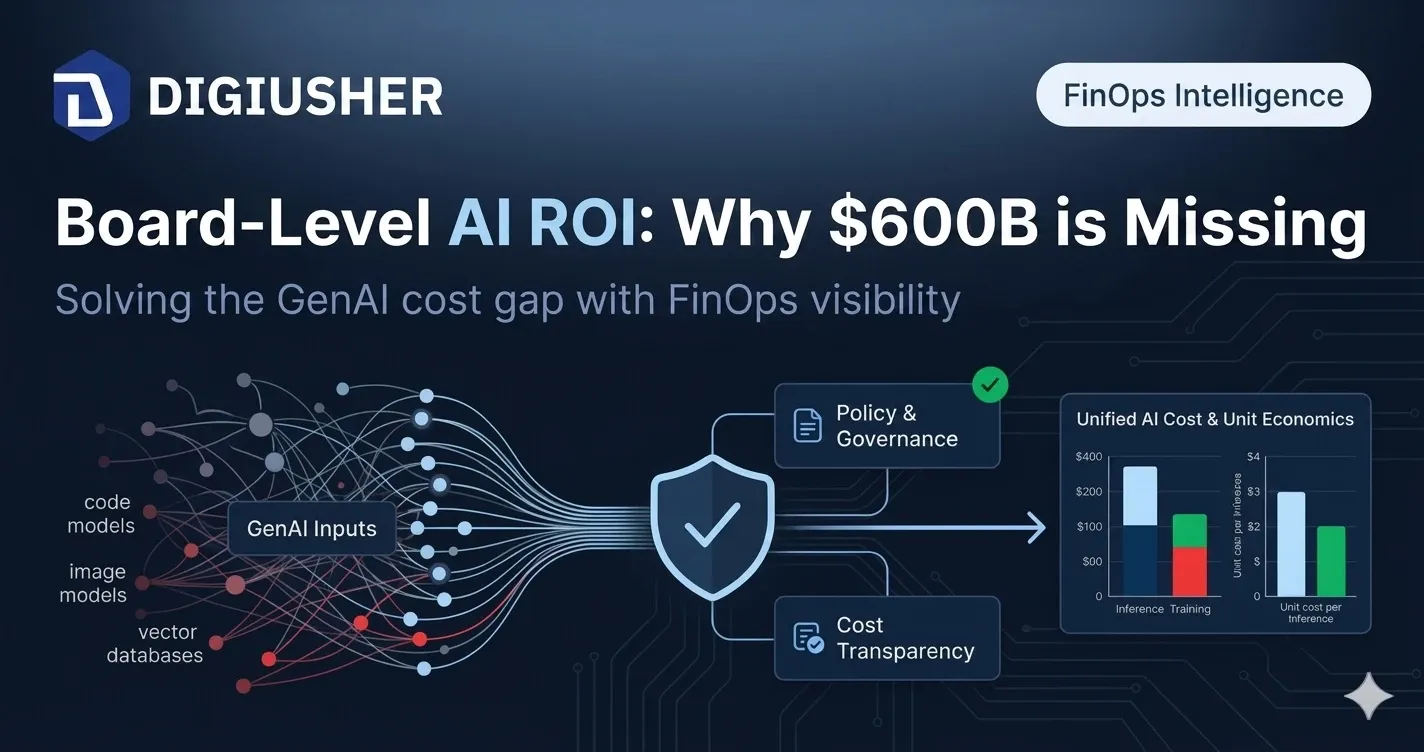
Board-Level AI ROI: Why $600B in Investment Is Delivering Single-Digit Returns — and What Fixes It
Only 7% of CFOs see high ROI from AI despite $270B in enterprise spend forecast for 2026. Here's the governance framework boards are demanding — and why cost attribution is the missing layer.
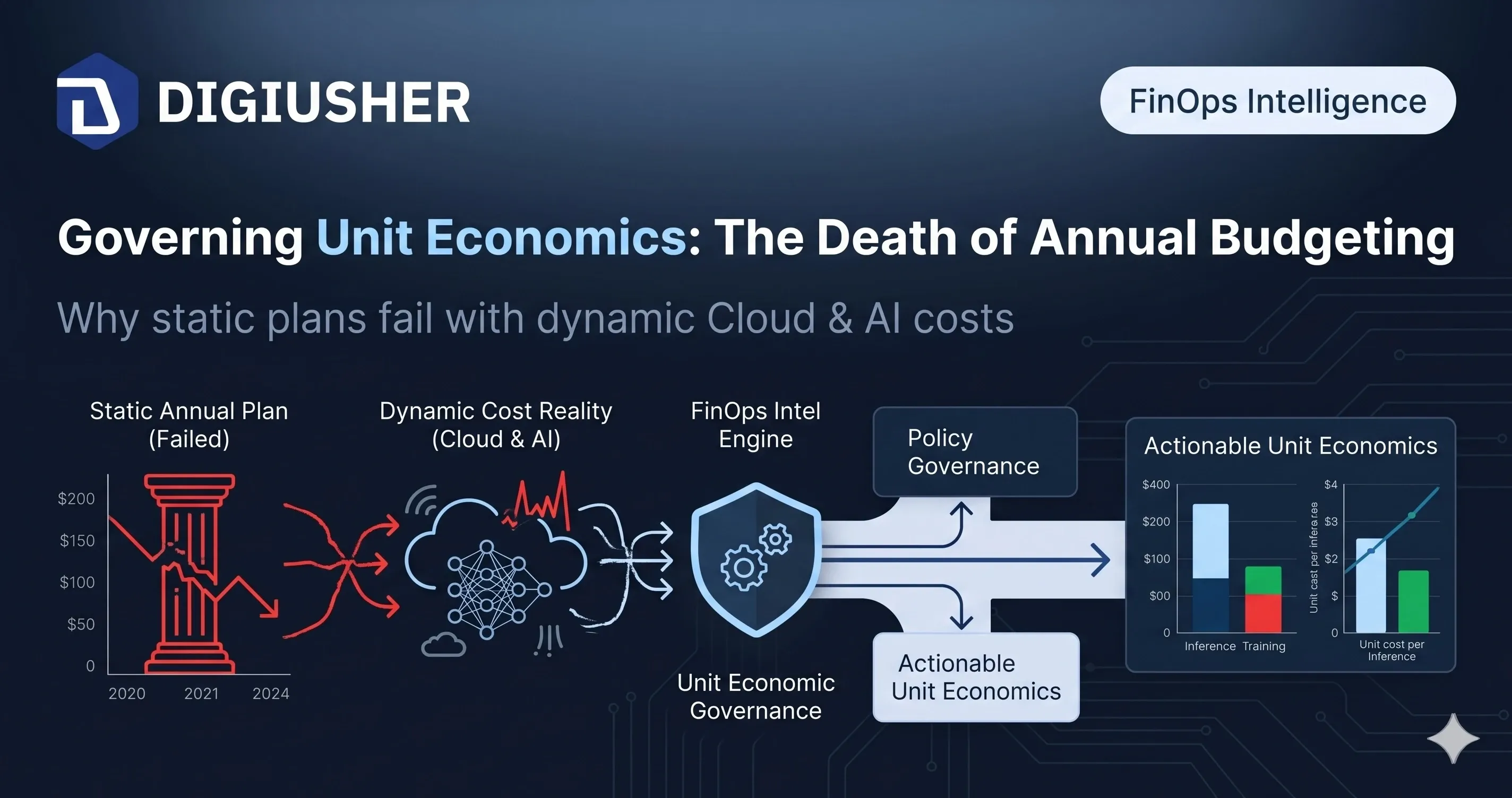
Why Cloud and AI Budgets Fail Annual Planning
Annual planning was built for fixed assets. Cloud and AI spend is consumption-driven, non-linear, and breaks the 12-month budget cycle. Here is what replaces it.
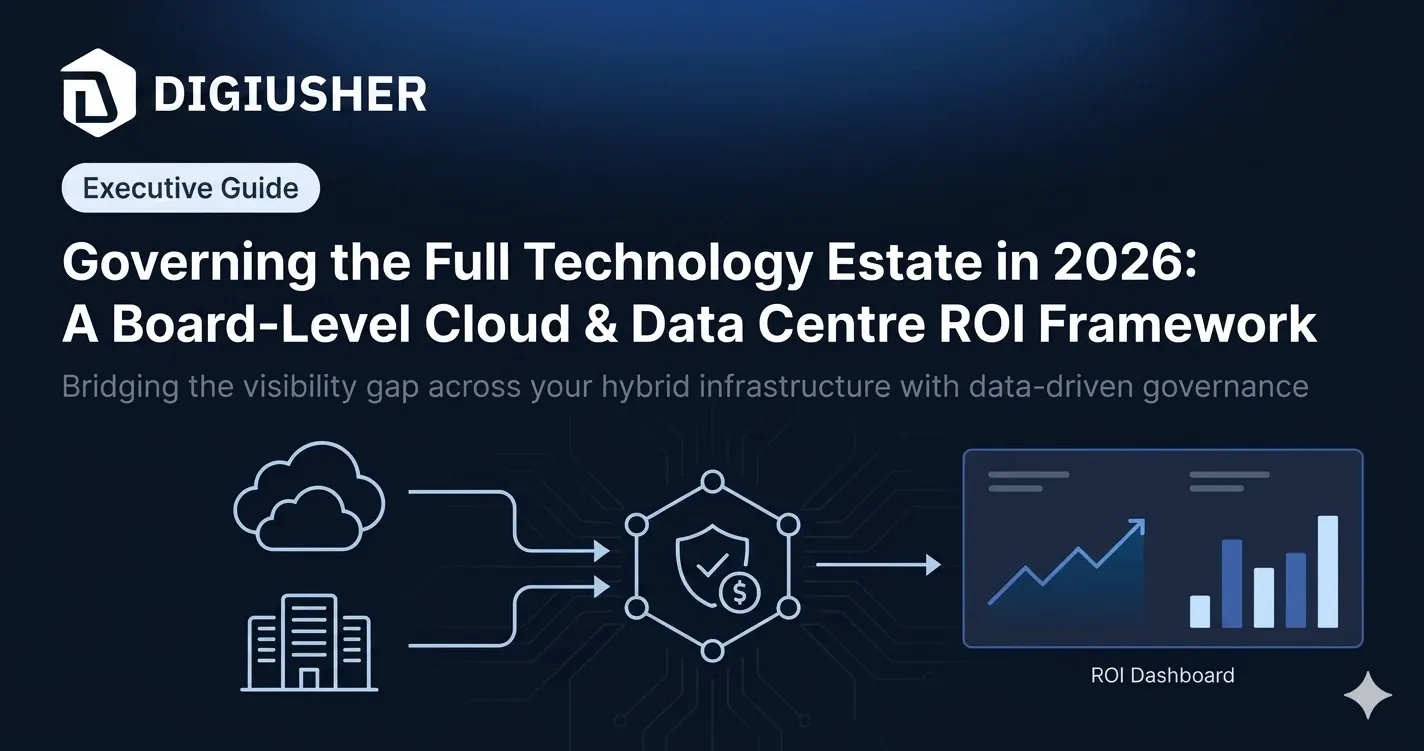
Board-Level Cloud and Data Centre ROI: Governing the Full Technology Estate in 2026
Cloud waste runs at 29-35% of spend. GPU idle time hits 30-60%. Data centre costs surpass $650B in 2026. Here is the board-level governance framework that connects every infrastructure dollar to measurable business value.