Board-Level AI ROI: Why $600B in Investment Is Delivering Single-Digit Returns — and What Fixes It
Only 7% of CFOs see high ROI from AI despite $270B in enterprise spend forecast for 2026. Here's the governance framework boards are demanding — and why cost attribution is the missing layer.
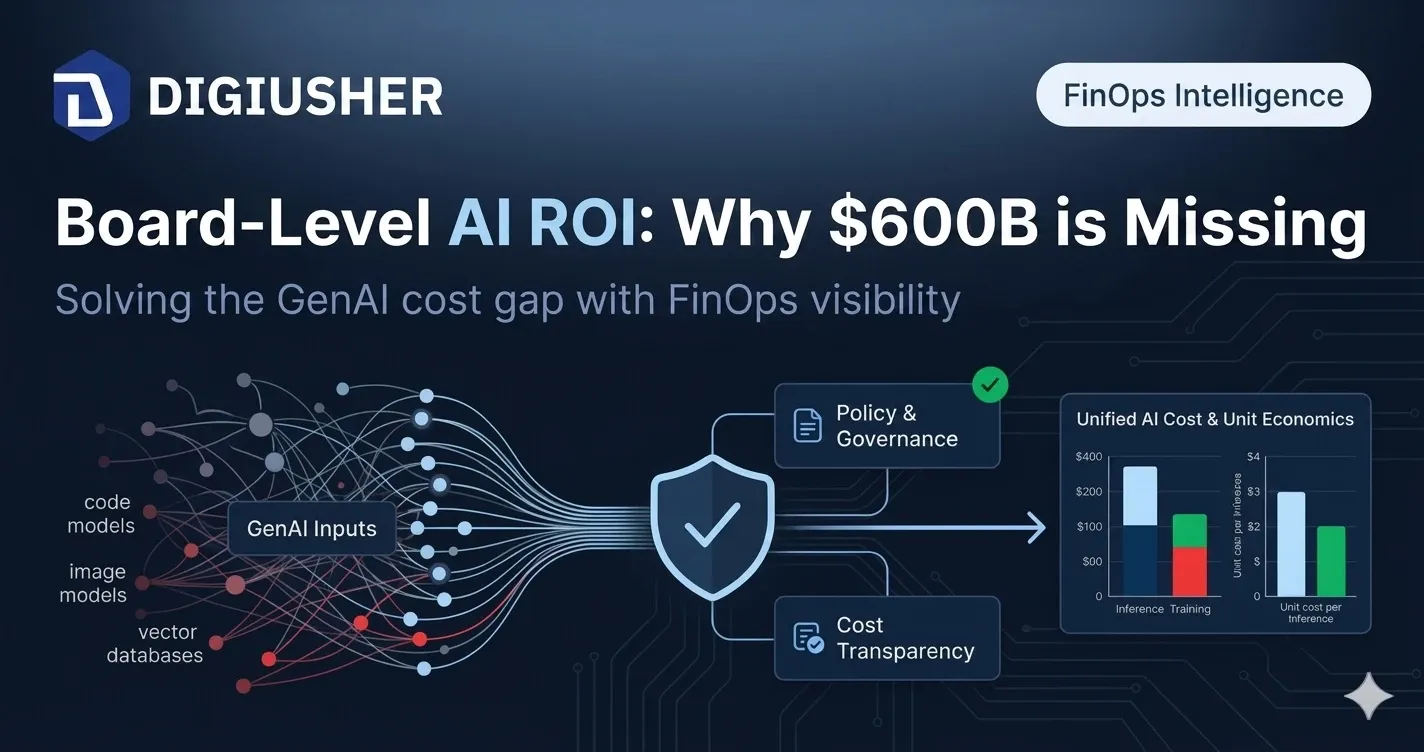
Enterprises have deployed an estimated $600 billion more in AI capital than they have generated in measurable enterprise revenue. That is not a technology problem. It is a board-level governance failure — one that is accelerating as AI budgets grow and the questions boards are prepared to ask become sharper.
Only 7% of CFOs report seeing high ROI from AI in their finance functions, and a December 2025 survey of 200 U.S. finance chiefs found that just 14% have seen a clear, measurable financial impact from AI investments to date — despite two-thirds expecting impact within two years. The gap between what AI costs and what AI demonstrably returns is not a rounding error. At the capital deployment scale enterprises are now operating, it is a material budget control failure.
Three quarters of CFOs are raising their technology budgets for 2026, with nearly half increasing by 10% or more. That investment acceleration makes the measurement problem more urgent, not less. Boards that accepted “build and learn” rationales for AI pilots in 2024 are applying capital allocation discipline in 2026. CFOs who cannot connect AI infrastructure spend to P&L lines in financial — not anecdotal — terms are losing credibility in the room.
This briefing explains why the measurement gap persists, what boards are now requiring, and what governance architecture closes it.
Executive Summary
- The ROI gap between AI capital deployed and revenue generated has grown to approximately $600 billion, making AI financial accountability the defining CFO challenge of 2026.
- Only 7% of CFOs see high ROI from AI functions, and Gartner warns that without governance and outcome-aligned roadmaps, more than half of AI pilots risk abandonment.
- 84% of enterprises report AI costs cutting gross margins by more than 6%, while only 15% can forecast AI costs within ±10% accuracy.
- 74% of enterprises want AI to drive revenue growth; only 20% have achieved it — across 3,235 business leaders in 24 countries surveyed by Deloitte in 2026.
- 98% of FinOps teams now manage AI spend, up from 63% in 2025, confirming that AI cost governance has crossed from experimental to mainstream enterprise imperative.
- By 2029, Gartner projects CFOs who implement strategic AI technology portfolio governance will unlock an additional 10 gross margin points — contingent on attribution discipline and outcome-aligned governance, not spend volume alone.
The $600B Accountability Gap — and Why Boards Now Own It
The mathematics of enterprise AI investment in 2026 are stark. Gartner predicts worldwide AI spending will top $2 trillion by 2026. Enterprise AI application software spending alone is projected to reach $270 billion — nearly triple 2024 levels — while big technology companies are projecting over $500 billion in AI infrastructure investment. The aggregate return on that capital, expressed in financial terms boards recognise, does not match the investment thesis.
The ROI gap between capital deployed and revenue generated has grown to approximately $600 billion. Boards have stopped counting pilots and started counting dollars, and 61% of senior business leaders now feel more pressure to prove AI ROI than they did a year ago.
The pressure is not evenly distributed. A May 2025 Gartner survey of 506 CIOs found that 72% of organisations are breaking even or losing money on their AI investments. As a result, the CFO role in AI decisions has expanded significantly — Deloitte’s Finance Trends 2026 survey found that 57% of finance executives now count themselves among the top leaders driving AI strategy, a significant shift from the traditional CFO role as budget approver and cost controller.
That shift has consequences for how AI must be governed. When the CFO is an AI strategy co-owner — not just a budget gatekeeper — they need financial infrastructure that gives them a defensible view of what AI is producing in financial terms. A cloud cost dashboard showing aggregate GPU spend does not provide that view. A board-level AI ROI framework requires attribution at the unit of production.
What the Board Is Actually Asking
The questions boards are now posing to CFOs are structurally different from the questions they asked 18 months ago. The 2024 board question was “are we investing enough in AI?” The 2026 board question is “what is each AI investment returning, and how does that compare to the capital we could deploy elsewhere?”
Those questions require different answers. They require an AI-Specific P&L.
AI-Specific P&L is a discrete financial ledger within an organisation’s management accounts that attributes AI infrastructure costs — including model inference tokens, GPU compute, orchestration overhead, and data platform charges — to the revenue lines, products, or customer segments those AI workloads directly serve. Unlike general cloud cost allocation, an AI-Specific P&L captures the full token economics of each AI application and connects gross margin impact to measurable business outcomes, giving CFOs and boards a financially rigorous basis for AI capital allocation decisions.
Google Cloud’s research on top-performing AI enterprises found they generate $10.30 in value for every dollar of AI investment, against a broader enterprise average of $3.70 — a 2.8x performance gap. The difference is not explained by the sophistication of the underlying models. It is explained by attribution discipline: the capacity to measure, at the workload and application level, what each AI capability costs and what it returns.
Why Activity Metrics Fail Boards — and What They Are Replacing
The dominant AI measurement architecture inside most large enterprises was designed for a different audience. Queries processed per day, tokens consumed per month, model uptime, latency percentiles, and adoption rates are operational metrics — they tell platform engineering teams whether the infrastructure is functioning. They tell CFOs and boards nothing they need to know about capital efficiency.
Gartner’s survey of 782 infrastructure and operations leaders in late 2025 found that only 28% of AI use cases fully succeed and meet ROI expectations, with 20% failing outright — and the primary cause of failure was not technical deficiency but the absence of business outcome integration. Leaders whose AI initiatives succeeded attributed that success primarily to integrating AI into existing workflows and securing full business executive support.
The measurement architecture problem runs deeper than metric selection. Larridin’s February 2026 research found that enterprises typically discover more than 150 AI applications in active use when they conduct a proper AI inventory — against an expectation of roughly 30. The ungoverned majority of that estate has no attribution infrastructure. AI spend that proliferated organically through developer tooling, SaaS subscriptions, and marketplace purchases is generating token costs with no corresponding measurement of what those costs are producing. That spend cannot demonstrate its value to a board regardless of what it is actually returning, because the financial infrastructure to prove it does not exist.
The Three Measurement Failures That Destroy Board Credibility
Measurement failure one: cost without attribution. AI infrastructure costs land in cloud bills, broken out by account and service, but not by the product, customer segment, or business process they serve. A CFO presenting a $4M quarterly AI infrastructure cost cannot tell the board what percentage of that cost is generating customer-facing revenue and what percentage is idle GPU capacity or experimental workloads with no production ROI case.
Measurement failure two: activity metrics instead of outcome metrics. Token consumption, API call volumes, and model query rates are reported to the board as evidence of AI programme momentum. None of these metrics are connectable to gross margin. A board member who asks “what is this generating in revenue?” cannot receive a meaningful answer from an activity report.
Measurement failure three: no baseline before deployment. Research from multiple institutions identifies the absence of pre-deployment baselines as the most common cause of AI ROI measurement failure. Without a defined performance baseline before deployment, it is mathematically impossible to calculate ROI. You cannot measure progress from an undefined starting point.
The AI-Specific P&L Imperative
The term “AI-Specific P&L” is appearing in board papers and audit committee agendas that did not contain it 12 months ago. The reason is structural: AI cost behaviour is materially different from the technology cost behaviour boards have governed before, and existing financial frameworks do not contain it well.
Traditional infrastructure cost is provisioned-resource cost. A server runs at a known rate. A software licence costs a fixed annual fee. The depreciation schedule is predictable. Budget variances at the cloud account level are explainable in a quarterly variance analysis.
AI cost is token-consumption cost — and token consumption is determined by design decisions, model versions, prompt architectures, and agentic workflows that are changing continuously, often without a capital approval gate. AI Cost Governance Report 2025 data shows that even minor changes in a prompt, model version, or agent workflow can spike GPU hours or token consumption by 100x overnight. Only 15% of enterprises can forecast AI costs within ±10% accuracy, and nearly one in four miss AI cost forecasts by more than 50%.
A 50% budget variance on a material cost category would trigger an audit committee response in any other context. The reason it has not triggered one for AI spend is that boards do not yet have the reporting infrastructure to see it happening in real time. The AI-Specific P&L creates that infrastructure.
What Board-Ready AI Financial Reporting Contains
AI-Specific P&L Structure: Board Reporting Framework
──────────────────────────────────────────────────────────────
REVENUE ATTRIBUTION
──────────────────────────────────────────────────────────────
AI-enabled revenue (attributed)           £XX.XM
  └─ Customer-facing AI products          £XX.XM
  └─ AI-augmented sales / service         £XX.XM
  └─ Internal productivity (quantified)   £XX.XM

AI COST OF PRODUCTION (FULLY LOADED)
──────────────────────────────────────────────────────────────
Inference cost (tokens × model price)     £XX.XM
  └─ Azure OpenAI                         £X.XM
  └─ AWS Bedrock                          £X.XM
  └─ Vertex AI / Gemini                   £X.XM
GPU compute (training + idle)             £X.XM
Orchestration and data platform           £X.XM
Governance and observability overhead     £X.XM
──────────────────────────────────────────────────────────────
TOTAL AI COST                             £XX.XM

AI GROSS MARGIN CONTRIBUTION
──────────────────────────────────────────────────────────────
AI gross margin                           XX.X%
  vs. prior quarter                       +/- X.X pp
  vs. board target                        +/- X.X pp

ATTRIBUTION COVERAGE
──────────────────────────────────────────────────────────────
Attributed AI spend                       XX%
Unattributed / Shadow AI spend            XX%
  ⚠ Governance risk: quantify and govern  £X.XM
──────────────────────────────────────────────────────────────
This is the structure of an AI financial report that answers board questions. It is not produced by cloud billing dashboards. It requires governance architecture that operates at the token and inference level, attributes costs to the business units and products consuming them, and surfaces the unattributed estate as a quantified risk.
What the 20% Who Prove AI Revenue Impact Do Differently
Deloitte’s 2026 State of AI survey found 74% of enterprises want AI to drive revenue growth; only 20% have achieved it. The 20% of enterprises that prove AI revenue impact are not using more sophisticated models — they are using more sophisticated measurement.
Three disciplines separate the enterprises generating board-defensible AI ROI from those still presenting activity metrics to their boards.
Discipline one: Attribution before deployment, not after
The enterprises capturing demonstrable AI ROI established their attribution architecture before any AI capability went into production — not in a retrospective effort to assign cost to spend that has already been incurred. Attribution after deployment is estimation. Attribution built into the deployment architecture is measurement.
This means every AI application is assigned a cost centre owner, a revenue attribution rule, and a unit economics target before its first token is consumed in production. McKinsey’s 2025 research confirmed that organisations seeing significant AI returns were twice as likely to have redesigned end-to-end workflows before selecting models. The attribution architecture is part of that workflow redesign.
Discipline two: Token-level governance, not account-level reporting
Cloud account-level AI cost reporting shows what was spent in total. Token-level governance shows what was spent per application, per model, per business process — and whether that granular spend is generating a proportionate return. The difference is the difference between a utility bill and a business case.
AI infrastructure cost operates on fundamentally different unit economics than traditional cloud compute. Token density — the ratio of tokens processed versus output generated — identifies model waste at the application level. Cost-per-inference metrics allow CFOs to assess the gross margin impact of specific AI capabilities rather than treating AI as an opaque shared infrastructure cost.
Discipline three: AI unit economics as a capital allocation tool
AI Unit Economics is the discipline of calculating the cost, revenue contribution, and gross margin impact of a single AI-driven business transaction — such as one inference call, one AI-assisted customer interaction, or one automated decision — at the workload and application level. Enterprises with mature AI Unit Economics governance can answer the questions boards are now asking: what does each AI capability cost to operate at scale, what revenue or margin does it generate, and does the unit-level return justify continued or expanded investment?
The enterprises using AI unit economics as a capital allocation tool are not simply managing costs. They are making portfolio decisions: scaling the AI capabilities with strong unit economics, governing the capabilities with acceptable unit economics, and retiring the capabilities with negative unit economics. That is the same portfolio discipline boards apply to every other capital programme. It is the discipline that converts AI from a technology experiment into a governed investment.
How DigiUsher Closes the Board-Level AI Reporting Gap
DigiUsher governs AI cost attribution at the token, inference, and workload level — connecting each AI cost unit to the product line, cost centre, or business unit it serves, and surfacing that attribution in the board-ready financial structure that CFOs need.
The platform operates as a FOCUS 1.x-native FinOps Operating System. FOCUS-native architecture means AI cost data from Azure OpenAI, AWS Bedrock, Google Vertex AI, Databricks, Snowflake ML, and direct API providers is normalised into a single, consistent cost schema — not reconciled post-hoc across incompatible billing formats. That normalisation is the foundation of credible multi-model AI unit economics.
AI governance capabilities built for the board-reporting requirement
Per-application token attribution — token costs attributed by application, model, business unit, and cost centre across every AI provider in the estate. A CFO can see what Azure OpenAI is costing the customer service product line and what Bedrock is costing the internal code generation platform — not just what the combined AI bill totals in the cloud account.
Agentic kill-switches and budget caps — autonomous AI agents are now generating spend decisions without human approval gates in many enterprise environments. DigiUsher’s agentic governance layer enforces pre-authorised token budget caps per agent workflow and per cost centre, with kill-switches that halt execution when budget thresholds are exceeded. The FinOps Foundation’s State of FinOps 2026 confirms that AI management is now a near-universal FinOps discipline at 98% of organisations. Governing what agentic workloads are spending is the next frontier.
GPU idle detection — idle GPU capacity is one of the most significant sources of AI cost without corresponding output. DigiUsher detects GPU idle time at the workload level and surfaces it as a quantified margin erosion figure — not a utilisation metric, but a financial impact.
Real-time AI cost anomaly detection — inference cost spikes generated by prompt changes, model upgrades, or agentic workflow modifications are detected and alerted at the inference level before they manifest as quarterly budget overruns. This is the operational capability that makes 10% AI cost forecast accuracy achievable rather than aspirational.
AI-Specific P&L reporting — the board-ready AI financial report, structured as described above, with attribution coverage, gross margin contribution by application, and unattributed Shadow AI spend surfaced as a quantified governance risk.
Deployment for regulated environments
For enterprises in financial services, healthcare, and government — where AI cost attribution data contains sensitive commercial and operational information — DigiUsher deploys as a self-hosted instance within the client’s own cloud perimeter using its Secure Relay Proxy architecture. AI cost data does not leave the governed environment. This deployment model was specifically validated for regulated-industry requirements, with DigiUsher operating at institutional scale for a leading private bank that required full data residency governance alongside AI cost attribution.
DigiUsher is listed on AWS Marketplace through its AWS ISV Accelerate Partner programme and on Azure Marketplace as an Azure ISV Co-Sell Ready solution, with MACC eligibility for enterprises committing to cloud spend through enterprise agreements. Global delivery is supported by a partner ecosystem that includes four of the top ten global systems integrators, with Infosys and Wipro actively delivering DigiUsher implementations at enterprise scale.
DigiUsher’s flat enterprise licensing model ensures that AI governance cost does not scale as a percentage of the AI spend it is governing. The ~3% of cloud spend model that was tolerable when cloud spend was the primary cost category becomes structurally untenable as AI spend — the fastest-growing and least-governed cost in the enterprise estate — is added to the denominator.
Frequently Asked Questions
What is board-level AI ROI and why does it matter in 2026?
Board-level AI ROI refers to the ability of an organisation to demonstrate, at board level, that its AI investments are generating measurable financial returns — expressed in the language of capital allocation, gross margin, and revenue attribution rather than activity metrics like queries processed or tokens consumed. Gartner expects enterprise AI application software spending to nearly triple to $270 billion in 2026, making AI a material capital allocation decision subject to the same governance discipline as any other board-level investment. Boards have stopped counting pilots and started counting dollars, with 61% of senior business leaders now feeling more pressure to prove AI ROI than a year ago.
Why do most enterprise AI investments fail to deliver board-visible ROI?
The primary cause is a measurement architecture problem rather than a technology failure. AI costs disperse across cloud bills, data platform charges, and SaaS model fees without being attributed to the specific business outcomes those workloads serve. Deloitte’s 2026 State of AI survey, conducted across 3,235 leaders in 24 countries, found that 74% of enterprises want AI to drive revenue growth, but only 20% have achieved it. A secondary cause is Shadow AI proliferation: enterprises typically discover more than 150 AI applications in active use when they conduct their first proper AI inventory — against an expectation of roughly 30.
What AI metrics should CFOs present to their board?
CFOs should report across four categories: AI unit economics (cost per inference, cost per AI-assisted transaction), AI gross margin contribution (net margin impact after full cost attribution), AI cost-to-revenue ratio (AI infrastructure spend as a proportion of AI-attributable revenue), and attribution coverage (the share of total AI spend assigned to a responsible cost centre or product line, with unattributed spend quantified as a governance risk). Google Cloud research found top-performing enterprises generate $10.30 in value per dollar of AI investment against a $3.70 average — a 2.8x gap explained by attribution discipline, not model sophistication.
What is an AI-Specific P&L and why do boards need one?
An AI-Specific P&L is a discrete financial ledger that attributes AI infrastructure costs — tokens, GPU compute, orchestration, and data platform charges — to the revenue lines and business units those workloads serve. Boards need one because AI cost behaviour is structurally different from traditional infrastructure. A single prompt change or model version upgrade can spike token consumption by 100x overnight. Only 15% of enterprises can forecast AI costs within ±10% accuracy, and 84% report AI-driven gross margin erosion exceeding 6%. No other material cost category with that variance profile would be governed without a dedicated financial ledger.
How does AI cost governance differ from traditional cloud FinOps?
Traditional cloud FinOps governs provisioned-resource costs that run at predictable rates. AI cost governance addresses a structurally different challenge: costs determined by token consumption, model selection, and autonomous agent behaviour — all of which can change dramatically without triggering a provisioning approval. The FinOps Foundation’s State of FinOps 2026 confirms this shift: 98% of FinOps teams now manage AI spend, up from 63% in 2025. The governance mechanisms required — token budget caps, per-application attribution, agentic kill-switches, and inference-level anomaly detection — do not exist in cloud FinOps tooling built before the generative AI era.
What should enterprises look for when evaluating an AI cost governance platform?
Five criteria: attribution depth (token costs attributed to cost centre, product, and business unit — not just cloud account); real-time anomaly detection (inference-level alerts before costs become quarterly events); agentic workload governance (kill-switches and budget caps for autonomous agents); AI unit economics calculation (cost-per-outcome metrics, not just aggregate spend reporting); and regulated-environment deployment flexibility (self-hosted or Secure Relay Proxy capability for enterprises where AI cost data must remain within the data perimeter).
How much AI spend is typically ungoverned in large enterprises?
Larridin’s February 2026 research found that enterprises typically discover more than 150 AI applications in active use when they conduct a proper AI inventory — against an expectation of roughly 30. The ungoverned majority of that estate has no attribution infrastructure and cannot demonstrate its value to a board. That gap between governed and ungoverned AI deployment is where board-level AI ROI accountability begins — not with the platforms on the approved vendor list, but with the sprawl that exists outside it.
How does DigiUsher address board-level AI ROI accountability?
DigiUsher governs AI cost attribution at the token, inference, and workload level across Azure OpenAI, AWS Bedrock, Vertex AI, Databricks, and Snowflake ML — normalised through FOCUS 1.x-native architecture into a single cost schema. The platform provides an AI-Specific P&L capability, agentic kill-switches, GPU idle detection, and real-time inference anomaly detection, all on flat enterprise licensing that does not scale as a percentage of the AI spend it governs. For regulated enterprises, DigiUsher deploys within the client’s own cloud perimeter, with no AI cost data leaving the governed environment. Global implementation is delivered through a partner ecosystem that includes Infosys and Wipro, with AWS ISV Accelerate and Azure ISV Co-Sell Ready certifications for procurement through cloud marketplace channels.
References
- McKinsey & Company / Menlo Ventures — “2026: The Year AI ROI Gets Real” (April 2026)
- Gartner — “How CFOs Can Maximize ROI from AI” (October 2025)
- Gartner — “Gartner Predicts By 2029, CFOs Who Implement Strategic AI Deployment Will Add 10 Margin Points of Growth” (April 2026)
- Gartner — “AI Projects in I&O Stall Ahead of Meaningful ROI Returns” (April 2026)
- RGP / CFO.com — “So Far, Few CFOs See Substantial ROI from AI Spending” (December 2025)
- FinOps Foundation — State of FinOps 2026 Report (data.finops.org)
- Deloitte — Finance Trends 2026 / State of AI 2026 (referenced in Speediyo analysis, April 2026)
- AI Cost Governance Report 2025 — Mavvrik (September 2025)
- Kyndryl — 2025 Readiness Report (referenced in Wndyr analysis, 2026)
- Larridin — State of Enterprise AI 2025 / February 2026 AI Inventory Research (via ClarityArc analysis)
- Google Cloud / Olakai — Enterprise AI ROI research, $10.30 per dollar value generation analysis (2026)
- World Economic Forum / McKinsey — “How CFOs Can Secure Solid ROI From Business AI Investments” (October 2025)
The board will not wait for better AI models to prove their case. They are waiting for the financial infrastructure that attributes what the current models are costing and what they are returning — at the workload level, in the language of capital allocation. That infrastructure is not a future capability. It is a 2026 governance requirement.
Ready to bring board-level AI ROI accountability to your organisation?
DigiUsher delivers AI-Specific P&L reporting, token-level cost attribution, and agentic governance across your full AI estate — normalised through FOCUS 1.x architecture, deployable within your own cloud perimeter for regulated environments, and licensed flat so governance cost does not compound as AI spend grows.
Book my 15-min discovery call →
Available on AWS Marketplace and Azure Marketplace. MACC-eligible. Delivered globally by Infosys, Wipro, and leading GSI partners. SOC 2 Type II certified. GDPR compliant. AWS ISV Accelerate Partner. Azure ISV Co-Sell Ready.
Related reading
- DigiUsher for AI Cost Governance and Management (10 Apr 2026) — The platform capability depth behind the AI-Specific P&L and token attribution framework described in this briefing.
- Why FinOps Is Now a Board-Level Discipline (18 Mar 2026) — The strategic context for why AI ROI accountability is converging with FinOps governance at the executive level.
- The $600B AI ROI Gap: A FinOps Operating System Perspective (27 Feb 2026) — Extends the investment-to-return analysis with FinOps OS architectural recommendations for closing the attribution gap.
- Cloud Cost Optimisation Is Dead. Long Live Technology Value Management. (14 Jan 2026) — Positions Technology Value Management as the successor discipline boards are demanding from FinOps teams.
- AI Unit Economics: The CFO’s Guide to Governing the Token Economy (22 Apr 2026) — How to build AI unit economics measurement from the token level upward.
DigiUsher in 15 min
Give your board a cost-to-outcome view they can actually act on.
DigiUsher connects cloud and AI spend to the outcomes it funds, in language finance already speaks.
Book my 15-min discovery callNo hard pitch · tailored to your stack
Continue Reading
More from the DigiUsher editorial team.
Seven Signals from the State of FinOps 2026: Why Technology Value Management Is Now a Board-Level Mandate
8% of FinOps teams now govern AI spend. Gartner forecasts $2.52T in global AI investment. The State of FinOps 2026 rewrites the rules for every CTO, CFO, and Head of FinOps.
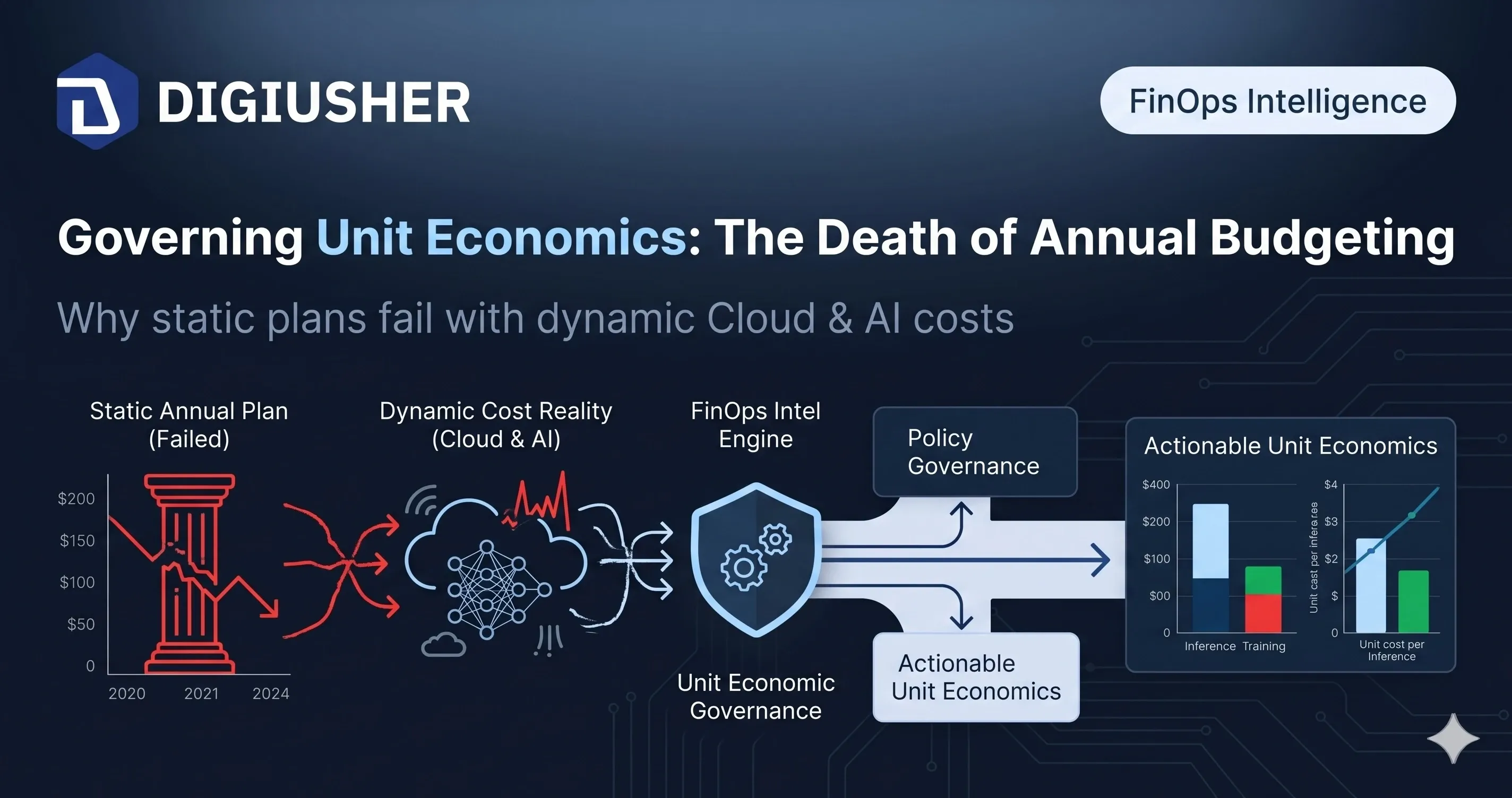
Why Cloud and AI Budgets Fail Annual Planning
Annual planning was built for fixed assets. Cloud and AI spend is consumption-driven, non-linear, and breaks the 12-month budget cycle. Here is what replaces it.
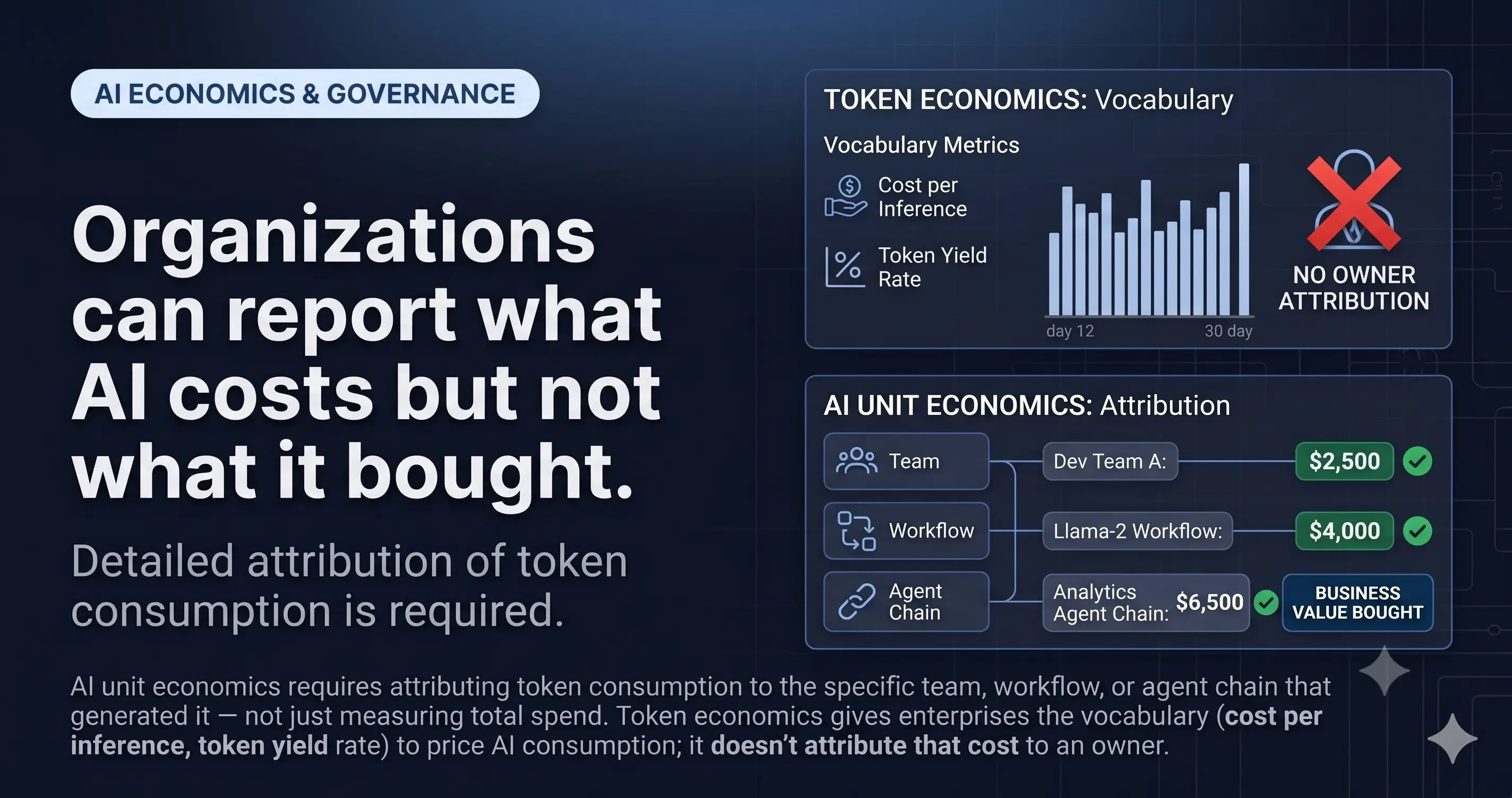
Token Economics Gave AI Spend a Vocabulary. It Still Has No Owner.
FinOps Foundation's token economics framework names the AI cost problem correctly. But naming a metric and attributing it to a team, workflow, or chain are two different disciplines — and most enterprises only have the first.