The $1 Trillion AI Infrastructure Economy: Who Pays the Bill?
Hyperscalers will spend $602 billion on AI infrastructure in 2026 — 75% of it on AI. LLM inference costs have fallen 1,000× in three years, yet enterprise AI bills are skyrocketing. This briefing explains the stacked cost architecture of the AI economy, the margin compression problem destroying AI ROI, and why FinOps governance — not more compute — determines who captures the margin in the age of the Token Factory.
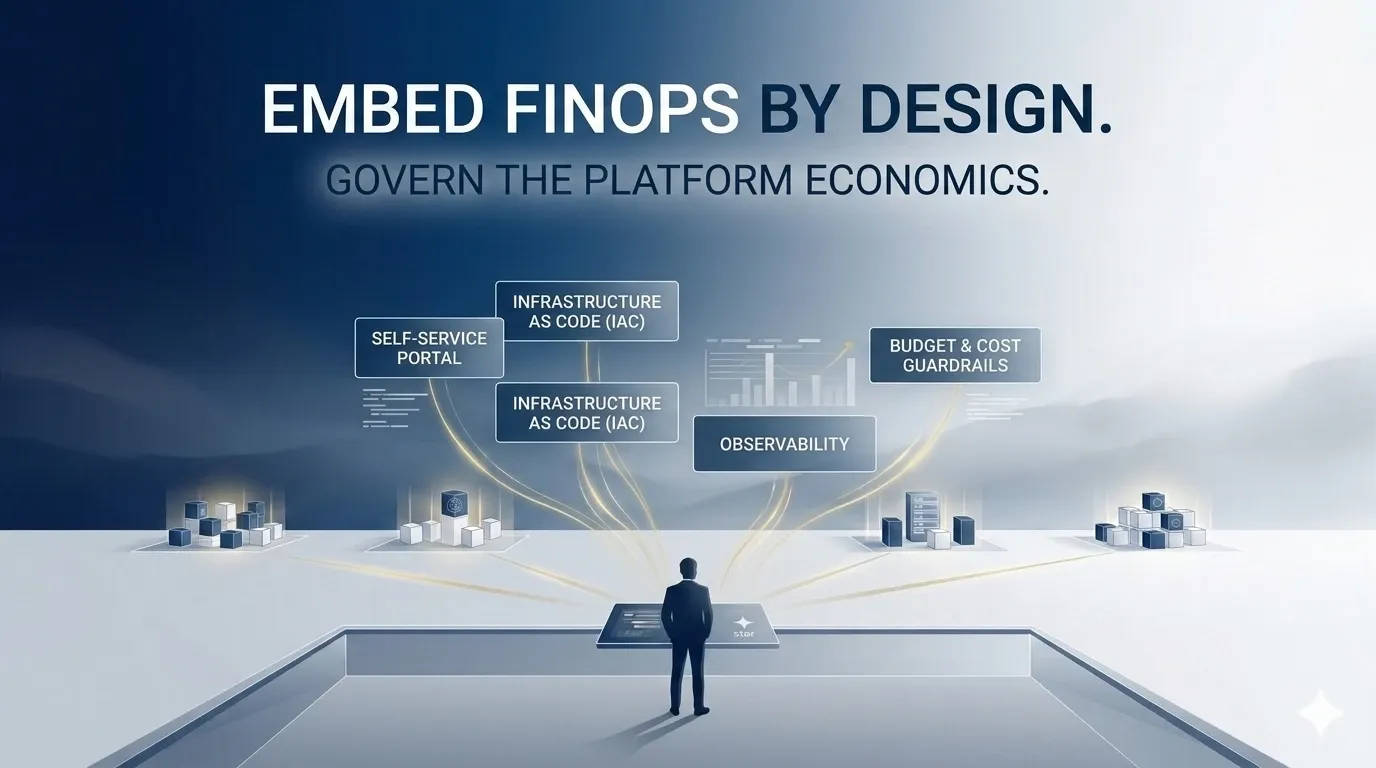
Executive Summary
Artificial intelligence is not just a technological revolution. It is a capital allocation event of historic scale — and the enterprise is caught in the middle of it.
The numbers in 2026 are staggering:
- Hyperscalers will spend $602 billion on infrastructure in 2026 — a 36% increase over 2025, with 75% (~$450 billion) directly tied to AI
- Goldman Sachs projects $1.15 trillion in hyperscaler CapEx from 2025–2027 — more than double the $477 billion spent in the prior three years
- LLM inference costs have fallen 1,000× in three years — yet the average enterprise AI budget grew from $1.2M to $7M between 2024 and 2026
- 67% of all AI compute is now inference, not training — a structural shift that makes per-token cost the defining enterprise profitability metric
- OpenAI loses an estimated $5 billion annually — spending $1.35 for every dollar earned, subsidising the API pricing that enterprise budgets are built on
The paradox is brutal: the unit cost of AI is collapsing. Enterprise AI bills are skyrocketing.
This briefing explains the five-layer cost architecture of the AI economy, the structural forces driving margin compression for every enterprise embedding AI into products and operations, and why FinOps financial governance — not more compute, not better models — determines who captures the margin in the age of the Token Factory.
What Is the AI Infrastructure Economy?
The AI infrastructure economy is the global capital mobilisation building the compute, networking, and energy systems that generative AI requires to function at scale.
Unlike previous technology infrastructure buildouts — the internet, cloud computing — the AI infrastructure economy operates at a velocity and capital intensity that has no precedent in technology history:
- The Big Five hyperscalers now spend 45–57% of revenue on CapEx — ratios that historically resembled industrial or utility companies, not software businesses
- Each of Amazon, Microsoft, Alphabet, and Meta individually exceeds $100 billion in annual infrastructure spending
- To fund this, hyperscalers raised $108 billion in debt in 2025 alone, with $1.5 trillion in total debt financing projected — transforming historically cash-funded technology businesses into leveraged capital enterprises
- NVIDIA’s CEO Jensen Huang has declared the end of the “Training Era” and the beginning of the “Inference Era”— where the primary output of AI infrastructure is not models, but tokens
At NVIDIA GTC 2026: Jensen Huang argued that the defining economic unit of the next decade is not the microprocessor, the cloud server, or the AI model. It is the Token. Every data centre has become a Token Factory — taking in electricity and data, producing intelligence.
Bain’s analysis reveals the uncomfortable arithmetic: to justify current CapEx levels, AI needs $2 trillion in annual revenue by decade’s end. Best-case forecasts project $1.2 trillion. That’s an $800 billion gap. The investment is being made regardless, because pulling back on AI CapEx carries its own catastrophic risks — whoever builds the largest, most efficient infrastructure first gains asymmetric advantages that compound over years.
For enterprises, this matters in one specific way: the massive infrastructure investment being made by hyperscalers will ultimately be monetised through the cloud bills and API charges that enterprises pay. Understanding the economics of that infrastructure buildout is understanding the future of your technology cost structure.
The AI Value Chain: Where the Money Flows
To understand who pays for AI — and who captures the margin — the AI economy must be understood as a five-layer value chain where each layer extracts economic value before the enterprise generates revenue:
AI Value Chain: Cost Flows Down, Value Must Flow Up
──────────────────────────────────────────────────────────
Silicon Layer          NVIDIA, AMD, custom ASICs
  ↓ GPU supply scarcity extracts premium margin
Cloud Infrastructure   AWS, Azure, Google Cloud, Oracle
  ↓ CapEx monetised through compute and managed service pricing
AI Platform Layer      Azure OpenAI, Bedrock, Vertex AI
  ↓ Management abstraction adds platform margin
Model Layer            OpenAI, Anthropic, Mistral, Cohere
  ↓ Token pricing extracts per-query margin (currently subsidised)
Enterprise Application Every company embedding AI in products
  ← Where value must be realised to justify every upstream cost
──────────────────────────────────────────────────────────
Silicon: Where Margin Starts
NVIDIA dominates GPU production and captures significant margin through supply constraints and demand intensity. NVIDIA’s Blackwell architecture delivering 15× better token economics per megawatt compared to previous generations shifts the competitive landscape — but the enterprise does not directly capture this efficiency unless its cloud provider deploys Blackwell infrastructure and passes the savings through.
The emergence of NVIDIA’s Vera Rubin platform promises 10× lower cost-per-token than Blackwell. If Company A generates tokens at $0.50 per million and Company B spends $2.00, Company A has an insurmountable margin advantage in the era of agentic AI. This is the silicon layer’s most important enterprise implication: infrastructure efficiency at the hardware layer compounds into competitive advantage at the product margin layer.
Cloud Infrastructure: Where Cost Concentrates
Hyperscalers — AWS, Azure, and Google Cloud — invest in data centres, networking, and energy infrastructure, then monetise through compute pricing, managed AI services, and enterprise contracts. Capital intensity at 45–57% of revenue means hyperscalers are betting their balance sheets on AI monetisation that is not yet fully materialised.
The enterprise pays for this infrastructure investment through cloud bills. Whether the investment proves prescient or excessive, the enterprise absorbs its cost either way — through compute pricing that reflects the CapEx being deployed.
AI Platform: Where Abstraction Extracts Margin
Managed AI services — Azure OpenAI Service, Amazon Bedrock, Google Vertex AI — abstract infrastructure complexity and provide API access to models. This abstraction is valuable; managing raw GPU infrastructure requires specialised expertise that most enterprises do not have. It also adds a platform margin layer on top of underlying compute costs.
Model: The Subsidised Layer That Will Reprice
AI vendors — OpenAI, Anthropic, Mistral, and others — capture value through token pricing, subscription APIs, and enterprise licensing. This is the most financially consequential layer for enterprises to understand:
Current API pricing is subsidised. OpenAI generated $3.7 billion in revenue while losing an estimated $5 billion in 2025 — spending $1.35 for every dollar earned. A Turing Award-winning Google researcher published a landmark paper in early 2026 identifying AI inference cost as the primary economic bottleneck preventing AI companies from reaching profitability.
The implication for enterprise buyers is direct: the current API pricing that enterprises have budgeted around is subsidised by venture capital and hyperscaler cross-subsidies. As providers move from subsidy-driven pricing toward cost-reflective rates, enterprises that have not built efficient inference architectures will face sudden, structural margin compression at scale.
Enterprise: Where Value Must Be Realised
The enterprise is where every upstream cost ultimately lands, and where value must be generated to justify the investment across every layer above it. Without financial governance that tracks stacked cost across the full AI value chain, enterprises cannot identify whether their AI features are generating margin or consuming it.
The Inference Inversion: Training Was Yesterday, Inference Is the Bill
The most important structural shift in AI economics in 2026 is the inversion from training-dominated to inference-dominated compute:
| Metric | 2023 | 2026 |
|---|---|---|
| Training share of AI compute | ~67% | ~33% |
| Inference share of AI compute | ~33% | ~67% |
| Inference market size | ~$15B | >$50B (projected) |
| Cost per million tokens (GPT-4 class) | $20 | $0.40 |
| Total inference cost reduction | Baseline | 1,000× lower |
The critical insight: The per-token cost of inference has collapsed 1,000× over three years. Enterprise AI bills are rising because the volume of tokens consumed has grown faster than the per-unit cost has fallen.
Training a frontier model is a one-time event requiring thousands of GPUs for weeks. Serving that model requires GPUs running 24/7 for years. With hundreds of millions of AI users generating tokens continuously — and enterprises deploying thousands of agentic workflows that chain multiple LLM calls in sequence — inference accounts for two-thirds of all AI compute in 2026.
For enterprises, this shifts the financial governance priority: Optimising training compute is a strategic decision made once per model. Optimising inference economics is a continuous financial discipline that operates daily, at the rate of every user query and every agentic step.
The Margin Compression Problem: Who Actually Pays?
The five-layer AI value chain creates a structural margin compression problem for every enterprise embedding AI into products and operations.
The Stacked Cost Architecture
Traditional software economics allowed enterprises to achieve 60–80% gross margins because the marginal cost of serving an additional customer approached zero. AI economics break this model fundamentally. AI-native applications carry ongoing variable costs — every inference, token, and agentic workflow step incurs spend that compounds with every user interaction.
A single enterprise AI feature may simultaneously carry:
- GPU compute cost (cloud infrastructure)
- Managed service overhead (AI platform)
- Token API charge (model vendor)
- Data egress cost (cross-region transfer)
- Storage cost (embedding vectors, RAG indices, audit logs)
Each billed independently. Each optimised by the vendor extracting it. None of them visible in aggregate as a cost per business outcome.
Agentic Workflows: The Cost Multiplier
Agentic AI architectures chain multiple LLM calls in sequence — one user query triggers three to ten model calls, each consuming tokens independently. The average enterprise AI budget grew from $1.2 million per year in 2024 to $7 million in 2026. Fortune 500 companies report monthly AI inference bills in the tens of millions of dollars.
Semantic caching paired with model routing reduces API call volume by 30–50% for typical enterprise deployments — but only for enterprises that have invested in the governance infrastructure to implement and monitor it continuously.
The Hidden Subsidy Risk
Current AI API pricing is subsidised. The economics are unsustainable at current scale: AI providers are burning capital to acquire enterprise adoption at below-cost pricing. When subsidy-driven pricing normalises toward true economic cost — driven by investor pressure, competitive dynamics, or simple capital exhaustion — enterprises operating without inference efficiency discipline will face sudden margin pressure that cannot be absorbed quickly.
The enterprises that build inference optimisation capability now — model routing, semantic caching, token budget governance, agentic workflow controls — will be structurally protected when pricing normalises. Those that do not will be restructuring their AI economics under pressure.
The Energy Dimension
AI infrastructure is not just compute-intensive — it is energy-intensive. Data centres powering AI workloads require massive electricity consumption, advanced cooling systems, and specialised facilities. Energy is emerging as a critical cost constraint in AI scalability.
Google’s $4.75 billion acquisition of Intersect Power for energy infrastructure signals how material this cost has become at hyperscaler scale. For enterprises running on-premises AI inference, energy cost is a first-order economic variable that cloud-only FinOps models ignore — and that becomes material at the GPU cluster scale required for production agentic workloads.
The Enterprise Dilemma: Neither Pure Acceleration Nor Pure Restraint
Enterprises navigating the AI infrastructure economy face a strategic choice that appears binary but is not:
Option 1 — Accelerate AI adoption: Invest aggressively, capture competitive differentiation, accept rising stacked costs and potential margin pressure.
Option 2 — Control costs aggressively: Preserve financial stability and predictable spend, accept slower innovation and competitive disadvantage.
The winning strategy is neither. It is controlled acceleration through financial governance — scaling AI investment continuously while enforcing the unit economics discipline, token attribution, and inference cost governance that ensure every pound of AI investment delivers measurable, traceable business return.
“The enterprises that navigate this crisis successfully share one characteristic: they treat AI inference cost with the same financial discipline they apply to any other major operational expenditure. They audit, route, cache, and optimise. They measure outcomes, not tokens. They plan for pricing normalisation rather than assuming subsidised rates will last.” — Cloudshim 2026 Analysis
This is precisely the distinction between enterprises that are building durable AI competitive advantage and those that are funding AI experiments at scale with no mechanism to measure or optimise their return.
Why FinOps Is the Deciding Factor
The AI infrastructure economy has created a new financial governance imperative: who governs AI economics determines who captures the margin.
The FinOps Foundation’s 2026 State of FinOps Report identifies AI and data platforms as the fastest-growing new category of enterprise spend — with token-based pricing, agent step billing, and retrieval costs introducing dimensions of cost volatility that legacy budgeting frameworks cannot handle.
The New Metric: Who Captures the Margin?
In the traditional cloud economy, the margin question was relatively simple: provision the right capacity, avoid waste, optimise reserved instance coverage.
In the AI economy, margin is extracted at five layers simultaneously — silicon, cloud, platform, model, and application. Every layer that the enterprise cannot govern extracts margin that reduces the return on AI investment.
Without governance, enterprises risk becoming margin takers across the entire AI stack — paying full price at every layer while generating insufficient return at the application layer to justify the investment.
The FinOps AI Governance Imperatives
Token economics as a continuous KPI: Cost-per-million-tokens (CPM) is the defining metric of AI profitability at the feature level. A 10× reduction in inference cost directly enables 10× more users at the same budget — or the same user count at 10× higher margin. CPM should be tracked weekly per model and per team, with budget alerts at 80% of monthly limits (not 100% — by the time the limit is reached, nothing can be done).
Model routing and intelligent tiering: Routing 60% of requests to cheaper models (Mistral Small, Llama), 30% to mid-tier, and 10% to premium models based on task complexity reduces average API cost 40–50% without performance impact. Average cost per request drops significantly compared to routing all requests to the highest-capability model. This is the highest-return AI optimisation available — no infrastructure change required, immediate margin impact.
Agentic workflow governance: Token consumption must be tracked per workflow chain and per business process, not just per individual API call. Agentic architectures running continuously 24/7 multiply inference cost in ways that prompt-level budgets cannot anticipate or control. Semantic caching alone can reduce API call volume by 30–50%.
Stacked cost attribution: Unified visibility across cloud compute, managed platform fees, and token API charges — attributed per AI feature and per customer interaction. Only enterprises that measure stacked AI cost per business outcome can make financially defensible decisions about which AI capabilities to scale.
Board-ready AI ROI metrics: Cost per resolved ticket, cost per automated decision, cost per customer interaction, revenue velocity enabled by AI — the business outcome metrics that translate infrastructure spend into EBITDA impact. Only 15% of AI decision-makers currently report an EBITDA lift from AI investment. The attribution infrastructure to produce this number is the competitive differentiator of 2026.
What Winners Will Do Differently
The enterprises that capture margin in the AI economy — rather than ceding it across the value chain — share five disciplines:
They treat AI as a financial system, not just a technology. Every AI deployment is evaluated on stacked cost, unit economics, and business outcome — not on capability alone. The question before any AI investment is not “can it do this?” but “at what cost per outcome, and does that cost generate positive margin?”
They measure AI unit economics from day one. CPM by model. Cost per AI feature. Cost per customer interaction. These metrics are not retrospective FinOps exercises — they are pre-deployment governance requirements that determine which AI investments scale and which are discontinued.
They optimise inference continuously, not periodically. Weekly CPM reviews. Model routing adjusted as usage patterns evolve. Semantic caching deployed for high-volume, repeatable query patterns. Agentic workflow costs monitored per step. Inference economics is not a quarterly optimisation exercise — it is a continuous financial discipline.
They govern across cloud and AI vendors as a unified cost model. The fragmented AI cost landscape — cloud compute here, platform fees there, model API charges from multiple vendors — requires a FOCUS-native normalisation layer that produces a single attributable cost view. Governance that covers only one vendor or only one cost dimension is structurally incomplete.
They align CIO, CFO, and board accountability around shared AI economic metrics. The governance failure in most enterprises is not technical — it is organisational. AI teams measure model performance. Finance teams measure total spend. Neither measures stacked cost per business outcome. Closing this gap requires shared metrics, joint decision-making on AI investment, and integrated governance that acts before inference spend reaches invoice-level surprise.
DigiUsher: The Control Plane for AI Economics
DigiUsher’s FinOps Operating System positions enterprises to govern the AI infrastructure economy as a financially disciplined competitive strategy — not an uncontrolled cost centre.
Unified AI cost visibility — cloud compute, managed AI platform fees, and token API charges from OpenAI, Anthropic, Hugging Face, Mistral, and Perplexity normalised to FOCUS 1.x in a single attributable cost model. The stacked cost view the enterprise value chain requires.
Real-time token governance — CPM tracking per model and per team, automated budget caps that throttle inference before spending reaches invoice thresholds, and agentic workflow cost attribution that surfaces per-process token economics before 24/7 autonomous workflows generate unbounded cost.
AI unit economics reporting — cost per inference, cost per AI feature, cost per active user — the business outcome metrics that connect AI infrastructure investment to EBITDA impact in the language CFOs and boards require.
Cross-layer margin analysis — stacked cost visibility across the full AI value chain per product and per customer interaction, enabling enterprises to identify precisely where margin is being extracted by upstream layers and where governance can recover it.
Inference optimisation intelligence — model routing insights, semantic caching opportunity identification, and Spot vs. on-demand GPU cost comparison — the operational levers that translate governance into margin.
Available as SaaS or BYOC for regulated industries with data sovereignty requirements. SOC 2® Type II and GDPR certified. Delivered globally through Infosys, Wipro, and Hexaware.
The $1 trillion AI infrastructure economy is already underway. The investments are being made. The platforms are being built. The models are improving. But the question remains unanswered for most enterprises: who pays the bill — and who keeps the profit? The answer will not be determined by technology alone. It will be determined by financial governance.
Frequently Asked Questions
What is the $1 trillion AI infrastructure economy and who is funding it?
The $1 trillion AI infrastructure economy is the global capital mobilisation building the compute, networking, and energy systems generative AI requires. Hyperscalers will spend $602 billion in 2026 — a 36% increase over 2025, with 75% ($450 billion) tied to AI. Goldman Sachs projects $1.15 trillion in hyperscaler CapEx from 2025–2027. Funded by operating cash flow and $108 billion in debt raised in 2025 alone ($1.5 trillion projected total). The Stargate project adds $500 billion in private infrastructure ambition. Governments are mobilising too: the EU’s €200 billion AI Continent Plan, Japan’s ¥1 trillion annual AI budget. This is a capital war being fought at a scale that dwarfs all previous technology infrastructure buildouts.
What is AI inference economics and why does it matter more than training in 2026?
AI inference economics measures and optimises the continuous per-token cost of running AI models in production. It matters more than training because inference accounts for 67% of all AI compute in 2026 — up from one-third in 2023. Unlike training (one-time, amortised), inference scales with every user query and every agentic workflow step. LLM inference costs have fallen 1,000× in three years, yet enterprise AI bills are rising because volume grows faster than per-token cost falls. The inference market exceeds $50 billion in 2026, growing faster than training for the first time. Cost-per-million-tokens (CPM) is now the defining enterprise AI profitability metric.
What is AI margin compression and how does it affect enterprise profitability?
AI margin compression is the reduction of gross margins driven by stacked costs across the AI value chain — silicon, cloud, platform, and model layers each extracting margin before the enterprise generates revenue. Traditional SaaS achieved 60–80% gross margins because marginal cost per additional customer approached zero. AI carries ongoing variable costs — every inference and token incurs spend. AI application margins are often well below the SaaS benchmark. Compression is compounded by subsidised pricing risk: OpenAI lost $5 billion in 2025 while generating $3.7 billion in revenue. As pricing normalises toward true economic cost, enterprises without efficient inference architectures face sudden structural margin pressure.
How is AI changing the enterprise cloud bill structure?
Three ways. Scale: average enterprise AI budget grew from $1.2M to $7M between 2024 and 2026. Variability: AI billing correlates with usage patterns — prompt length, model selection, agentic workflow complexity — creating cost swings traditional budgets cannot absorb. Fragmentation: AI costs arrive from multiple vendors simultaneously — cloud compute, model API charges, platform fees — in incompatible billing formats with no unified attribution to business outcomes. Without a FinOps layer normalising, attributing, and governing across all AI cost sources, enterprises cannot measure AI ROI or prevent margin erosion.
What is the token factory concept and why should enterprises care?
The token factory is Jensen Huang’s analogy for the modern AI data centre — taking in electricity and data, producing tokens of intelligence. It reframes AI economics from a technology question to a manufacturing one: what is your cost per unit of output, and how does it compare to the value each unit generates? In the AI economy, the enterprise that generates intelligence at the lowest cost-per-token for a given quality level captures durable competitive advantage. NVIDIA’s Vera Rubin delivers 10× lower cost-per-token than Blackwell — meaning a company at $0.50/million tokens has an insurmountable margin advantage over one at $2.00. For enterprises, inference economics is a strategic competitive variable, not an infrastructure detail.
How should enterprises measure AI ROI in 2026?
Using business outcome metrics, not infrastructure metrics. Cost per resolved ticket, cost per customer interaction, cost per automated decision, and revenue velocity enabled by AI — not GPU utilisation and token counts. Six metrics define mature AI ROI: CPM as a weekly KPI; stacked cost-per-AI-feature including all layers; AI gross margin (revenue from AI features minus full inference cost); agentic workflow cost-per-outcome; AI budget forecast accuracy within ±15%; EBITDA impact attribution. Only 15% of AI decision-makers report an EBITDA lift from AI investment. The 85% who cannot are operating without the attribution infrastructure to prove — or improve — AI economics.
How does DigiUsher’s FinOps OS govern enterprise AI economics?
Through four integrated capabilities: unified visibility normalising cloud compute, platform fees, and token API charges from all AI vendors to FOCUS 1.x in a single attributed cost model; real-time token governance with CPM tracking, automated budget caps, and agentic workflow attribution before 24/7 systems generate unbounded cost; AI unit economics reporting connecting infrastructure investment to cost-per-inference and EBITDA outcomes; and cross-layer margin analysis identifying precisely where the AI value chain is extracting enterprise margin and where governance can recover it.
References
- Introl — Hyperscaler CapEx Hits $600B in 2026 (+36% YoY, 75% AI)
- IEEE ComSoc — Hyperscaler CapEx >$600bn in 2026
- CreditSights — Hyperscaler CapEx 2026 Estimates: 75% AI Infrastructure
- GPUnex — AI Inference Economics 2026: The 1,000× Cost Collapse
- Cloudshim / Oplexa — AI Inference Cost Crisis 2026
- Spheron — AI Inference Cost Economics 2026: GPU FinOps Playbook
- NVIDIA — Rethinking AI TCO: Cost per Token Is the Only Metric That Matters
- BuySellRam — The Token Factory: How NVIDIA GTC 2026 Redefined AI Economics
- Futurum — AI Capex 2026: The $690B Infrastructure Sprint
- Forrester — Predictions 2026: AI Moves From Hype to Hard Hat Work
- Goldman Sachs — AI Infrastructure CapEx 2025–2027 Projection
- FinOps Foundation — State of FinOps 2026
- McKinsey — Generative AI Economic Value Estimate: $2.6–$4.4T annually
- FinOps Foundation — FOCUS Specification
Govern the AI Economy or Be Governed By It
The $1 trillion AI infrastructure economy is building infrastructure that enterprises will fund through cloud bills and API charges for years. The investment is being made. The platforms are operational. The models are improving daily.
The question that remains unanswered for most enterprises: is your AI investment generating margin, or consuming it?
DigiUsher’s FinOps OS gives your finance, engineering, and AI teams the attribution infrastructure, token governance, and unit economics reporting to answer that question — continuously, at the model level, at the product level, and at the EBITDA level.
DigiUsher in 30 min
Understand what each AI workload costs before scale amplifies the risk.
DigiUsher tracks cost per token, per inference, and per GPU hour — so your unit economics keep pace with adoption.
Book a 30-min walkthroughNo hard pitch · tailored to your stack
Continue Reading
More from the DigiUsher editorial team.
AI Cloud Margins: The New Battlefield for Enterprise Profitability
84% of enterprises report gross margin erosion from AI workloads. Only 15% can forecast AI costs within ±10%. AI inference now represents 85% of the enterprise AI budget — and the API pricing it is built on is subsidised. This executive briefing explains the five structural forces compressing enterprise AI margins, why LCOAI is the metric that changes everything, and how FinOps governance determines who keeps the profit.

GPU Cost Governance for Azure OpenAI, AWS Bedrock & Google Vertex AI
GPU infrastructure is now the fastest-growing cost driver in enterprise cloud — and 30–50% of that spend is wasted on idle capacity. This FinOps guide covers GPU pricing across Azure, AWS, and GCP, the five mechanisms through which AI compute costs spiral out of control, and the governance framework that stops GPU from becoming your largest and least-governed cost centre.
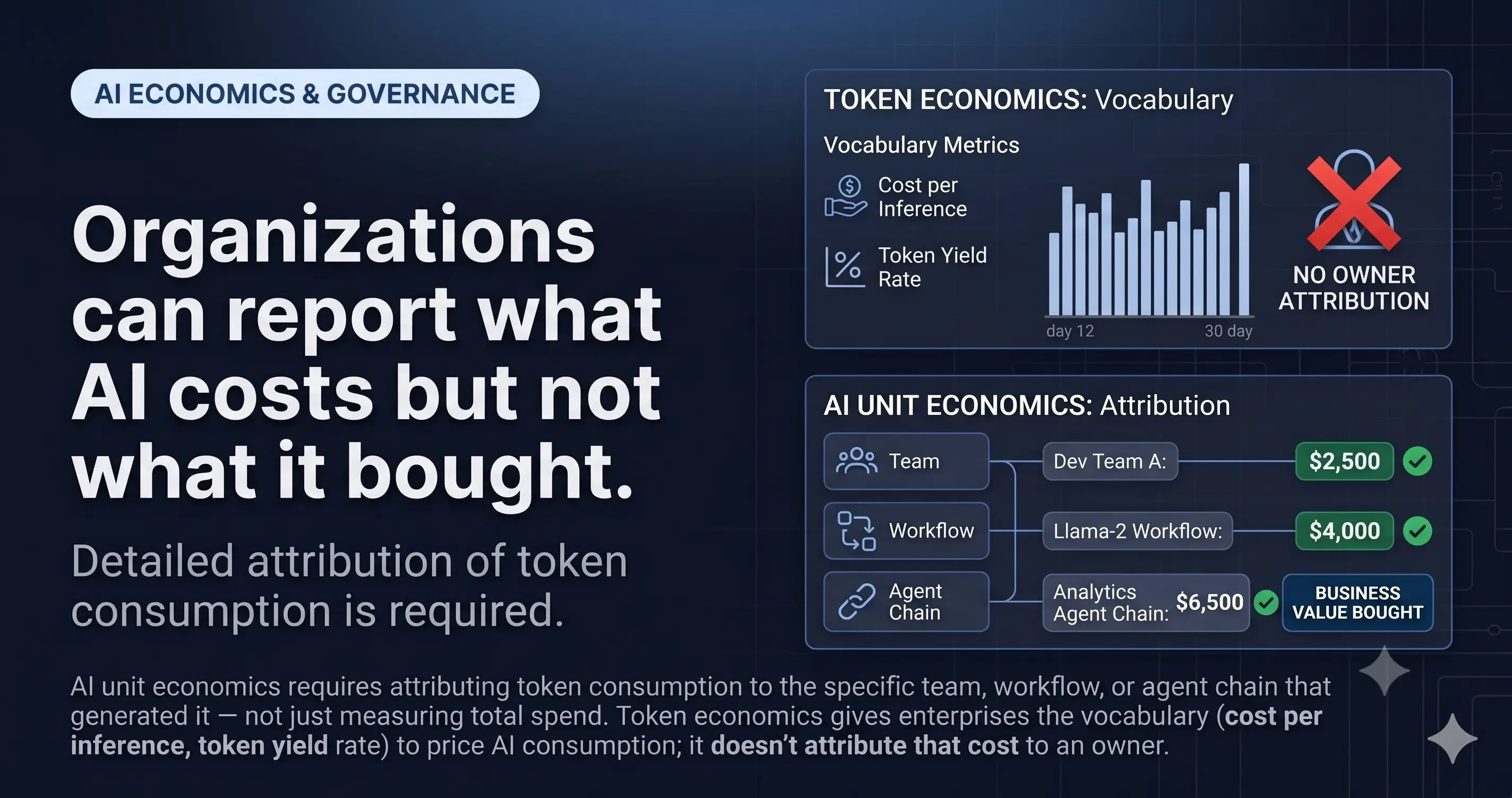
Token Economics Gave AI Spend a Vocabulary. It Still Has No Owner.
FinOps Foundation's token economics framework names the AI cost problem correctly. But naming a metric and attributing it to a team, workflow, or chain are two different disciplines — and most enterprises only have the first.