AI Cloud Margins: The New Battlefield for Enterprise Profitability
84% of enterprises report gross margin erosion from AI workloads. Only 15% can forecast AI costs within ±10%. AI inference now represents 85% of the enterprise AI budget — and the API pricing it is built on is subsidised. This executive briefing explains the five structural forces compressing enterprise AI margins, why LCOAI is the metric that changes everything, and how FinOps governance determines who keeps the profit.
Executive Summary
Artificial intelligence is driving the most dramatic shift in cloud economics since the birth of hyperscale computing. But the enterprise narrative around AI has been dominated by capability and adoption — while the financial reality has been quietly and systematically destructive to margins.
The data from 2025–2026 is unambiguous:
- 84% of enterprises report significant gross margin erosion tied to AI workloads
- 80% miss their AI infrastructure forecasts by more than 25% — structural failure, not temporary miscalculation
- Only 15% can forecast AI costs within ±10% — the minority that will compound competitive advantage while others bleed
- AI inference now represents 85% of the enterprise AI budget — driven by production-scale agentic deployments consuming 5–30× more tokens per task than the chatbots enterprises used to model costs against
“AI is blowing up the assumptions baked into budgets. What used to be predictable is now elastic and expensive.” — Sundeep Goel, CEO of Mavvrik
For CIOs, CFOs, and FinOps leaders, the central question has shifted. It is no longer whether to adopt AI.
The real question is: who captures the margin — the cloud provider, the AI vendor, or the enterprise deploying the technology?
Without financial governance, the answer is the former two. With it, the answer can be the third.
What Is AI Margin Compression?
AI margin compression is the reduction in enterprise gross margins caused by the stacked, variable, and unpredictable cost structure of AI infrastructure.
It differs from traditional cloud cost overrun in three critical respects:
Traditional cloud cost overrun:        AI margin compression:
─────────────────────────────────────  ──────────────────────────────────────
Over-provisioned VMs                   Stacked vendor margins (4 layers)
Static, predictable scaling            Non-linear inference scaling
Budget visible in cloud bill           Cost invisible behind token abstraction
Fixed monthly variance                 Agentic multiplication (5–30× per task)
Single provider                        Multi-platform fragmentation
AI margin compression is not an operational problem — it is a structural economic condition that emerges when enterprises deploy AI without the attribution infrastructure to connect infrastructure spend to business outcomes. 84% of enterprises have already entered this condition. Most discovered it only when the quarterly margin report revealed erosion they could not explain from their cloud bills.
The enterprises that will capture margin in the AI economy are not necessarily those with the best models or the most infrastructure. They are the ones that build financial governance before scale makes the problem ungovernable.
The AI Infrastructure Arms Race
To understand why enterprise AI margins are under pressure, the economics of the supply side must be understood first.
Cloud providers are investing at a scale that has no precedent in technology history. Hyperscaler CapEx reached $602 billion in 2026, with approximately 75% — $450 billion — directed specifically at AI infrastructure: GPU clusters, AI networking fabrics, specialised data centres, and cooling systems engineered for extreme compute density. Goldman Sachs projects total hyperscaler CapEx from 2025–2027 will reach $1.15 trillion.
Specialised AI infrastructure providers are mobilising alongside them. AI cloud provider CoreWeave doubled its planned capital expenditure to $30–35 billion, triggering immediate investor scrutiny around whether margin structures are sustainable at that investment intensity.
The implication for enterprises is direct: every dollar of AI infrastructure investment must ultimately be recovered through the cloud bills and API charges that enterprises pay. The current pricing structure — where AI API costs are held below true economic cost by venture capital and hyperscaler cross-subsidies — is funded by this investment wave. It is not permanent.
The hidden risk: Enterprises building AI economic models that assume current subsidised pricing persists are making a financially exposed assumption. When pricing normalises toward true economic cost, enterprises without inference efficiency discipline face a 30–50% cost increase on existing workloads — not from new features, but from the same deployments they are running today.
Why AI Workloads Are Economically Different
Traditional cloud infrastructure was built around predictable cost behaviour: provision a VM, pay an hourly rate, scale linearly with demand. AI workloads break every assumption in this model.
GPU Economics: A 30–200× Cost Multiplier
High-performance GPUs required for AI training and inference are not a premium tier of traditional compute. They represent a fundamentally different economic category. GPU-based infrastructure costs 30–200× more per compute hour than standard CPU instances, depending on model complexity, scale, and utilisation pattern.
AI training costs for frontier models are increasing at 2.4× per year — a compounding that dwarfs any cost trajectory in traditional cloud infrastructure. What costs $79 million to train today (GPT-4 equivalent) is approaching $1 billion for frontier models. And enterprise applications built on these models carry the downstream economics of every upstream cost layer.
AI Pricing: A Variable Function, Not a Fixed Rate
Traditional compute is priced on a simple function: instance type × hours. AI workloads are priced on a complex function of tokens processed, inference volume, GPU hours consumed, model size, prompt complexity, and context window length.
The same model request can cost 10× more depending on prompt length and usage patterns. An engineer who increases average system prompt length by 500 tokens generates a 25% cost increase on every API call that prompt is attached to — at enterprise scale, this is a material P&L event that looks like normal infrastructure cost in the billing system.
Idle Infrastructure: A Structural Waste Generator
In real-world AI deployments, engineering teams report GPU clusters running idle up to 60% of the time while still costing hundreds of thousands of dollars weekly. AI experimentation — prompt engineering, model evaluation, RAG pipeline iteration — consumes GPU compute at production rates without generating production value. This idle waste does not appear as a distinct line item; it compounds silently into elevated monthly bills.
Five Structural Forces Compressing Enterprise AI Margins
Force 1 — GPU Scarcity Economics Set the Floor
GPU economics determine the minimum cost of every unit of AI output produced by enterprise applications. NVIDIA GPUs power the majority of AI workloads across hyperscaler data centres. The scarcity, capital intensity, and rapid generation cycles of this hardware create a cost floor that sits beneath every managed AI service layer.
Hyperscaler data centre lifecycle optimisation, when executed correctly, can reduce total infrastructure costs by up to 40%. But this optimisation benefit belongs to the provider — it shapes their margin structure, not the enterprise’s invoice, unless the enterprise negotiates directly at infrastructure level rather than through managed API layers.
The practical enterprise implication: using managed AI platforms insulates from GPU operational complexity but does not reduce GPU economic exposure. Token charges absorb GPU costs through stacked pricing rather than eliminating them.
Force 2 — Stacked Vendor Margins Compound the Cost
The AI ecosystem has created a four-layer margin stack between GPU hardware and enterprise application value:
AI Value Chain: Where Margin Is Extracted
──────────────────────────────────────────────────────────────────
Layer                  Margin Type           Who Captures It
──────────────────────────────────────────────────────────────────
GPU Hardware           Hardware scarcity     NVIDIA and equivalents
(NVIDIA, AMD)          premium

Cloud Infrastructure   Infrastructure ROI    AWS, Azure, Google Cloud
(Hyperscalers)         on CapEx deployed

AI Platform            Managed service       Azure OpenAI, Bedrock,
(Managed Services)     abstraction margin    Vertex AI

Model Provider         API and licensing     OpenAI, Anthropic,
(Foundation Models)    margin per token      Mistral, Cohere
──────────────────────────────────────────────────────────────────
Enterprise             ← Value must be       The enterprise —
Application            realised here         currently under pressure
──────────────────────────────────────────────────────────────────
Most enterprises deploying managed AI platforms pay stacked margins across all four upstream layers simultaneously — without visibility into their aggregate, without the ability to identify which layers can be bypassed, and without cost attribution connecting the stacked charge to the business outcome it funds.
Without strong cost visibility, enterprises may unknowingly pay stacked margins across multiple layers of the AI ecosystem for every unit of output they generate.
Force 3 — Inference Dominance Has Rewritten the Budget Model
The defining economic shift of 2026 is not more AI adoption. It is the shift from training-dominated to inference-dominated AI spend.
AI inference now represents 85% of the enterprise AI budget. This is not a prediction — it is the reported reality of enterprises that have moved from experimental AI pilots to production agentic deployments. The shift happened because the economics changed fundamentally:
| Dimension | Training | Inference |
|---|---|---|
| Frequency | One-time or periodic | Continuous, every interaction |
| Cost driver | Model complexity × GPU-hours | Tokens × frequency × model tier |
| Scaling behaviour | Predictable | Non-linear with agentic depth |
| Budget model | Project-based CapEx | Operational OpEx, usage-driven |
| Primary challenge | Scheduling and resource | Real-time governance |
The agentic multiplication problem: Gartner’s March 2026 analysis confirms agentic AI models require 5–30× more tokens per task than standard chatbots. Enterprises that built their AI ROI cases on single-query chatbot economics — and then deployed multi-step agentic workflows at production scale — encountered cost structures an order of magnitude higher than their financial models assumed.
An agentic customer service workflow that chains 10 sequential LLM calls generates 10× the inference cost of a chatbot answering the same query in one step. At production scale, processing thousands of customer interactions daily, this multiplication is not a variance — it is a structural P&L reality that changes the financial viability of the AI investment entirely.
Force 4 — Subsidised Pricing Creates a Hidden Repricing Risk
One of the most underappreciated financial risks in enterprise AI is the assumption that current API pricing is the real price.
It is not.
OpenAI generated approximately $3.7 billion in revenue while losing an estimated $5 billion in 2025 — spending $1.35 for every dollar it earned, with losses driven by the cost of serving billions of daily inference requests. A Turing Award-winning Google researcher published a landmark paper in early 2026 identifying AI inference cost as the primary economic bottleneck preventing AI companies from reaching profitability.
Current AI API pricing is held below true economic cost by venture capital investment and hyperscaler cross-subsidies designed to drive adoption. As capital discipline tightens and investors demand a path to profitability, pricing normalisation is not a theoretical risk — it is an expectation embedded in the economics of every major AI provider.
The projected impact when pricing normalises: API costs increase by 30–50% from current levels. Enterprises that have not built inference efficiency discipline — model routing, prompt optimisation, semantic caching, agentic workflow controls — face this repricing on their existing workloads without any corresponding reduction in infrastructure consumption.
The enterprises that build inference efficiency now are not just saving money today — they are insulating their AI economics against the repricing event that will separate sustainable AI programs from those that fail under financial pressure.
Force 5 — Strategic Unprofitability: A Bet That Needs Governance
Research across 475 executives documented a striking finding: organisations are deliberately accepting near-term margin compression on the bet that AI investment pays off later. This strategic unprofitability is not a planning failure — it is an increasingly conscious competitive positioning choice.
The financial logic is sound in principle: invest now, accept lower margins, capture scale economics and competitive advantage as AI capabilities mature. Enterprises that delay AI investment while competitors build AI-driven efficiency may find themselves at a permanent cost and capability disadvantage.
The problem is not the bet. The problem is making it without the measurement infrastructure to know if it is paying off.
“AI/ML bills are surging and the commitment is clear — and ROI still needs more tangible data to be accurately calculated.” — Cloud Economics Pulse, April 2026
The input side of strategic AI investment appears clearly in the cloud bill. The output side — features shipped, customers retained, margins held — appears nowhere in the billing system. This visibility gap is what transforms a calculated investment strategy into uncontrolled margin erosion. The organisations that will win are not those that invest the most. They are those that can measure return at the unit level, continuously, and adjust before the bet becomes a structural loss.
LCOAI: The Metric That Changes Everything {#lcoai-the-metric-that-changes-everything}
Traditional AI cost metrics — per-token billing, GPU-hour rates, quarterly cloud invoices — share a common limitation: they capture isolated slices of AI economics that cannot be compared across deployment models or used to make lifecycle investment decisions.
LCOAI (Levelized Cost of Artificial Intelligence) addresses this gap. Published in a peer-reviewed paper in Expert Systems with Applications (2026), LCOAI is a standardised economic metric that quantifies total capital and operational expenditure per unit of productive AI output, normalised by valid inference volume.
It is, in the language of energy economics, the Levelised Cost of Electricity equivalent for AI — enabling rigorous, transparent comparison between API deployment and self-hosted alternatives across their full economic lifecycle.
LCOAI in Practice: A Decision Framework
Consider an organisation evaluating AI deployment for customer service automation, where 1,000 human-handled interactions cost $300:
| Deployment Option | LCOAI (per 1,000 interactions) | Economic Implication |
|---|---|---|
| Human service baseline | $300 | Reference cost |
| OpenAI GPT-4.1 API (current pricing) | ~$15 | 20× cost reduction — strong ROI at current subsidised rates |
| Self-hosted LLaMA-2-13B (moderate scale) | ~$24.80 | Higher than API at moderate scale; more efficient at high volume |
| GPT-4.1 API (pricing normalised +40%) | ~$21 | Economics compress — self-hosted becomes competitive |
| Self-hosted at high volume | ~$8–12 | Strongest economics at enterprise scale with full ownership |
Source: Curcio, E. (2026). Introducing LCOAI. Expert Systems with Applications, 299, Article 130077.
The LCOAI insight that API-level cost comparison misses: the crossover point between API and self-hosted deployment is not visible in current token pricing. It becomes visible only when full lifecycle costs — GPU amortisation, operational overhead, fine-tuning investment, inference efficiency — are normalised against actual productive output volume. Enterprises making deployment architecture decisions without LCOAI analysis are optimising for today’s subsidised API price rather than for the economics that will govern their AI infrastructure over the next three to five years.
The Hidden Profit Equation of the AI Cloud Economy
For hyperscalers, AI represents both the largest growth opportunity and the most capital-intensive margin challenge in their history. AWS generates a disproportionate share of Amazon’s total operating profit — demonstrating that cloud infrastructure, governed correctly, produces extraordinary margins. AI is compressing these margins through CapEx intensity while simultaneously generating the revenue growth that justifies the investment.
The enterprise consequence: hyperscalers are optimising their pricing models, marketplace distribution, and committed contract structures to recover AI infrastructure investment over time. Enterprises that understand this dynamic can negotiate more effectively and plan more accurately. Those that treat cloud AI as a utility with stable, predictable pricing are operating on a financial assumption that the underlying economics do not support.
This is why the FinOps community has seen AI spend management move from a niche concern to the top priority for financial operations teams — and why 98% of FinOps teams now manage AI spend, up from 31% just two years earlier. The discipline that cloud infrastructure required in 2018 is the same discipline that AI infrastructure requires now — but faster, at higher cost, and with less time to learn from mistakes.
The Emerging Discipline: AI FinOps for Margin Governance
Modern FinOps is evolving from reactive cost reporting to proactive economic governance for AI workloads. The capability gap is significant — but the path forward is well-defined for organisations that recognise it.
AI Cost Observability — tracking AI consumption across models, APIs, GPU clusters, and inference workloads with real-time granularity. Not the monthly cloud bill, which arrives after margin is already lost — continuous telemetry that surfaces cost signals at the engineering decision layer.
AI Unit Economics — calculating cost per AI feature, cost per customer interaction, and cost per automated decision. The business-outcome metrics that connect infrastructure spend to the P&L outcomes the investment was designed to generate. The 85% of enterprises that cannot report LCOAI-aligned metrics for their AI investments cannot make financially defensible scaling decisions.
Inference Governance — token budget allocation per team and per product, model routing based on task complexity, semantic caching for repeatable query patterns, and agentic workflow cost attribution that surfaces per-chain economics before 24/7 autonomous systems generate unbounded spend.
Multi-Provider AI Strategy — avoiding vendor lock-in by normalising costs across Azure OpenAI, AWS Bedrock, Google Vertex AI, and direct API providers to a unified FOCUS 1.x cost model. The enterprises that can compare true LCOAI across providers make better deployment decisions and have stronger negotiating positions with every vendor they work with.
The shift that defines leading enterprises in 2026: from measuring AI by what it costs to measuring it by what it returns — per interaction, per feature, per customer, per pound of cloud spend.
What Winning Enterprises Are Doing Differently
The 15% of enterprises that can forecast AI costs within ±10% are not simply lucky — they have implemented specific governance disciplines that the 85% have not. The differentiators are operational, not architectural:
They have LCOAI visibility before deployment decisions are made. Infrastructure architecture choices — API vs. self-hosted, model tier selection, inference hardware — are evaluated on full-lifecycle economics, not current token prices. Repricing scenarios are modelled at decision time, not discovered after contracts are signed.
They attribute cost at the feature level, not the invoice level. Every AI feature has a tracked cost per interaction. Product teams see AI cost alongside product metrics. Finance can reconcile AI infrastructure spend with revenue attribution at the product line level.
They govern the agentic multiplication effect. Token consumption is tracked per workflow chain, not per API call. Agentic architectures have per-chain budget caps that prevent autonomous workflows from generating unbounded inference spend.
They treat inference pricing normalisation as a planning scenario, not a hypothetical. Their AI economic models include a scenario where API prices increase 30–50%, and they have identified which workloads remain viable under normalised pricing and which require architectural change.
They connect FinOps to strategic AI investment decisions. The FinOps function is not a retrospective reporting exercise — it is a pre-deployment advisory and continuous governance mechanism that participates in AI investment decisions before commitments are made.
DigiUsher: From AI Cost Centre to Profit Engine
DigiUsher’s FinOps Operating System provides the unified AI margin governance layer that transforms AI from an unpredictable cost centre into a financially governed competitive investment:
Unified AI cost visibility — token charges from OpenAI, Anthropic, Hugging Face, Mistral, and Perplexity normalised alongside GPU infrastructure costs from Azure, AWS, and GCP in a single FOCUS 1.x attributed cost model. The stacked margin view that makes total AI feature economics calculable.
Real-time AI unit economics — cost per inference, cost per AI feature, cost per customer interaction surfaced as continuous KPIs. The LCOAI-aligned measurement infrastructure that connects GPU infrastructure investment to EBITDA impact.
Agentic workflow governance — token consumption tracked per workflow chain and per business process. Automated budget caps that throttle agentic systems before inference spend reaches invoice thresholds.
Inference optimisation intelligence — model routing insights, semantic caching opportunities, and API-versus-self-hosted crossover analysis that quantify the margin recovery available from each optimisation lever.
Repricing scenario modelling — financial models that surface the economic impact of API pricing normalisation on existing AI workloads, enabling procurement, architecture, and strategic planning decisions before the pricing event occurs.
Available as SaaS or BYOC for regulated industries. SOC 2® Type II and GDPR certified. Delivered globally through Infosys, Wipro, and Hexaware.
Innovation without economic governance destroys margins. The enterprises that master AI cloud economics — not just AI capabilities — will define the profitability landscape of the next decade.
Frequently Asked Questions
What is AI margin compression and why is it affecting enterprise profitability?
AI margin compression is the reduction in enterprise gross margins caused by the stacked, variable cost structure of AI infrastructure. 84% of enterprises report significant gross margin erosion tied to AI workloads. Three mechanisms operate simultaneously: stacked vendor margins across GPU hardware, cloud, platform, and model API layers; inference volume explosion (85% of AI spend is now inference, with agentic workflows consuming 5–30× more tokens per task than chatbots); and subsidised pricing risk — current API costs are below true economic cost, and normalisation means 30–50% price increases on existing workloads.
What is LCOAI and why is it better than cost-per-token metrics?
LCOAI (Levelized Cost of Artificial Intelligence) is a peer-reviewed standardised metric that quantifies total CAPEX and OPEX per unit of productive AI output across the full deployment lifecycle. Cost-per-token captures only one slice of AI economics, omitting infrastructure investment, operational costs, and system inefficiencies. LCOAI makes API deployment and self-hosted deployment economically comparable — GPT-4.1 API is ~$15 per 1,000 interactions (subsidised); self-hosted LLaMA at moderate scale is ~$24.80 per 1,000 interactions. The crossover point where self-hosted becomes cheaper is the decision LCOAI is designed to surface.
Why are 80% of enterprises missing their AI infrastructure forecasts by more than 25%?
The forecasting failure is structural. Enterprises use budget models built for static infrastructure costs to govern dynamic, usage-driven AI spend. Three mechanisms break traditional forecasting: inference non-linearity (costs scale with query complexity, not user count); agentic multiplication (enterprises modelled chatbot-level token consumption, deployed agentic workflows costing 5–30× more per task); and model pricing volatility (AI API pricing changes as vendors adjust subsidisation levels). Annual IT budget cycles cannot absorb monthly inference cost variability.
What is ‘inference bill shock’ and how does agentic AI multiply costs?
Inference bill shock is the experience of costs rapidly exceeding projections as enterprises move from experimental chatbots to production agentic deployments. Gartner’s March 2026 analysis confirms agentic AI requires 5–30× more tokens per task than standard chatbots. An agentic workflow chaining 10 sequential LLM calls generates 10× the inference cost of a single chatbot response. Enterprises that built ROI cases on chatbot-level token consumption encountered real agentic costs an order of magnitude higher than their financial models assumed.
What should CFOs and CIOs do now to protect AI margins?
Four actions: establish AI unit economics (cost per inference, per feature, per customer interaction) before AI spend exceeds $500K/year; model for API pricing normalisation — build scenarios where costs increase 30–50% and identify which workloads remain viable; deploy LCOAI analysis for high-volume deployment decisions comparing API versus self-hosted economics; implement real-time inference governance with token budget allocation and agentic workflow cost attribution. Waiting until margin compression is visible in the quarterly P&L means waiting until it is already structural.
What is ‘strategic unprofitability’ in enterprise AI and is it a sound investment strategy?
Strategic unprofitability is the deliberate acceptance of near-term margin compression on the bet that AI investment pays off at scale. 475 executives report making this trade-off consciously. The strategy is coherent — but it requires the measurement infrastructure to determine whether the bet is paying off. Without AI unit economics connecting inference spend to business outcomes, strategic unprofitability is indistinguishable from uncontrolled capital waste. The governance discipline is what makes strategic investment different from structural margin erosion.
How does DigiUsher address enterprise AI margin compression?
Through four integrated capabilities: unified cost visibility normalising all AI vendor charges and GPU infrastructure costs to FOCUS 1.x; AI unit economics producing LCOAI-aligned cost per inference, feature, and customer interaction continuously; agentic workflow governance with per-chain token attribution and automated budget caps; and repricing scenario modelling that surfaces the financial impact of API pricing normalisation before it occurs. Governance that acts before margin is lost rather than explaining it after.
References
- Mavvrik / Benchmarkit — State of AI Cost Governance 2025
- AnalyticsWeek — Inference Economics Report 2026
- Oplexa — AI Inference Cost Crisis 2026
- Curcio, E. (2026). Introducing LCOAI. Expert Systems with Applications, 299, Article 130077
- GPUnex — AI Inference Economics: The 1,000× Cost Collapse
- Gartner — Agentic AI Token Consumption Analysis, March 2026
- FinOps Foundation — State of FinOps 2026
- CreditSights — Hyperscaler CapEx 2026: $602B, 75% AI Infrastructure
- Goldman Sachs — AI Infrastructure CapEx 2025–2027 Projection
- Reuters — CoreWeave CapEx Doubles to $30–35 Billion
- CloudZero — Cloud Economics Pulse April 2026
- Spheron — AI Inference Cost Economics 2026: GPU FinOps Playbook
- FinOps Foundation — FOCUS Specification
- Forrester — Public Cloud Market Outlook 2026: $1.03 Trillion
Govern the Margin Before the Market Does It For You
The AI infrastructure economy is already underway. The capital is being deployed. The models are improving. The enterprise adoption is accelerating. But the financial reality confronting 84% of enterprises is that AI investment is currently destroying more margin than it is protecting.
DigiUsher’s FinOps OS gives your finance, engineering, and AI leadership teams the attribution infrastructure, inference governance, and LCOAI-aligned unit economics to answer the question that boards are already asking:
Is our AI investment generating margin — or consuming it?
DigiUsher in 30 min
Understand what each AI workload costs before scale amplifies the risk.
DigiUsher tracks cost per token, per inference, and per GPU hour — so your unit economics keep pace with adoption.
Book a 30-min walkthroughNo hard pitch · tailored to your stack
Continue Reading
More from the DigiUsher editorial team.
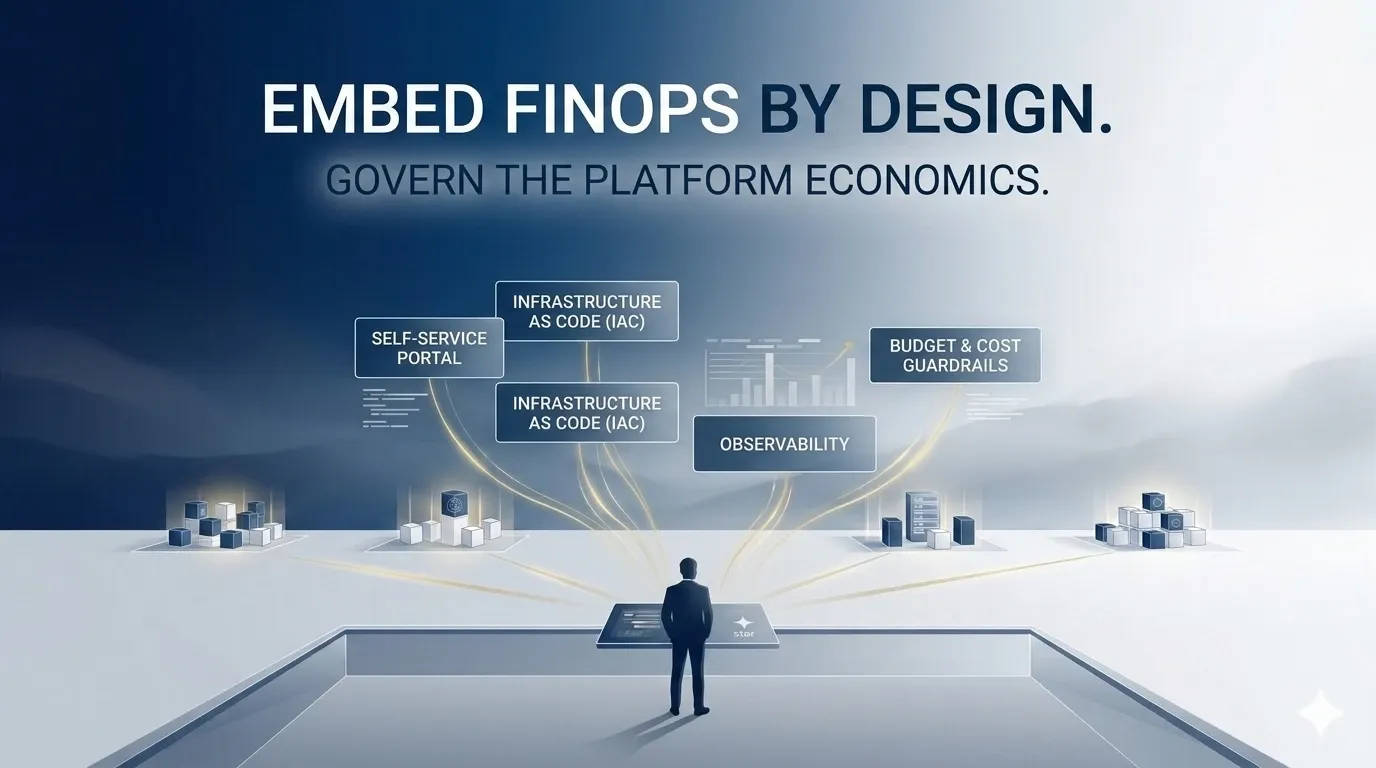
The $1 Trillion AI Infrastructure Economy: Who Pays the Bill?
Hyperscalers will spend $602 billion on AI infrastructure in 2026 — 75% of it on AI. LLM inference costs have fallen 1,000× in three years, yet enterprise AI bills are skyrocketing. This briefing explains the stacked cost architecture of the AI economy, the margin compression problem destroying AI ROI, and why FinOps governance — not more compute — determines who captures the margin in the age of the Token Factory.
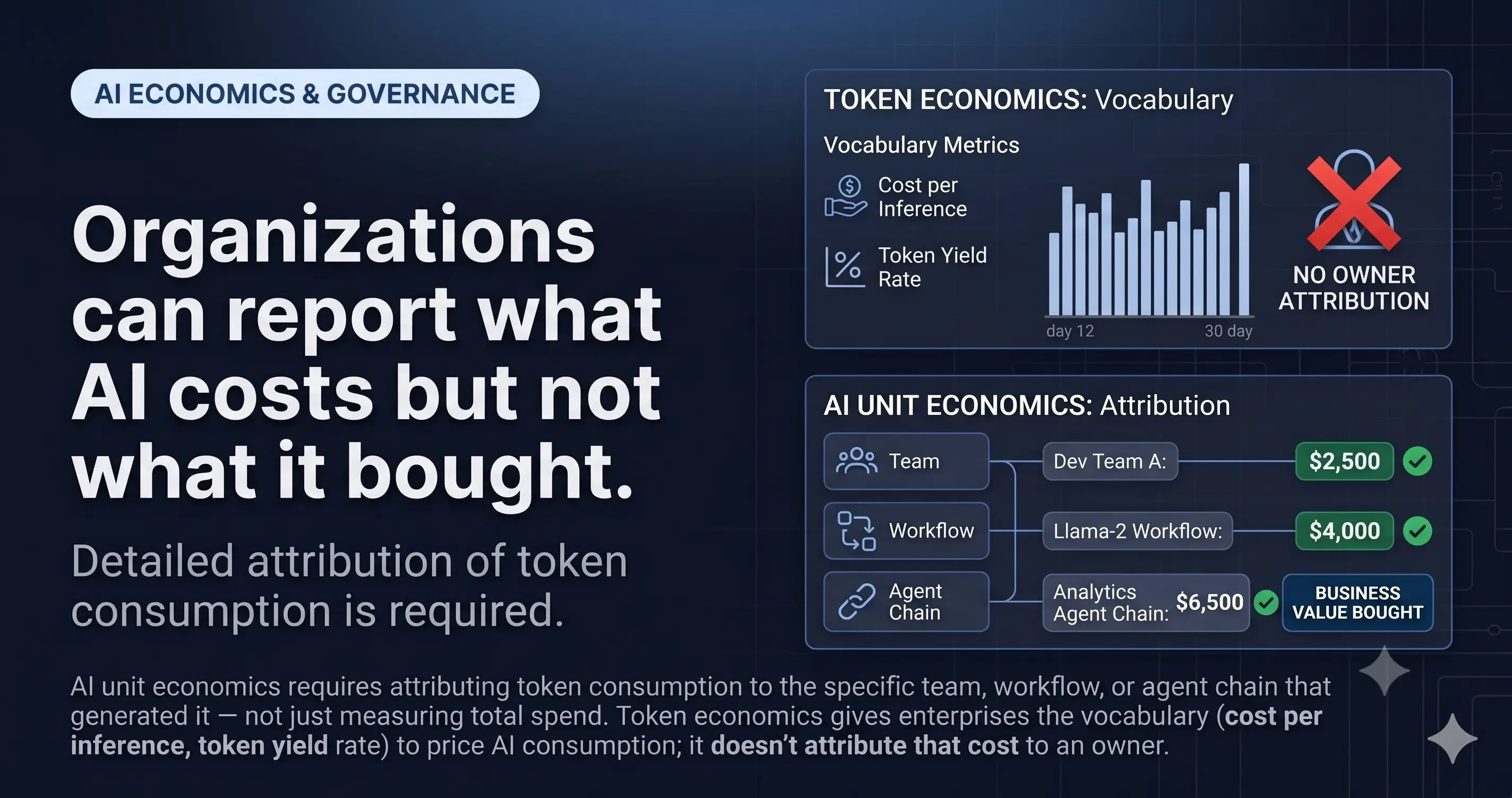
Token Economics Gave AI Spend a Vocabulary. It Still Has No Owner.
FinOps Foundation's token economics framework names the AI cost problem correctly. But naming a metric and attributing it to a team, workflow, or chain are two different disciplines — and most enterprises only have the first.

Azure OpenAI vs AWS Bedrock vs Google Vertex AI: The FinOps Guide to GenAI Cost Governance
Enterprises are deploying GenAI across Azure OpenAI, AWS Bedrock, and Google Vertex AI simultaneously — three platforms with incompatible billing models, different governance capabilities, and hidden costs that erode AI ROI. This FinOps guide compares all three platforms on cost structure, attribution capability, optimisation levers, and governance gaps — with a practical cross-platform normalisation framework.