Why Cloud and AI Budgets Fail Annual Planning
Annual planning was built for fixed assets. Cloud and AI spend is consumption-driven, non-linear, and breaks the 12-month budget cycle. Here is what replaces it.
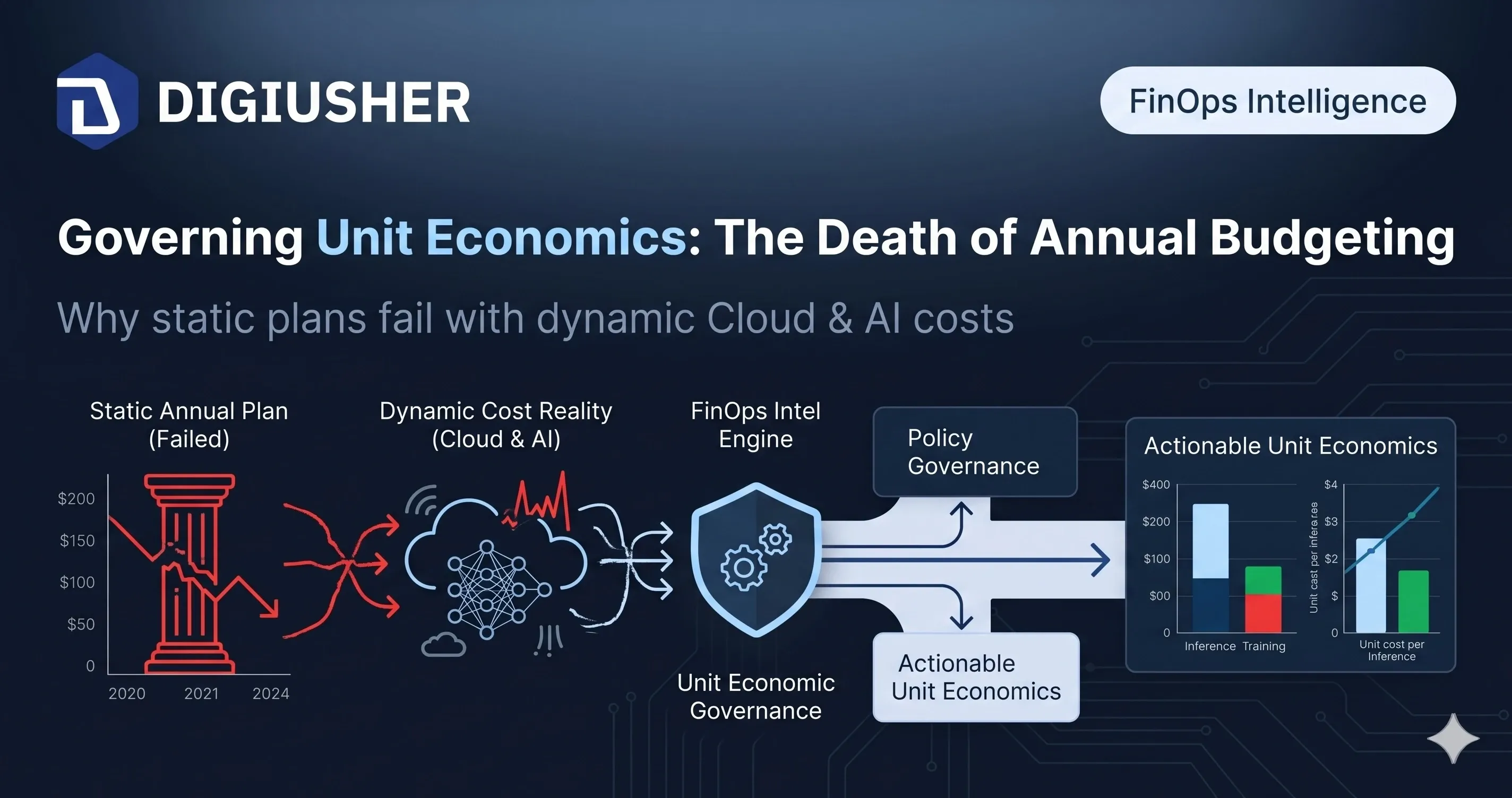
In November 2025, a global manufacturer locked its 2026 cloud and AI budget at $84M. By March, actuals were tracking 27% higher. By May, the CFO had been asked twice in board meetings to explain the variance, and twice had answered with the same three-letter acronym: AI.
That story is not exceptional. It is the dominant pattern for enterprise cloud and AI spend in 2026, and it has a single structural cause: annual planning was built for fixed assets and is being applied to consumption.
The FinOps Foundation surveyed 1,192 practitioners responsible for more than $83B in annual cloud spend for its State of FinOps 2026, and 98% now manage AI spend — a category that did not exist in most enterprise budget books two years ago. Gartner forecasts public cloud end-user spending will reach $850B in 2026 at 21.3% year-over-year growth. The Flexera 2026 State of the Cloud Report measures 29% waste in IaaS and PaaS, an uptick from prior years driven directly by AI dynamics breaking traditional forecasting models. Annual planning is the wrong instrument for the asset class.
Executive Summary
- 98% of FinOps practices now manage AI spend (FinOps Foundation State of FinOps 2026) — a category absent from most annual budgets approved before 2024.
- 29% of cloud IaaS and PaaS spend is wasted in 2026, up from prior years (Flexera 2026) — the structural residue of fixed budgets applied to variable consumption.
- Only 25% of enterprises have 40% or more of AI projects in production today, while 54% expect to reach that milestone within six months (Deloitte 2026 State of AI in the Enterprise) — meaning more than half of enterprises will have a different AI cost profile by Q4 than they had at budget setting.
- 48% of CFOs say they are ultimately responsible for AI ROI (RGP / CFO.com) — variance accountability has moved to finance without the tooling moving with it.
- Only 14.2% of FinOps practices operate at Run maturity (FinOps Foundation 2026) — meaning one in seven enterprises has the operating model required to govern consumption at the speed it now changes.
- Gartner projects 50% of multi-cloud implementations will fail to deliver expected results by 2029 — a forecasting and governance failure, not a technology failure.
The Annual Planning Trap
Annual planning works when three conditions hold: cost drivers are stable across the planning horizon, the asset base is fixed enough to depreciate, and variance against budget can be explained by a discrete event. Cloud and AI satisfy none of these conditions.
Cloud cost is generated continuously by engineering decisions, customer demand, model selection, instance type availability, and data volume. None of these variables are owned by finance, and none of them are constant across a 12-month window. AI compounds the problem: model selection alone can change per-inference cost by an order of magnitude, and a successful feature launch can produce a step-change in token consumption without any infrastructure event having occurred.
The result is that annual budgets stop predicting anything useful within a quarter or two of being approved. Finance teams then spend the remainder of the year explaining variance after the fact — a posture that erodes credibility at board level and provides no governance capability whatsoever. The Flexera 2026 report frames it directly: as organisations adopt new services and AI workloads, accurate forecasting “remains a persistent challenge”, and AI is “poised to create more budget overruns.”
This is not a forecasting accuracy problem. It is a planning instrument problem. CFOs running cloud and AI through annual cycles are using a tool designed for fixed assets to govern consumption, and the answer is not to forecast harder. The answer is to replace the instrument.
Three Structural Failures of Annual Cloud and AI Planning
Failure One: Cloud Cost Is Consumption, Not Allocation
Annual planning allocates a budget — a fixed pool of capital that an organisation commits to a category for a defined period. Cloud cost is not allocated; it is consumed, continuously, by every engineering decision and every customer interaction. The difference matters because allocated capital can be controlled by approval gates, while consumed cost can only be controlled by consumption governance.
A finance team that approves a $50M annual cloud budget has not actually approved $50M of cloud spend. It has approved 12 months of unconstrained consumption against a notional ceiling that nothing in the engineering workflow knows about. By the time finance learns that consumption is tracking 18% above plan, the spend has already happened. There is no recall mechanism for consumption that has already occurred — only a forensic explanation of how it happened.
The FinOps Foundation’s 2026 data shows the consequence: 90% of FinOps respondents now have a remit beyond public cloud, into SaaS, data platforms, licensing, and on-premises. Each new category amplifies the consumption-versus-allocation gap. An enterprise with a unified annual budget across cloud, Databricks, Snowflake, SaaS, and AI providers has no governance instrument that operates at the speed those workloads change.
Failure Two: AI Workloads Break the Unit Economics Model Quarterly
Traditional cloud unit economics — cost per user, cost per transaction, cost per region — held stable enough across a year that annual planning could project forward with reasonable confidence. AI breaks this. The unit economics of an AI workload change every time a new model is released, every time the team changes prompts, every time a feature ships, and every time GPU availability shifts in a region.
The Deloitte 2026 State of AI in the Enterprise data is unambiguous: 25% of enterprises currently have 40% or more of AI projects in production, but 54% expect to reach that milestone within six months. That means the enterprise AI cost surface is going to roughly double in production scope inside two quarters, against budgets set in the previous calendar year. No annual model can absorb that shift.
The structural failure is that AI workloads do not fit into the planning categories that finance teams operate on. A traditional cloud budget allocates by environment (prod, dev, staging), by business unit, or by region. An AI workload’s cost is driven by model selection, prompt design, token volume, GPU instance availability, and retrieval frequency — none of which map cleanly to the categories the budget tracks. The result is that AI cost appears in the budget as a single line item with no decomposition, and variance against that line item has no attributable cause.
Failure Three: The Estate Expanded Faster Than the Planning Model
The third structural failure is the silent one. The cloud-only estate that annual planning was designed for has, in most enterprises, been replaced by a multi-layer technology surface that the planning model never extended to cover.
The 2026 FinOps Foundation data captures the shift: practices that began with AWS and Azure billing now govern Databricks consumption, Snowflake credits, Kubernetes attribution, Azure OpenAI tokens, AWS Bedrock inference, Vertex AI usage, direct OpenAI and Anthropic API spend, SaaS sprawl, marketplace transactions, and increasingly on-premises infrastructure. Each layer has its own cost model, its own billing cadence, and its own attribution challenge. Annual planning models — which were designed when the surface was AWS and “some Azure” — do not reach these categories at all.
The consequence is a planning blind spot at the surface level. Finance projects a $50M cloud budget, then discovers in March that Databricks alone is running at $8M annualised, that an AI feature has driven Azure OpenAI tokens to $2M per quarter, and that Snowflake credits are growing 40% year-over-year. None of these were in the plan because the plan was structured against the wrong taxonomy. Catching up requires not better numbers but a different operating model.
What Is a FinOps Financial Control System?
A FinOps Financial Control System is a continuous governance layer that replaces fixed annual cloud and AI budgets with rolling forecasts, real-time variance attribution, and policy-as-code controls enforced at deploy time. It treats cloud and AI spend as consumption to be governed against an evolving value model, not as a fixed cost line to be projected once a year.
Unlike traditional FP&A, a FinOps Financial Control System operates on FOCUS-normalised data across the full technology estate and integrates engineering, finance, and product into a single control loop. In the FinOps Foundation maturity model, it is the operating substrate for Run-stage organisations expanding beyond cloud into AI, SaaS, data platforms, and on-premises governance.
The shift from annual budgeting to a Financial Control System changes four things at once:
From Annual Planning             To FinOps Financial Control System
─────────────────────────────    ───────────────────────────────────
Fixed 12-month budget            Rolling 13-week and 12-month forecast
Variance explained in arrears    Variance attributed in hours
Cost ceiling per cost centre     Policy-as-code at deploy time
Cloud-only scope                 Cloud + K8s + AI + Data + SaaS + DC
Annual chargeback close          Continuous showback and chargeback
Spreadsheets reconciled monthly  FOCUS 1.x normalised data continuously
─────────────────────────────    ───────────────────────────────────
The variance conversation        The value conversation
The change is not a reporting upgrade. It is a different operating system for cloud and AI financial governance — one that matches the cadence of the asset class being governed.
The Continuous Planning Operating Model
A continuous planning operating model has five components. Each replaces a specific failure of the annual cycle.
A rolling forecast cadence. Replace the annual budget snapshot with a rolling 13-week and 12-month forecast refreshed weekly against FOCUS-normalised actuals. The forecast is not better because it is more accurate at any single point — it is better because it absorbs new information continuously and reflects the current state of the estate, not the state at budget approval.
FOCUS 1.x as the data substrate. Cost data from every layer of the estate — multi-cloud infrastructure, Kubernetes, AI workloads, data platforms, SaaS, on-premises — normalised into a single specification. Without this, every category requires a separate conversation with finance and no consolidated view exists. With it, the same governance framework operates across the entire technology surface.
Continuous attribution. Every dollar of consumption attributable, in real time, to a business unit, product, team, or model. Attribution that arrives at month-end close is too slow to govern consumption; it can only explain it. Attribution that arrives within hours of consumption creates accountability where it actually changes behaviour — at the engineering and product decision layer.
Policy-as-code controls at deploy time. Tagging requirements, token budget caps, GPU idle thresholds, agentic kill-switches, and reservation utilisation rules enforced as engineering primitives, not finance escalations. The Flexera 2026 finding that 29% of cloud spend is wasted is, at its root, an absence of these controls. Adding them at the platform layer prevents waste rather than detecting it.
Variance as value, not as exception. When the operating model assumes continuous change, variance against the previous forecast is not an exception to be explained — it is data about the business. The conversation moves from “why are you over budget?” to “what changed in the drivers, and is the change producing value?” That is the conversation a CFO can take to the board.
How To Evaluate a Continuous Planning Platform
The criteria below should be the buyer’s evaluation framework when assessing platforms to replace or supplement annual planning. Each criterion exists because a specific structural failure of cloud and AI governance requires it.
| Evaluation Criterion | Why It Matters in 2026 |
|---|---|
| FOCUS 1.x native architecture | Cost data normalised across cloud, Kubernetes, AI, data platforms, and SaaS using the open specification — not a compatibility layer added later |
| Continuous forecasting (rolling 13-week / 12-month) | Replaces annual snapshots with a forecast that absorbs new consumption signals weekly |
| AI workload governance native | Token attribution, GPU idle detection, agentic kill-switches, model-level cost decomposition — built in, not retrofitted |
| Full estate coverage | One platform governs cloud + Kubernetes + Databricks + Snowflake + SaaS + on-premises — not a separate tool per category |
| BYOC / data sovereignty deployment | Collector inside the customer perimeter; billing data never leaves the customer’s cloud environment for regulated industries |
| Flat enterprise licensing | The vendor’s commercial incentive aligned with the customer’s cost reduction — not with cloud spend growing |
| Regulated-industry proof points | Demonstrated deployment at institutional scale where compliance and data residency are non-negotiable |
| SI partner delivery | Global delivery through Infosys, Wipro, and Hexaware — not direct-only |
The fifth and sixth criteria are the structural ones most often missed. A platform that requires billing data to be exported to a third-party cloud is disqualified for any enterprise in banking, insurance, healthcare, or public sector — regardless of how good its UI or forecasting algorithms are. A platform that charges a percentage of cloud spend has commercial incentives misaligned with the buyer’s planning objective; at $50M of annual cloud spend, a 3% rate is $1.5M per year, growing as the customer’s costs grow. Flat enterprise licensing separates the cost of governance from the cost being governed.
How DigiUsher Operationalises Continuous Planning
DigiUsher is a FinOps Operating System built on FOCUS 1.x natively, designed to be the substrate of a continuous planning operating model. The capability map below is the one that resolves each of the failures described above.
Plan maintains rolling 13-week and 12-month forecasts across the full technology estate, refreshed weekly against FOCUS-normalised actuals. Scenario modelling allows finance and engineering to project the cost impact of model swaps, region migrations, AI feature launches, and commitment renewals before they happen.
Radar runs continuous anomaly detection across cloud, Kubernetes, AI provider, and data platform spend. Variance is surfaced in hours, attributed to a service, team, or model, and routed to the owner who can act on it — not held for month-end close.
Meter governs AI workloads at the cost surface annual planning cannot reach. Token-level attribution across Azure OpenAI, AWS Bedrock, Vertex AI, Databricks, Snowflake ML, and direct API providers. Per-model, per-team, per-environment, and per-chain breakdown for agentic workloads. GPU idle detection at the cluster, namespace, and pod level for self-hosted inference.
Guard enforces governance at deploy time as policy-as-code. Tagging policies that block non-compliant resources, token budget caps that throttle runaway agentic workloads, GPU idle thresholds that reclaim wasted capacity, and kill-switches that halt cost anomalies before they reach finance escalation.
Allocate runs automated chargeback and showback to business units, products, and cost centres without manual reconciliation. Cost attribution at the cadence of the business, not the cadence of the month-end close.
The platform deploys via SaaS, Managed SaaS, or via Bring Your Own Cloud with a Secure Relay Proxy for regulated industries — a leading private bank operates DigiUsher inside its own perimeter at institutional scale, with billing data never leaving the bank’s cloud environment. A European energy utility recovered €1M in 45 days on its Databricks estate using the same operating model — variance surfaced at the cadence of consumption, attributed to specific workloads, and remediated by the engineering teams that owned them.
DigiUsher is licensed flat at the enterprise level — the commercial model does not scale as a percentage of cloud spend. SOC 2 Type II certified, GDPR compliant, AWS ISV Accelerate Partner, Azure ISV Co-Sell Ready, GCP Partner. Delivered globally by Infosys, Wipro, and Hexaware.
Frequently Asked Questions
Why does annual planning fail for cloud and AI budgets?
Annual planning fails because cloud and AI are consumption costs, not fixed costs. Traditional FP&A was designed for capital expenditure on assets with depreciation schedules and predictable utilisation — servers in a data centre, software licences with seat counts. Cloud and AI spend behaves differently: cost is generated continuously by engineering decisions, customer demand, model selection, and data volume, and it can move by tens of percent in a single quarter without a budget event having occurred. The FinOps Foundation State of FinOps 2026 surveyed 1,192 practitioners responsible for over $83B in annual cloud spend, and 98% now manage AI spend — a category that did not exist in most enterprise budgets two years ago. Annual budgets approved in November cannot survive a major model swap in March or a generative AI feature launch in May. The structural failure is not poor estimation; it is using a planning instrument designed for fixed assets to govern a consumption surface. DigiUsher replaces the annual cycle with a continuous forecasting loop that refreshes weekly against FOCUS-normalised actuals across cloud, Kubernetes, AI, data platforms, and SaaS — so finance is governing the estate as it actually behaves, not as it was projected to behave nine months ago.
What is the difference between annual budgeting and continuous forecasting?
Annual budgeting sets a fixed cost ceiling for a 12-month period and reports variance against it. Continuous forecasting maintains a rolling projection — typically 13 weeks and 12 months — that updates as actuals arrive and as business drivers change. The distinction is structural, not procedural. Annual budgeting assumes that the variables driving cost are stable enough that an annual estimate has predictive value. Continuous forecasting assumes the variables move faster than the budget cycle and treats every weekly refresh as the new baseline. For cloud and AI, the second assumption is now empirically correct: Gartner forecasts public cloud growth of 21.3% in 2026 to $850B end-user spending, with AI workloads projected to grow fivefold by 2029. An enterprise running annual planning against those rates is governing the past, not the future. Continuous forecasting also changes the variance conversation from “why did you spend more than budget?” to “what changed in the drivers, and is the change creating value?”
How much does cloud waste typically cost an enterprise running annual planning?
Enterprises running pure annual planning typically waste 27–29% of cloud spend. The Flexera 2026 State of the Cloud Report places wasted IaaS and PaaS spend at 29%, an uptick from prior years driven largely by AI workload dynamics that traditional planning models cannot accommodate. At an industry level, that translates to over $100B globally — and for a single enterprise running $50M of annual cloud spend, it is approximately $14.5M per year of value evaporation. The waste accumulates in three specific places: idle resources that survive between quarterly reviews because no one is watching them at sub-monthly cadence; over-committed reservations purchased against an annual demand model that has already changed; and AI experimentation that runs against shared infrastructure with no attribution back to a product or business case. None of these are visible in an annual budget framework — they only become visible at the cadence of consumption.
Why is AI spend particularly difficult to plan annually?
AI spend is difficult to plan annually because it is driven by variables that did not exist in the prior planning cycle. Model selection changes per-inference cost by an order of magnitude. Token consumption scales with feature adoption, not with provisioned capacity, so a successful AI feature launch can produce a step-change in cost without any infrastructure event. GPU availability is non-deterministic in many regions, forcing workloads onto more expensive instance types at short notice. The Deloitte 2026 State of AI in the Enterprise found that only 25% of enterprises have 40% or more of AI projects in production today, while 54% expect to reach that milestone within six months — meaning more than half of enterprises will have a fundamentally different AI cost profile in two quarters than they had during budget setting. CFOs are then accountable for variance that originated outside the assumptions of the plan.
What should enterprises look for when evaluating a cloud and AI planning platform?
Enterprises should evaluate planning platforms against five criteria specific to consumption governance: FOCUS 1.x native data normalisation across all technology categories, continuous forecasting cadence rather than annual snapshots, AI workload attribution down to model and chain level, regulated-industry deployment options that keep billing data inside the customer perimeter, and a commercial model that does not scale as a percentage of cloud spend. The fifth point is structural: a vendor charging 3% of cloud spend has a commercial incentive aligned with the customer’s cost growing, not shrinking — which is the opposite of what an enterprise should buy when the goal is consumption governance. Buyers should also examine whether the platform can govern Kubernetes, Databricks, Snowflake, and direct AI provider costs through the same data model, or whether each category requires a separate tool and a separate conversation with finance.
How does DigiUsher replace annual planning for cloud and AI?
DigiUsher replaces annual planning with a continuous FinOps Financial Control System built on five capabilities. Plan maintains rolling 13-week and 12-month forecasts across the full technology estate, refreshed weekly against FOCUS-normalised actuals. Radar runs continuous anomaly detection so cost spikes are surfaced and attributed within hours, not at month-end close. Meter attributes AI spend at the model, team, environment, and chain level, including token-level governance for Azure OpenAI, AWS Bedrock, Vertex AI, and direct API providers. Guard enforces tagging, token budget caps, GPU idle limits, and agentic kill-switches as policy-as-code at deploy time. Allocate runs automated chargeback and showback to business units, products, and cost centres without manual reconciliation. The platform deploys via SaaS or via Bring Your Own Cloud with a Secure Relay Proxy for regulated industries, and is licensed flat at the enterprise level — so the commercial model aligns with the customer’s cost reduction rather than against it.
What happens when enterprises continue to use annual planning for cloud and AI?
Enterprises that continue to use annual planning for cloud and AI experience three predictable outcomes. The first is structural variance: actuals diverge from budget by 15–30% within two quarters, driven by AI adoption, model switches, and demand growth that the annual estimate did not capture. The Flexera 2026 State of the Cloud Report measures 29% waste in IaaS and PaaS, much of which is the residue of annual commitments that no longer match consumption. The second is forecasting credibility erosion at the board level: a CFO who has explained cloud variance as an exception for three consecutive quarters loses the room. The RGP study found 48% of CFOs are now ultimately responsible for AI ROI — variance without explanation is now a personal accountability problem. The third is missed value capture: enterprises with annual-only planning cannot redirect spend toward higher-return AI initiatives mid-cycle, so the highest-return opportunities go unfunded while underperforming initiatives continue to burn.
References
- FinOps Foundation — State of FinOps 2026
- Flexera — 2026 State of the Cloud Report
- Gartner — Public Cloud Services Forecast, Q1 2026
- Deloitte — The State of AI in the Enterprise 2026
- Deloitte — CFO Guide to Tech Trends 2026
- RGP / CFO.com — CFO AI ROI Study, December 2025
- CFO Dive — Top 5 AI Adoption Challenges Facing CFOs in 2026
- FinOps Foundation — AI for FinOps: Agentic Use Cases
- Fortune — The Hidden ROI of AI: What Leaders Should Actually Measure (April 2026)
- FOCUS Specification 1.x — FinOps Open Cost and Usage Specification
Annual planning was the right instrument for fixed assets. Cloud and AI are not fixed. The CFOs who will keep the room in 2027 are the ones who replaced the instrument, not the ones who tried to forecast harder against it.
Ready to replace your annual cycle with a continuous FinOps Financial Control System?
Book a 30-minute briefing with the DigiUsher team. We will walk you through a working example of rolling 13-week forecasting, FOCUS-normalised attribution across your cloud, Kubernetes, AI, and data platform estate, and policy-as-code controls that prevent the variance an annual model can only explain. SOC 2 Type II certified. GDPR compliant. AWS ISV Accelerate Partner. Azure ISV Co-Sell Ready. GCP Partner. Delivered globally by Infosys, Wipro, and Hexaware.
Related reading
- Cloud Cost Optimization Is Dead: What Comes Next · March 14, 2026 · Establishes the operating-model shift this briefing applies to annual planning specifically.
- Why FinOps Is a Board-Level Discipline in 2026 · February 4, 2026 · The board-level companion piece on why cloud and AI cost governance has moved into capital allocation.
- The Death of Annual Chargeback: Why FinOps Needs Continuous Allocation · January 22, 2026 · The chargeback and showback mechanisms continuous forecasting depends on.
- The CFO’s Guide to AI ROI: Closing the $600B Gap · April 8, 2026 · Deeper dive on the AI value-attribution mechanism this briefing introduces.
- FinOps for AI: Governing Tokens, GPUs, and Agentic Workloads · March 28, 2026 · Technical companion that details how Meter and Guard govern the AI cost surface annual planning cannot capture.
DigiUsher in 30 min
Give your board a cost-to-outcome view they can actually act on.
DigiUsher connects cloud and AI spend to the outcomes it funds, in language finance already speaks.
Book a 30-min walkthroughNo hard pitch · tailored to your stack
Continue Reading
More from the DigiUsher editorial team.
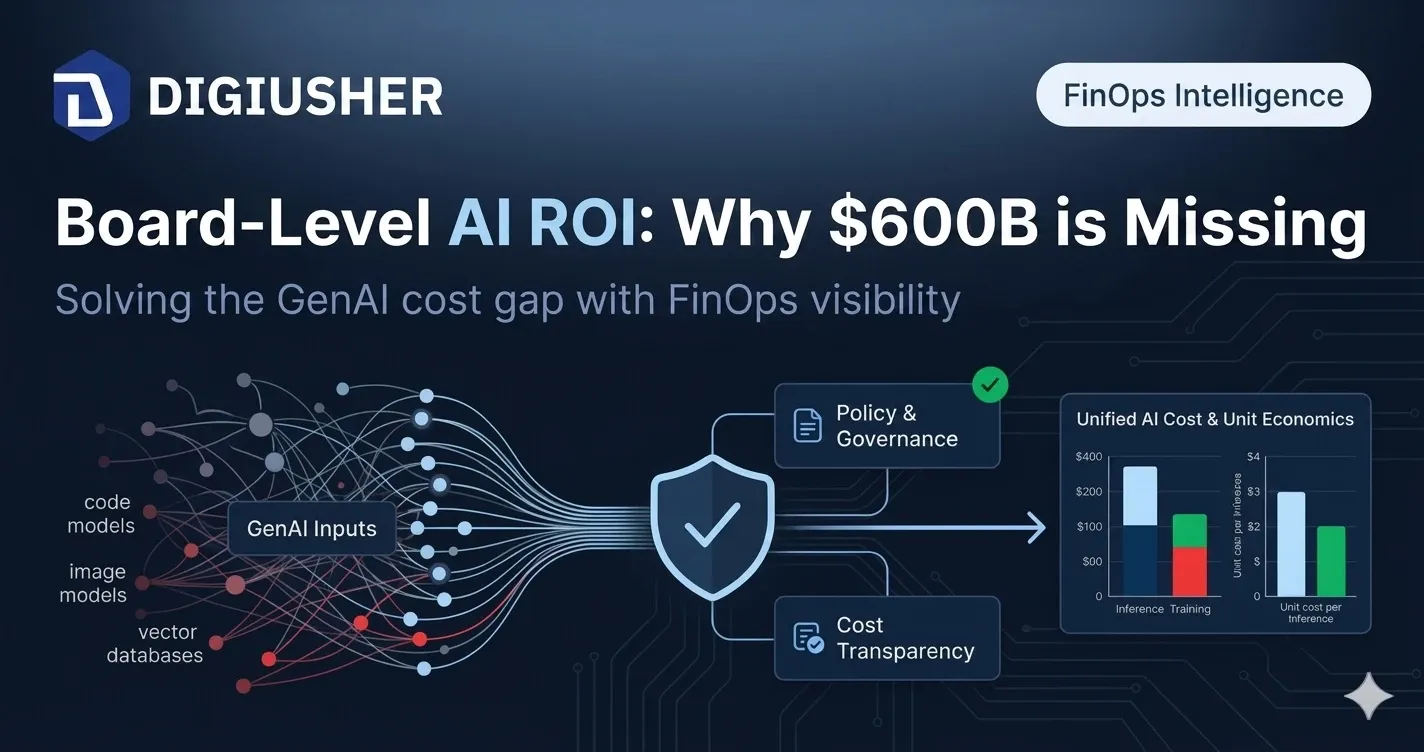
Board-Level AI ROI: Why $600B in Investment Is Delivering Single-Digit Returns — and What Fixes It
Only 7% of CFOs see high ROI from AI despite $270B in enterprise spend forecast for 2026. Here's the governance framework boards are demanding — and why cost attribution is the missing layer.
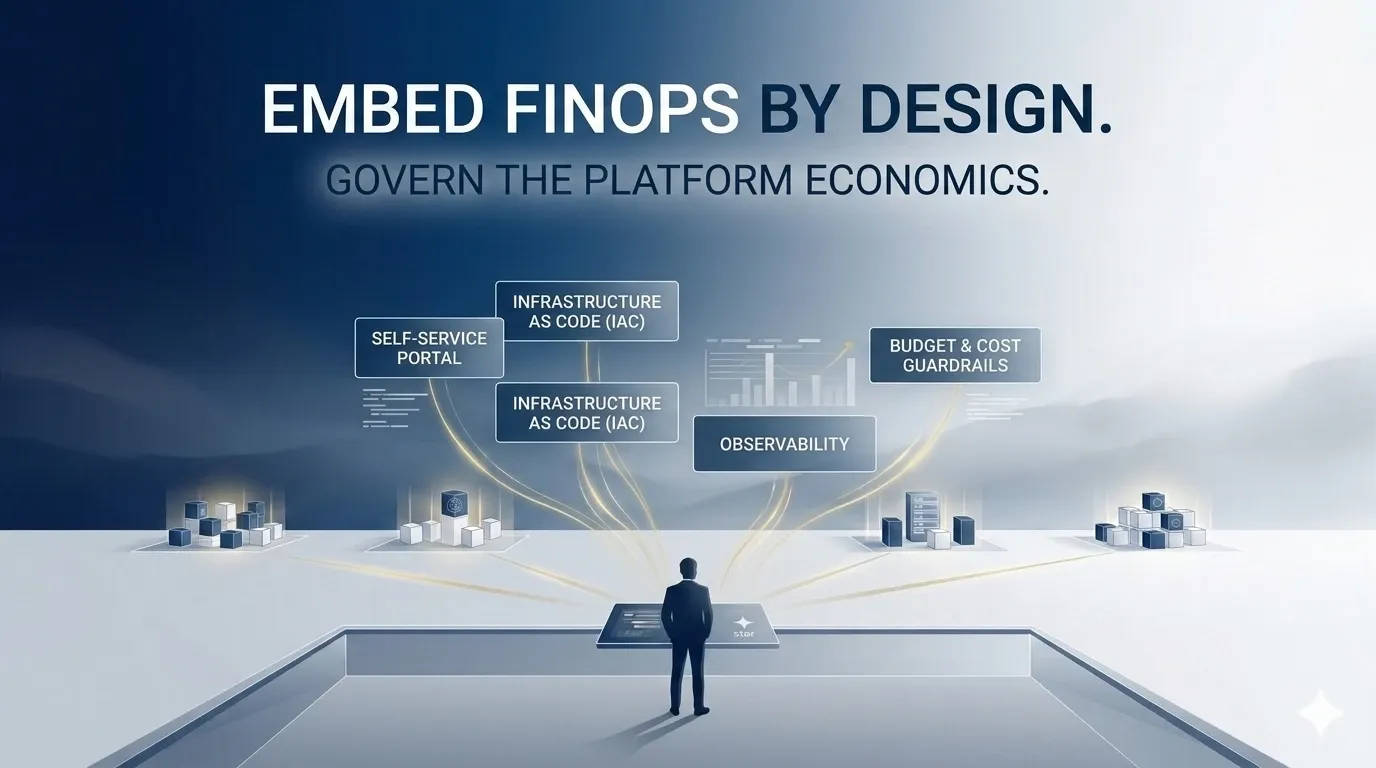
Seven Signals from the State of FinOps 2026: Why Technology Value Management Is Now a Board-Level Mandate
8% of FinOps teams now govern AI spend. Gartner forecasts $2.52T in global AI investment. The State of FinOps 2026 rewrites the rules for every CTO, CFO, and Head of FinOps.
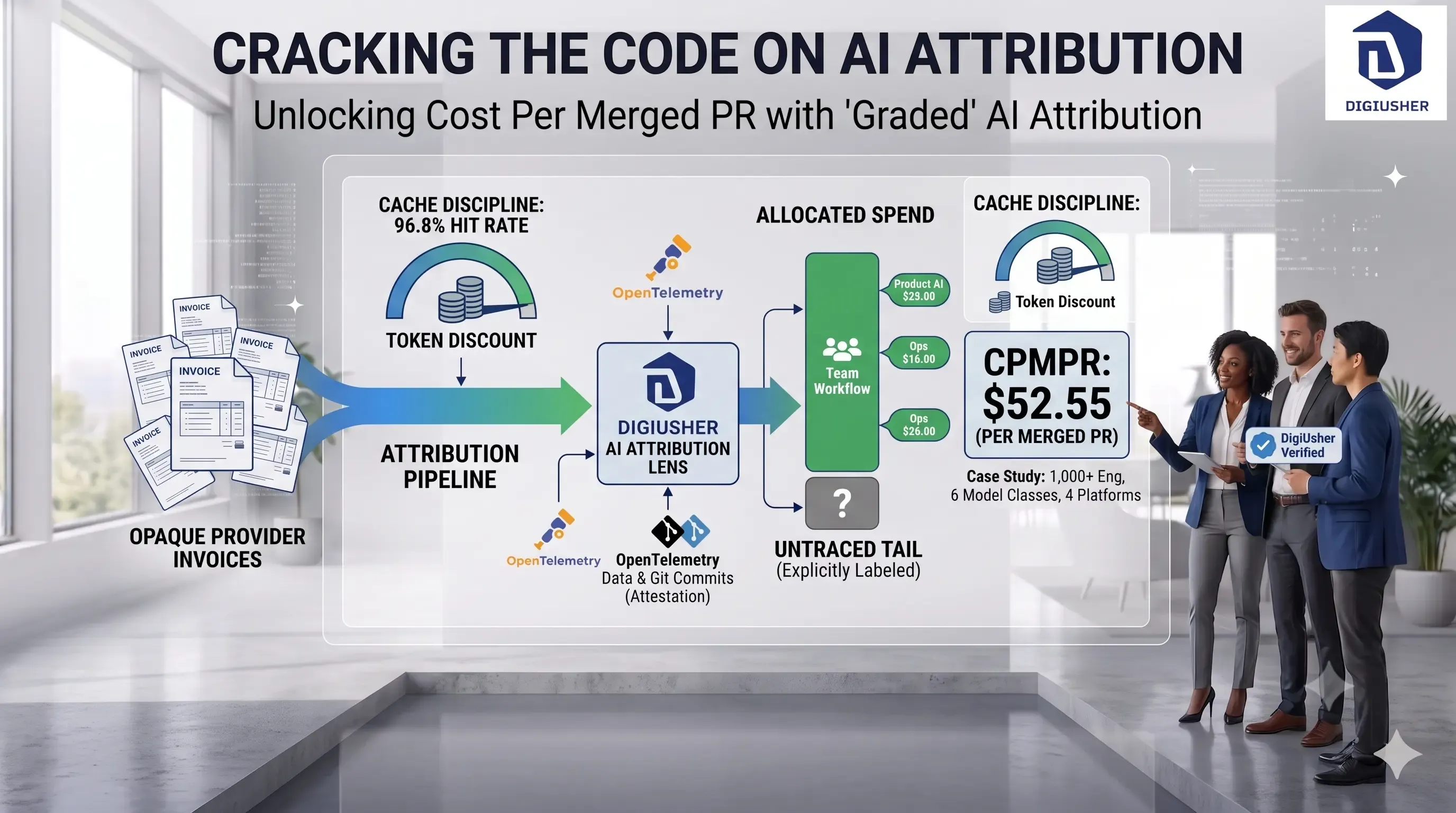
$52.55 Per Merged Pull Request: How One 1,000-Engineer Firm Priced Its Own AI Spend
A public technology firm with 1,000+ engineers refused to run its AI spend on faith. Here's the ledger it built instead — $52.55 per merged PR, 96.8% cache-hit rate, and a blended cost of $0.75 per million tokens.