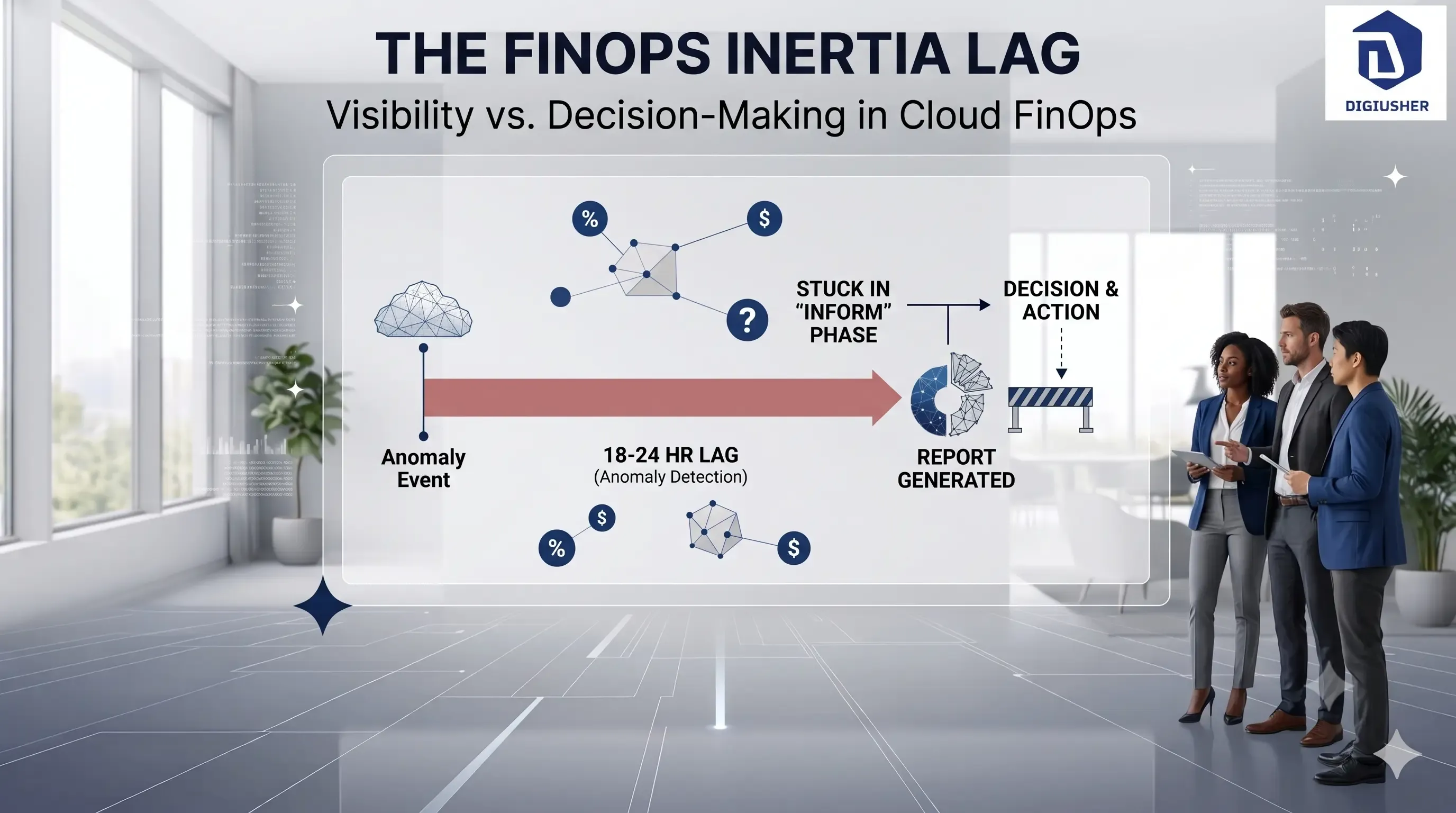
Most FinOps Programs Stall at "Inform" — and Never Reach Optimize
Visibility tools generate reports, not decisions. Legacy FinOps tools carry an 18-to-24-hour anomaly detection lag, according to the DigiUsher live TCO index — and that lag, not a lack of dashboards, is why most programs never leave the Inform phase.
A FinOps team built a cost allocation taxonomy that took four months to complete. It was accurate, it was granular, it was color-coded by business unit. And then, the following quarter, cloud spend grew by the same percentage it had the quarter before. No one had been empowered to act on what the taxonomy revealed.
This is the Inform trap. It is not a tooling problem. It is a structural problem disguised as a reporting problem, and it is the most common failure mode in enterprise FinOps programs today.
Why “Inform” Feels Like Progress
The FinOps Foundation’s maturity model describes three phases: Inform, Optimize, Operate. Most organizations can describe exactly where they are in that model. They say “Inform” with a note of resignation, as if Optimize were a destination they’re navigating toward but can never quite reach. The honest diagnosis is more uncomfortable: many organizations are not actually moving. They are circling.
Inform feels like progress because it produces artifacts — dashboards, taxonomies, monthly decks — and artifacts are easy to mistake for outcomes. A finished report closes a ticket. It does not close a cost gap. Teams get rewarded, internally, for the completion of the report rather than the change in spend that follows it, and that incentive quietly becomes the program’s real objective function, whether or not anyone intended it to be.
Understanding why organizations get stuck requires naming the failure modes precisely, not just their symptoms.
The First Blocker: The Accountability Vacuum
Cost data lands in dashboards consumed primarily by the FinOps team itself. Engineering teams receive reports as a notification, not as a mandate. Finance receives summaries that feed into variance analysis but produce no spending authority changes. No individual owns a budget line that maps to a cloud resource group and faces a consequence when that line drifts. Without that ownership structure, every anomaly becomes someone else’s problem by default.
This vacuum is rarely a deliberate choice. It’s usually the byproduct of how FinOps programs get funded in the first place — as a cost-visibility initiative, reporting into a Cloud Center of Excellence or a platform team, with no direct line to the P&L owners whose budgets the spend actually affects. The team can tell you what happened. It has no formal channel to make anyone act on it.
The Second Blocker: Detection Latency
Optimization decisions require timely signals. The DigiUsher live TCO index shows that legacy FinOps tools carry an 18-to-24-hour anomaly detection lag. In environments where workloads burst, scale horizontally, or spin up ephemeral infrastructure, 24 hours is not a monitoring window — it is a write-off window. By the time an anomaly surfaces in a weekly cost review, the spend has already occurred, the engineering team has moved on to the next sprint, and the conversation becomes retrospective rather than corrective. You cannot optimize a cost you are always discovering after the fact.
The retrospective framing compounds over time. Each cycle of “here’s what happened last week” trains the organization to treat cost review as a historical exercise — closer to an audit than to an operational discipline. Nobody expects to act in an audit meeting. They expect to acknowledge. That expectation, repeated quarter after quarter, is what keeps a program parked at Inform even as its reporting gets more sophisticated.
The Third Blocker: No Shared Language
FinOps practitioners often sit organizationally between two functions that measure success in fundamentally incompatible units. Finance measures variance to budget. Engineering measures deployment velocity and uptime. Neither metric maps cleanly onto the other. Without a normalized cost framework — one that translates infrastructure decisions into financial outcomes that both sides trust — every cross-functional conversation degenerates into a negotiation over whose numbers are right.
The FOCUS 1.3 specification exists precisely to eliminate this translation layer, but organizations that adopt the standard without enforcing it as the single source of record for both teams gain nothing from it structurally. A shared schema that both teams have access to but neither team is required to use is not a shared language — it’s an optional dialect that whoever’s in the room can ignore when the numbers are inconvenient.
Why Fixing One Blocker at a Time Doesn’t Work
It’s tempting to treat these as independent problems to solve in whatever order is easiest — buy a faster monitoring tool, run a FOCUS adoption workshop, ask leadership for an accountability memo. In practice, fixing them out of sequence tends to produce the appearance of progress without the substance of it. A faster detection tool without an owner to act on the alert just produces faster alerts that still go nowhere. A shared schema without anyone required to use it becomes shelfware within a quarter. Accountability assigned without the data to back it up puts someone in an impossible position — responsible for a number they can’t see clearly or act on quickly enough to matter.
The sequence matters because each fix depends on the one before it actually holding.
Breaking Out of the Inform Phase
Start with accountability assignment. Before any tooling change, map every significant cost category to a named owner in engineering — a tech lead, a platform team, a service owner — and give that owner a quarterly budget with real consequences for overrun and real credit for savings. This is a governance decision, not a technology one. It does not require a new dashboard. It requires an executive sponsor willing to hold the structure.
Next, close the detection gap. Move from batch cost reporting to near-real-time anomaly signaling. The goal is to surface a cost event within the same operational window in which an engineer can still affect its outcome. This means integrating cost signals into the same incident-response and alerting infrastructure that engineering already monitors. When a cost anomaly appears in the same Slack channel as a latency alert, it gets treated with the same urgency.
Finally, establish the shared framework before the shared meeting. Finance and engineering should not be reconciling their numbers in a monthly review. They should be pulling from the same normalized data model — one that maps cloud resource consumption to product, team, and business unit using consistent allocation logic — before either team builds a report. The DigiUsher FinOps Operating System enforces this at the data layer, not the reporting layer, which is the only place where the enforcement is durable.
The Concrete Takeaway
Audit the last three months of cost anomalies your program surfaced. For each one, identify how many days elapsed between the anomaly occurring and a named individual taking a corrective action. That number is your Inform gap. It’s a more honest maturity metric than anything on a standard FinOps scorecard, because it measures the thing that actually separates Inform from Optimize: not whether the data exists, but whether anyone with the authority to act on it ever sees it in time to do so.
Close that gap, and Optimize stops being a phase you’re aspiring to and becomes the phase you’re already operating in.
See how fast a real cost anomaly reaches the person who can act on it. DigiUsher closes the detection-to-action gap by putting cost signals in the same alerting infrastructure engineering already trusts, on a FOCUS-native data model finance already speaks. Book a 30-minute walkthrough and bring your last quarter’s anomaly log; we’ll show you where the days went.
DigiUsher in 30 min
See which team owns every dollar — in real time.
DigiUsher turns raw billing data into allocation finance trusts — chargeback, showback, and guardrails included.
Book a 30-min walkthroughNo hard pitch · tailored to your stack
Continue Reading
More from the DigiUsher editorial team.
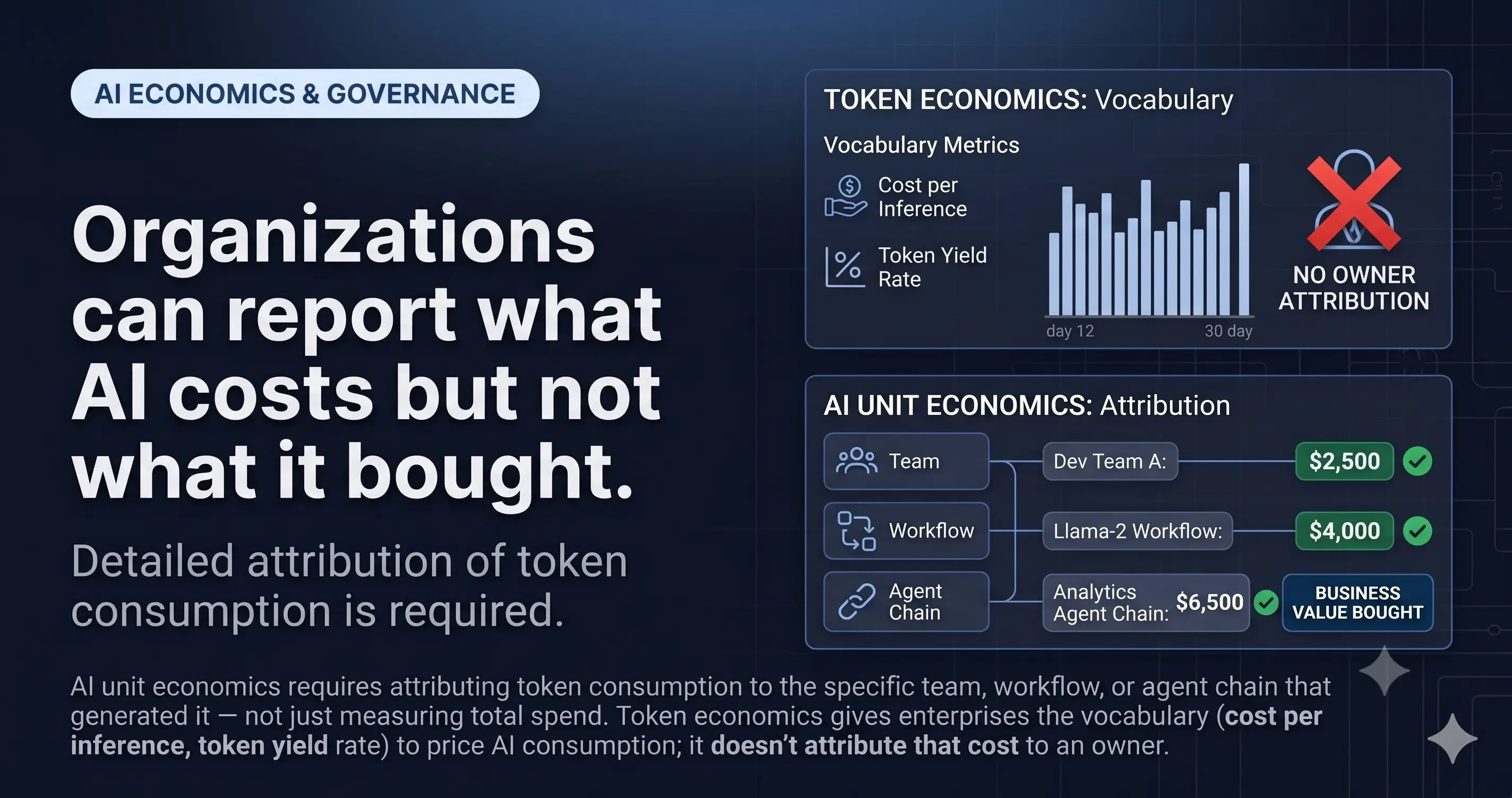
Token Economics Gave AI Spend a Vocabulary. It Still Has No Owner.
FinOps Foundation's token economics framework names the AI cost problem correctly. But naming a metric and attributing it to a team, workflow, or chain are two different disciplines — and most enterprises only have the first.
Seven Signals from the State of FinOps 2026: Why Technology Value Management Is Now a Board-Level Mandate
8% of FinOps teams now govern AI spend. Gartner forecasts $2.52T in global AI investment. The State of FinOps 2026 rewrites the rules for every CTO, CFO, and Head of FinOps.
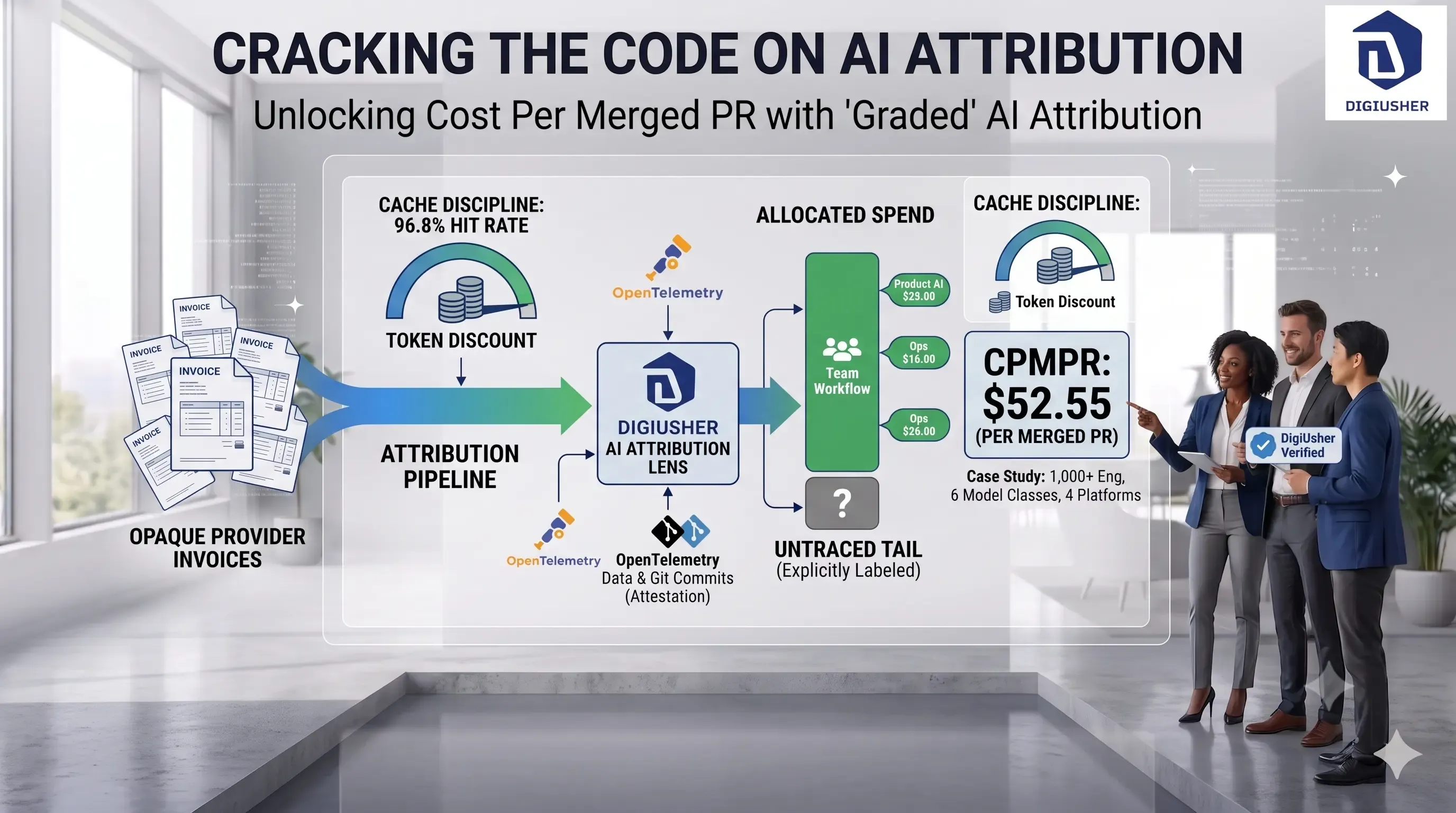
$52.55 Per Merged Pull Request: How One 1,000-Engineer Firm Priced Its Own AI Spend
A public technology firm with 1,000+ engineers refused to run its AI spend on faith. Here's the ledger it built instead — $52.55 per merged PR, 96.8% cache-hit rate, and a blended cost of $0.75 per million tokens.