Why Shadow IT Is a Financial Risk, Not an IT Problem
30–40% of IT spending in large organisations is Shadow IT. 98% of executives admit to bypassing IT for technology purchases. Shadow AI adds $670,000 to average breach costs. This briefing reframes Shadow IT as a financial governance failure — explains the AI multiplier effect that turns ungoverned spending into enterprise margin risk — and sets out the FinOps operating model that replaces restriction with controlled accountability.
Executive Summary
For years, Shadow IT has been framed as a security or compliance concern — unauthorised tools, unmanaged SaaS subscriptions, or engineers bypassing centralised IT controls. That framing is now operationally dangerous because it produces the wrong intervention.
Security teams that respond to Shadow IT with access controls discover that employees route around them. IT governance teams that run quarterly audits discover they are documenting spend that occurred months ago. Procurement teams that enforce approval workflows discover that developers with API keys and corporate credit cards have already provisioned what they needed before the request was submitted.
The 2026 data makes the scale unavoidable:
- 30–40% of IT spending in large organisations is Shadow IT — Gartner
- 98% of executives admit to bypassing IT for technology purchases — Zylo
- 80% of employees use non-sanctioned applications to get their work done — Microsoft
- Shadow AI specifically adds $670,000 to average breach costs — IBM global study of 600 organisations
- Only 2% of organisations have FinOps teams covering cloud, SaaS, and GenAI holistically — the governance gap that Shadow IT exploits
Shadow IT today is not about rogue tools. It is not about employees making bad decisions. It is about innovation that has outpaced the financial governance model designed to account for it — generating budget leakage, undermining cloud commitment economics, and creating ROI blind spots that make technology investment impossible to evaluate.
The enterprise that treats Shadow IT as a security problem will continue chasing symptoms. The enterprise that treats it as a financial operating model failure will solve the root cause — and unlock innovation safely.
What Is Shadow IT in 2026?
Shadow IT is technology adopted, purchased, or operated by employees and business units outside central IT and finance governance. In 2026, it has evolved far beyond unauthorised software installations into a multi-vector, multi-billion-pound financial governance challenge:
Shadow IT: The 2026 Landscape
─────────────────────────────────────────────────────────────────────
Form                  Scale                  Financial Mechanism
─────────────────────────────────────────────────────────────────────
Cloud environments    Millions in ungoverned  Provisioned with API keys,
                      infrastructure          never tagged, never attributed

SaaS marketplace      $1.4M per 1,000 users  Departmental purchases bypass
purchases             unmanaged spend         enterprise commitments

AI API integrations   Token costs scale       Ungoverned API keys generate
                      non-linearly            orders-of-magnitude overspend

Autonomous AI agents  Recursive loops in      Thousands of $/hr before anyone
                      hours not days          is aware of the process running
─────────────────────────────────────────────────────────────────────
Cloud providers have intentionally lowered the barrier to adoption — AWS, Azure, and GCP enable instant provisioning. AI vendors including OpenAI, Anthropic, and Hugging Face allow teams to integrate advanced capabilities with only an API key and a payment method. Innovation friction has disappeared. Financial controls often have not.
Gartner estimates 30–40% of IT spending in large organisations is Shadow IT. By 2027, 75% of employees are expected to acquire, modify, or create technology without IT oversight — up from 41% in 2022. The trajectory is not toward less Shadow IT. It is toward more, faster, with higher per-unit cost as AI replaces static SaaS subscriptions with usage-driven inference spend.
The Evolution from Rogue Apps to Autonomous Spending
The character of Shadow IT has shifted fundamentally across three generations:
Generation 1 — Unauthorised Software (2010–2018): Employees installing unapproved desktop applications, using personal Dropbox accounts for work files, or subscribing to productivity tools outside IT procurement. Risk: primarily security and compliance. Scale: bounded by individual productivity tools.
Generation 2 — SaaS and Cloud Self-Service (2018–2023): Teams procuring SaaS through cloud marketplaces, developers spinning up cloud environments with corporate credit cards, product teams deploying infrastructure outside procurement visibility. Risk: budget leakage and commitment misalignment. Scale: tens of thousands of pounds per team, millions across the enterprise.
Generation 3 — AI APIs and Autonomous Agents (2023–present): The current frontier. Product teams integrating AI APIs directly into applications. Developers using AI coding assistants. Data teams running LLM-powered workflows. And — the highest-risk evolution — autonomous AI agents deployed with persistent API access to enterprise systems, running continuously, making decisions without human oversight.
The critical financial distinction: Generation 1 and 2 Shadow IT involves static costs — a subscription is a fixed monthly charge. Generation 3 Shadow AI involves dynamic costs — an AI agent in a reasoning loop at 2:00 AM can generate thousands of pounds in compute costs before business hours begin. The financial governance model for static Shadow IT does not govern dynamic Shadow AI.
Shadow AI: The New Multiplier
Generative AI has dramatically amplified the financial stakes of ungoverned technology adoption — introducing a cost multiplication effect that has no equivalent in traditional Shadow IT.
The mechanism: AI costs based on tokens are fundamentally unknowable when unmonitored. A team running high-volume inference queries — document processing, summarisation, AI agent workflows — can have costs many orders of magnitude beyond a normal SaaS cost, and no one is aware of this until the cloud provider invoice arrives.
The scale this creates: by March 2026, a collective $400 million in unbudgeted cloud spend had accumulated across Fortune 500 organisations from ungoverned agentic AI deployments alone. At the Gartner Data & Analytics Summit, the atmosphere shifted: the “AI at any cost” era is over. The FinOps Reckoning has begun.
The Numbers Behind Shadow AI Risk in 2026
IBM’s global study of 600 organisations found that Shadow AI added $670,000 to average breach costs, 20% of organisations reported breaches specifically caused by Shadow AI, and only 37% had detection or governance policies in place.
54% of enterprises report financial losses tied to AI misuse or errors. Shadow AI incidents increase legal and compliance costs by 25–35%. The average cost of a Shadow AI data breach has reached $4.2 million.
The volume of data employees are sending to ungoverned AI tools has increased sixfold in one year. The average organisation experiences 223 AI-related data security incidents per month. Source code accounts for 42% of AI risk-related violations — developers uploading proprietary code for debugging assistance.
86% of employees now use AI tools at least weekly for work. 63% believe it is acceptable to use AI tools without IT oversight if no company-approved option is provided.
The Shadow AI risk is not primarily a security story — though the security dimension is severe. The primary financial risk is the cost exposure created when each team runs its own API keys, model subscriptions, and usage patterns in isolation: no overall understanding of organisation-wide AI costs, no ability to understand costs for specific products or business units, no ability to limit costs until they have already compounded beyond budget tolerance.
The Agentic Escalation
Autonomous AI agents represent a qualitatively different financial risk from chatbot-based Shadow AI. Traditional Shadow AI involves a human submitting a request to an AI tool. Agentic Shadow AI involves an autonomous system with API access that:
- Chains actions across multiple services
- Runs continuously, including outside business hours
- Makes decisions without human review
- Can enter recursive reasoning loops that generate unbounded spend
Only 44% of organisations have adopted financial guardrails for AI — meaning 56% have autonomous agents operating with no enforcement mechanism to prevent runaway spend. A single agent in a recursive loop can exhaust daily compute budgets before the first employee arrives at work. This is not a hypothetical risk — it is a documented pattern already generating material financial losses at enterprise scale.
Why Shadow IT Has Become a CFO Problem
Traditional IT governance assumed procurement acted as the financial gate. Cloud marketplaces, API-first AI platforms, and self-service SaaS have removed that gate. Forrester analysts note that decentralised purchasing models now allow operational teams to incur significant recurring spend before finance teams detect it. Three financial risks define the consequence:
Financial Risk 1 — Budget Leakage
Untracked services accumulate across teams: duplicate SaaS subscriptions for tools that solve the same problem differently, idle cloud environments provisioned for experiments that concluded months ago, AI workloads left running after the use case they were built for was abandoned.
Shadow IT and unsanctioned workloads increase total cloud costs by 10–15% for most enterprises — on top of the 27–35% baseline cloud waste that exists even in governed environments. For an enterprise spending $20 million annually on cloud, Shadow IT may be adding $2–3 million in unattributed, unattributable cost annually.
The CFO problem: Budget leakage from Shadow IT does not appear as a distinct line item. It inflates every infrastructure cost category while providing no attribution to business outcome. Finance teams performing month-end variance analysis cannot distinguish between legitimate scaling cost and Shadow IT accumulation without workload-level attribution that standard cloud billing does not provide.
“The financial team is left to try to perform forensic accounting on the situation.” — TrueFoundry, Shadow AI Risk Analysis
Financial Risk 2 — Commitment Misalignment
Enterprises negotiate large cloud commitments — AWS Enterprise Discount Programmes, Azure Enterprise Agreements, GCP committed use contracts — based on projected utilisation. These agreements deliver significant cost reductions for workloads that consume committed capacity. Shadow IT systematically destroys this value.
When teams purchase SaaS through marketplace channels outside the enterprise agreement, or provision cloud resources using departmental budgets that bypass the central commitment framework, those costs accumulate on the cloud invoice without counting toward committed utilisation. The enterprise pays full on-demand rates on Shadow IT spend while committed capacity sits underutilised — a double financial penalty: paying for Shadow IT at premium rates, and forfeiting the discount value of unused commitment capacity simultaneously.
The CFO problem: Cloud commitment ROI depends on utilisation rates that Shadow IT undermines without finance teams having visibility into the dynamic. CFO financial models that assume 85% commitment utilisation based on approved workloads may be operating at 60% because 25% of consumption is occurring outside the commitment structure.
Financial Risk 3 — ROI Blind Spots
When teams adopt tools independently, costs appear centralised in the cloud bill while the value they generate remains decentralised and unmeasured. Finance can see the spend. No one can attribute the return.
Only 31% of organisations have clearly defined ownership between FinOps, IT, and procurement for SaaS spend. Only 2% have FinOps teams covering cloud, SaaS, and GenAI holistically. This means 98% of enterprises cannot produce a cross-domain technology ROI report that connects spend to business outcome.
The CFO problem: When AI initiatives face board scrutiny — and increasingly they will, with Forrester projecting 25% of planned AI spend will be delayed into 2027 because projects cannot demonstrate ROI — the enterprise that adopted AI through ungoverned Shadow IT channels cannot answer the foundational question: what business value did this investment generate? ROI blind spots are not just a FinOps inconvenience; they are a strategic governance failure that will cost enterprises their next wave of technology investment approvals.
From IT Governance to Economic Governance
The pattern that consistently fails: organisations that respond to Shadow IT by tightening security access, enforcing approval workflows, or blocking AI tool categories discover that:
- Security blocks create workarounds, not compliance
- Approval workflows add friction that productive employees route around
- Blocking AI tools reduces employees to using sanctioned tools that are less capable, while colleagues at competitors use ungoverned but more powerful alternatives
Shadow IT persists because it is driven by business incentives, not rogue behaviour. Teams want speed. Developers want autonomy. Product leaders want experimentation capability. The right governance model does not eliminate these incentives — it aligns them with financial accountability.
The emerging best practice is clear: Shadow IT should be addressed through FinOps principles, not IT policy.
| Traditional IT Governance | Modern Economic Governance |
|---|---|
| Is this tool approved? | Who owns this cost and what does it fund? |
| Approval gates and access controls | Financial guardrails and automatic attribution |
| Central IT control | Distributed accountability with FinOps enablement |
| Periodic security audits | Continuous governance with automated enforcement |
| Block unauthorised tools | Surface cost, assign ownership, enforce budget |
| AI tool restriction | Token budgets, model tier governance, agentic controls |
The FinOps Foundation is explicit: collaboration between engineering, finance, and business stakeholders — not IT restriction — is the foundation of sustainable cloud and AI economics.
The operational shift: instead of asking “how do we stop teams from using ungoverned tools?”, the question becomes “how do we ensure every tool has automatic cost attribution, every experiment has a budget cap, and every expense has an owner?” When cost ownership is assigned automatically at provisioning, Shadow IT becomes visible to the teams creating it — creating the financial accountability structure that security policy alone cannot produce.
The FinOps Operating System: What Visibility Tools Cannot Do
Dashboards showing what ungoverned spend exists cannot govern it. Discovering Shadow IT retrospectively in a quarterly audit cannot prevent the cost that has already accumulated. The governance model that resolves Shadow IT as a financial risk requires capabilities beyond visibility:
Automatic tagging and ownership assignment at provisioning. Every cloud resource, every API key, every marketplace purchase attributed to an owning team, cost centre, and product at the point of creation — not discovered in retrospective audit. No resource enters the billing system without complete attribution metadata.
Marketplace governance. Cloud marketplaces are the fastest-growing Shadow IT vector — teams purchasing SaaS and AI services through AWS Marketplace, Azure Marketplace, and GCP Marketplace using departmental budgets that bypass enterprise commitment frameworks. Marketplace governance ensures these purchases count toward committed capacity, are attributed to owning teams, and are visible in real-time financial dashboards.
AI spend monitoring with automated enforcement. Real-time token consumption tracking per team and per product, with budget alerts at configurable thresholds and automated throttle and suspend actions before monthly limits are breached. Shadow AI governance requires automated enforcement — not alerts that engineers read two days after the cost has been generated.
Agentic workflow controls. Autonomous AI agents require kill-switch infrastructure: configurable spend thresholds that automatically terminate processes generating runaway costs, along with continuous monitoring that identifies recursive loops before they consume daily compute budgets overnight.
Anomaly detection for emerging Shadow IT. Spend patterns that diverge from historical baselines trigger real-time alerts — surfacing new Shadow IT adoption at the point of financial impact rather than in the quarterly review that arrives six weeks later.
What Forward-Looking CIOs and CFOs Are Doing in 2026
The enterprises leading in Shadow IT financial governance in 2026 have moved decisively away from security-framed responses toward economic governance models. The specific disciplines distinguishing leaders:
Marketplace-aware procurement governance — tracking every cloud marketplace purchase against enterprise commitment structures in real time, ensuring self-service adoption contributes to negotiated discounts rather than bypassing them.
AI spend monitoring from day one — every AI API key attributed to a team and covered by a token budget cap before the first inference call. The cost of AI adoption is visible to engineering teams at the point of consumption, not discovered by finance teams at month-end.
FOCUS-aligned cost standardisation — normalising cloud, SaaS, AI API, and marketplace spend to a unified attribution model. The prerequisite for cross-domain ROI analysis: a single cost schema that connects every technology expense to the business outcome it funds.
Automated financial guardrails — budget enforcement that acts automatically rather than alerts that require human response time. The speed at which Shadow AI can generate costs — thousands of pounds per hour from a single misconfigured agent — makes human-response governance structurally insufficient.
Continuous ROI measurement — technology investment evaluated on cost per business outcome, not just total spend. The governance intelligence that answers the board question: is this AI investment generating return proportionate to the financial exposure it creates?
DigiUsher: Turning Shadow IT into Accountable Innovation
DigiUsher’s FinOps Operating System approaches Shadow IT not as a phenomenon to eliminate but as a governance gap to close — enabling controlled autonomy rather than restrictive compliance.
Normalised multi-cloud and AI consumption data — cloud, SaaS, marketplace, and AI API spend from all providers normalised to FOCUS 1.x in a single attributed cost model. Every expense visible, every owner identified, every product line attributable.
Automatic financial ownership assignment — every provisioned resource and every API key attributed to an owning team, cost centre, and product at creation. Shadow IT cannot accumulate when attribution is mandatory at provisioning.
Real-time budget guardrails — token budget caps, cloud spend thresholds, and marketplace purchase controls enforced automatically with throttle and suspend actions. Governance that acts before cost is incurred — not reports that arrive after margin has already been eroded.
AI and agentic governance — token consumption tracked per workflow and per agent, with automated kill triggers for runaway processes and per-team model tier access controls. The Shadow AI governance infrastructure that 56% of enterprises currently lack.
CIO and CFO-ready ROI visibility — cross-domain technology spend connected to business outcomes in board-ready format. The governance intelligence that enables the answer: every pound of technology spend in this organisation has an owner, a business case, and a measurable return.
The objective is not to eliminate experimentation. It is to ensure every experiment has economic accountability — making Shadow IT not a risk to suppress but an innovation channel to govern.
Available as SaaS or BYOC for regulated industries. SOC 2® Type II and GDPR certified. Delivered globally through Infosys, Wipro, and Hexaware.
Shadow IT disappears when accountability becomes automatic. Accountability becomes automatic when governance operates at the provisioning layer — not the audit layer.
Frequently Asked Questions
What is Shadow IT and why is it a financial risk rather than just a security problem?
Shadow IT is technology adopted outside central IT and finance governance — cloud environments, SaaS subscriptions, AI APIs, and autonomous agents. Gartner estimates 30–40% of IT spending in large organisations is Shadow IT. 98% of executives bypass IT for technology purchases. It is a financial risk because it generates budget leakage (10–15% additional cloud cost), commitment misalignment (bypasses enterprise discount structures), and ROI blind spots (only 2% of organisations have FinOps covering cloud, SaaS, and GenAI holistically). Security framing produces access controls that employees circumvent. Financial framing produces attribution and accountability that makes ungoverned spend visible.
What is Shadow AI and why is it more financially dangerous than traditional Shadow IT?
Shadow AI is AI tool usage outside governance, policy, and financial visibility. It is more dangerous because AI costs are usage-driven and non-linear. A team running inference queries can generate costs orders of magnitude beyond normal SaaS cost without any signal until the invoice arrives. Shadow AI adds $670,000 to average breach costs (IBM). The average enterprise experiences 223 AI security incidents monthly from ungoverned usage. 47% of generative AI users access tools through personal accounts. Autonomous AI agents in recursive loops can exhaust daily compute budgets before business hours begin.
How much does Shadow IT cost enterprises?
Shadow IT adds 10–15% to total enterprise cloud costs on top of 27–35% baseline cloud waste. Unmanaged SaaS spend totals $1.4 million per 1,000 users. 12% of SaaS expenditures are currently unmanaged across enterprises. Shadow AI breaches cost an average of $4.2 million per incident and enterprises face $1.8 million average in compliance violation fines from improper AI usage. For a mid-market enterprise with $20M annual cloud spend, Shadow IT financial losses may exceed $2–3M annually before breach and compliance costs.
Why do security controls fail to solve Shadow IT?
Security controls address symptoms. Shadow IT persists because it is driven by business incentives — speed, autonomy, experimentation. 63% of employees believe it is acceptable to use AI tools without IT oversight if no company-approved alternative is provided. Blocking tools creates workarounds. The effective model treats Shadow IT as a financial accountability problem: when cost ownership is automatically assigned at provisioning and every experiment has a budget cap, the financial consequence of ungoverned adoption becomes visible to the teams creating it — producing the accountability structure that security policy alone cannot.
What does FinOps governance for Shadow IT look like operationally?
FinOps governance for Shadow IT operates at five levels: automatic tagging and ownership assignment at provisioning (no resource enters billing without attribution metadata); marketplace governance (purchases count toward enterprise commitments, not around them); AI spend monitoring with automated throttle and suspend actions (not alerts that arrive after cost has accumulated); agentic workflow controls (kill-switch infrastructure for runaway AI processes); and anomaly detection that surfaces new Shadow IT at the point of financial impact. The key distinction: FinOps governance enforces accountability continuously at provisioning and usage time — not retrospectively in quarterly audits.
How does DigiUsher address Shadow IT as a financial governance problem?
Through controlled autonomy rather than restriction. FOCUS 1.x normalised cost visibility across cloud, SaaS, marketplace, and AI APIs. Automatic financial ownership assignment at resource and API key creation. Automated budget guardrails with throttle and suspend actions. AI and agentic governance with per-chain token attribution and kill-switch infrastructure. Board-ready ROI visibility connecting every technology expense to business outcome. The goal: Shadow IT disappears when accountability becomes automatic — every experiment has an owner, a budget, and a measurable return.
References
- Gartner — Shadow IT Spending Estimate: 30–40% of Large Enterprise IT
- Zylo — SaaS Statistics 2026: 98% of Executives Bypass IT for Technology Purchases
- IBM Security — Cost of a Data Breach Report: Shadow AI Adds $670,000 Per Breach
- Netskope — 2026 AI Usage and Security Report: 47% Use AI Through Personal Accounts
- BlackFog — Shadow AI Research 2026: 86% Use AI at Least Weekly, 63% Believe IT Oversight Unnecessary
- Kiteworks / Netskope — 2026 AI Data Security: 223 Monthly AI Incidents Per Enterprise
- DataStackHub — Cloud Cost Statistics 2025–2026: Shadow IT Adds 10–15% to Cloud Costs
- SQ Magazine — Shadow AI Statistics 2026: 54% of Enterprises Report Financial Losses
- AnalyticsWeek — The $400M Cloud Leak: Agentic AI and FinOps Reckoning 2026
- BetterCloud — SaaS Statistics 2026: $1.4M Unmanaged SaaS Spend Per 1,000 Users
- Gartner — AI Governance Spending Forecast: $492M in 2026, $1B by 2030
- FinOps Foundation — State of FinOps 2026: Only 2% Cover Cloud, SaaS, and GenAI Holistically
- TrueFoundry — Shadow AI Risk: The Cost of Ungoverned AI API Keys
- CIO.com — Shadow AI: The Hidden Agents Beyond Traditional Governance
- Vectra AI — Shadow AI Explained: Risks, Costs, and Enterprise Governance (2026)
- FinOps Foundation — FOCUS Specification
Make Shadow IT Financially Accountable — Before the Next Invoice Surprises You
Shadow IT is no longer a security rebellion. It is a signal that innovation has outpaced the financial governance model designed to account for it.
Enterprises that treat it as a security problem will continue chasing symptoms. Those that treat it as a financial operating model challenge will unlock the same innovation capability — safely, accountably, and profitably.
DigiUsher’s FinOps OS makes Shadow IT visible, attributed, and governable — at the provisioning layer, not the audit layer.
DigiUsher in 30 min
Give your board a cost-to-outcome view they can actually act on.
DigiUsher connects cloud and AI spend to the outcomes it funds, in language finance already speaks.
Book a 30-min walkthroughNo hard pitch · tailored to your stack
Continue Reading
More from the DigiUsher editorial team.
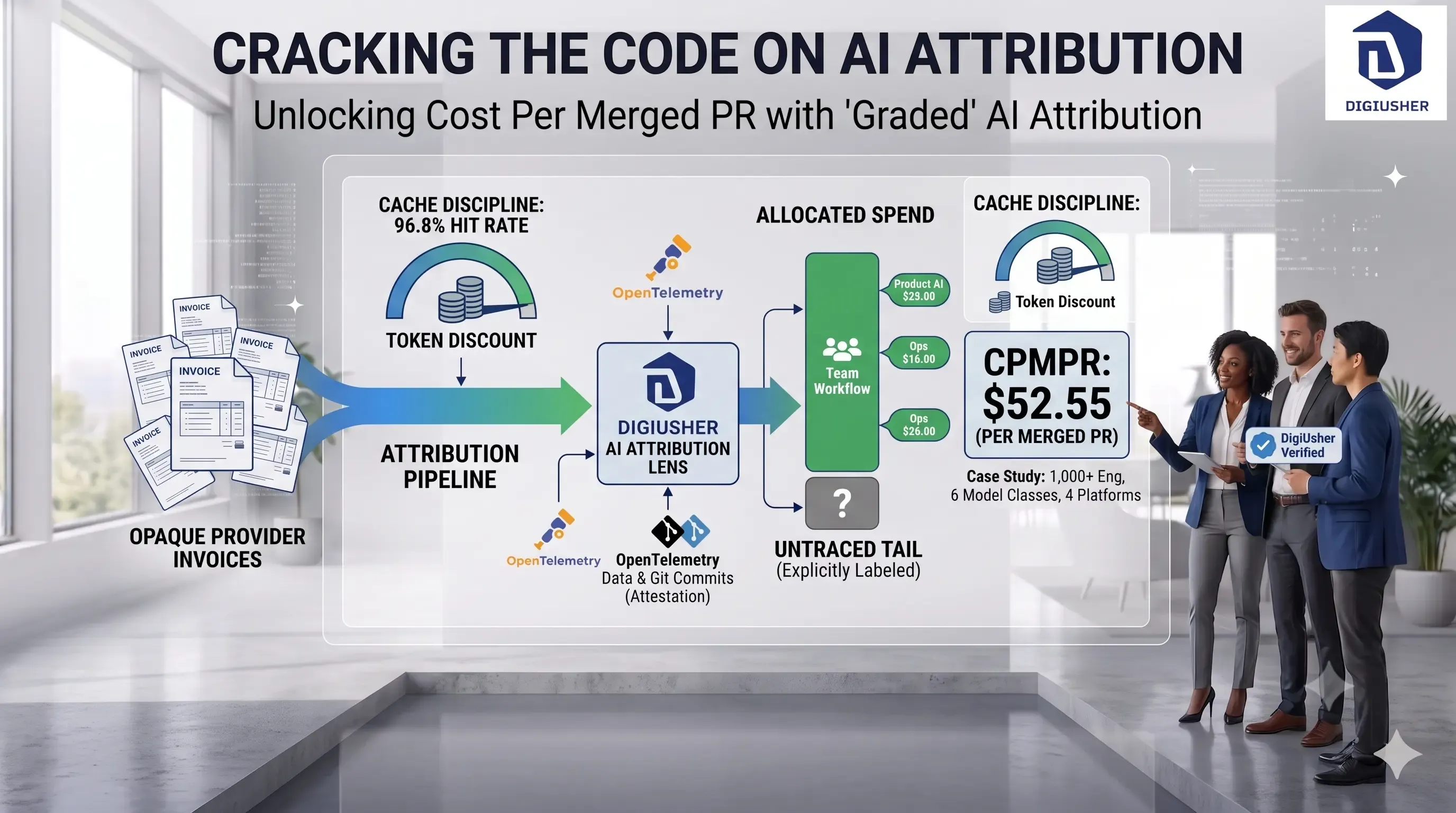
$52.55 Per Merged Pull Request: How One 1,000-Engineer Firm Priced Its Own AI Spend
A public technology firm with 1,000+ engineers refused to run its AI spend on faith. Here's the ledger it built instead — $52.55 per merged PR, 96.8% cache-hit rate, and a blended cost of $0.75 per million tokens.

AI Unit Economics: Why Your AI Invoice Can No Longer Answer the Board’s Question
98% of FinOps teams now manage AI spend, but almost none can price a merged pull request. Here's the framework for AI unit economics in 2026 — and why the invoice alone can't answer the board's question.
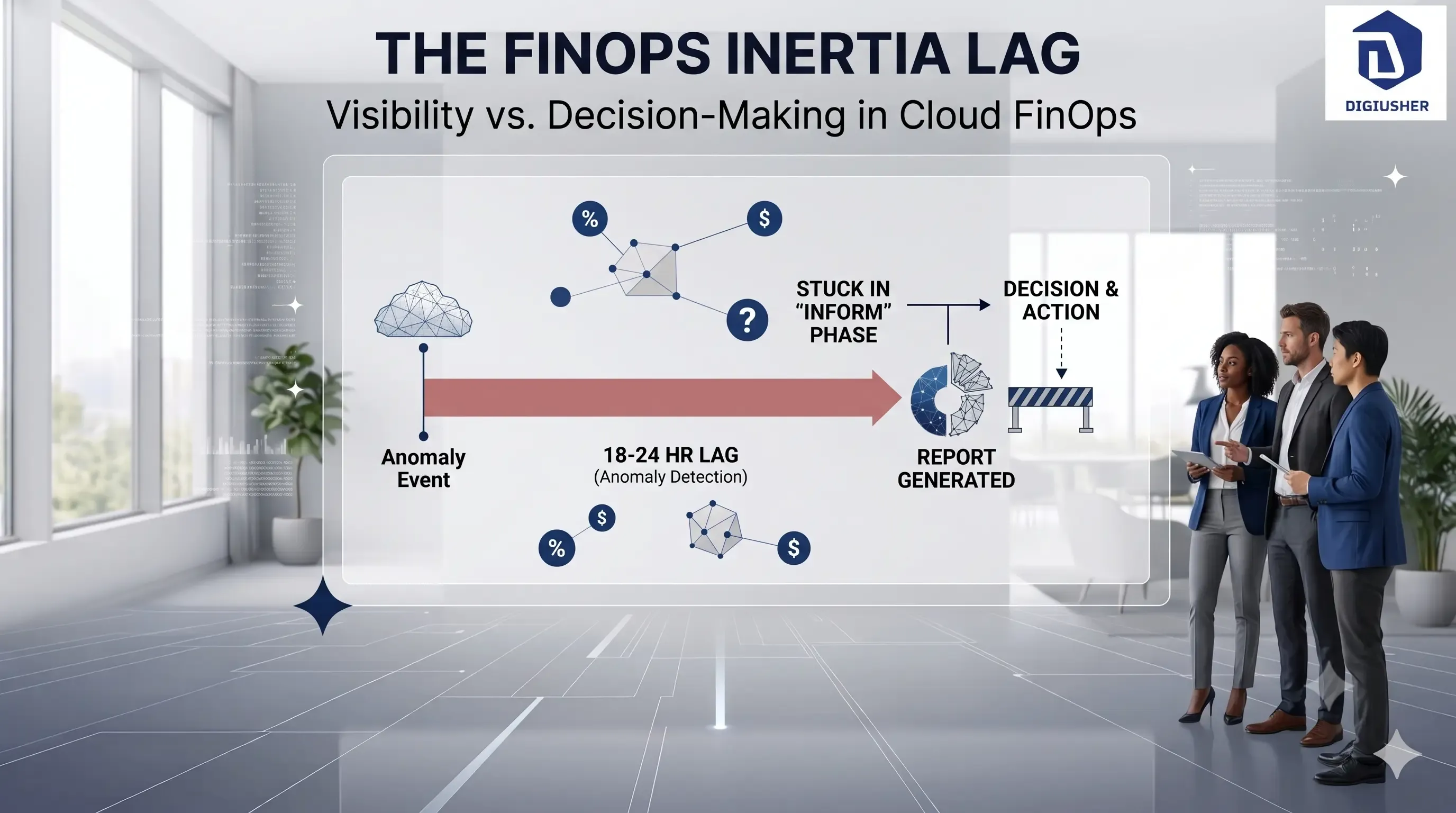
Most FinOps Programs Stall at "Inform" — and Never Reach Optimize
Visibility tools generate reports, not decisions. Legacy FinOps tools carry an 18-to-24-hour anomaly detection lag, according to the DigiUsher live TCO index — and that lag, not a lack of dashboards, is why most programs never leave the Inform phase.