Exotel: From Multi-Cloud Margin Blind Spots to 32% Gross Margin Visibility
Exotel routes 25 billion+ conversations a year across a multi-cloud estate — and couldn't see how infrastructure cost was eating into gross margin. Here's how DigiUsher took it to 32% improved margin visibility, 22% less multi-cloud waste, and 40+ hours saved a month.
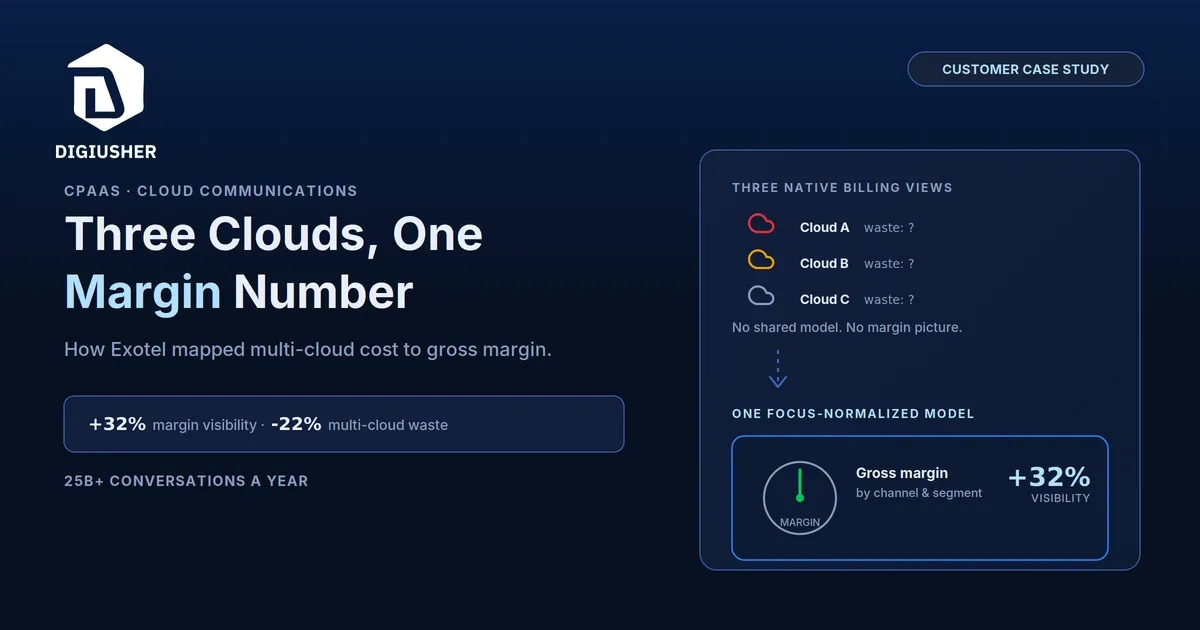
Customer Case Study · DigiUsher · September 16, 2026
Exotel routes more than 25 billion conversations a year for 7,000+ businesses across voice, chat, bots, and contact centers — on infrastructure spread across multiple cloud providers. What the engineering team couldn’t do was connect that infrastructure cost back to gross margin at the speed the business needed. DigiUsher closed that gap: 32% improvement in gross margin visibility, 22% reduction in multi-cloud waste, and 40+ hours a month of manual cost-analysis work eliminated entirely.
CPaaS FinOps case study · multi-cloud cost management · gross margin visibility · Exotel case study
At a Glance
| Customer | Exotel Techcom Private Limited |
| Headquarters | Bengaluru, India |
| Industry | Cloud Communications / CPaaS |
| Cloud estate | Multi-cloud |
| Use case | Gross margin visibility and multi-cloud waste reduction at conversation scale |
Results at a Glance
| Metric | Before DigiUsher | After DigiUsher |
|---|---|---|
| Gross margin visibility | Infrastructure cost not mapped to margin | 32% improvement |
| Multi-cloud waste | Baseline | 22% reduction |
| Manual cost-analysis overhead | 40+ hours/month | Eliminated |
About Exotel
Exotel Techcom Private Limited, founded in 2011 and headquartered in Bengaluru, is one of India’s pioneering cloud communications companies — building what the company describes as the invisible backbone of business communication for thousands of brands across India and beyond. Exotel introduced Voice APIs to the Indian market before “CPaaS” was a mainstream category, and today its platform handles more than 25 billion conversations a year for over 7,000 businesses across voice, SMS, chat, bots, and contact-center workflows, with operations extending across India, SAARC, Southeast Asia, the Middle East, and beyond.
That scale runs on a multi-cloud infrastructure footprint — a deliberate architectural choice for resilience and reach in a business where a dropped call or a delayed message is a customer-facing failure, not an internal inconvenience. The same multi-cloud footprint that gives Exotel its reliability is also what made infrastructure cost genuinely difficult to reason about at the unit-economics level the business needed.
The Challenge
CPaaS is, structurally, a low-margin, high-volume business — Exotel’s own leadership has described the category as fast-moving and margin-thin by nature. In a business where margin is earned or lost at conversation scale, infrastructure cost isn’t a back-office line item; it’s a direct input to whether the unit economics of the business work at all.
Exotel’s engineering organization could see the cloud bill. What it couldn’t do reliably was connect that bill to gross margin — which workloads, which customer segments, which channels (voice versus SMS versus bot-driven conversations) were consuming infrastructure cost at a rate that was eating into the margin those conversations were supposed to generate. Multi-cloud made the problem structurally harder: cost, performance, and waste signals arrived in three different native formats, from three different providers, with no common model connecting them to a single margin picture.
Three Critical Gaps
Gap 1 — Cost Wasn’t Mapped to Margin
Native multi-cloud billing could show total infrastructure spend. It could not show gross margin by channel, by customer segment, or by conversation type — the breakdown Exotel’s business leadership actually needed to know whether pricing and infrastructure architecture were aligned with the margin the business was targeting.
Gap 2 — Waste Was Invisible Across Three Different Billing Models
AWS, Azure, and GCP each expose cost, utilization, and waste signals differently. Without a normalized view across all three, overprovisioned capacity, idle resources, and inefficient routing decisions in one cloud were invisible from inside another — and each cloud’s native tooling could only ever show its own slice of a genuinely cross-cloud waste problem.
Gap 3 — Manual Reconciliation Ate Engineering Time Every Month
Building even an approximate cross-cloud cost picture meant manually exporting billing data from three providers and reconciling it by hand against usage and customer data — more than 40 hours of engineering time every month, spent assembling a view of the estate rather than acting on it.
The DigiUsher Solution
DigiUsher deployed its FinOps Operating System across Exotel’s full multi-cloud estate, normalizing cost data to a single FOCUS-based model and building the three capabilities the three gaps required.
Capability 1 — Margin-Mapped Cost Attribution
DigiUsher connected infrastructure cost — compute, networking, and managed communication-service spend — to the channel, customer segment, and conversation type generating it. Gross margin stopped being a finance-side estimate reconciled after the fact and became a number engineering could see change in near real time as traffic patterns shifted.
Capability 2 — Cross-Cloud Waste Normalization
By normalizing AWS, Azure, and GCP billing and utilization data into one FOCUS-conformant model, DigiUsher surfaced waste — idle capacity, overprovisioned instances, inefficient routing — as a single cross-cloud picture rather than three disconnected native reports. Waste that was invisible from inside any one provider’s console became visible and actionable across all three at once.
Capability 3 — Automated Reconciliation
The manual export-and-reconcile cycle across three billing systems was replaced with continuous, automated normalization. The 40+ hours a month previously spent assembling a cost picture moved back into engineering work that actually improved the estate.
The Results
32% Improvement in Gross Margin Visibility
With cost mapped to channel, segment, and conversation type, Exotel’s leadership gained a 32% improvement in gross margin visibility — the ability to see, specifically, where infrastructure cost was compressing margin rather than inferring it from an aggregate bill after the quarter closed.
22% Reduction in Multi-Cloud Waste
Normalizing waste signals across all three cloud providers turned a previously invisible, cross-cloud problem into a specific, actionable one. The result was a 22% reduction in multi-cloud waste — capacity and spend recovered by seeing the full estate at once rather than one provider at a time.
40+ Hours a Month Returned to Engineering
Automated, continuous reconciliation eliminated the manual cross-cloud billing exercise entirely. That time moved from cost-picture assembly into the platform and reliability work that a 25-billion-conversation-a-year estate actually demands.
In Their Words
“DigiUsher gave us an 80% improvement in operational efficiency.”
— Darshan Datta, Director of Engineering, Exotel
The efficiency Datta describes and the 32%/22%/40-hour figures above are two different lenses on the same shift — one qualitative, from the engineering team living with the tooling day to day, and one quantified, from the margin and waste data the platform produces. Both point at the same underlying change: infrastructure cost stopped being something Exotel reconciled after the fact and became something the team could see and act on directly.
Why This Matters for CPaaS and Conversation-Scale Infrastructure
Exotel’s challenge — real multi-cloud scale, thin category margins, and no line of sight from infrastructure cost to the margin it was consuming — is not specific to cloud communications. It’s the defining pattern for any high-volume, low-margin-per-unit business running multi-cloud infrastructure at scale.
The universal pattern:
- A high-volume, margin-thin business builds multi-cloud infrastructure for resilience and reach
- Native billing shows total spend per provider, not gross margin by channel, segment, or unit of business value
- Waste and utilization signals arrive in three incompatible native formats, invisible across providers
- Engineering time goes into manually reconciling a cross-cloud cost picture instead of acting on it
- Pricing and architecture decisions get made without a reliable view of the margin they’re actually producing
The DigiUsher resolution:
- FOCUS-native attribution maps infrastructure cost directly to the business unit — channel, segment, conversation type — consuming it
- A single normalized model surfaces waste across every cloud provider at once, not one console at a time
- Automated reconciliation removes the manual cross-cloud billing exercise entirely
- Gross margin becomes a number the business can see move in near real time, not a quarterly reconstruction
- Engineering time returns to the platform work that a high-volume estate actually requires
Frequently Asked Questions
What specific challenge did Exotel face before DigiUsher?
Three interconnected gaps: infrastructure cost wasn’t mapped to gross margin by channel, customer segment, or conversation type; waste was invisible across Exotel’s three cloud providers because each exposed cost and utilization signals in its own native format; and building even an approximate cross-cloud cost picture required more than 40 hours of manual reconciliation every month.
What results did Exotel achieve?
A 32% improvement in gross margin visibility, a 22% reduction in multi-cloud waste, and the elimination of 40+ hours per month of manual cost-analysis overhead — freeing that engineering time for platform and reliability work.
Why is gross margin visibility specifically hard for a CPaaS business?
CPaaS is a high-volume, thin-margin category by nature — margin is made or lost at conversation scale, not on a handful of large transactions. That means infrastructure cost has to be traceable down to the channel or conversation type generating it for margin visibility to mean anything; an aggregate multi-cloud bill can’t answer whether a specific customer segment or channel is margin-accretive or margin-negative.
How does DigiUsher normalize waste signals across three different cloud providers?
By ingesting AWS, Azure, and GCP billing and utilization data and mapping it to a single FOCUS-conformant model, rather than presenting three separate provider-native reports side by side. Idle capacity, overprovisioning, and inefficient routing become visible as one cross-cloud picture, which is what makes a 22% waste reduction achievable rather than three smaller, harder-to-coordinate optimization projects.
Did Exotel have to change cloud providers or architecture to get these results?
No. DigiUsher attributes and normalizes cost and waste signals across the existing multi-cloud estate — the architecture that gives Exotel its resilience and reach didn’t need to change for the cost and margin visibility to improve.
Is this result specific to CPaaS, or does it generalise to other high-volume, thin-margin businesses?
The pattern generalises to any business where margin is earned per unit at high volume — messaging, payments processing, ad tech, e-commerce fulfilment — and where multi-cloud infrastructure makes cost-to-margin attribution structurally harder than it would be on a single provider. The attribution and normalization approach that worked for Exotel’s conversation-scale estate applies wherever the unit of business value is high-volume and margin-thin.
The DigiUsher Difference for Multi-Cloud, High-Volume Businesses
DigiUsher’s FinOps Operating System normalizes cost, waste, and margin data across every cloud provider in the estate — not as three separate reports to reconcile by hand, but as one FOCUS-conformant model built to answer the margin question directly.
Margin-mapped attribution — infrastructure cost tied to channel, segment, and unit of business value, not just total spend.
Cross-cloud waste normalization — one picture across AWS, Azure, and GCP, not three disconnected consoles.
Automated reconciliation — the manual cross-cloud billing exercise is removed, not streamlined.
Flat enterprise licensing — cost governance that doesn’t scale against the business’s own growth in conversation volume.
Available on AWS Marketplace (ISV Accelerate Partner) and Azure Marketplace (ISV Co-Sell Ready). Delivered globally through Infosys, Wipro, and Hexaware.
A 25-billion-conversation-a-year estate doesn’t have a cost problem. It has a margin-visibility problem — and those require different tools to solve.
See what margin-mapped attribution looks like on your own multi-cloud estate. ++Book my 15-min discovery call++ and bring last month’s cloud invoices from every provider — we’ll show you where they map to margin.
DigiUsher in 15 min
See which team owns every dollar, in real time.
DigiUsher turns raw billing data into allocation finance trusts: chargeback, showback, and guardrails included.
Book my 15-min discovery callNo hard pitch · specific to your stack
Continue Reading
More from the DigiUsher editorial team.
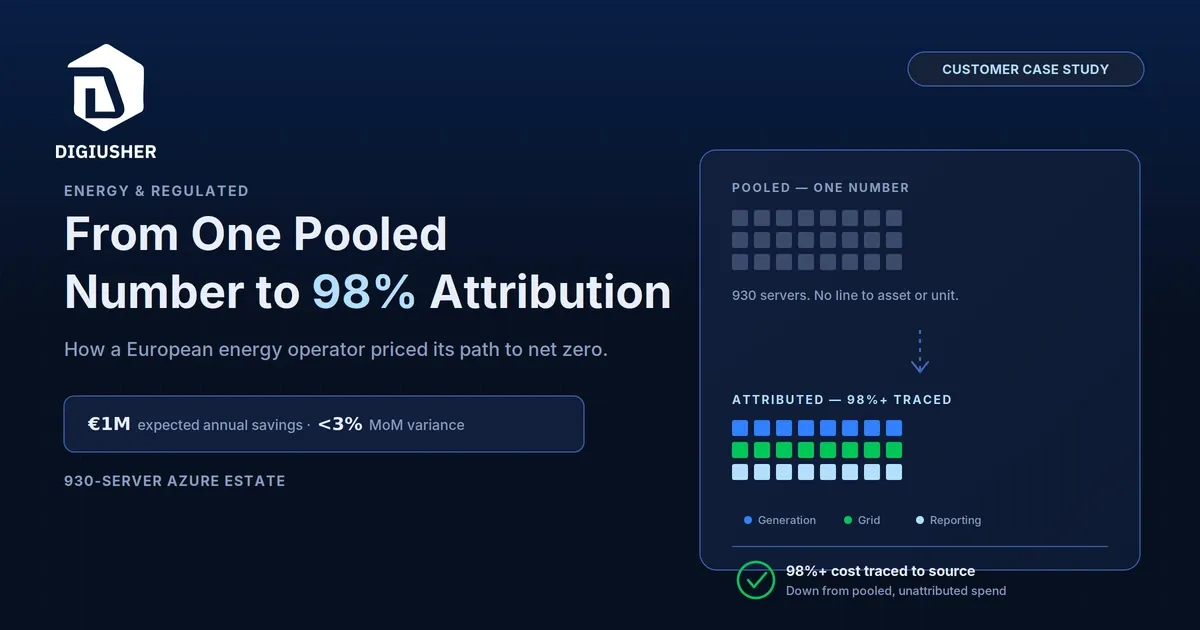
From Pooled Azure Spend to 98% Cost Attribution: How a European Energy Operator Priced Its Path to Net Zero
A European energy and renewables operator ran a 930-server Azure estate on pooled, unallocated cost. Here's how FOCUS-native attribution took it to 98%+ traceability, cut data-prep time 70%, and brought monthly budget variance under 3%.
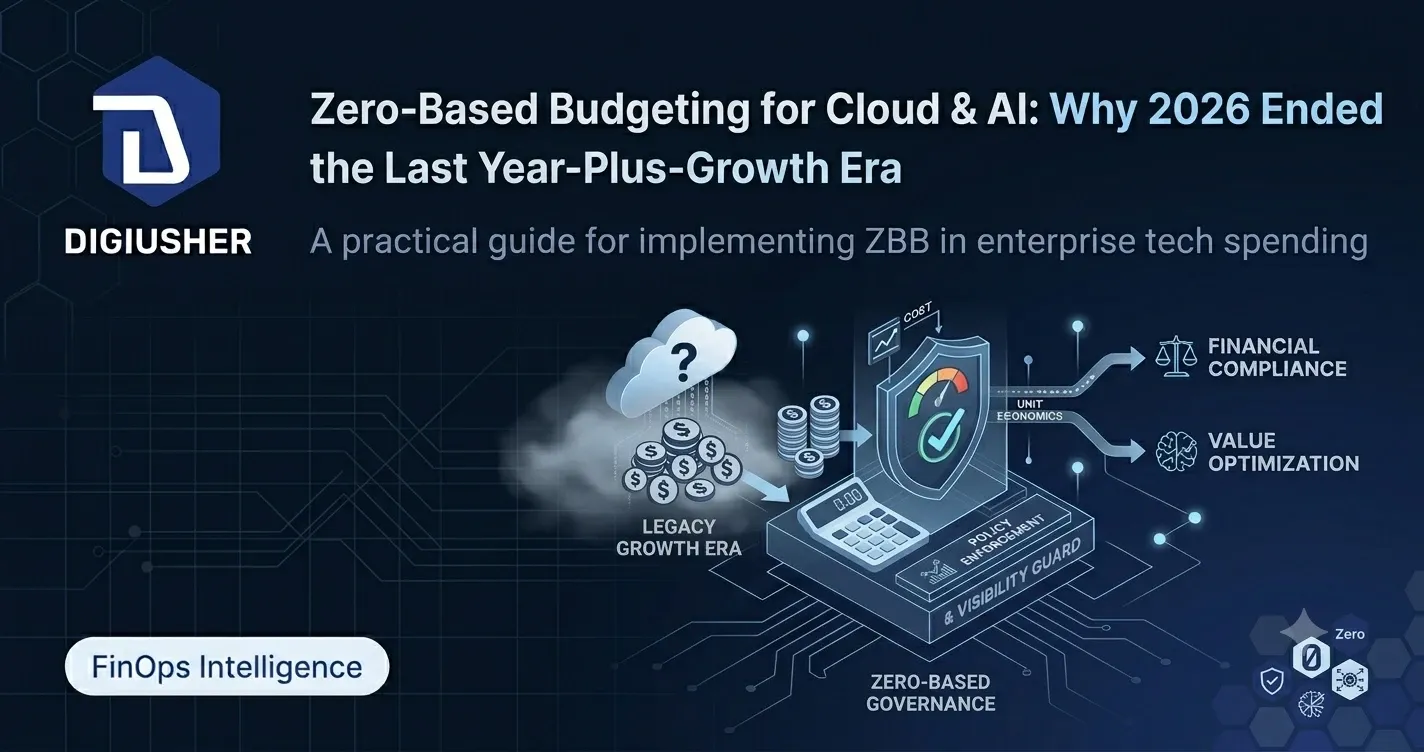
Zero-Based Budgeting for Cloud and AI: Why 2026 Ended the Last-Year-Plus-Growth Era
80–85% of enterprises miss AI cost forecasts by 25% or more. Zero-based budgeting is the discipline that ends the last-year-plus-growth model for cloud and AI spend.

AI and Cloud Economics in Regulated Industries: Governing the Spend You Cannot See
95% of GenAI pilots return nothing measurable, yet regulated industries are scaling AI fastest under the heaviest constraints. Why sovereignty and attribution now decide ROI.