From Pooled Azure Spend to 98% Cost Attribution: How a European Energy Operator Priced Its Path to Net Zero
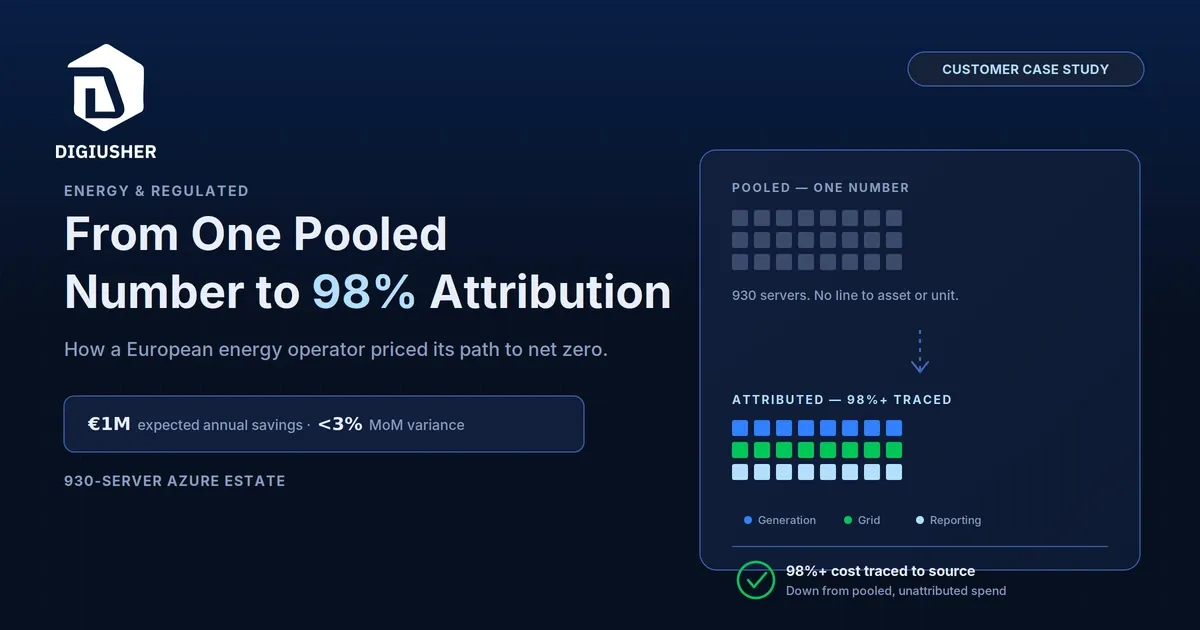
A European energy and renewables operator ran a 930-server Azure estate on pooled, unallocated cost. Here's how FOCUS-native attribution took it to 98%+ traceability, cut data-prep time 70%, and brought monthly budget variance under 3%.
Customer Case Study · DigiUsher · September 16, 2026
A European energy and renewables operator ran 930 servers on Azure to support a public 2040 net-zero commitment — and could not tell you, with confidence, which business unit or asset generated any given euro of that spend. DigiUsher’s FOCUS-native attribution layer changed that: cost attribution accuracy moved to 98%+, data-prep time before any analysis could begin fell 70%, and month-over-month budget variance dropped under 3%, driving an expected €1M in annualised cost reduction — demonstrating that a public sustainability commitment is only as credible as the attribution behind the spend data that reports on it.
FinOps case study · energy utility cloud cost · FOCUS-native attribution · regulated industry FinOps
At a Glance
| Customer | A large European energy and renewables operator (anonymised at customer’s request) |
| Headquarters | Western Europe |
| Industry | Energy & Renewables — regulated utility |
| Cloud estate | Azure — 930 servers |
| Use case | FOCUS-native cost attribution ahead of a 2040 net-zero commitment |
Results at a Glance
| Metric | Before DigiUsher | After DigiUsher |
|---|---|---|
| Cost attribution accuracy | Pooled at subscription level | 98%+ |
| Data-prep time before analysis | Baseline (manual export/reconciliation) | 70% reduction |
| Month-over-month budget variance | Unpredictable, over 3% | Under 3% |
| Annualised cost reduction | — | €1M (expected) |
About the Operator
The company is one of Western Europe’s larger energy and renewables operators — a utility with a public, board-level commitment to reach net zero by 2040. That commitment is not a marketing position for a company of this size; it’s a multi-decade capital allocation program touching generation assets, grid infrastructure, and an increasingly cloud-native data estate built to model, forecast, and report on the transition itself.
The transition runs on data. Renewable generation forecasting, grid-load modeling, emissions reporting, and asset-level performance monitoring all sit on a 930-server Azure estate that grew, as these estates do, faster than the governance built to explain it. By the time DigiUsher engaged, the company had real cloud scale and a real net-zero deadline — and no reliable way to connect the two.
The Challenge
Utilities occupy an unusual position in enterprise cloud economics: heavily regulated, capital-intensive, and — increasingly — dependent on cloud infrastructure for exactly the sustainability reporting that regulators, boards, and rating agencies expect them to get right. A 930-server Azure estate supporting that mission generates real cost. What it didn’t generate was an answer to a basic question: which part of the business is this euro for?
That gap is not cosmetic in a regulated utility. Net-zero progress reporting, internal capital allocation across generation assets, and board-level cost oversight all assume the underlying spend data can be trusted and traced. Pooled, subscription-level billing cannot support any of those conversations — it can only support “we spent this much,” which was no longer a sufficient answer for a company being asked, publicly, to account for a 2040 commitment.
Three Critical Gaps
Gap 1 — Attribution Collapsed at the Subscription Level
Azure billing arrived aggregated by subscription, not by asset, business unit, or the specific renewables-forecasting or grid-modeling pipeline generating the load. A 930-server estate supporting multiple generation regions, forecasting workloads, and reporting pipelines produced one number: total spend. It could not produce the number that mattered — cost per asset, per business unit, or per net-zero-reporting workload — which is precisely the traceability a board-level sustainability commitment requires.
Gap 2 — Manual Data-Prep Consumed the Team Before Analysis Could Start
Every cost review began the same way: exporting raw Azure billing data, manually reconciling it against internal cost-center mappings, and cross-referencing asset ownership by hand before anyone could ask a single analytical question. This reconciliation step — not the analysis itself — consumed the majority of the team’s time each cycle. The FinOps team was, in effect, a data-preparation function that occasionally got to do FinOps.
Gap 3 — Budget Variance Eroded Forecast Confidence
Without attribution, forecasting was built on trend extrapolation rather than traceable cause and effect. Month-over-month budget variance ran unpredictably above 3% — enough that finance leadership could not present cloud spend forecasts to the board with the same confidence as other capital lines, at exactly the moment a public net-zero commitment demanded that confidence.
The DigiUsher Solution
DigiUsher deployed its FOCUS-native attribution engine across the full 930-server Azure estate, aligned with the operator’s data residency and audit requirements, and built the three capabilities the three gaps required.
Capability 1 — FOCUS-Native Attribution to Asset and Business Unit
Rather than bolting a tagging convention onto existing Azure billing exports, DigiUsher’s attribution model normalized cost data to the FOCUS specification at ingestion — connecting compute, storage, and networking line items directly to the generation asset, business unit, or reporting pipeline consuming them. The subscription-level total became a traceable sum of specific, attributable parts.
Capability 2 — Continuous, Automated Data Normalization
The manual export-and-reconcile cycle was replaced with a continuous, automated FOCUS-normalized feed. Analysts stopped spending the first half of every review cycle preparing data to be analyzable, because it arrived that way. This is the direct mechanism behind the 70% reduction in data-prep time — not a process optimization on top of manual work, but the removal of the manual step itself.
Capability 3 — Variance Tracking and Budget Guardrails
With attributed, continuously updated cost data in place, forecasting shifted from trend extrapolation to a model grounded in actual per-asset consumption patterns. Budget guardrails flagged deviations against forecast in near real time rather than at month-end reconciliation, giving finance leadership the ability to explain — and act on — variance before it compounded into a quarterly surprise.
The Results
98%+ Cost Attribution Accuracy
From a starting point of pooled, subscription-level billing, the operator moved to 98%+ traceability of Azure spend to the specific asset, business unit, or reporting pipeline that generated it. For a regulated utility reporting against a public net-zero commitment, this is not a convenience metric — it’s the difference between a defensible sustainability data trail and an estimate.
70% Reduction in Data-Prep Time
Removing the manual export-and-reconciliation step gave the FinOps and finance teams back the majority of the time previously spent preparing data rather than using it. That time moved directly into the analytical and forecasting work the team existed to do in the first place.
Under 3% Month-over-Month Budget Variance
Attribution-grounded forecasting brought monthly budget variance under the 3% threshold — a level of predictability that let finance leadership present cloud and technology spend to the board with the same confidence afforded to other major capital lines.
€1M Expected Annualised Cost Reduction
Once cost was visible at the asset and business-unit level, specific optimization — rightsizing, eliminating idle capacity, correcting misallocated reserved-instance coverage — replaced speculative, estate-wide cost-cutting exercises. The combined effect: an expected €1M in annualised cost reduction, identified and actioned once the underlying spend was finally traceable.
What This Meant for the Business
The operator’s Head of Cloud Platforms described the shift in direct terms: before attribution, the team could report what the company spent on Azure each month; after, they could report what each part of the business — down to the individual generation asset — actually cost to run, and why that number moved when it did. For a company answerable to a board and, ultimately, a regulator for a 2040 net-zero commitment, that distinction is the entire point of the exercise: sustainability reporting is only as credible as the cost and consumption data underneath it.
Why This Matters for Regulated, Capital-Intensive Operators
The operator’s challenge — cloud scale outpacing attribution, manual reconciliation consuming the FinOps function, budget variance undermining forecast credibility — is not unique to energy. It’s the defining pattern for any regulated, capital-intensive business running a growing cloud estate in support of a public commitment it will be held accountable for.
The universal pattern:
- A regulated or capital-intensive business builds real cloud scale to support a core business or compliance mandate
- Billing remains aggregated at the subscription or account level, not the asset or business-unit level the mandate requires
- Reconciliation consumes the FinOps team before analysis can begin
- Budget variance runs high enough to undermine forecast credibility with the board
- Reporting against the public commitment (net zero, regulatory capital adequacy, audit readiness) rests on estimated, not traceable, cost data
The DigiUsher resolution:
- FOCUS-native attribution ties shared infrastructure cost to the asset or business unit consuming it, at ingestion
- Continuous normalization replaces manual export-and-reconcile cycles entirely
- Attribution-grounded forecasting brings variance under control before it compounds
- Cost data becomes traceable enough to sit inside a public sustainability or regulatory report, not just an internal dashboard
- Deployment respects the residency, audit, and sign-off requirements regulated buyers cannot compromise on
The DigiUsher Difference for Regulated, Capital-Intensive Estates
DigiUsher’s FinOps Operating System is architected FOCUS-native from the ground up — not a reporting layer added after the fact — which is what makes 98%+ attribution achievable on a 930-server, multi-workload estate without a multi-quarter tagging remediation project.
FOCUS-native attribution — cost tied to asset, business unit, and pipeline at ingestion, not reconstructed after the fact.
Deployment built for regulated buyers — residency, audit, and sign-off requirements accommodated without compromising attribution accuracy.
Continuous normalization — the manual export-and-reconcile cycle is removed, not optimized.
Board-ready variance control — forecasting grounded in attributed consumption data, not trend extrapolation.
Available as SaaS, Managed, or BYOC for regulated industries. SOC 2 Type II and GDPR certified, FOCUS-conformant. Delivered globally through Infosys, Wipro, and Hexaware.
The company could always report what it spent. What it couldn’t do — until attribution — was report what that spend was for, which is the only question a public net-zero commitment actually asks.
See what FOCUS-native attribution looks like on your own regulated estate. ++Book my 15-min discovery call++ and bring your own residency and audit requirements — we’ll show you where attribution lands without moving data outside your perimeter.
DigiUsher in 15 min
Your regulated AI workloads deserve attribution that survives an audit.
DigiUsher maps every workload to an owner and a policy, so compliance reviews start from evidence rather than spreadsheets.
Book my 15-min discovery callNo hard pitch · specific to your stack
Continue Reading
More from the DigiUsher editorial team.
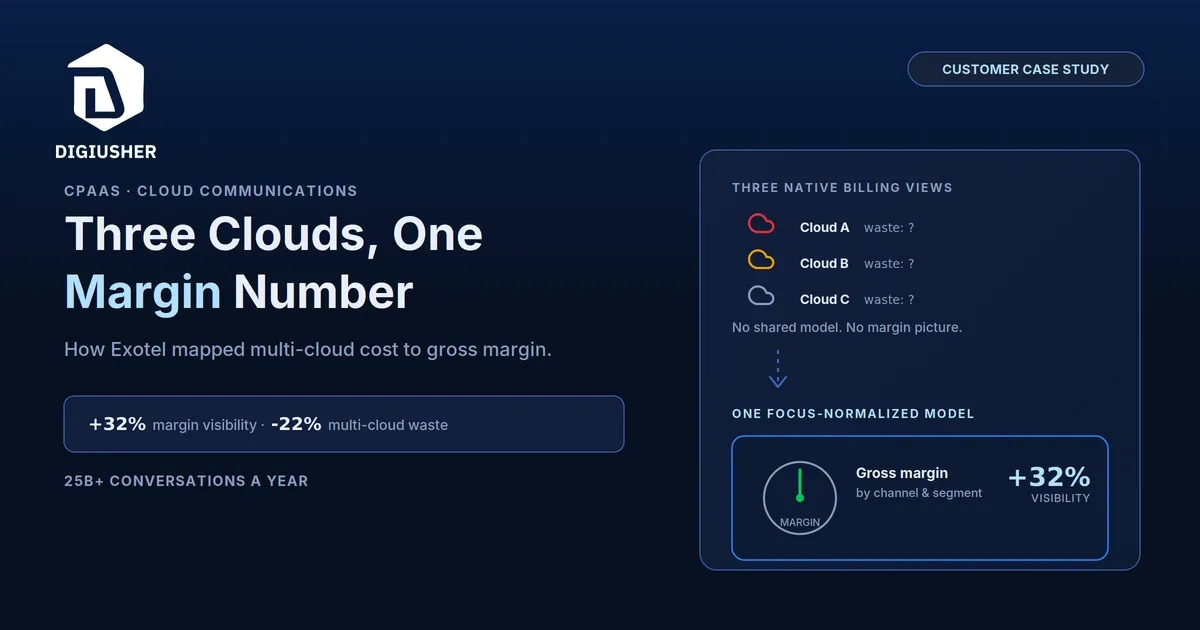
Exotel: From Multi-Cloud Margin Blind Spots to 32% Gross Margin Visibility
Exotel routes 25 billion+ conversations a year across a multi-cloud estate — and couldn't see how infrastructure cost was eating into gross margin. Here's how DigiUsher took it to 32% improved margin visibility, 22% less multi-cloud waste, and 40+ hours saved a month.
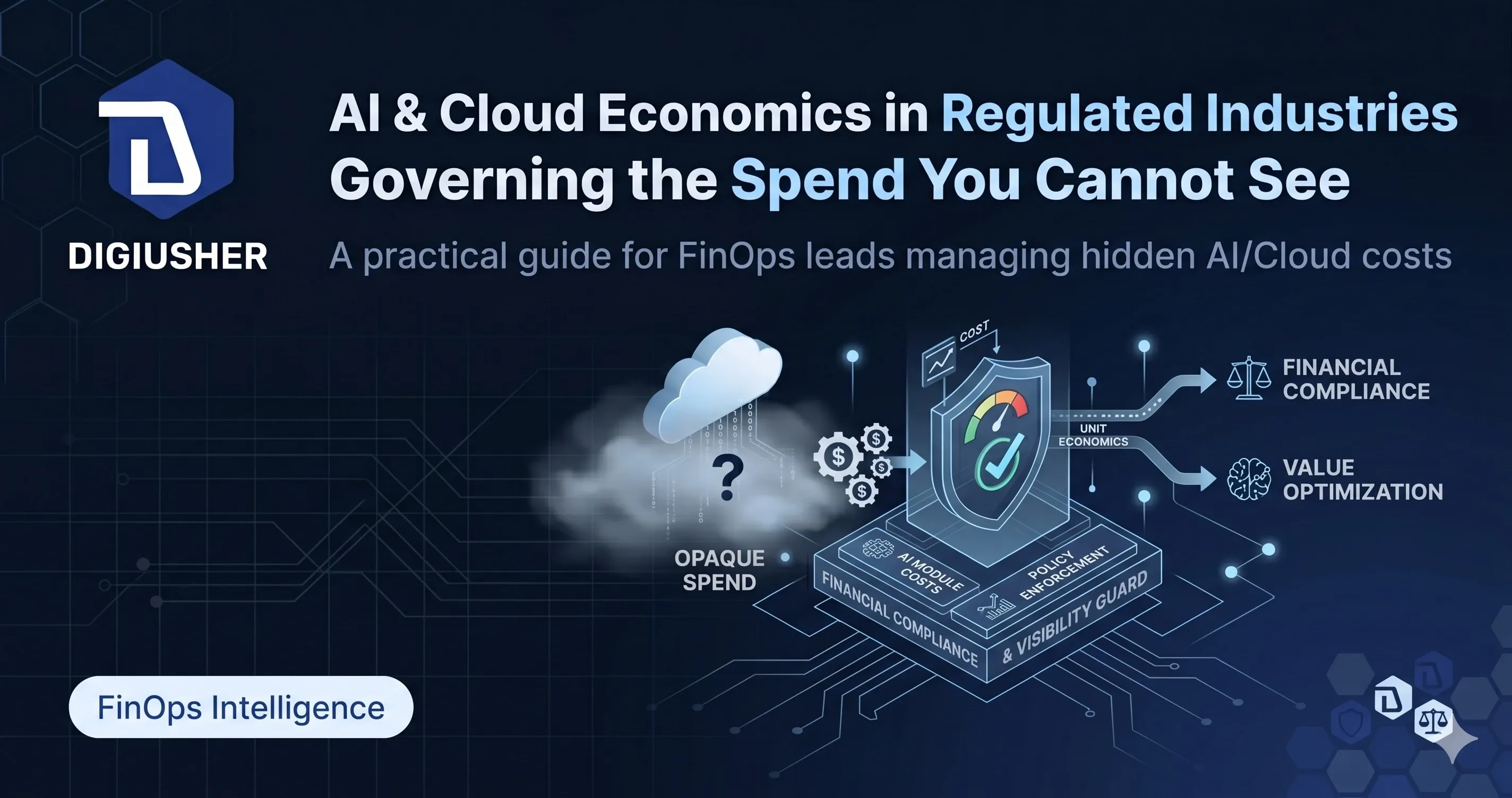
AI and Cloud Economics in Regulated Industries: Governing the Spend You Cannot See
95% of GenAI pilots return nothing measurable, yet regulated industries are scaling AI fastest under the heaviest constraints. Why sovereignty and attribution now decide ROI.
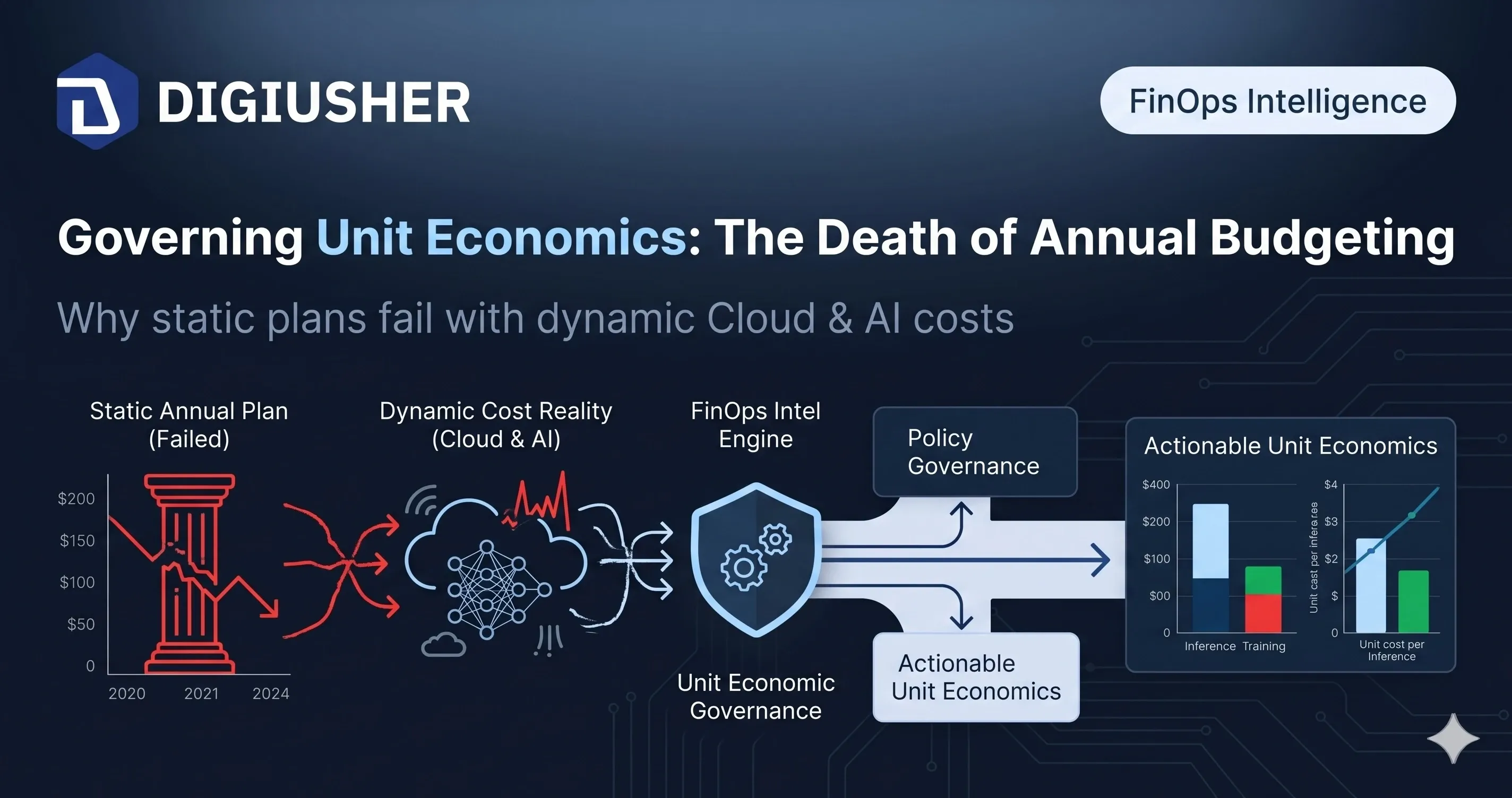
Why Cloud and AI Budgets Fail Annual Planning
Annual planning was built for fixed assets. Cloud and AI spend is consumption-driven, non-linear, and breaks the 12-month budget cycle. Here is what replaces it.