DigiUsher Is Now Microsoft Azure ISV Co-Sell Ready and Listed on the Microsoft Marketplace
DigiUsher has achieved Microsoft Azure ISV Co-Sell Ready status and is live on the unified Microsoft Marketplace — the platform that consolidated Azure Marketplace and AppSource in September 2025 and now hosts 6M+ monthly visitors. Microsoft sellers can co-sell DigiUsher to enterprise customers. Purchases are MACC-eligible, meaning they count 100% toward existing Azure Consumption Commitments. This is what Azure ISV Co-Sell Ready actually means, how MACC procurement works, and why this is the most commercially efficient way to purchase enterprise FinOps governance.
The Announcement — and What Azure ISV Co-Sell Ready Actually Means
DigiUsher has achieved Microsoft Azure ISV Co-Sell Ready status and is live on the Microsoft Marketplace — the unified platform that merged Azure Marketplace and AppSource in September 2025 and now hosts 6 million+ monthly visitors.
Like our AWS Marketplace announcement, we want to be precise about what this designation entails — because enterprise FinOps buyers deserve to understand what they are trusting, not just what badge is being displayed.
Azure ISV Co-Sell Ready is not a listing confirmation. It is a validated co-sell status with specific requirements and operational consequences. To achieve Co-Sell Ready status, DigiUsher:
Microsoft Azure ISV Co-Sell Ready — What DigiUsher Completed
──────────────────────────────────────────────────────────────
✅ Enrolled in Microsoft AI Cloud Partner Program
✅ Active transactable offer published live in
   Microsoft Marketplace (not a "Contact Me" listing —
   a fully transactable SaaS offer that Microsoft can
   process payments for on DigiUsher's behalf)
✅ Co-sell collateral approved in Partner Center:
   customer-facing one-pager and pitch deck reviewed
   by Microsoft's co-sell team
✅ Solution visible to Microsoft's field organization
   through Microsoft's co-sell tooling
✅ Available across all three Microsoft entry points:
   Microsoft Marketplace · Azure Portal · Azure AppSource
──────────────────────────────────────────────────────────────
Result: Microsoft sellers can actively co-sell
        DigiUsher to their enterprise customers
──────────────────────────────────────────────────────────────
The practical consequence: DigiUsher now sits in Microsoft seller tools and enterprise recommendation engines. Microsoft’s field organization — hundreds of thousands of sellers with deep enterprise relationships across every vertical — can introduce DigiUsher to enterprise accounts, champion it in technology conversations, and support deal closure alongside DigiUsher’s own sales motion.
For enterprise buyers, this means DigiUsher conversations can begin through your Microsoft account manager — with Microsoft’s credibility, warm introductions, and validated co-sell positioning behind them.
The Microsoft Marketplace in 2026: A Platform, Not a Catalog
Before explaining what DigiUsher’s Azure listing means for buyers, it is worth understanding what the Microsoft Marketplace has become.
On 25 September 2025, Microsoft unified Azure Marketplace and AppSource into a single platform: the Microsoft Marketplace. This consolidation is material, not cosmetic:
The 2026 Microsoft Marketplace — What Changed
──────────────────────────────────────────────────────────────
Before (dual platforms):
  Azure Marketplace → Infrastructure tools, SaaS
  AppSource         → Microsoft 365 integrations, Dynamics

After (unified):
  Microsoft Marketplace → Everything:
  ├── Azure infrastructure and SaaS
  ├── Microsoft 365 integrations
  ├── AI Apps and Agents (new dedicated category)
    └── 6M+ monthly visitors in a single catalog

Commercial implications:
  One listing reaches the full Microsoft enterprise buyer set
  One "Azure benefit eligible" badge signals MACC eligibility
  One discovery surface for Microsoft sellers across all tiers
──────────────────────────────────────────────────────────────
The addition of an AI Apps and Agents category is directly relevant for DigiUsher: Azure OpenAI cost governance, AKS GPU cluster attribution, agentic workflow kill-switches, and AI token budget enforcement are the capabilities enterprises shopping the AI category increasingly require — and DigiUsher provides them natively.
Microsoft also announced App Accelerate at Ignite 2025 — a new unified program expected to launch in 2026 that consolidates ISV Success, Marketplace Rewards, and co-sell benefits into a single pathway, including an early co-sell access route for ISVs before they reach the $100K ACR threshold. DigiUsher’s existing Co-Sell Ready status positions it to benefit from App Accelerate as the program rolls out.
What Azure ISV Co-Sell Ready Actually Means
Microsoft operates a progressive co-sell status system with four levels. Understanding where DigiUsher sits — and what each level means — matters for enterprise procurement decisions.
The Co-Sell Status Hierarchy
| Status | What It Enables | Requires |
|---|---|---|
| Listed | Discoverable in Marketplace catalog | Active Marketplace account |
| Co-Sell Ready | Visible to Microsoft sellers; sellers can co-sell | Transactable offer + approved co-sell collateral |
| Azure IP Co-Sell Eligible | MACC burn-down; Microsoft seller quota credit | $100K ACR/MBS revenue + technical validation + transactable offer |
| Certified Software | Premium trust badge; highest enterprise credibility | Architecture excellence review by Microsoft |
DigiUsher holds Co-Sell Ready status — the validated status that makes DigiUsher visible to and co-sellable by Microsoft’s field organization.
What Co-Sell Ready Delivers Operationally
Microsoft seller visibility. DigiUsher appears in Microsoft’s internal seller tools and partner recommendation engines. When a Microsoft account executive is working with an enterprise customer on Azure cost governance, FinOps platform selection, or AI infrastructure strategy, DigiUsher is surfaced as a co-sell option.
Warm introductions at enterprise accounts. Co-selling with Microsoft opens access to their global sales force and enterprise buyers who are already investing heavily in Azure. Microsoft sellers actively promote partner solutions to fill technology gaps in their customers’ cloud environments. DigiUsher conversations that begin through a Microsoft account manager carry the credibility signal that enterprise procurement teams respond to.
Association with Microsoft’s cloud strategy. When a Microsoft seller introduces DigiUsher, it signals technical validation and strategic alignment with the Microsoft ecosystem — particularly valuable when selling into risk-averse enterprises or regulated industries where vendor credibility is a procurement criterion.
The Pathway to IP Co-Sell Eligible and MACC
DigiUsher is actively progressing toward Azure IP Co-Sell Eligible status — the higher tier that fully qualifies DigiUsher offers for MACC burn-down and gives Microsoft sellers quota retirement credit for co-selling.
IP Co-Sell Eligible requires:
- $100K in Azure Consumed Revenue or Marketplace Billed Sales over 12 months
- Microsoft technical validation — reference architecture diagram review confirming DigiUsher’s solution is primarily platformed on Azure and drives Azure consumption
- Transactable offer — which DigiUsher already maintains on the Marketplace
Contact DigiUsher sales for current MACC procurement options and private offer configuration while IP Co-Sell Eligible status is progressed.
MACC: How Azure Committed Spend Purchases DigiUsher
The Microsoft Azure Consumption Commitment (MACC) is the single most important commercial mechanism for enterprise Azure buyers considering a Marketplace purchase. Understanding it changes how FinOps platform procurement decisions are made.
What MACC Is
A MACC is a contractual agreement where an enterprise commits to spending a specific amount on Azure over a defined period — typically one to three years. Enterprise customers make these commitments to secure Azure pricing advantages, and the commitment pools are substantial: close to $900 billion in enterprise cloud commitments sit across hyperscalers globally, with Microsoft Azure holding a significant share.
How MACC-Eligible Marketplace Purchases Work
When DigiUsher reaches full Azure IP Co-Sell Eligible / MACC-enrolled status, the procurement arithmetic changes completely:
MACC Purchase Mechanics — DigiUsher via Azure Marketplace
──────────────────────────────────────────────────────────────
Enterprise situation:
  3-year Azure Consumption Commitment: £5,000,000
  Remaining uncommitted: £2,400,000

DigiUsher Marketplace purchase (MACC-eligible):
  Purchase price: £120,000/year
  MACC contribution: 100% of pretax price
  Remaining MACC after purchase: £2,280,000

Procurement implication:
  No new capital request ✅
  No new vendor onboarding ✅
  No separate legal review ✅
  Appears on Azure invoice ✅
  Consumes existing Azure commitment ✅
──────────────────────────────────────────────────────────────
Microsoft describes this precisely: the enterprise does not need to request new capital — only use what is already committed. For CFOs, this is one of the most compelling commercial arguments for Marketplace procurement: the FinOps governance platform that governs Azure spend is funded by the Azure commitment itself.
The MACC Purchase Rule Enterprises Must Know
Only purchases completed through Azure portal using the ‘Get it in Azure portal’ button contribute to MACC. Purchases made directly on Microsoft Marketplace via credit card do not count. Always verify the ‘Azure benefit eligible’ badge is visible on the DigiUsher listing before proceeding, and complete the transaction within Azure portal using an Azure subscription tied to your organization’s commitment.
Multiparty Private Offers: Enterprise-Grade Azure Commerce
For large enterprises, regulated industries, or organizations working with GSI partners, Multiparty Private Offers (MPOs) are the preferred procurement route for DigiUsher through Azure Marketplace.
What Multiparty Private Offers Enable
MPOs allow DigiUsher, Microsoft, and an enterprise channel partner (GSI, CSP, or reseller) to collaborate on a single commercial transaction within the Microsoft Marketplace framework:
Multiparty Private Offer Structure
──────────────────────────────────────────────────────────────
DigiUsher       → Initiates the offer with base pricing
                  and platform terms

Channel Partner → Infosys / Wipro / Hexaware or customer's
(GSI/CSP)         preferred SI partner adjusts pricing,
                  attaches service delivery margin

Customer        → Buys the complete deal through Microsoft
                  Marketplace — software + services in
                  one transaction

MACC Credit     → 100% of purchase counts toward customer's
                  MACC (where MACC-eligible)
──────────────────────────────────────────────────────────────
One transaction. One invoice. Custom terms.
Commercial simplicity without procurement compromise.
──────────────────────────────────────────────────────────────
MPOs simplify enterprise deals that involve GSI delivery alongside platform software — the procurement reality for most DigiUsher large enterprise deployments where Infosys, Wipro, or Hexaware are delivering implementation and managed service alongside the DigiUsher platform.
BYOC via Azure Marketplace Private Offer
For regulated enterprises — banking, insurance, healthcare, government — DigiUsher’s Enterprise Unlimited self-hosted subscription is available through Azure Marketplace private offers. BYOC (Bring Your Own Cloud) deployment through DigiUsher’s Secure Relay Proxy means:
- Cost data is processed entirely within the enterprise’s own Azure environment
- Billing data never leaves the enterprise’s own infrastructure perimeter
- Full DigiUsher platform capability with full data sovereignty
- Transaction appears on Azure invoice and counts toward MACC (where eligible)
ICICI Bank — one of India’s largest financial institutions — operates DigiUsher in exactly this BYOC deployment model. The regulated-industry reference that confirms this is not a theoretical architecture but a deployed, production reference for enterprise FinOps at institutional scale.
What DigiUsher Delivers for Azure Customers
DigiUsher purchased through Azure Marketplace is not an Azure cost dashboard. It is a unified financial governance platform that governs the full technology cost surface — Azure, multi-cloud, AI, Kubernetes, and marketplace — from a single FOCUS 1.x normalized cost model.
Beyond Azure Cost Management
Azure Cost Management provides strong visibility within the Azure estate. DigiUsher sits above it — ingesting Azure, AWS, GCP, Kubernetes (AKS, EKS, GKE, OKE), Databricks, Snowflake ML, Azure OpenAI, AWS Bedrock, Vertex AI, and direct AI API providers and normalizing all of it to FOCUS 1.x in a single attributed view.
For Microsoft-centric enterprises: DigiUsher provides the cross-cloud governance that Azure Cost Management cannot, covering the AWS and GCP workloads that almost every large Azure estate runs alongside its primary Microsoft infrastructure.
Azure OpenAI and AKS Cost Governance — Native
Two of the fastest-growing cost categories in Azure estates have no native governance depth in Azure Cost Management at the workload level:
Azure OpenAI — token consumption per team, model tier selection tracking, per-team token budget enforcement, and agentic workflow kill-switches. The governance layer that prevents the $400M Fortune 500 agentic AI overspend pattern before it reaches the Azure invoice.
Azure Kubernetes Service (AKS) — namespace, pod, and service-level cost attribution across AKS clusters alongside EKS and GKE simultaneously. Mandatory attribution schema enforced through IDP admission controls. Non-production environment scheduling recovering 65–70% of non-production compute hours. The Kubernetes cost governance that Azure Cost Management’s cluster-level billing cannot provide.
Azure Hybrid Benefit Intelligence
DigiUsher’s commitment intelligence layer tracks Azure Hybrid Benefit utilization — helping enterprises maximize the 40–72% compute discount available to those with existing Windows Server or SQL Server licenses — alongside Azure Reservations and Committed Use tracking across all three hyperscalers in a single ESR view.
MACC Commitment Tracking
DigiUsher tracks Azure MACC commitment draw-down in real time — alongside AWS EDP and GCP committed-use utilization — giving CFOs the cross-cloud commitment burn-down view that Azure Cost Management cannot produce.
How to Purchase DigiUsher Through Microsoft Marketplace
Standard Subscription via Azure Portal
- Navigate to Microsoft Marketplace and search “DigiUsher”, or follow the direct Azure Marketplace link:azuremarketplace.microsoft.com/en-us/marketplace/apps/digiusherlimited1718970771340.digiusher_offer_azure1
- Look for the ‘Azure benefit eligible’ badge to confirm MACC eligibility (when available)
- Click ‘Get it in Azure portal’ — this ensures the purchase flows through your Azure subscription and counts toward your MACC
- Complete the SaaS subscription — the transaction appears on your next Azure invoice
- Begin onboarding: connect Azure, AWS, and GCP billing data for immediate multi-cloud visibility
Also available via:
- Azure AppSource: appsource.microsoft.com/en-us/product/web-apps/digiusherlimited1718970771340.digiusher_offer_azure1
- Azure Portal: portal.azure.com/#create/digiusherlimited1718970771340.digiusher_offer_azure1/preview
Enterprise / Regulated Industry — Multiparty Private Offer
For large enterprises, regulated deployments, GSI-partnered implementations, or multi-year commitments:
- Contact DigiUsher sales: sales@digiusher.com or +44 7483 214871
- Provide estate size, cloud provider mix, Azure commitment details, and deployment requirements (SaaS or BYOC)
- DigiUsher configures a Multiparty Private Offer in Microsoft Partner Center — co-ordinating with your GSI partner (Infosys, Wipro, Hexaware, or your preferred SI)
- Review and accept the private offer through Azure Portal
- Transaction is MACC-eligible (where applicable); BYOC deployment begins under your own Azure infrastructure
Certifications and Partner Status — The Complete Picture
| Certification / Program | Status |
|---|---|
| Microsoft Azure ISV Co-Sell Ready | ✅ Active — Microsoft sellers can actively co-sell DigiUsher |
| Microsoft Marketplace | ✅ Listed and transactable — SaaS subscription + private offers |
| Azure AppSource | ✅ Listed |
| Azure Portal | ✅ Directly deployable |
| IP Co-Sell Eligible / MACC | 🔄 In progression — contact sales for current MACC options |
| AWS ISV Accelerate Partner | ✅ Active — listed on AWS Marketplace |
| Google Cloud Partner | ✅ Active — listed on GCP Marketplace |
| SOC 2® Type II | ✅ Certified |
| GDPR Compliant | ✅ Compliant |
| BYOC / Secure Relay Proxy | ✅ Available for regulated industries |
Delivered globally through Infosys, Wipro, and Hexaware.
Frequently Asked Questions
What is Azure ISV Co-Sell Ready and what does DigiUsher achieving this mean for buyers?
Azure ISV Co-Sell Ready is the validated co-sell status in Microsoft’s partner program that makes DigiUsher visible to and co-sellable by Microsoft’s global field sales organization. Microsoft sellers can now introduce DigiUsher to enterprise customers, champion it in Azure cost governance conversations, and support deal closure. Requirements met: live transactable offer in Microsoft Marketplace, approved co-sell collateral (one-pager and pitch deck) in Partner Center, and active Microsoft Cloud Partner Program membership. For buyers, this means DigiUsher conversations can begin through existing Microsoft account manager relationships — with Microsoft’s enterprise credibility behind them.
What is MACC and how does it work for DigiUsher?
The Microsoft Azure Consumption Commitment (MACC) is an enterprise’s contractual commitment to spend a specific amount on Azure over time. MACC-eligible Marketplace offers count 100% of the pretax purchase price toward that commitment. When DigiUsher achieves full IP Co-Sell Eligible and MACC-enrolled status, enterprise Azure buyers can purchase DigiUsher from their existing committed Azure budget — no new capital, no new vendor onboarding, one Azure invoice. Purchase must be completed through Azure portal (not direct Marketplace credit card) to count toward MACC. Contact DigiUsher sales for current MACC procurement options.
What happened to Azure Marketplace and AppSource in 2025?
On 25 September 2025, Microsoft unified both into the single Microsoft Marketplace — 6M+ monthly visitors, one hub for all solutions including a new AI Apps and Agents category. Co-sell requirements and Partner Center workflows remained unchanged. DigiUsher is accessible through Microsoft Marketplace, Azure Portal, and Azure AppSource simultaneously.
What is a Multiparty Private Offer and when should I use it?
An MPO allows DigiUsher, Microsoft, and a channel partner (Infosys, Wipro, Hexaware, or your preferred SI) to collaborate on a single private deal through Microsoft Marketplace. One transaction covers software and services. Custom pricing and terms. MACC-eligible where applicable. Use MPOs for large enterprises, regulated industries requiring BYOC, GSI-partnered deployments, or multi-year contracts. Contact sales@digiusher.com to configure.
Does DigiUsher on Azure Marketplace only govern Azure?
No. Azure Marketplace is the commercial entry point. DigiUsher’s FinOps OS governs Azure, AWS, GCP, OCI, Alibaba Cloud, Kubernetes, Databricks, Snowflake ML, Azure OpenAI, AWS Bedrock, Vertex AI, and direct AI API providers — all normalized to FOCUS 1.x. The multi-cloud and AI governance that Azure Cost Management cannot provide, purchased through the Azure commercial relationship.
What other marketplace listings does DigiUsher have?
AWS Marketplace (AWS ISV Accelerate Partner), Microsoft Marketplace/AppSource (Azure ISV Co-Sell Ready), and Google Cloud Marketplace (Google Cloud Partner). Multi-marketplace presence means enterprises can purchase DigiUsher from AWS EDP, Azure MACC, or GCP committed-use budgets — whichever committed cloud budget is most advantageous to consume.
References
- Microsoft Learn — Azure Consumption Commitment (MACC) Benefit: Customer Guide
- Microsoft Learn — Azure Consumption Commitment Enrollment: Publisher Guide
- Microsoft Learn — Co-Sell Requirements: Co-Sell Ready and IP Co-Sell Eligible
- Microsoft Learn — Transacting on Microsoft Marketplace
- Microsoft Community Hub — Your Next Big Move: Thriving in the Reimagined Microsoft Marketplace (November 2025)
- Clazar — Azure Co-Sell vs. IP Co-Sell Eligible: Complete Guide for ISVs (February 2026)
- Clazar — A Complete Guide to Co-Selling with Azure (March 2026)
- Tackle — Breaking Down the Microsoft Azure Consumption Commitment (MACC) (November 2025)
- Tackle — How to Co-Sell With Microsoft Azure: A Complete Guide (2026)
- Tackle — Microsoft Azure IP Co-Sell Requirements Checklist
- DigiUsher — Azure Marketplace Listing
Purchase DigiUsher on Microsoft Marketplace
DigiUsher is live, transactable, and co-sold by Microsoft sellers. Enterprise FinOps governance across Azure, AWS, GCP, AKS, Azure OpenAI, and AI platforms — purchasable from your existing Azure committed spend in a single Microsoft Marketplace transaction.
DigiUsher in 15 min
See which team owns every dollar, in real time.
DigiUsher turns raw billing data into allocation finance trusts: chargeback, showback, and guardrails included.
Book my 15-min discovery callNo hard pitch · specific to your stack
Continue Reading
More from the DigiUsher editorial team.
FinOps OS: The Missing Layer in Marketplace Economics
Cloud marketplaces have transformed enterprise software procurement — but governance has not kept pace. Discover why native cloud tools stop at visibility, why marketplace economics demands a FinOps OS layer, and how DigiUsher governs SaaS, AI APIs, and partner billing as first-class cost objects.
DigiUsher: The FinOps Operating System for Multi-Cloud Cost Management
76% of enterprises now run workloads across two or more cloud providers. Multi-cloud should mean resilience and choice — but without a unified FinOps OS, it means fragmented billing, incompatible cost schemas, and governance gaps that compound into tens of millions in unattributed spend. This is DigiUsher: what it does, who it's built for, why FOCUS 1.x native architecture changes the game, and why 7 of 10 enterprise evaluation criteria favor a purpose-built FinOps OS over a single-cloud or single-category tool.
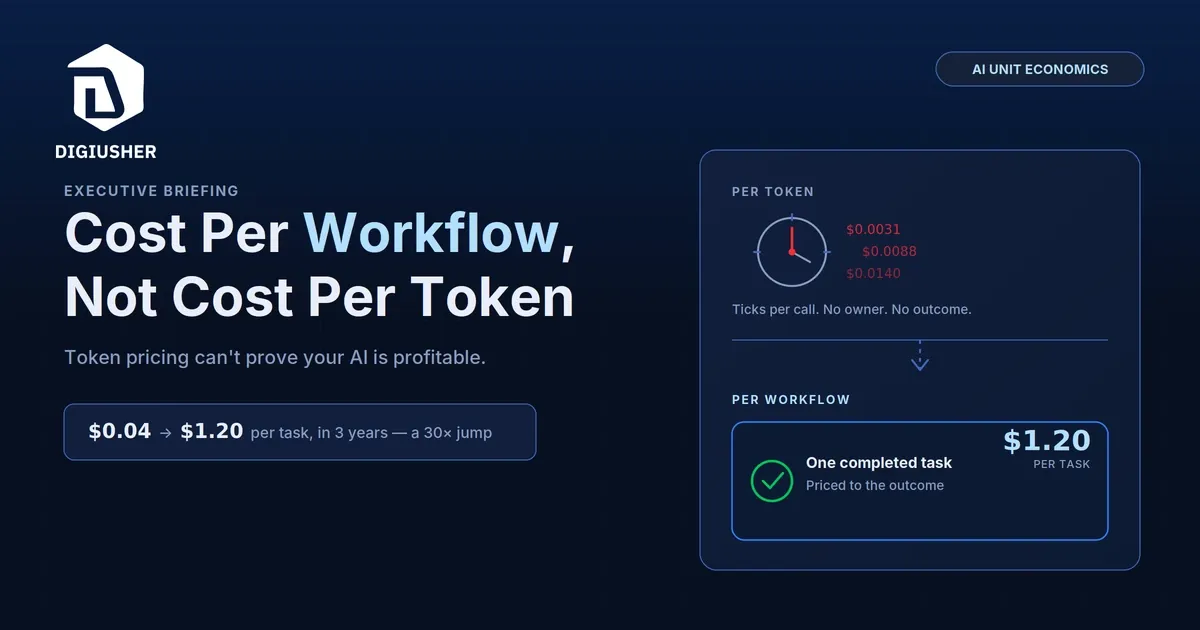
Cost Per Workflow: Why Token Pricing Can't Prove Your AI Is Profitable
AI workflows now cost 30x more per task than in 2023, and 73% of enterprises still can't explain why. Here's how to price a workflow, not a token.