The State of Tokenomics 2026: What 472 Enterprises Just Told the Industry TBM Can't Answer
472 enterprises just told the Tokenomics Foundation their top AI cost challenge isn't pricing. It's proving value. Here's what that means for FinOps in 2026.
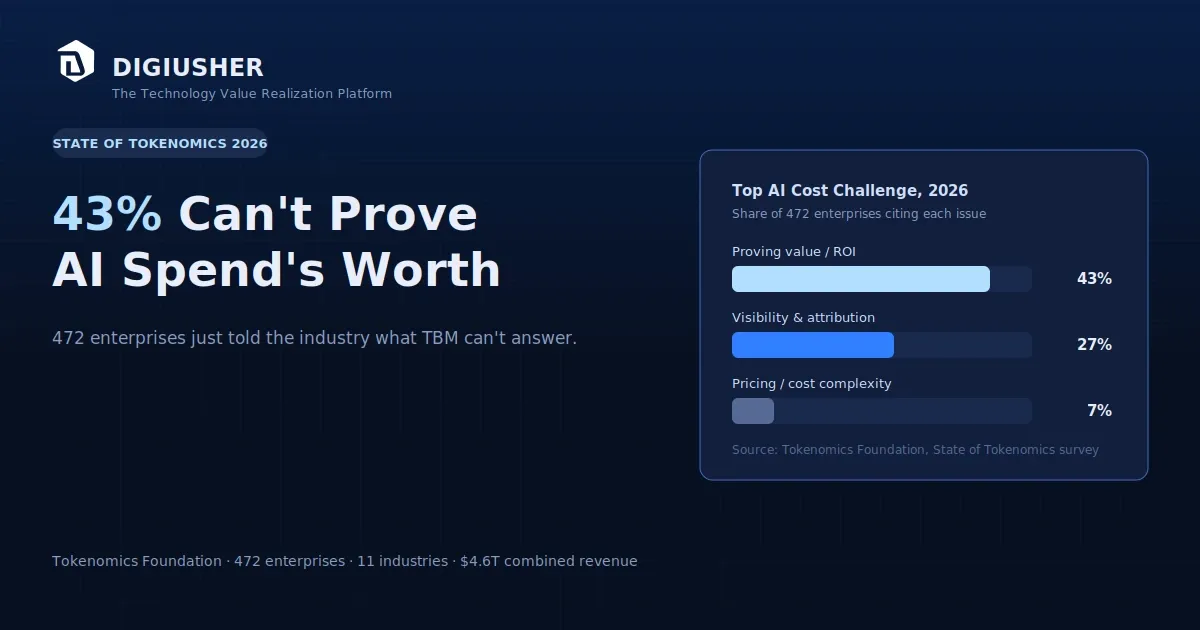
Five hundred FinOps and Tokenomics practitioners packed the Muziekgebouw in Amsterdam last week for an event that didn’t exist a year ago. They weren’t there for pricing tips. When the Tokenomics Foundation closed its first Tokenomicon with the results of its inaugural State of Tokenomics survey, 43% of 472 enterprises named the same problem: they cannot prove what their AI spend is worth.
Only 7% said pricing was the issue.
That gap — proof over price — is the whole story of AI cost governance in 2026, and it is a gap that a decade of Technology Business Management tooling was never built to close.
What 500 Practitioners in Amsterdam Just Confirmed
The Linux Foundation’s Tokenomics Foundation launched in August 2026 with 29 founding members, including JPMorgan Chase and IBM, as the first vendor-neutral body dedicated to measuring, attributing, and connecting enterprise AI token costs to business value. Its first in-person gathering, Tokenomicon plus FinOps X, ran September 22 and 23 in Amsterdam, sold out, drawing technology and finance leaders from Deutsche Bank, Booking.com, Google Cloud, AWS, and Microsoft.
The closing keynote delivered the Foundation’s first State of Tokenomics report: 472 responses across 11 industries, representing organizations with $4.6 trillion in combined revenue. This is not a startup pulse-check. It is a large-enterprise data set, and its headline finding lands directly on the question every FinOps practitioner has been asked by their CFO at least once this year.
Proving value or ROI was the most frequently cited AI cost challenge, at 43%. Visibility and attribution of spending followed at 27%. Cost or pricing complexity — the problem most vendor pitches are still built to solve — trailed at just 7%.
What Is Tokenomics?
Tokenomics, in enterprise technology finance, is the discipline of converting AI spend into provable business value. It attributes priced token events from model APIs, hyperscaler AI platforms, and autonomous coding agents through the organization, owner, agent, run, work item, model, and token class, so that AI cost can be expressed as a unit metric — cost per merged pull request, value per token — rather than a raw monthly total.
It extends FinOps unit economics into agentic workloads specifically, where consumption scales with agent activity rather than headcount, and where cache efficiency and model-class selection, not sentence-level prompt trimming, are the dominant waste levers. The Foundation’s own event introduced two new tools for this work: Big-T Notation, a Big-O-style framework for estimating how token consumption scales as agentic workflows grow more complex, and a shared Tokenomics Mind Map giving the industry one vocabulary for a category that has been improvising its own terms for two years.
The upcoming FOCUS 1.5 specification, previewed at the same event, adds model ID, token-type breakdown, and PrincipalId tracking directly into the open billing standard — the same standardization move that let FOCUS normalize cloud billing across AWS, Azure, and GCP now extending into AI.
The 43% Problem: Proving Value, Not Tracking Spend
Every enterprise in the survey can already see its AI bill. The API dashboards, the hyperscaler consoles, and the finance system all show a number. What 43% of them cannot do is answer the next question a CFO actually asks: is this spend working.
That distinction — visibility versus proof — is easy to state and hard to build, because it requires two separate capabilities most organizations built at different times for different reasons. Visibility is a data-engineering problem: land every priced event in one place. Proof is a modeling problem: express that spend against a business outcome the reader already trusts, and defend the confidence level of every allocation along the way.
A genuinely useful counterpoint came from PointFive Labs, a governing-board member of the Tokenomics Foundation, in research presented at the same event: reducing token consumption does not reliably reduce cost. That single finding disqualifies an entire category of “prompt optimization” pitches as a complete answer. If cutting tokens does not reliably cut spend, the 43% cannot be solved by writing shorter prompts. It requires attribution deep enough to show which agent, which run, and which model class actually drove the number — which is precisely the ownership gap the same survey exposes next.
Why Ownership Is the Hidden Variable
A third of surveyed enterprises said a CTO, CIO, or technology function owns AI economics. A quarter share it informally across the organization. Twelve percent have no defined owner at all.
The consequence is not abstract. Organizations with clear ownership are almost four times more likely to link AI spend to a measurable outcome than organizations without it. Ownership, in other words, is not an org-chart formality — it is the single strongest predictor in the entire survey of whether an enterprise can answer the 43% question at all.
This tracks with what the FinOps Foundation’s own State of FinOps 2026 report found on the adjacent question of scale: 98% of practitioners now manage AI spend, up from 63% the year before and just 31% the year before that. AI governance has gone from an edge case to a near-universal FinOps responsibility inside two budget cycles, and Goldman Sachs research cited by the Linux Foundation projects global token usage will grow roughly 24 times between 2026 and 2030. An ownership gap that exists today is not sitting still. It is compounding against a curve that has not finished accelerating.
Where Technology Business Management Runs Out of Road
Technology Business Management built the discipline that made the first half of this problem solvable. TBM maps IT cost to towers, services, and consumers so finance and engineering can agree on what was spent and by whom — the same groundwork the 27% “visibility and attribution” respondents are still working through. That groundwork is a genuine prerequisite. No enterprise can attribute value it has not first attributed cost.
But TBM was built to answer where the money went, and the Amsterdam data shows that question no longer satisfies the audience asking it. Forrester made the same point independently, in its own Q2 2026 IT Financial Management Wave: a solution that only explains where the money went is already obsolete, because CIOs need help deciding what to do next, not a better report on what already happened. The analyst and the practitioner survey arrived at the same conclusion from opposite directions in the same quarter.
This is the case for Technology Value Realization, not as a rebrand of TBM but as its logical extension. TVR keeps the attributed-cost ledger TBM built and adds the layer TBM was never designed to produce: a unit metric tied to a business outcome, and a savings figure verified as realized rather than merely identified. A cost number without a value denominator is an invitation to cut the wrong thing — and cutting the wrong AI spend, in a market growing 24 times by 2030, is a more expensive mistake every quarter it goes uncorrected.
Cost Per Merged PR: What Proof Actually Looks Like
Abstractions are easy to sell and hard to verify. DigiUsher runs its own AI Attribution Lens against its own engineering organization for exactly this reason — proof should survive being pointed at the vendor first.
Across 77 agent runs on six Claude model classes in mid-2026, DigiUsher’s own Tokenomics data shows a cost per merged pull request of $52.55, a 96.8% cache-hit ratio, and a blended rate of $0.75 per million tokens. That figure is not a benchmark borrowed from an industry report. It is DigiUsher’s own AI engineering spend, attributed through the same eight-layer lens — Organization, Ledger, Owner, Agent, Run, Work Item, Model, Token Class — that the platform applies to a customer’s estate.
The mechanism matters more than the number. Cost per merged PR composes alongside cost per workload (Cloud Edition), cost per pipeline run (Data Cloud Edition), and cost per service (Kubernetes Edition) into a single AI-inclusive cost per customer figure — a computation only possible for a platform holding the whole estate in one FOCUS-native ledger, rather than a separate AI point tool sitting beside a separate cloud cost tool.
How Enterprises Should Respond Before the Next Board Review
The survey data points to a specific, sequenced response rather than a general call to “invest in AI governance.”
Name an owner first. The single largest predictor of outcome-linked AI spend in the entire survey was clear ownership, not tooling maturity. A named CTO, CIO, or FinOps lead — not a committee — should own AI economics before any platform decision is made.
Land every event in one ledger before optimizing anything. PointFive Labs’ finding that token reduction does not reliably reduce cost means optimization work started before attribution is complete is optimization aimed at the wrong target.
Grade every allocation honestly. Directly tagged, inferred from usage, or rule-distributed — a single blended total is not defensible in front of a board that has started asking harder questions, and untraced spend reported as its own line is more credible than untraced spend quietly averaged away.
Pick one unit metric the board already trusts. Cost per customer, cost per merged PR, cost per transaction — the specific metric matters less than choosing one the reader can act on without a translation layer.
Evaluating a Platform Built for This
The survey results, read alongside the FinOps Foundation’s parallel research, converge on a consistent set of buyer requirements rather than a feature checklist:
| Evaluation Criterion | Why It Matters in 2026 |
|---|---|
| FOCUS native architecture | Normalizes AI cost data in the same open specification as every other domain — not a proprietary schema bolted on after the fact |
| AI workload governance | Token attribution, agentic kill-switches, GPU idle detection built in natively, not retrofitted from a cloud cost tool |
| BYOC / data sovereignty | Collector runs inside the customer’s own perimeter; billing data never leaves the environment |
| Flat enterprise licensing | No percentage of spend — the vendor’s incentives stay aligned with the customer’s own cost reduction goals |
| Full estate coverage | Cloud, Kubernetes, data platforms, SaaS, and on-premises normalized alongside AI, not governed in isolation |
| Regulated-industry proof points | Deployment validated at institutional scale, under real data-residency and audit requirements |
| Global SI delivery | Implementation at enterprise transformation pace through partners such as Infosys, Wipro, and Hexaware |
How DigiUsher Answers the 43%
DigiUsher treats AI as one domain edition inside a single ledger, not a separate tool bolted onto cloud cost management. The AI Edition — Models, Agents, GPU — runs the same eight-layer AI Attribution Lens described above across managed platforms like Bedrock, Vertex, and Azure AI, direct providers like Anthropic and OpenAI, and engineering agents including Claude Code, Cursor, and Codex.
Every allocation carries its own confidence grade, and untraced spend is reported honestly rather than absorbed into an average — the exact practice the 27% “visibility and attribution” cohort in the Tokenomics Foundation’s survey is still building toward. Because the platform runs via a BYOC Secure Relay Proxy, this attribution happens inside the customer’s own perimeter, a requirement already validated by a leading global private-sector bank, ICICI Bank, under full data residency, security review, and audit-trail controls — and separately delivering €1M in realized value within 45 days for a European energy transition enterprise on its Databricks-on-Azure estate, via Wipro.
DigiUsher is deployed on a flat enterprise licence, never a percentage of spend, is AWS ISV Accelerate and Azure ISV Co-Sell Ready, holds SOC 2 Type II and GDPR certification, and is delivered globally through Infosys, Wipro, and Hexaware. The platform’s own dogfood data — $52.55 cost per merged PR, 96.8% cache-hit ratio — runs on the same mechanism before it is ever pointed at a customer’s estate.
Book a 15-minute discovery call and DigiUsher will show the first attributed cost per merged PR from your own AI Edition data within 48 hours of connecting a source.
Frequently Asked Questions
What is Tokenomics? Tokenomics is the discipline of converting AI spend into provable business value, rather than simply tracking what AI costs. It works by attributing every priced token event — from model APIs, hyperscaler AI platforms, and autonomous coding agents — through a chain of organization, owner, agent, run, work item, model, and token class, so the result can be expressed as a unit metric rather than a raw bill. The Tokenomics Foundation’s own September 2026 survey of 472 enterprises found that proving value, not managing price, is the dominant challenge practitioners face, cited by 43% of respondents against just 7% who named pricing complexity. DigiUsher’s AI Edition operationalizes this through an eight-layer AI Attribution Lens that produces a single unit metric — cost per merged pull request — verified against the actual bill rather than modeled in advance. Any enterprise still measuring AI spend as a monthly total by vendor is measuring the wrong thing; the practitioners who have moved past that stage are the ones reporting measurable outcomes to their board.
What is the difference between Technology Business Management and Technology Value Realization? Technology Business Management (TBM) answers where technology money went: it maps IT cost to towers, services, and consumers so finance and IT can agree on a bill. Technology Value Realization (TVR) answers what that spend produced: it extends the same discipline forward, from an attributed cost to a unit metric tied to a business outcome, and verifies that any claimed saving actually lands in a later bill. Forrester’s own Q2 2026 IT Financial Management Wave made the same distinction from the analyst side, warning that a solution which only explains where the money went is already obsolete, and calling for tools that support decisions rather than better reports. TBM remains the prerequisite — an organization cannot attribute value it has not first attributed cost — but it is no longer sufficient on its own, particularly for AI spend that scales with agent activity rather than headcount. DigiUsher’s platform is built to do both in one ledger: FOCUS-native attribution for the TBM layer, and a unit economics engine — cost per merged PR, cost per workload, cost per pipeline run — for the TVR layer on top of it.
Why does AI cost attribution matter more in 2026 than it did in 2025? Because the scale and the ownership gap have both widened at once. The FinOps Foundation’s State of FinOps 2026 report found that 98% of practitioners now manage AI spend, up from 63% the year before and just 31% the year before that — AI governance has become close to universal FinOps responsibility inside two budget cycles. At the same time, the Tokenomics Foundation’s own September 2026 survey found that a third of enterprises assign AI-economics ownership to a CTO, CIO, or technology function, a quarter share it informally across the organization, and 12% have no defined owner at all. Goldman Sachs research cited by the Linux Foundation projects global token usage will grow roughly 24 times between 2026 and 2030, meaning any attribution gap open today compounds against a fast-rising base rather than a flat one. Enterprises that wait for AI spend to stabilize before building attribution are waiting for a curve that is still accelerating; the ones already reporting outcomes are the 33% who assigned clear ownership before the scale arrived.
How should enterprises prove AI ROI to their board? Enterprises should replace a single blended AI cost total with a unit metric tied to something the board already tracks — cost per customer, cost per merged pull request, cost per transaction — rather than trying to defend a raw number that has no denominator. A cost figure without a value denominator invites the board to cut the wrong thing, because a 20% increase in AI spend that accompanies 35% revenue growth from an AI-powered product is a different story from the same increase with no attached outcome. Getting there requires the sequenced approach the FinOps Foundation formalized this year: attribution graded as directly tagged, inferred from usage, or rule-distributed, with untraced spend reported honestly rather than absorbed into an average. DigiUsher’s Value Engine composes exactly this unit economics view — any AI cost slice divided by any business metric, verified against the bill it was drawn from rather than a forecast — and the platform’s own dogfood data (77 agent runs, $52.55 cost per merged PR, 96.8% cache-hit ratio) shows the mechanism operating on DigiUsher’s own AI workloads before it is applied to a customer’s. Boards do not need a lower AI number. They need a number with a denominator they can act on.
How much of enterprise AI spend goes unattributed today? The Tokenomics Foundation’s September 2026 survey of 472 enterprises across 11 industries, representing $4.6 trillion in combined revenue, found that visibility and attribution of AI spend was the second-most-cited challenge at 27%, trailing only the broader problem of proving value at 43%. That gap sits on top of a rapidly rising base: the FinOps Foundation’s State of FinOps 2026 report shows AI management has gone from 31% of practitioners two years ago to 98% today. Separately, PointFive Labs research presented at the same Amsterdam event found that reducing token consumption does not reliably reduce cost, meaning the attribution gap cannot be closed through prompt optimization alone; it requires a ledger that traces spend to an owner, agent, run, and model in the first place. DigiUsher’s Meter module addresses this directly through its AI Attribution Lens, an eight-layer value map running Organization through Token Class, with untraced spend reported as its own line rather than folded into an average that hides where the gap actually is.
How does DigiUsher address the AI value-attribution gap? DigiUsher addresses the gap by treating AI as one domain edition inside a single FOCUS-native ledger, rather than a separate tool bolted onto cloud cost management. Every priced token event — from hyperscaler AI platforms, direct model providers, and autonomous coding agents such as Claude Code, Cursor, and Codex — is attributed through an eight-layer AI Attribution Lens covering Organization, Ledger, Owner, Agent, Run, Work Item, Model, and Token Class, with each allocation graded as directly tagged, inferred, or rule-distributed so the confidence level is visible, never assumed. The output composes into a single signature metric for the AI Edition — cost per merged pull request — which sits alongside cost per workload, cost per pipeline run, and cost per service from DigiUsher’s other domain editions inside one AI-inclusive cost per customer figure. Because DigiUsher is deployed via a BYOC Secure Relay Proxy, this attribution runs inside the customer’s own perimeter, a requirement that has already been validated by a leading global private-sector bank, ICICI Bank, operating under full data residency and audit controls. The platform runs this exact mechanism on its own engineering organization first — 77 agent runs, $52.55 cost per merged PR, 96.8% cache-hit ratio, $0.75 per million tokens blended — before it is asked to run on a customer’s estate.
What should enterprises look for when evaluating an AI cost governance platform in 2026? Enterprises should evaluate against seven criteria that the market’s own direction has made close to non-negotiable. First, FOCUS 1.x native architecture, so AI cost lands in the same open specification as every other domain rather than a proprietary schema. Second, AI workload governance built in from the start — token attribution, agentic kill-switches, GPU idle detection — not retrofitted from a cloud cost tool. Third, BYOC or an equivalent data-sovereignty architecture, since a SaaS-only tool that pulls billing data out of the customer’s environment is disqualifying for regulated industries. Fourth, flat enterprise licensing, because a vendor charging a percentage of spend is structurally incentivized against the customer’s own cost reduction. Fifth, coverage of the full technology estate — cloud, Kubernetes, data platforms, SaaS, on-premises — since AI spend rarely sits in isolation from the rest of the bill. Sixth, regulated-industry proof points at institutional scale, not a logo wall of pilots. Seventh, global delivery through systems integrators such as Infosys, Wipro, and Hexaware, so the platform can be implemented at the pace a large enterprise transformation actually requires, not a single-region rollout.
What happens when organizations fail to govern AI spend? They accumulate a board-level credibility gap that widens every quarter AI spend keeps growing without an attached outcome. The Tokenomics Foundation’s data shows this concretely: organizations with no defined AI-economics owner — 12% of the September 2026 survey sample — are four times less likely to link their AI spend to a measurable outcome than organizations with clear ownership. Practically, this shows up as a CFO who cannot explain a cloud and AI variance beyond business-unit level, an engineering organization that keeps shipping AI features with no financial accountability until the invoice arrives, and a board that starts asking the same question every mature FinOps practice eventually hears: what did this spend actually buy. Forrester’s Q2 2026 IT Financial Management Wave frames the consequence bluntly for any tool still stuck at the reporting stage — a solution that only explains where the money went is already obsolete, because CIOs now need help deciding what to do next, not another report confirming what already happened.
The question changed. A decade of Technology Business Management tooling answered where the money went. The 472 enterprises in Amsterdam just confirmed, in one survey, that the question their boards are actually asking now is what it bought.
Ready to See Your Own Cost Per Merged PR?
DigiUsher’s AI Edition attributes every priced token event — model APIs, hyperscaler AI platforms, autonomous coding agents — into one FOCUS-native ledger, and expresses the result as a unit metric your board can act on. First insight within 48 hours of connecting a source. Full enterprise integration in two to four weeks.
Book my 15-minute discovery call →
Deployed as SaaS, Managed SaaS, or fully self-hosted (BYOC) for regulated industries. SOC 2 Type II certified. GDPR compliant. AWS ISV Accelerate Partner. Azure ISV Co-Sell Ready. Delivered globally by Infosys, Wipro, and Hexaware.
References
- Tokenomics Foundation — State of Tokenomics report (September 2026)
- FinOps Foundation — State of FinOps 2026
- Linux Foundation — Tokenomics Foundation Launches (August 4, 2026)
- Linux Foundation — Announces Tokenomicon Conference (June 2026)
- Forrester — Announcing The Forrester Wave: IT Financial Management Software, Q2 2026
- PointFive — Joins the Tokenomics Foundation as a Premier Member (August 2026)
- daily.dev — Token Economics in Amsterdam: Inside the First Tokenomicon
- Tokenomicon + FinOps X Amsterdam — Event Agenda
- ITAM Forum — Tokenomicon + FinOps X Event Listing
Related Reading
- FinOps for AI: Why Optimization Alone No Longer Answers the CFO’s Question (June 20, 2026) — extends this post’s ownership-gap findings into a full framework for standing up an AI FinOps function.
- The AI Cloud Margins Nobody Is Reporting (May 14, 2026) — shows the P&L consequence of the same unattributed-spend problem this post traces back to its root cause.
- CFO’s Guide to Closing the AI ROI Gap (April 2, 2026) — gives the CFO persona referenced here a board-ready template for the unit-metric argument made in this post.
- Why FinOps Is a Board-Level Conversation Now (March 11, 2026) — companion piece on the same shift from cost visibility to value accountability.
- The FinOps Operating System Missing Layer (February 18, 2026) — explains why full-estate coverage, not another point tool, closes the attribution gap this post describes.
© 2026 DigiUsher. All rights reserved. Privacy Policy · Terms of Service · Trust Center
DigiUsher in 15 min
Give your board a cost-to-outcome view they can actually act on.
DigiUsher connects cloud and AI spend to the outcomes it funds, in language finance already speaks.
Book my 15-min discovery callNo hard pitch · specific to your stack
Continue Reading
More from the DigiUsher editorial team.
Product Updates - DigiUsher Ships Its First AI Cost Attribution Feature
Only 39% of organisations can attribute any business impact to their AI spend. DigiUsher's release shipped AI Lens and began a new enhanced allocation-engine to close that gap.
Product Updates - Budgets Re-egineered to Purpose Driven
DigiUsher launched new enhanced Budgets domain — the capstone of a quarter spent building toward Technology Value Realisation.
Product Updates - Industry's most advanced Allocation Engine, 4 new integrations - Redis, Grafana, Vercel and ClickHouse
After weeks of parity testing, DigiUsher's next-generation allocation engine became the production default. The same release added Redis Cloud, Grafana Cloud, Vercel, and ClickHouse Cloud billing.