Product Updates - DigiUsher Ships Its First AI Cost Attribution Feature
Only 39% of organisations can attribute any business impact to their AI spend. DigiUsher's release shipped AI Lens and began a new enhanced allocation-engine to close that gap.
98% of FinOps teams now manage AI spend. 39% can point to any business impact from it. That gap between managing and defending is the problem this release started solving — not by promising to solve it eventually, but by shipping the first piece of the answer inside two weeks.
What shipped
AI Lens — the first AI model-cost attribution dashboard — shipped this release, giving all our customers a direct view of AI infrastructure spend broken down by the complete AI journey and model rather than buried inside a general cloud cost report. It arrived alongside a reworked Anthropic usage ingestion pipeline, meaning the data behind the dashboard reflects real, correctly parsed model usage rather than an approximation.
Underneath AI Lens, the release carried the heavier architectural weight of this feature: our next-generation cost allocation engine. A config reference-graph and pure compiler established how allocation rules get defined and validated. A materialisation core turned that configuration into actual allocated cost records. A conservation gate, and run-health monitoring made the engine’s output verifiable rather than merely plausible. And CRUD and publish APIs, alongside a dedicated Allocation Hub UI, gave FinOps practitioners a way to author and manage allocation rules directly rather than filing a ticket for an engineer to run a migration.
Elsewhere, Databricks recommendation scenarios extended optimisation coverage into data platforms.
AI Lens and the attribution gap
The AI cost problem isn’t that organisations lack visibility into what AI costs — 98% of FinOps teams now manage AI spend, up from 31% just two years earlier. It’s that visibility hasn’t translated into defensibility: only 39% of organisations can attribute any EBIT impact to their AI investment at all. 58% of FinOps practitioners name AI cost management as the single skillset they most need to build over the next twelve months — a direct admission of how far the gap between managing and defending still runs.
AI Lens isn’t a complete answer to that gap. It’s the first shippable step — AI infrastructure spend broken out across 8 layers including models and tokens, in the same lens a practitioner already uses for the rest of their cloud estate, built on a freshly reworked usage ingestion pipeline so the underlying data is trustworthy rather than approximated.
Why a conservation gate, and why now
A cost allocation engine that can’t prove its own arithmetic is asking an organisation to trust it on faith. This release shipped a conservation gate specifically to remove that faith requirement — an automated check, run on every execution, verifying that every unit of cost entering the engine is fully and exactly distributed across its destinations, with nothing created, duplicated, or silently dropped along the way. It’s the allocation-engine equivalent of double-entry bookkeeping for catching problems before they reach a customer’s chargeback report.
Most practitioners recommend allocation accuracy clear 80-90% before an organisation moves from showback to hard chargeback, because below that threshold, untagged and misallocated costs generate disputes that erode trust in the whole system faster than any dashboard can rebuild it. A conservation gate doesn’t by itself guarantee an organisation clears that threshold — but it guarantees that whatever accuracy the engine achieves is real and provable, not an artefact of cost silently disappearing or duplicating somewhere in the pipeline.
Enhanced Allocation Engine v2
──────────────────────────────────────────────────────────────
Phase   What it delivered
────────────────────────    ────────────────────────────────
1        Config reference-graph + pure compiler
2       expense_allocations materialization core
3        Config CRUD/publish APIs + derived expense dimensions
4        Allocation Hub UI
──────────────────────────────────────────────────────────────
Each phase independently shippable and testable before the
next began — not a single big-bang cutover.
──────────────────────────────────────────────────────────────
What this means for evaluating any AI cost intelligence platform
A few questions worth applying to any vendor here: is AI cost actually broken out by model, in the primary cost lens a practitioner already uses, or buried inside a general cloud report the team responsible for it never actually opens? Does the allocation engine have a provable conservation check, or is it asking for trust it hasn’t earned? Is any allocation engine rebuild staged in independently shippable phases that can each be tested and audited, or can the vendor only describe the end state? And is there a dedicated hub for authoring allocation rules directly, rather than logic buried in database migrations no FinOps practitioner can own or audit themselves?
39% of organisations can attribute business impact to their AI spend. This release shipped the first dashboard built specifically to move that number — and the allocation engine underneath it, built to prove its own math before anyone has to trust it.
See AI cost intelligence built this way, against your own estate. Book a 30-minute session and we’ll map AI spend by model, team, and workload against your actual AI tooling and cloud infrastructure. Request a demo →
Related reading
- Product Updates - Kubernetes GPU Governance and Resource Intelligence — June 29, 2026
- Product Update - DigiUsher Goes Deep on Data Platform Governance — July 27, 2026
- AI Unit Economics: Why Your AI Invoice Can No Longer Answer the Board’s Question — July 16, 2026
- The Death of Chargeback: Why Cost Allocation Is Failing in the Kubernetes and AI Era — April 30, 2026
© 2026 DigiUsher. All rights reserved. Privacy Policy · Terms of Service · Trust Center
DigiUsher in 15 min
Give your board a cost-to-outcome view they can actually act on.
DigiUsher connects cloud and AI spend to the outcomes it funds, in language finance already speaks.
Book my 15-min discovery callNo hard pitch · specific to your stack
Continue Reading
More from the DigiUsher editorial team.
Product Updates - Budgets Re-egineered to Purpose Driven
DigiUsher launched new enhanced Budgets domain — the capstone of a quarter spent building toward Technology Value Realisation.
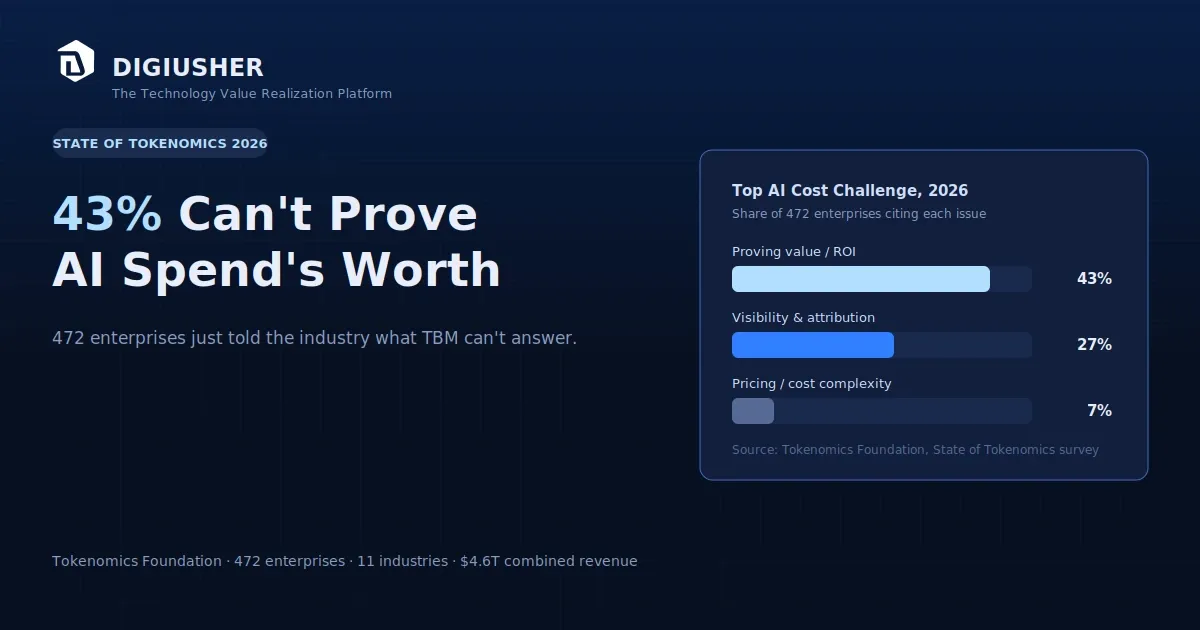
The State of Tokenomics 2026: What 472 Enterprises Just Told the Industry TBM Can't Answer
472 enterprises just told the Tokenomics Foundation their top AI cost challenge isn't pricing. It's proving value. Here's what that means for FinOps in 2026.
Product Updates - Industry's most advanced Allocation Engine, 4 new integrations - Redis, Grafana, Vercel and ClickHouse
After weeks of parity testing, DigiUsher's next-generation allocation engine became the production default. The same release added Redis Cloud, Grafana Cloud, Vercel, and ClickHouse Cloud billing.