Product Updates - Budgets Re-egineered to Purpose Driven
DigiUsher launched new enhanced Budgets domain — the capstone of a quarter spent building toward Technology Value Realisation.
Enforcing a technology budget requires an allocation engine already proven correct underneath it, not a budget alert layered on top of unverified numbers. An enhanced budgeting feature gives an enterprise a threshold and a fiscal calendar — it doesn’t retroactively fix the allocation accuracy that alert depends on. Without that sequencing, an organisation can set a budget without ever really knowing whether breaching it means anything real. This release is where a quarter of underlying engineering work becomes the platform’s new baseline: a Budgets domain, launched only once the allocation engine beneath it had already earned the trust to support it.
Only 39% of organisations could attribute business impact to their AI spend at the start of this quarter’s build. 76% of large enterprises now spend more than $5 million a month on public cloud — the scale a budget needs to enforce against meaningfully.
What shipped
A new enhanced Budgets domain launched on top of a now fully modernised core, with a default sweep and a fiscal year setting so budget enforcement speaks the same financial calendar the rest of the organisation already uses. The weekly digest was rewritten to rank its contents by money rather than chronology, and the authentication and session-security layer received a round of hardening as part of ongoing platform investment. Recommendation coverage completed a notable stretch too — native Databricks scenarios, GCP BigQuery table recommendations, and Snowflake warehouse and table cost scenarios all shipped this release, alongside a MongoDB Atlas billing integration extending normalised coverage into one more managed data platform. And the AI attribution pipeline running through this whole series reached its finest grain yet: tracing a specific pull request’s AI spend back to the individual runs behind it.
Why budgets, and why now
A budget enforced against an allocation engine nobody fully trusts is a budget built on sand. This release’s new Budgets domain launched deliberately after, not before, the industry’s most advanced allocation engine reached full production maturity. That sequencing was a choice. A budget alert firing against numbers a FinOps team doesn’t trust gets ignored the same way any noisy alert does — industry-wide, weekly alert volumes run into the thousands, with only a small fraction ever requiring real action. A budget alert firing against a fully validated allocation engine is one a team can actually act on, without first re-checking whether the underlying number is even right.
Fiscal year budgeting, shipped as part of the same domain, matters for a specific practical reason: most large enterprises don’t run a calendar-year budget cycle, and a platform assuming they do produces numbers finance can’t reconcile against what the board actually reviews. The default sweep — automatically rolling unspent or overspent budget into the correct period — removes a manual reconciliation step FinOps teams have historically done by hand, at the exact point the underlying allocation data became trustworthy enough to automate against.
The quarter, taken together
Technology Value Realisation — proving technology spend converted into a measurable outcome — isn’t a label applied after the fact to whatever shipped. It’s the specific, sequenced work this quarter’s engineering actually did: a resource layer trustworthy enough to attribute against, an enhanced allocation engine proven correct before it was trusted, an AI cost pipeline reaching down to the individual pull request, and now a budgeting system enforcing against all of it using the organisation’s own fiscal calendar.
A few evaluation criteria worth applying to any platform claiming this kind of maturity: are budgets enforced against a genuinely validated allocation engine, or just a number nobody’s checked? Is budget enforcement fiscal-year-aware, given most enterprises don’t run a calendar-year cycle? Does AI attribution resolve to the individual run, or stop at the work-item level? And is recommendation coverage actually complete across the major data platforms — Databricks, Snowflake, BigQuery — rather than one generic import covering all three poorly?
A budget enforced against numbers nobody’s verified is a budget nobody will act on. This release sequenced it the other way round.
See what fiscal-year budget enforcement looks like against your own allocation data. Book a 30-minute session and we’ll map resource utilisation, AI attribution, and allocation accuracy against your actual technology footprint. Request a demo →
Related reading
- Product Updates - Industry’s Most Advanced Allocation Engine, 4 New Integrations — September 7, 2026
- Product Updates - Parity-Tested and Production-Ready: DigiUsher’s Allocation Engine — August 24, 2026
- Product Updates - The AI Telemetry Pipeline Goes Live — August 10, 2026
- Product Updates - Kubernetes GPU Governance and Resource Intelligence — June 29, 2026
© 2026 DigiUsher. All rights reserved. Privacy Policy · Terms of Service · Trust Center
DigiUsher in 15 min
Give your board a cost-to-outcome view they can actually act on.
DigiUsher connects cloud and AI spend to the outcomes it funds, in language finance already speaks.
Book my 15-min discovery callNo hard pitch · specific to your stack
Continue Reading
More from the DigiUsher editorial team.
Product Updates - DigiUsher Ships Its First AI Cost Attribution Feature
Only 39% of organisations can attribute any business impact to their AI spend. DigiUsher's release shipped AI Lens and began a new enhanced allocation-engine to close that gap.
Product Updates - Industry's most advanced Allocation Engine, 4 new integrations - Redis, Grafana, Vercel and ClickHouse
After weeks of parity testing, DigiUsher's next-generation allocation engine became the production default. The same release added Redis Cloud, Grafana Cloud, Vercel, and ClickHouse Cloud billing.
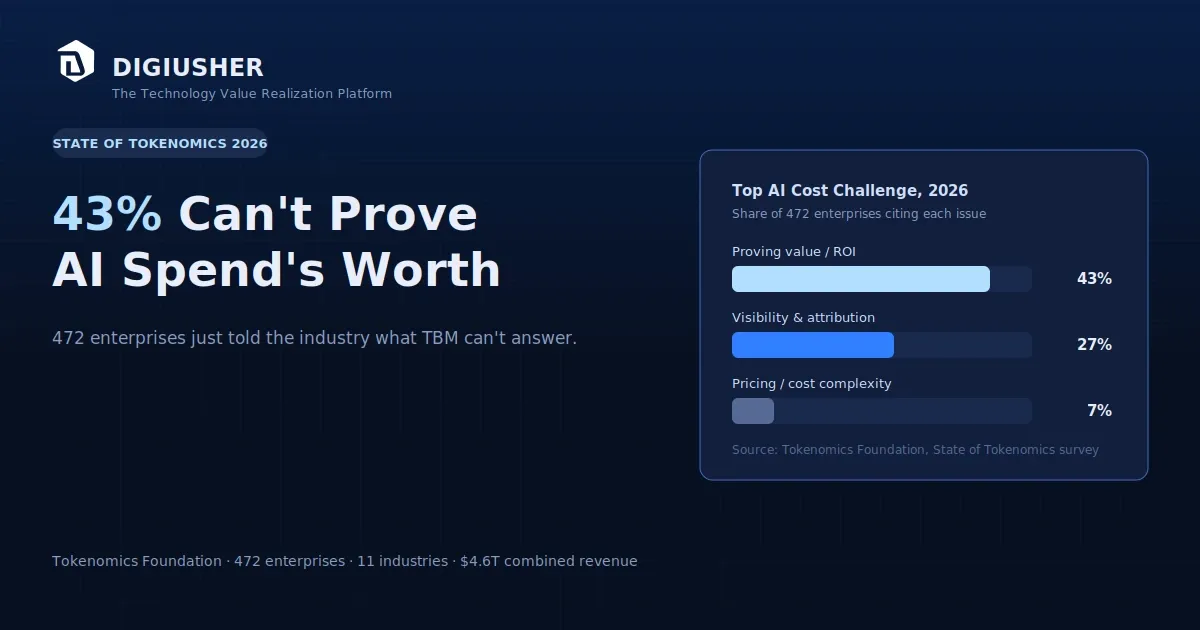
The State of Tokenomics 2026: What 472 Enterprises Just Told the Industry TBM Can't Answer
472 enterprises just told the Tokenomics Foundation their top AI cost challenge isn't pricing. It's proving value. Here's what that means for FinOps in 2026.