Product Updates - The AI Telemetry Pipeline Goes Live
73% of organizations experience outages from alerts they ignored. DigiUsher shipped an enhanced notification engine in its platform designed not to become one more ignored channel.
73% of organisations have had an outage caused by an alert somebody had already learned to ignore. That statistic sat squarely in front of the engineering team as they began building a notification platform, and it shaped the decision to launch in phases rather than all at once.
In this release the new industry leading AI attribution spec. Proactive governance, not retrospective reporting, is the dividing line between a dashboard and a genuine Technology Value Realisation platform — and it’s the line this release’s work crosses.
What shipped
The AI telemetry connector and ingest pipeline went live this release paired immediately with the first version of an AI attribution lens API and a model-price sync process. Claude.ai Enterprise Analytics billing joined OpenAI Platform as the second AI vendor integration added this month, and GitHub organisation billing usage brought engineering-tool spend into the same normalised view.
The notification platform launched in its first three phases: a documented spec covering the entire rollout, an in-app notification core with a single pilot event type for recommendation assignments, and a notification centre with a read API and bell-and-drawer UI.
AI telemetry goes live
Every capability in the AI attribution story — AI Lens, unit economics, work-item-level cost joins — depends on one thing existing first: a reliable pipeline that receives and normalises AI infrastructure usage data. That pipeline went live this release. It’s not a customer-facing feature in itself; it’s the plumbing that makes every AI-cost feature after it possible.
The timing matters against a real backdrop: 98% of FinOps teams now manage AI spend, and only around 39% of organisations can attribute any business impact to that investment. That gap is exactly what a telemetry pipeline exists to close, one normalised data source at a time — Claude.ai Enterprise Analytics billing and GitHub organisation billing usage, both added this release, are two more sources feeding into that same normalised pipeline rather than living as separate, unreconciled data silos.
Why notifications are designed against fatigue, not just capable of it
A notification feature on any platform is easy to build badly. The research on what happens when it is built badly is specific: the average team already receives more than 2,000 alerts weekly across existing tools, with only 3% requiring immediate action, and 73% of organisations report an outage caused directly by an alert someone had already learned to tune out. Any new notification channel enters that environment already competing against fatigue, not starting from a blank slate.
An in-app notification in the enhanced notification module launched with exactly one event type — recommendation assignment — rather than every possible alert category at once. And a notification centre with a bell-and-drawer UI gave users a place to review notifications on their own terms rather than only receiving them as interruptions. Later phases add coalescing holds, daily caps, and granular unsubscribe controls — the specific mechanisms that keep a notification channel from becoming the next thing on that 2,000-alerts-a-week pile.
Enhanced Notification Module — Phased Launch, This Release
──────────────────────────────────────────────────────────────
Phase   What shipped
────────    ──────────────────────────────────────────────
Spec        Full rollout design: event types, channels,
             governance model
P1          In-app notification core, one pilot event type
P2          Notification centre — read API, bell/drawer UI
──────────────────────────────────────────────────────────────
Deliberately staged against a documented fatigue baseline:
2,000+ weekly alerts industry-wide, only 3% actionable
──────────────────────────────────────────────────────────────
What this means for evaluating any AI telemetry platform
A few things worth checking on any vendor here: is there a genuinely normalised telemetry pipeline underneath every AI cost feature, since attribution and unit economics both fail without reliable infrastructure usage data behind them? Are multiple AI vendor billing sources normalised into one view, given that 98% of FinOps teams now manage AI spend but rarely from just one vendor? And is any notification rollout actually staged against a documented fatigue baseline, or does it just add another firehose to the pile most teams are already ignoring?
73% of organisations have been burned by an alert they’d already learned to ignore. A notification platform that launches deliberately slow, in phases, is designed specifically so it never joins that pile.
See AI telemetry and proactive governance built this way, against your own estate. Book a 30-minute session and we’ll map your AI vendor spend, notification coverage, and legacy system dependency against your actual environment. Request a demo →
Related reading
- Product Update - DigiUsher Goes Deep on Data Platform Governance — July 27, 2026
- Product Updates - Parity-Tested and Production-Ready: DigiUsher’s Allocation Engine — August 24, 2026
- Product Updates - DigiUsher Ships Its First AI Cost Attribution Feature — July 13, 2026
- GPU Cost Governance for Azure OpenAI, AWS Bedrock & Google Vertex AI — March 19, 2026
© 2026 DigiUsher. All rights reserved. Privacy Policy · Terms of Service · Trust Center
DigiUsher in 15 min
Understand what each AI workload costs before scale amplifies the risk.
DigiUsher tracks cost per token, per inference, and per GPU hour, so your unit economics keep pace with adoption.
Book my 15-min discovery callNo hard pitch · specific to your stack
Continue Reading
More from the DigiUsher editorial team.
Product Updates - Industry's most advanced Allocation Engine, 4 new integrations - Redis, Grafana, Vercel and ClickHouse
After weeks of parity testing, DigiUsher's next-generation allocation engine became the production default. The same release added Redis Cloud, Grafana Cloud, Vercel, and ClickHouse Cloud billing.
Product Updates - DigiUsher Ships Its First AI Cost Attribution Feature
Only 39% of organisations can attribute any business impact to their AI spend. DigiUsher's release shipped AI Lens and began a new enhanced allocation-engine to close that gap.
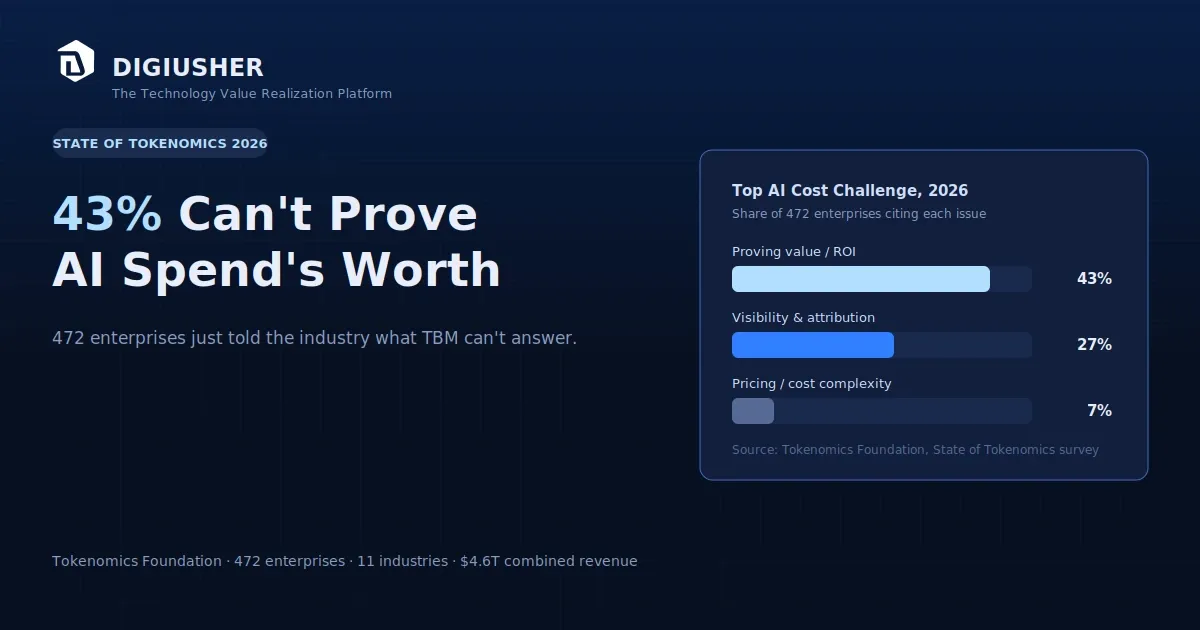
The State of Tokenomics 2026: What 472 Enterprises Just Told the Industry TBM Can't Answer
472 enterprises just told the Tokenomics Foundation their top AI cost challenge isn't pricing. It's proving value. Here's what that means for FinOps in 2026.