GPU Cost Governance for Azure OpenAI, AWS Bedrock & Google Vertex AI
GPU infrastructure is now the fastest-growing cost driver in enterprise cloud — and 30–50% of that spend is wasted on idle capacity. This FinOps guide covers GPU pricing across Azure, AWS, and GCP, the five mechanisms through which AI compute costs spiral out of control, and the governance framework that stops GPU from becoming your largest and least-governed cost center.

Executive Summary
Generative AI is rapidly becoming the most compute-intensive — and most poorly governed — workload enterprises have ever deployed.
Large language models, AI copilots, enterprise assistants, and autonomous agentic workflows now depend on GPU infrastructure delivered through three dominant managed platforms:
- Azure OpenAI Service (Microsoft)
- Amazon Bedrock (Amazon Web Services)
- Google Vertex AI (Google Cloud Platform)
These platforms dramatically simplify AI adoption. They also introduce a structural cost governance problem: GPU consumption is now the fastest-growing cost driver in enterprise cloud infrastructure, and the token-based billing these platforms use makes the underlying GPU economics invisible to the teams generating the cost.
The numbers in 2026 are unambiguous:
- An 8×NVIDIA H100 instance costs ~$98/hr on AWS and Azure — over $70,000/month at continuous operation
- 30–50% of provisioned GPU capacity is typically wasted on idle or underutilized infrastructure
- 40–60% of AI infrastructure consumption occurs during experimentation phases before production workloads begin
- 98% of FinOps teams now manage AI spend — with GPU cost governance identified as the top capability gap
The question is no longer whether AI will increase cloud spending. It already has.
The question is: how do you govern GPU consumption before it becomes your largest and least-governed cost center?
What Is GPU Cost Governance?
GPU cost governance is the financial discipline of monitoring, attributing, optimizing, and enforcing budgets for GPU-accelerated AI compute — spanning managed AI platforms (Azure OpenAI, AWS Bedrock, Vertex AI), direct GPU cluster rentals, and on-premises AI infrastructure.
It differs from traditional cloud cost management in one critical respect: GPU compute is an order of magnitude more expensive than general-purpose cloud compute, and the billing model used by managed AI platforms (tokens, requests, compute hours) abstracts the underlying GPU economics from the teams generating the cost.
GPU vs. Standard Cloud Compute — Cost Reality
──────────────────────────────────────────────────────────────
Infrastructure Type       Approx. Cost per Hour
──────────────────────────────────────────────────────────────
Standard CPU instance      $0.30 – $0.50/hr
NVIDIA A100 GPU (on-demand) $1.29 – $3.40/hr per GPU
NVIDIA H100 GPU (on-demand) $3.00 – $12.30/hr per GPU
8×H100 Training Cluster    $88 – $98/hr (entire node)
──────────────────────────────────────────────────────────────
Cost multiplier vs CPU:     30× – 200× per GPU-hour
──────────────────────────────────────────────────────────────
This represents a 30–200× cost multiplier compared to traditional compute workloads. For enterprise AI teams, this means:
- Even moderate AI experimentation can generate six-figure monthly cloud bills
- Idle GPU resources burn cash at a rate that has no precedent in conventional cloud infrastructure
- The billing abstraction of managed AI platforms makes these costs invisible until the monthly invoice arrives
The Real Cost of GPU Compute in 2026
Understanding the actual GPU pricing landscape is the prerequisite for governing it effectively.
H100 Pricing Across Hyperscalers (Early 2026)
The NVIDIA H100 — the dominant GPU for both training and inference across enterprise AI — is priced comparably across the three major hyperscalers for equivalent 8-GPU configurations:
| Platform | Instance | GPU Configuration | On-Demand Rate | Per-GPU Rate |
|---|---|---|---|---|
| AWS | P5.48xlarge | 8×H100 SXM | $98.32/hr | ~$12.29/hr |
| Azure | ND H100 v5 | 8×H100 | $98.46/hr | ~$12.31/hr |
| GCP | A3 HighGPU | 8×H100 | $88.49/hr | ~$11.06/hr |
Prices as of early 2026. Fluctuate by region and availability — verify on provider pricing pages.
At continuous 24/7 operation, an 8×H100 cluster on AWS or Azure generates approximately $70,790–$70,900 per month in GPU compute charges alone — before egress, storage, platform fees, or managed service overhead.
The 5× Price Gap: Hyperscalers vs. Specialized Providers
The same H100 GPU costs $2.49/hr on specialized GPU cloud providers versus $12.30/hr on Azure — a nearly 5× price difference that compounds to $70,632/month for a 10-GPU cluster running continuously.
This gap reflects fundamentally different value propositions. Hyperscalers are not simply selling GPU compute — they are selling ecosystem integration, enterprise SLAs, compliance certifications, and IAM/VPC/audit infrastructure wrapped around the GPU. For AI workloads that need this managed environment (production inference with compliance requirements), hyperscaler pricing is justified. For fault-tolerant training workloads that do not need managed services, this premium may not be.
Spot Instances: The Most Accessible Cost Lever
Spot and preemptible instances reduce GPU costs by 60–70% across all three hyperscalers — the highest-return cost optimization available without changing workload architecture. Training a 70B parameter model on preemptible instances rather than on-demand can reduce training cost from $71,000 to approximately $21,000–$28,000 for the same compute outcome.
The requirement: Fault-tolerant workloads with checkpoint-and-restart capability. Training jobs that can resume from saved state handle Spot interruptions gracefully. Real-time inference with latency SLAs cannot tolerate interruption — on-demand capacity is required.
Why Managed AI Platforms Hide GPU Costs
Azure OpenAI, AWS Bedrock, and Google Vertex AI all abstract GPU infrastructure behind simplified billing models. This abstraction is valuable for adoption velocity — it is structurally problematic for financial governance.
The Token-to-GPU Invisibility Problem
| What the invoice shows | What is actually happening |
|---|---|
| ”Azure OpenAI: 500M tokens consumed — $1,250” | GPU cluster executing transformer inference at $6.98–$12.30/GPU-hr |
| ”AWS Bedrock: 2M requests — $420” | Anthropic Claude running on H100 nodes via Bedrock managed infrastructure |
| ”Vertex AI: 1,000 compute hours — $3,000” | Custom model training on A100/H100 cluster with varying utilization rates |
Behind every API call, a GPU cluster is executing compute. Token pricing removes the GPU signal from engineering decision-making at precisely the moment it would be most valuable — during prompt design, model selection, and agentic architecture decisions that directly determine GPU consumption patterns.
The practical consequence: An engineer choosing GPT-4o over GPT-3.5-turbo for a use case that does not require premium capability increases infrastructure cost by 5× — invisibly, with no cost signal at the point of decision. At production scale, this single architectural choice can represent hundreds of thousands of dollars of avoidable GPU spend annually.
Platform-Specific Cost Visibility Gaps
Each managed platform has distinct governance limitations that compound the token abstraction problem:
Azure OpenAI provides billing visibility at subscription and resource group level — not at workload or team level. Multiple teams sharing an Azure OpenAI deployment appear as a single billing unit. Prompt inefficiency — verbose system messages, unnecessary context — compounds token consumption silently. PTU commitments are billed regardless of utilization.
AWS Bedrock provides the best native attribution mechanism through Application Inference Profiles (AIPs) — but AIPs must be enforced at call time through SDK configuration. Without AIP enforcement, attribution requires correlating charges with CloudWatch logs. The multi-model catalog creates cost variance that is invisible without standardized metrics — Claude, Titan, Llama, and Mistral have materially different per-token rates that make aggregate spend comparisons misleading.
Google Vertex AI has the most complex cost structure — compute-based training charges, token-based inference charges, and data processing charges accumulate as separate billing dimensions. Sustained use discounts apply retroactively, making intra-month cost forecasting imprecise. Shared endpoints serving multiple teams require log-to-billing joins for accurate attribution.
The FinOps gap: All three platforms provide visibility within their own billing environment. None provides cross-platform GPU economics — the unified view that multi-platform AI governance requires.
Five Ways GPU Costs Spiral Out of Control
1. Token-Based Pricing Hides GPU Reality
The token-to-GPU relationship is invisible in standard billing. An Azure OpenAI API call consuming 1,000 output tokens represents GPU execution that cannot be reconciled with the invoice charge without platform-level telemetry. When this invisibility scales across thousands of API calls per minute from engineering teams making real-time decisions — about prompt design, model selection, context window usage — the aggregate GPU cost becomes ungovernable without a dedicated attribution layer.
Governance action: Map token consumption back to GPU-hour equivalents per workload and per team. Surface the infrastructure economics that token billing conceals at the engineering decision layer — cost per 1,000 tokens should translate to a visible GPU-spend signal before each production deployment, not after the monthly invoice.
2. AI Experimentation Consumes 40–60% of Infrastructure Budget Before Production
AI development cycles are GPU-intensive before any production workload exists. Prompt engineering on GPT-4o class models, model evaluation across Claude versions, RAG pipeline iteration on Vertex AI — each iteration consumes GPU compute billed at production rates with no attribution to productive output.
Research across AI engineering teams shows experimentation can represent 40–60% of total AI infrastructure consumption before production workloads begin. A team of 10 AI engineers conducting ungoverned experimentation generates GPU spend comparable to a production deployment — with zero revenue attribution and no finance visibility until the monthly bill arrives.
The structural issue is not that AI experimentation is wasteful — it is essential. The issue is that ungoverned experimentation at production-tier GPU rates, with no environment separation and no cost signal, systematically generates six-figure monthly bills that look identical to productive compute in the billing system.
Governance action: Separate GPU budget pools for dev, test, staging, and production. Route experimentation to cheaper A100 instances or open-source models on Bedrock (Llama) and Vertex AI (Gemini Flash) before validating on premium H100 capacity. Mandatory experiment tagging that distinguishes research spend from production infrastructure in financial reporting.
3. Idle GPU Clusters Burn Cash Continuously
GPU infrastructure bills by the hour whether workloads are active or idle. AI training jobs complete and clusters remain provisioned. Inference endpoints maintain reserved GPU capacity for peak demand that never fully materializes. Development environments persist between sprint cycles.
Industry analysis consistently finds 30–50% of GPU budget wasted on capacity that is provisioned but not actively generating output.
The arithmetic is unforgiving. An H100 cluster at 30% utilization on AWS:
On-demand rate:       ~$12.29/GPU-hr × 8 GPUs = $98.32/hr total
Productive compute:   30% × $98.32 = $29.50/hr
Idle waste:           70% × $98.32 = $68.82/hr
Monthly idle waste:   $68.82 × 24 × 30 = $49,550/month
A ten-cluster training environment at 30% average utilization wastes approximately $495,000/month in idle GPU capacity — before the idle compute is even identified as a governance problem.
Governance action: Real-time GPU utilization monitoring per cluster with configurable idle detection thresholds. Automated scale-down when utilization falls below defined levels. Training job SLA enforcement that auto-terminates jobs exceeding time or cost limits. Scheduled shutdown of non-production GPU environments outside business hours.
4. The Multi-Layer AI Cost Stack Multiplies Hidden Margin
Enterprise AI platforms introduce four consecutive cost layers between the GPU hardware and the enterprise application — each extracting margin before business value is realized:
GPU Hardware (NVIDIA)         Hardware manufacturer margin
          ↓
Cloud Infrastructure           Hyperscaler infrastructure margin
(AWS / Azure / GCP)
          ↓
AI Platform (Bedrock /         Managed service abstraction margin
Azure OpenAI / Vertex AI)
          ↓
Model Provider (OpenAI /       API and model licensing margin
Anthropic / Mistral)
          ↓
Enterprise Application         ← Business value must be realized here
Most enterprises deploying managed AI platforms pay stacked margins across all four upstream layers simultaneously — without visibility into the aggregate or the ability to identify where margin recovery is possible. The token price charged by a managed platform includes hyperscaler infrastructure margin, managed platform margin, and model provider margin layered on top of each other.
The business consequence: When an AI feature appears to cost $X in token charges, the actual GPU infrastructure cost behind that charge may be $X/3 or $X/5. Understanding the stacked margin structure enables enterprises to evaluate when direct GPU infrastructure (accepting operational complexity) generates better margin than managed platform abstraction.
Governance action: End-to-end stacked cost attribution. Map total AI feature cost — GPU infrastructure, managed platform, model provider, and egress — to the business outcomes each feature generates. Surface the effective cost-per-outcome that makes every upstream margin layer visible and governable.
5. Multi-Platform Fragmentation Prevents Cost Normalization
Most enterprises distribute AI workloads across all three managed platforms simultaneously:
| Platform | Typical Use Case | Billing Unit |
|---|---|---|
| Azure OpenAI | Enterprise copilots, M365 integrations | Tokens (input + output) |
| AWS Bedrock | Multi-model applications, AWS-native workloads | Tokens / requests (model-dependent) |
| Vertex AI | ML pipelines, data-centric AI, Gemini workloads | Compute hours + tokens + data processing |
Three platforms. Three incompatible billing units. Three separate invoices that finance teams attempt to reconcile manually each month — producing approximations rather than attributions.
Without normalization, finance cannot produce a cross-platform AI cost view. Engineering cannot compare GPU efficiency across platforms. Boards cannot evaluate AI ROI by platform or by business outcome.
Governance action: FOCUS 1.4 cross-platform normalization: convert Azure tokens, Bedrock per-request charges, and Vertex compute hours to equivalent cost-per-outcome metrics in a unified financial model. This is the prerequisite for everything else — governance without normalization produces three separate dashboards, not one source of truth.
GPU Cost Optimization Levers by Impact
Ranked from highest immediate return to highest structural impact:
Immediate — Spot / Preemptible Instances (60–70% saving)
Every fault-tolerant training workload not using Spot is leaving 60–70% of compute cost on the table. The requirement is checkpoint-and-restart capability — implemented once, it makes every future training job dramatically cheaper. AWS Spot (~60–70%), Azure Spot (~65%), GCP Preemptible (~60–70%).
High — GPU Right-Sizing by Workload (30–60% saving)
H100 costs 3× A100 per GPU-hour for the same GPU count — but the H100 advantage (3–6× faster training) only fully materializes above 70B parameters. Models under 13B parameters frequently run more cost-efficiently on A100, making H100 spend an unnecessary premium. GCP offers A100 single-GPU instances at ~$3.29/hr — the cheapest hyperscaler option for fine-tuning and small model training.
High — Serverless Endpoints for Sporadic Inference (eliminates idle)
For internal tools, low-frequency AI features, and development environments, serverless inference eliminates idle GPU hours entirely — the largest single waste category in AI infrastructure. All three platforms offer serverless inference modes. Vertex AI batch prediction offers an explicit 50% discount for non-real-time workloads.
Medium — INT8/INT4 Quantization (2–4× memory reduction)
Quantization reduces GPU memory requirements 2–4×, enabling smaller and cheaper GPU instances for inference. For production chatbot and copilot workloads where slight quality trade-off is acceptable, quantization reduces inference infrastructure cost proportionally to the instance tier reduction it enables.
Medium — Request Batching (up to 8× effective throughput)
Serving 8 inference requests per GPU call costs the same as serving 1 — implementing batching for non-interactive workloads reduces effective cost per inference proportionally to batch size. Vertex AI batch prediction provides the explicit 50% pricing discount that reflects this economic reality.
Structural — Reserved Instances After Rightsizing (30–50% saving)
Reserved capacity and committed use contracts deliver 30–50% reduction for validated, stable baselines. The critical sequencing rule: rightsize first, then commit. Committing to reserved capacity before rightsizing locks in waste at a discount — reducing the unit cost while leaving the total waste intact.
The Emerging Discipline: AI FinOps for GPU-Intensive Workloads
Traditional FinOps frameworks were built for infrastructure workloads with predictable, linear cost behaviors. AI introduces fundamentally different cost variables that require new governance frameworks:
- Token processing — usage-driven, non-linear, sensitive to prompt design decisions
- GPU hours consumed — billed whether productive or idle, invisible in managed platform billing
- Model complexity — model selection multiplies per-request cost by 5–20× without visible cost signal
- Inference scaling — agentic workflows chain multiple LLM calls, multiplying token consumption nonlinearly
- Training pipelines — one-time large cost events that require job-level governance and SLA enforcement
98% of FinOps teams now manage AI spend — but GPU cost management skills remain the #1 capability gap. The discipline is evolving rapidly, and the enterprises that build AI FinOps capability now — before GPU costs compound at production AI scale — will have a structural advantage over those that retrofit governance onto established AI cost structures.
IDC FutureScape 2026: By 2027, G1000 organizations will face up to a 30% rise in underestimated AI infrastructure costs — driven precisely by under-forecasting the GPU economics hidden behind token-based managed platform billing.
Why CIOs and CFOs Must Pay Attention Now
AI adoption is not only a technological shift. It is an economic transformation of cloud infrastructure with direct margin implications.
For CIOs: GPU infrastructure is becoming the largest single cost driver in the cloud estate — larger than networking, storage, or general-purpose compute for AI-adopting organizations. Without governance frameworks that attribute GPU cost to workloads, teams, and business outcomes, the cloud bill grows faster than AI adoption creates value.
For CFOs: The financial risk is not AI adoption itself — it is ungoverned AI adoption. An enterprise generating $50M in annual AI cloud spend with 30% idle waste is leaving $15M/year on the table. That same enterprise without cross-platform normalization cannot produce an AI ROI analysis for the board. And without real-time GPU governance, the next six-figure AI overspend will arrive as a monthly invoice surprise rather than a pre-empted financial risk.
Emerging frameworks like the Levelized Cost of AI (LCOAI) attempt to quantify lifecycle AI costs across infrastructure, energy, and operations — providing boards with a capital-equivalent metric for evaluating AI investment. Enterprises that implement GPU cost governance now are building the attribution infrastructure that LCOAI and future board-level AI reporting frameworks require.
DigiUsher: The AI Compute Control Layer
Enterprises cannot govern AI GPU economics with cloud dashboards alone — not least because those dashboards speak three different cost languages and stop at their own cloud boundary.
DigiUsher’s FinOps Operating System provides the unified GPU cost governance layer that managed AI platforms individually cannot:
Unified AI cost observability — real-time GPU utilization monitoring per cluster, workload, and team across Azure, AWS, and GCP. Token consumption mapped back to GPU-hour equivalents. The infrastructure economics that token billing conceals, surfaced continuously.
Cross-platform FOCUS normalization — Azure token charges, Bedrock per-request billing, and Vertex compute hours normalized to FOCUS 1.4 in a single unified cost model. One source of truth for total GPU spend across all three platforms.
Automated GPU governance — idle cluster scale-down, training job SLA enforcement with auto-termination, non-production environment scheduling, and budget guardrails that throttle inference before spending reaches invoice thresholds. Governance that acts, not reports.
AI unit economics — cost per inference, cost per AI feature, cost per business outcome across all three platforms. The metric set that connects GPU infrastructure investment to EBITDA impact — in the language CFOs and boards require.
Stacked cost attribution — end-to-end visibility mapping GPU infrastructure cost through managed platform and model provider layers to the business outcomes each feature generates. The transparency that reveals where AI investment is generating margin and where it is consuming it.
Available as SaaS or BYOC for regulated industries. SOC 2® Type II and GDPR certified. Delivered globally through Infosys, Wipro, and Hexaware.
The next wave of cloud cost challenges will not come from storage, networking, or virtual machines. They will come from GPU compute infrastructure powering AI. The enterprises that implement strong GPU cost governance across Azure OpenAI, AWS Bedrock, and Google Vertex AI now will scale AI without losing financial control. Those that do not will discover, too late, that their most powerful technology investment has quietly become their largest ungoverned cost center.
Frequently Asked Questions
What is GPU cost governance and why is it critical for Azure OpenAI, Bedrock, and Vertex AI?
GPU cost governance is the financial discipline of monitoring, attributing, optimizing, and enforcing budgets for GPU-accelerated AI compute. It is critical for managed AI platforms because token-based billing abstracts underlying GPU economics — an Azure OpenAI token charge, a Bedrock API call, and a Vertex inference request each represent GPU compute at $2–12/GPU-hr happening invisibly. Without governance, 30–50% of that compute is wasted on idle capacity that billing cannot distinguish from productive output.
What does GPU compute actually cost on Azure, AWS, and Google Cloud in 2026?
An 8×NVIDIA H100 instance costs approximately $98/hr on AWS P5 and Azure ND H100 v5, and $88/hr on GCP A3 HighGPU. At continuous operation, this is $70,000–73,000/month for a single training cluster. Single-GPU H100 costs ~$12.31/hr on Azure, ~$11.06/hr on GCP. A100 is materially cheaper — AWS P4d at $32.77/hr for 8 GPUs, GCP A2 at $26.27/hr. Spot discounts of 60–70% are available on all three for fault-tolerant workloads. Specialized GPU providers offer H100 at $2.49–$3.50/hr on-demand — 60–85% below hyperscaler rates.
Why does token-based pricing on managed AI platforms hide GPU costs?
Token billing charges per output unit (tokens processed, requests served) rather than per GPU infrastructure consumed. This removes the GPU signal from engineering decision-making — an engineer choosing GPT-4o over GPT-3.5-turbo increases infrastructure cost by 5× invisibly, with no cost signal at the point of decision. At production scale, unmanaged model selection and prompt inefficiency represent hundreds of thousands of dollars of avoidable GPU spend, arriving as monthly invoice surprises rather than real-time governance signals.
How much GPU compute is typically wasted in enterprise AI deployments?
30–50% of provisioned GPU capacity is typically wasted — idle between training jobs, reserved for peak inference demand that never fully materializes, or consumed by ungoverned experimentation. AI experimentation phases can represent 40–60% of total AI infrastructure consumption before production workloads begin. An H100 cluster at 30% utilization on AWS wastes approximately $49,550/month in idle compute — invisible in the cloud bill, which charges provisioned capacity regardless of utilization.
What are the best GPU cost optimization strategies in 2026?
Six levers by impact: Spot/preemptible instances for training (60–70% saving); GPU right-sizing — A100 for sub-13B models, H100 for 70B+ (30–60% saving); serverless endpoints for sporadic inference (eliminates idle); INT8/INT4 quantization (2–4× memory reduction enabling smaller instances); request batching for non-interactive inference (up to 8× throughput improvement); reserved instances after rightsizing (30–50% on validated baselines — sequence matters: rightsize before committing).
How does DigiUsher govern GPU costs across Azure, AWS, and GCP simultaneously?
Through four integrated capabilities: unified GPU utilization monitoring across all three platforms with token consumption mapped to GPU-hour equivalents; FOCUS 1.4 cross-platform normalization converting all three billing schemas to a unified cost model; automated GPU governance including idle scale-down, training job SLA enforcement, and budget guardrails that throttle before thresholds are breached; and AI unit economics tracking cost per inference, feature, and business outcome in board-ready format.
References
- ByteIota — H100 Costs $2.49 or $12.30 in 2026: GPU Cloud Pricing Analysis (March 2026)
- SpendArk — Machine Learning Cloud Costs: GPU Pricing Across AWS, Azure, GCP (2026)
- IntuitionLabs — NVIDIA AI GPU Prices: H100 and H200 Cost Guide
- IntuitionLabs — H100 Rental Prices Compared: $1.49–$6.98/hr Across 15+ Cloud Providers
- Spheron — GPU Cloud Pricing Comparison 2026: Every Major Provider Side by Side
- FinOps Foundation — State of FinOps 2026
- IDC — Balancing AI Innovation and Cost: The New FinOps Mandate
- StackSpend — Bedrock vs Vertex vs Azure OpenAI: Which Managed AI Platform (March 2026)
- Jarvis Labs — NVIDIA H100 Price Guide 2026
- AWS EC2 GPU instance pricing
- Azure N-series GPU pricing
- Google Cloud GPU pricing
- FinOps Foundation — FOCUS Specification
- NVIDIA — Rethinking AI TCO: Cost per Token
Govern Your GPU Compute Before It Governs Your Margins
GPU infrastructure has become the new battleground for enterprise cloud margins. Every Azure OpenAI deployment, every Bedrock API call, every Vertex AI training job is executing GPU compute that token billing makes invisible — until the monthly invoice arrives.
DigiUsher’s FinOps OS surfaces that GPU economics, attributes it to the teams and products generating it, and enforces the governance actions that prevent idle waste from becoming a structural margin problem
DigiUsher in 15 min
Understand what each AI workload costs before scale amplifies the risk.
DigiUsher tracks cost per token, per inference, and per GPU hour, so your unit economics keep pace with adoption.
Book my 15-min discovery callNo hard pitch · specific to your stack
Continue Reading
More from the DigiUsher editorial team.
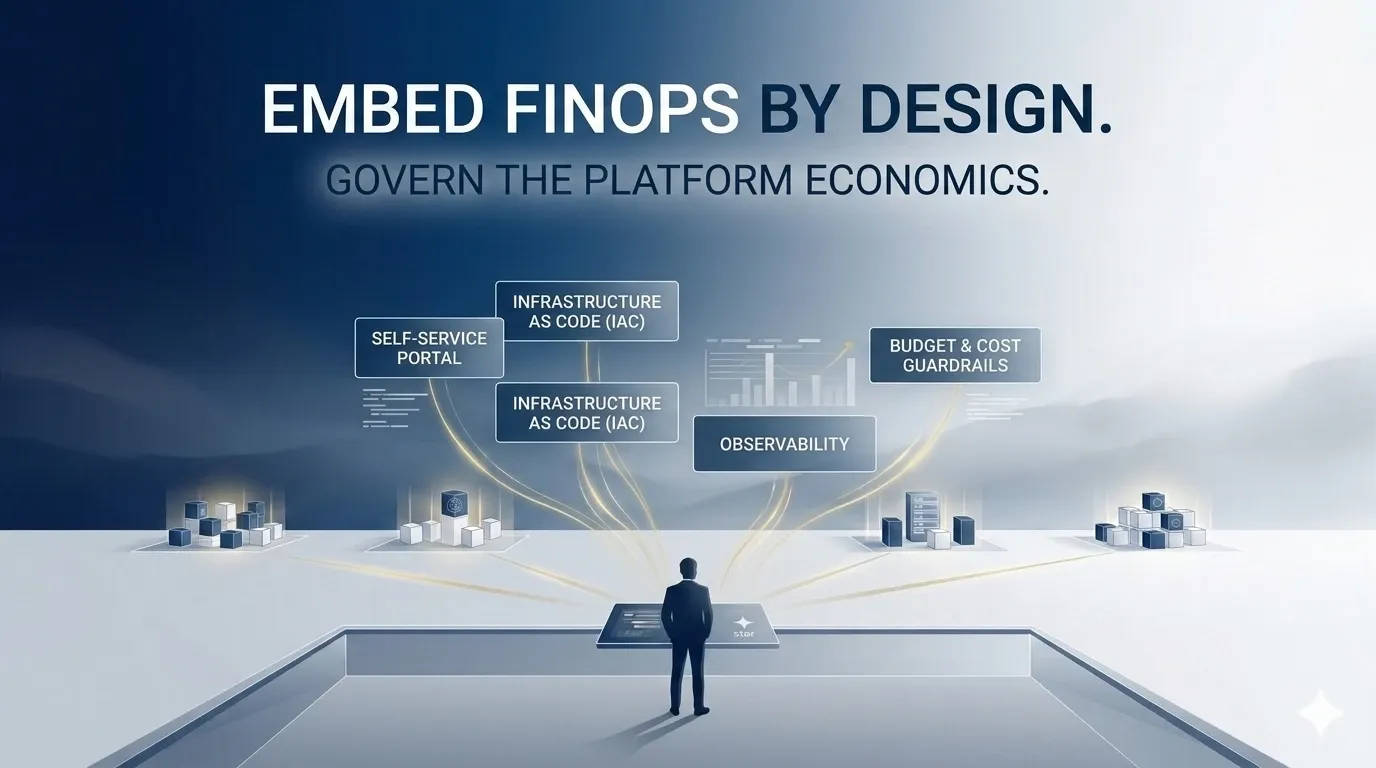
The $1 Trillion AI Infrastructure Economy: Who Pays the Bill?
Hyperscalers will spend $602 billion on AI infrastructure in 2026 — 75% of it on AI. LLM inference costs have fallen 1,000× in three years, yet enterprise AI bills are skyrocketing. This briefing explains the stacked cost architecture of the AI economy, the margin compression problem destroying AI ROI, and why FinOps governance — not more compute — determines who captures the margin in the age of the Token Factory.
Azure OpenAI vs AWS Bedrock vs Google Vertex AI: The FinOps Guide to GenAI Cost Governance
Enterprises are deploying GenAI across Azure OpenAI, AWS Bedrock, and Google Vertex AI simultaneously — three platforms with incompatible billing models, different governance capabilities, and hidden costs that erode AI ROI. This FinOps guide compares all three platforms on cost structure, attribution capability, optimization levers, and governance gaps — with a practical cross-platform normalization framework.
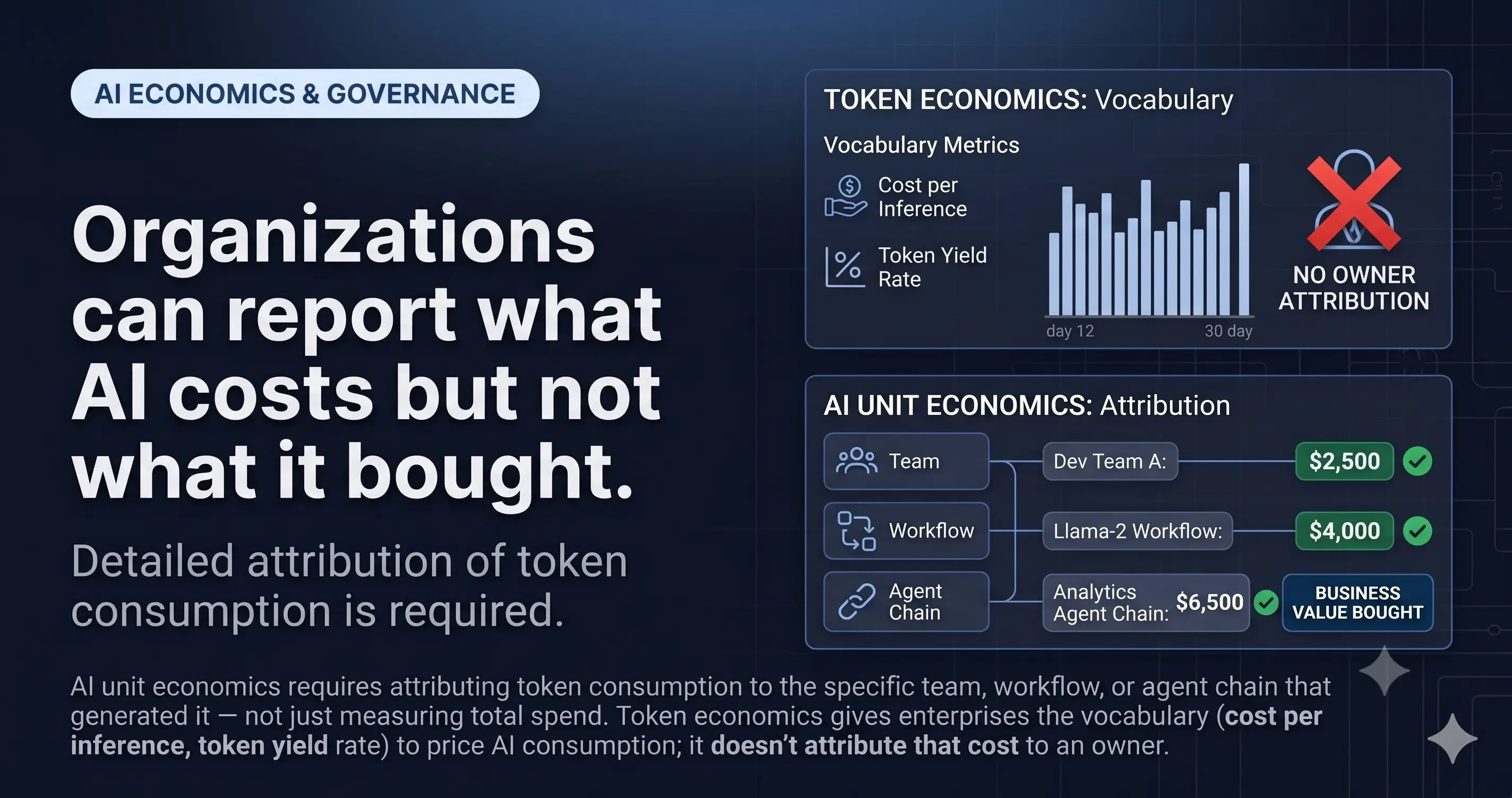
Token Economics Gave AI Spend a Vocabulary. It Still Has No Owner.
FinOps Foundation's token economics framework names the AI cost problem correctly. But naming a metric and attributing it to a team, workflow, or chain are two different disciplines — and most enterprises only have the first.