Product Update - DigiUsher Goes Deep on Data Platform Governance
Data cloud platforms are now the most actively managed SaaS category in FinOps. DigiUsher's release shipped native Databricks and Snowflake governance to match.
Data cloud platforms are now the single most actively managed SaaS category in FinOps practice — ahead of observability tools, ahead of security tooling, ahead of everything else that isn’t cloud infrastructure itself. That’s not a niche finding buried in a footnote; it’s the headline signal from the FinOps Foundation’s own 2026 practitioner survey. This release build treats it that way.
What shipped
Databricks and Snowflake both received full, purpose-built governance this release — resources, metrics, and recommendation scenarios for each, shipped as two distinct integrations rather than one generic connector reused twice. Databricks recommendations reach cluster, warehouse, and serving scenarios specifically, recognising that the optimisation levers inside a data platform genuinely differ from generic cloud compute. OpenAI Platform billing joined the roster of normalised AI vendor integrations alongside them, extending the same FOCUS-native treatment already applied to cloud infrastructure into a proprietary AI billing format.
Why data platforms are now the priority
The FinOps Foundation’s 2026 State of FinOps report is unambiguous about where practitioner attention has shifted. Data cloud platforms rank as the most actively managed SaaS and PaaS category today, and 90% of FinOps teams now manage SaaS spend as part of their scope at all, up from 65% just a year earlier. The reason is structural, not fashionable: Databricks and Snowflake bill in proprietary units — DBUs and credits respectively — that resist direct dollar comparison without a normalisation layer, and both platforms run compute shared across many teams through clusters and warehouses, meaning cost visibility that stops at the warehouse level misses the query- or job-level detail that actually explains the bill.
The scale of what sits undiscovered in that gap isn’t abstract. One internal optimisation effort implemented 43 Databricks recommendations in under ten days and tracked roughly $816,000 in annualised DBU savings from that alone — evidence that warehouse-level showback, without query-level attribution underneath it, leaves real money unaccounted for. This release’s Databricks and Snowflake resources, metrics, and recommendation scenarios are built to close exactly that gap.
Data Platform Governance — What Shipped This Release
──────────────────────────────────────────────────────────────
Platform         Coverage shipped
────────────────    ──────────────────────────────────
Databricks         Resources, metrics, cluster/warehouse/
                     serving recommendation scenarios
Snowflake           Resources, metrics, and recommendations
OpenAI Platform     Native FOCUS-normalised billing integration
──────────────────────────────────────────────────────────────
What this means for evaluating any data platform governance offering
A few questions worth applying to any vendor here: does it offer platform-specific resources and metrics, or just a generic import applied twice to two genuinely different platforms? Are recommendation scenarios actually matched to each platform’s own levers — cluster, warehouse, and serving optimisation in Databricks look nothing like generic compute rightsizing? Is billing natively normalised, or does DBU and credit pricing stay stuck in its own proprietary unit with no real dollar comparison possible? And is there a shared design system across every chart, since comparing a Kubernetes chart to a Databricks chart to an AI spend chart only works if colour and scale stay consistent across all three.
Data cloud platforms are now the most actively managed SaaS category in FinOps. This release built the governance to match that reality, rather than leaving Databricks and Snowflake as an afterthought behind the major clouds.
See Databricks and Snowflake governed this way, against your own data platform estate. Book a 30-minute session and we’ll map cluster, warehouse, and query-level cost against your actual data platform footprint. Request a demo →
Related reading
- Product Updates - DigiUsher Ships Its First AI Cost Attribution Feature — July 13, 2026
- Product Updates - The AI Telemetry Pipeline Goes Live — August 10, 2026
- Token Economics Gave AI Spend a Vocabulary. It Still Has No Owner. — July 9, 2026
- Designing Cost Allocation Engines That Finance Trusts: A FinOps Practitioner’s Playbook — May 14, 2026
© 2026 DigiUsher. All rights reserved. Privacy Policy · Terms of Service · Trust Center
DigiUsher in 15 min
See what your cloud and AI costs are really telling you.
Book a walkthrough and see how DigiUsher ties spend to the teams, workloads, and outcomes behind it.
Book my 15-min discovery callNo hard pitch · specific to your stack
Continue Reading
More from the DigiUsher editorial team.
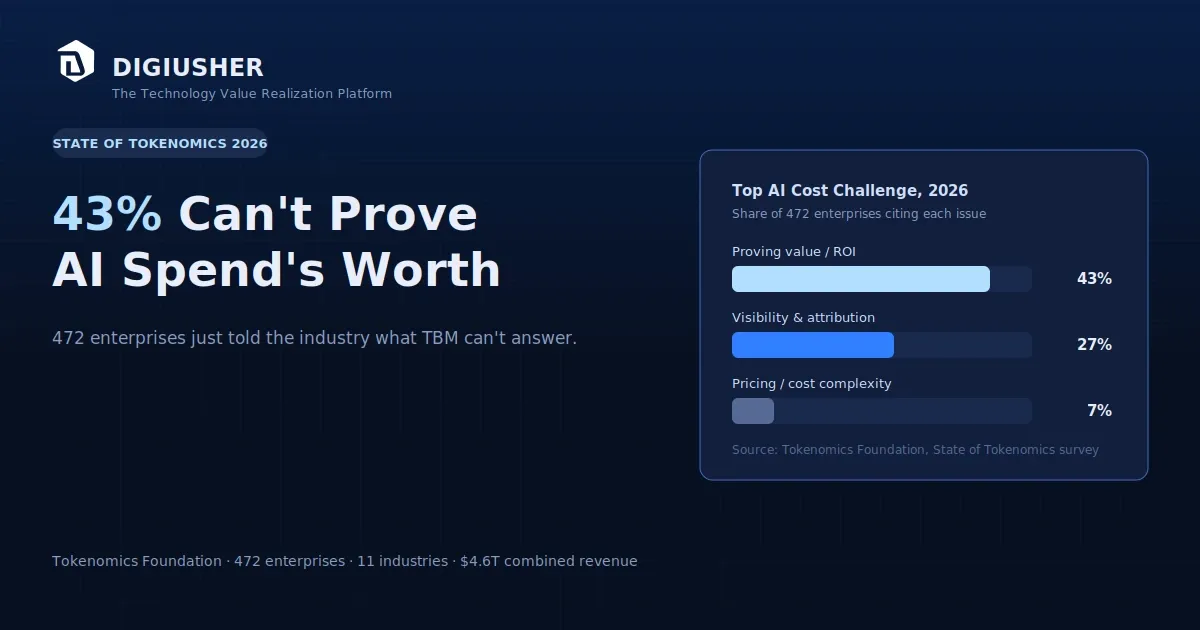
The State of Tokenomics 2026: What 472 Enterprises Just Told the Industry TBM Can't Answer
472 enterprises just told the Tokenomics Foundation their top AI cost challenge isn't pricing. It's proving value. Here's what that means for FinOps in 2026.
Product Updates - Budgets Re-egineered to Purpose Driven
DigiUsher launched new enhanced Budgets domain — the capstone of a quarter spent building toward Technology Value Realisation.
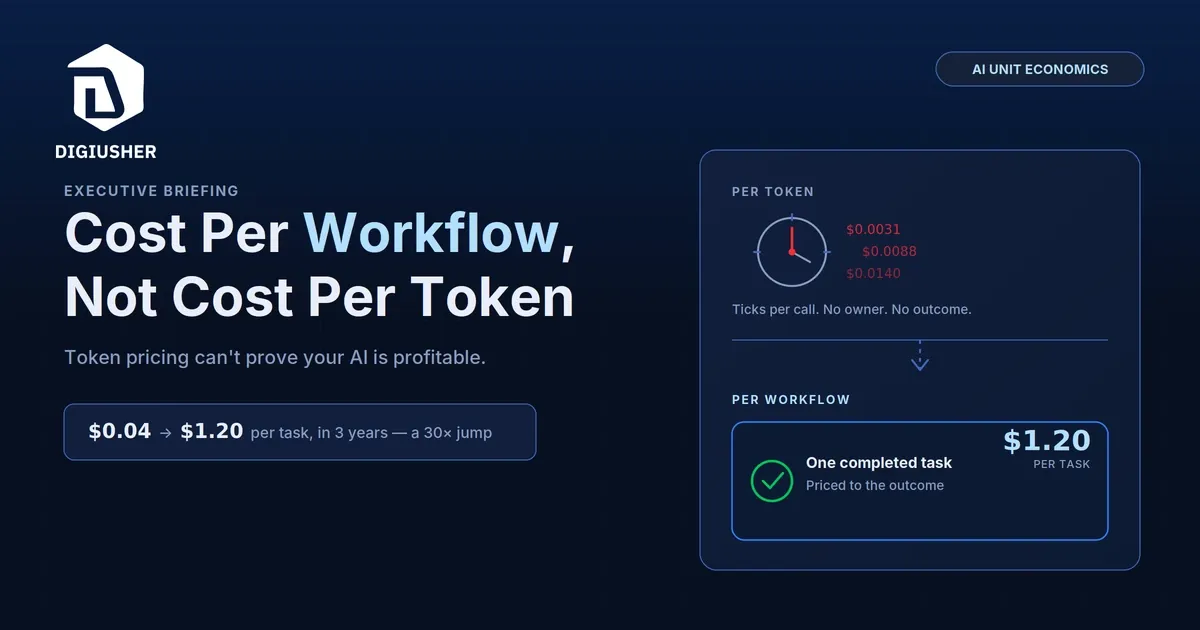
Cost Per Workflow: Why Token Pricing Can't Prove Your AI Is Profitable
AI workflows now cost 30x more per task than in 2023, and 73% of enterprises still can't explain why. Here's how to price a workflow, not a token.