DigiUsher: The FinOps Operating System for Multi-Cloud Cost Management
76% of enterprises now run workloads across two or more cloud providers. Multi-cloud should mean resilience and choice — but without a unified FinOps OS, it means fragmented billing, incompatible cost schemas, and governance gaps that compound into tens of millions in unattributed spend. This is DigiUsher: what it does, who it's built for, why FOCUS 1.x native architecture changes the game, and why 7 of 10 enterprise evaluation criteria favor a purpose-built FinOps OS over a single-cloud or single-category tool.
The Multi-Cloud Cost Problem No Single Native Tool Solves
76% of enterprises now operate workloads across two or more cloud providers. This is not a strategic choice for most — it is the accumulated reality of three years of digital transformation: different teams, different projects, different preferred platforms, different vendor relationships, all converging on a cloud estate that spans AWS, Azure, GCP, and increasingly Oracle OCI.
Multi-cloud was supposed to bring resilience and optionality. What it also brought — without unified governance — is a financial management problem that no single native tool was designed to solve.
The Multi-Cloud Governance Gap
──────────────────────────────────────────────────────────────
AWS says compute is "EC2"
Azure says compute is "Virtual Machines"
GCP says compute is "Compute Engine"

Same resource. Three names. Three schemas.
Three billing exports. Three attribution models.
Three separate governance tools with no unified view.

Now add AI: Azure OpenAI tokens + Bedrock requests +
Vertex AI compute hours + Databricks DBUs + direct
API calls. Six incompatible billing units. Zero
cross-provider normalization in any native tool.
──────────────────────────────────────────────────────────────
Result: FinOps teams doing ETL engineering, not
        financial governance. Finance receiving
        approximations, not attributions.
──────────────────────────────────────────────────────────────
The FinOps Foundation’s FOCUS (FinOps Open Cost and Usage Specification) was created specifically to solve this normalization problem. In 2026, FOCUS is no longer aspirational — it has real production support from the hyperscalers, a growing tool ecosystem, and a working group actively evolving the spec to meet real enterprise needs. The question is not whether FOCUS will become the de facto standard for cloud cost data. It already is. The question is how quickly your organization gets on board.
A FinOps platform without FOCUS-native architecture in 2026 is asking you to build the normalization layer yourself — which is ETL engineering, not FinOps.
Why a FinOps OS — Not a FinOps Tool
The FinOps tooling landscape has more than 115 products in 2026. They broadly fall into five categories:
| Category | What It Governs | What It Misses |
|---|---|---|
| Cloud cost reporters | AWS/Azure/GCP infrastructure billing | AI, Kubernetes depth, SaaS, marketplace |
| Kubernetes cost tools | Namespace/pod attribution | Cloud infrastructure, AI, commitment management |
| Commitment managers | RI/SP/CUD optimization | AI governance, Kubernetes, SaaS, multi-cloud attribution |
| AI cost monitors | Token consumption | Cloud infrastructure, Kubernetes, commitment strategy |
| Native cloud tools | Single-provider visibility | Everything outside their cloud boundary |
Each category solves one slice of the modern enterprise cost governance problem. And each slice grows independently — meaning five separate tools, five separate governance models, five separate data schemas that require manual normalization to produce any cross-domain insight.
“Dashboards are table stakes of yesterday — reactive. You have to move to proactive, real-time, automation. But you can’t automate what you can’t see.” — FinOps Foundation State of FinOps 2026 practitioner
A FinOps Operating System is a different architectural choice. Rather than governing one slice of the cost surface with specialist depth, it governs the full technology cost surface from a single FOCUS-normalized data model — enabling cross-domain attribution, unified governance enforcement, and business-outcome reporting that no combination of single-category tools can produce independently.
The FinOps Foundation’s 2026 State of FinOps confirms this trajectory: what was once a cloud-focused practice is now definitively multi-technology. 90% of respondents now manage SaaS or have plans to (up from 65%), alongside licensing (64%), private cloud (57%), and data center (48%). AI management has become nearly universal at 98%.
The enterprise that governs cloud with one tool, Kubernetes with another, AI with a third, SaaS with a fourth, and marketplace with a fifth is not running a FinOps program. It is running five separate cost reporting exercises with a coordination problem.
DigiUsher is the FinOps Operating System that unifies them.
DigiUsher: Eight Integrated Capabilities
Capability 1 — FOCUS 1.x Native Multi-Cloud Normalization
Every cloud. Every AI platform. One cost schema.
DigiUsher ingests billing data from:
- Cloud infrastructure — AWS, Azure, GCP, Oracle Cloud (OCI), Alibaba Cloud
- Kubernetes — EKS, AKS, GKE, OKE — namespace, pod, and service level
- Data platforms — Databricks (cluster, job, workflow), Snowflake ML
- AI platforms — Azure OpenAI, AWS Bedrock, Vertex AI, Hugging Face, Anthropic, Mistral
- Marketplace — AWS Channel Partner Private Offers, Azure MPO, GCP Channel Services
All of it normalized to FOCUS 1.x in a single attributed cost model. Not a compatibility layer applied after the fact. FOCUS-native architecture from the ground up.
If you have ever tried to compare cloud costs across AWS, Azure, and Google Cloud in a single spreadsheet, you already know the pain. Every provider speaks a different language. AWS gives you a CUR with hundreds of cryptically named columns. Azure exports a completely different CSV. GCP pipes data into BigQuery in yet another format. FOCUS was built to solve exactly this problem.
DigiUsher was built on this foundation — so your FinOps team governs from one attributed view rather than reconciling three incompatible billing exports.
Capability 2 — Real-Time Attribution Across Every Dimension
From invoice to insight. From cloud to team to outcome.
DigiUsher attributes cost at six levels of granularity simultaneously:
DigiUsher Attribution Depth
──────────────────────────────────────────────────────────────
Level                   Who Uses It
──────────────────────────────────────────────────────────────
Workload / Service      Engineering teams — daily optimization
Namespace / Cluster     Platform teams — Kubernetes governance
Team / Cost Center      FinOps teams — chargeback and showback
Product / Feature       Product teams — cost per capability
Business Unit           Finance teams — budget accountability
Business Outcome        CFO / Board — ROI per technology investment
──────────────────────────────────────────────────────────────
Showback and chargeback reports generate automatically from attribution data — without monthly manual engineering effort from FinOps teams. The attribution model translates between the technical layer (where resources live) and the financial layer (who owns the cost and what business value it generates).
Capability 3 — AI and GPU Cost Governance — Native, Not Bolted On
Token budgets. Kill-switches. Per-chain attribution. GPU idle detection.
AI management has become nearly universal at 98% of FinOps teams — up from just 31% two years ago. The enterprises that have not yet built AI cost governance infrastructure are governing an increasingly large fraction of their total cloud spend through approximation rather than attribution.
DigiUsher governs AI with six specific mechanisms:
Per-chain agentic attribution — token consumption tracked per workflow chain from initiation to completion, attributed to owning team and product. The granularity that surfaces per-agent economics.
Automated token budget caps — per-team and per-product limits with throttle and suspend actions before monthly thresholds are breached. Governance that acts before cost accumulates.
Agentic kill-switch infrastructure — automated termination when per-run consumption exceeds configured thresholds. The mechanism that prevents recursive reasoning loops from generating unbounded inference spend.
GPU idle detection — per-cluster GPU utilization monitoring with automated scale-down. Average enterprise GPU utilization is 20–35%; DigiUsher detects and terminates the 65–80% idle period.
Model routing intelligence — cost signals identifying where frontier model inference calls can be replaced by cheaper alternatives without quality loss. 30–50% API cost reduction for governed workloads.
AI unit economics — cost per inference, cost per resolved interaction, cost per AI feature tracked continuously as financial KPIs alongside cloud infrastructure metrics.
Capability 4 — Automated Financial Guardrails
Governance that prevents. Not dashboards that explain after.
DigiUsher’s governance operates across four lifecycle stages:
| Stage | Mechanism | What It Prevents |
|---|---|---|
| Pre-provisioning | Cost estimates in IDP workflows | Expensive architecture decisions made without cost signal |
| At-provisioning | Tagging enforcement via admission controls | Unattributed resources entering billing system |
| At-usage | Token budget caps, GPU idle detection | Runaway AI spend, idle GPU waste |
| At-invoice | Anomaly detection, threshold alerts | Monthly cost surprises discovered too late |
Cloud costs don’t optimize themselves. Platform engineers need tools integrated with existing workflows, not unused financial dashboards.
DigiUsher integrates with CI/CD pipelines, IaC repositories, Backstage developer portals, and GitOps workflows — surfacing cost context at the point of engineering decision, where it can influence architectural choices before resources are provisioned.
Capability 5 — Commitment Intelligence and ESR Management
ESR measured across AWS, Azure, and GCP. Coverage optimized. Lock-in managed.
DigiUsher tracks Effective Savings Rate (ESR) continuously in a unified cross-provider view — not assembled manually from three separate commitment dashboards:
- AWS Savings Plans and Reserved Instance coverage, utilization, and ESR
- Azure Reservations and Azure Hybrid Benefit tracking
- GCP Committed Use Discounts and sustained use discount attribution
Commitment gap analysis identifies where additional coverage would improve ESR. Over-commitment risk (Commitment Lock-in Risk / CLR) surfaces where committed capacity is being wasted. Projected ESR impact of proposed commitment changes displayed before purchase — enabling informed decisions at commitment time rather than guesswork validated in next quarter’s ESR report.
Industry benchmark for context: median AWS Compute ESR rose from 0% in 2023 to 15% in 2024, with 64% of organizations using RIs/SPs in 2024 (up from 45% in 2023). High-spend GCP organizations achieve 54.3% ESR with CUDs and private rates combined. DigiUsher’s commitment intelligence is designed to move clients from median toward world-class ESR through continuous, automated commitment management rather than quarterly manual reviews.
Capability 6 — Marketplace and SaaS Governance
Private offers attributed. Committed spend tracked. SaaS inside the cloud bill visible.
Enterprise committed spend on AWS, Azure, and GCP crossed $531B in 2025. Cloud marketplace procurement is now the primary enterprise software buying channel — SaaS, AI services, and partner-delivered solutions all entering the cloud bill alongside infrastructure.
DigiUsher governs this consolidated billing plane:
- Marketplace attribution — Channel Partner Private Offers, Multiparty Private Offers, GCP Channel Services normalized to FOCUS 1.x
- Committed spend tracking — credit rate awareness (AWS at 50%, GCP at 1:1, Azure by transaction) with real-time draw-down projection
- SaaS classification — marketplace SaaS separated from infrastructure spend within each cloud bill
- Private offer ROI — contracted terms validated against billing actuals
DigiUsher is an AWS ISV Accelerate Partner listed on AWS Marketplace — governing the same channel ecosystem it advises enterprises on. No theoretical capability; operational experience from inside the marketplace.
Capability 7 — BYOC for Regulated Industries
Your data stays in your cloud. Our governance stays with you.
DigiUsher enables BYOC deployment — full platform capability with billing data processed entirely within the enterprise’s own cloud environment.
One of the largest financial institutions — operates DigiUsher in this BYOC deployment model. This is not a theoretical architecture; it is a deployed reference for regulated enterprise FinOps at institutional scale.
For banking, insurance, healthcare, and government enterprises: the platforms that cannot offer BYOC are disqualified before capability evaluation begins. The regulatory question is binary. DigiUsher’s BYOC provides the binary answer.
Certifications: SOC 2® Type II · GDPR compliant · AWS ISV Accelerate · Azure ISV Co-Sell Ready · Google Cloud Partner
Capability 8 — Board-Ready ROI Reporting
From cloud bill to business value. In the language boards understand.
Mature FinOps practices are focusing on value capabilities: unit economics, AI value quantification, and influencing technology selection. The center of gravity is spreading as teams take responsibility for increasing technology value, not just reducing technology cost.
DigiUsher’s ROI layer produces:
- Cost per AI product — every AI infrastructure investment attributed to the product capability it enables
- Cost per customer interaction — cloud and AI economics translated to per-customer business metrics
- Cost per AI feature — gross margin impact analysis per AI capability at the product level
- Cloud efficiency ratio — value per cloud dollar across all technology investments
- ESR and AI unit economics dashboard — the combined performance score that connects infrastructure decisions to financial outcomes
The reporting layer that transforms FinOps from a cost-reduction function into a technology investment intelligence capability — answering the question boards are now asking: is our technology investment generating return proportionate to its cost?
Who DigiUsher Is Built For
Enterprise FinOps Teams
The Head of FinOps managing a multi-cloud estate across AWS, Azure, and GCP — alongside AI workloads on Bedrock and Azure OpenAI, Kubernetes clusters on EKS and AKS, and Databricks for data engineering — needs one governance platform, not five. DigiUsher provides the unified FOCUS-normalized view that makes cross-domain attribution, ESR measurement, and AI cost governance achievable without manual ETL.
Engineering and Platform Teams
Platform engineers who need cost visibility at the namespace, service, and workload level — integrated into Backstage, GitOps pipelines, and IDP workflows — not in a separate FinOps portal that engineering teams do not visit. If developers must leave their IDE for separate FinOps dashboards, they won’t. Cost information must surface within existing tools.
CFOs and CIOs
The CFO who needs to answer board questions about AI ROI and cloud investment return — not just cloud spend totals. The CIO who needs commitment strategy insight, technology value measurement, and governance confidence before the next AI infrastructure investment decision.
Regulated Industry Enterprises
Banking, insurance, healthcare, and government organizations that need BYOC deployment for data sovereignty. The enterprises for which SaaS-only FinOps platforms are disqualified before evaluation begins. A global private Bank is the reference.
MSPs and System Integrators
MSPs delivering FinOps as a managed service to clients at every scale — without VMware revenue thresholds, percentage-of-spend pricing that compresses margins, or multi-cloud coverage gaps that undermine client reporting accuracy. DigiUsher’s partner program is open, multi-tenant, and built for the economics of MSP service delivery.
The Evaluation Framework: Seven Questions That Separate FinOps Platforms
When evaluating FinOps platforms in 2026, seven criteria consistently separate the platforms that govern the 2026 technology cost surface from those built for the 2018 cloud estate:
| # | Criterion | Why It Matters | DigiUsher |
|---|---|---|---|
| 1 | FOCUS 1.x native? | The data foundation for cross-provider normalization | ✅ Native |
| 2 | AI workload governance? | 98% of FinOps teams manage AI spend | ✅ Native — tokens, GPU, agents |
| 3 | Multi-cloud depth? | 76% of enterprises run 2+ clouds | ✅ Equal depth across 6 providers |
| 4 | BYOC available? | Required for regulated industries | ✅ |
| 5 | Flat vs. % pricing? | Flat bounds cost as AI spend grows | ✅ Flat including Enterprise Unlimited |
| 6 | Automated enforcement? | Dashboards report; guardrails prevent | ✅ Pre-provisioning through invoice |
| 7 | SI partner delivery? | Large enterprise implementation at scale | ✅ Infosys, Wipro, Hexaware |
A vendor without a clear FOCUS strategy in 2026 is a yellow flag. Apply the same logic to AI governance, BYOC, and automated enforcement: a platform that cannot answer definitively on any of these criteria may be describing its roadmap rather than its production capability.
The DigiUsher Proof Points
A large global Bank — BYOC deployment for regulated enterprise FinOps. One of the largest financial institutions trusting DigiUsher for cloud financial governance at institutional scale.
European Utility firm — €1M saving identified and actioned within 45 days of deployment. Without architectural changes to the existing cloud estate. The fastest enterprise FinOps ROI timeline in the DigiUsher customer base.
Global SI Partners — delivered through Infosys, Wipro, CoForge, and Hexaware across enterprise clients in financial services, energy, retail, and technology sectors globally. Three of the world’s largest systems integrators validating DigiUsher’s enterprise delivery capability at scale.
20% additional savings above traditional cloud cost tool baselines — reported by DigiUsher customers. Platform pays for itself in under 90 days.
Frequently Asked Questions
What is DigiUsher and what makes it a FinOps Operating System?
DigiUsher is a FinOps Operating System — a unified financial governance platform governing cloud infrastructure, AI workloads, Kubernetes, Databricks, SaaS, and cloud marketplace transactions from a single FOCUS 1.x normalized cost model. It is architecturally distinct from single-category FinOps tools in three respects: full-surface scope (not one cost category), automated enforcement (not advisory dashboards), and board-ready ROI output (not cost reports). Eight integrated capabilities — FOCUS normalization, real-time attribution, AI governance, automated guardrails, commitment intelligence, marketplace governance, BYOC deployment, and ROI reporting — operate from a single data model rather than requiring separate tools for each domain.
Why does multi-cloud FinOps require FOCUS 1.x normalization?
Without FOCUS, multi-cloud FinOps teams face schema incompatibility (AWS, Azure, and GCP call the same resources different names with different billing models), attribution impossibility (cross-provider unit economics and business-outcome mapping are structurally impossible from incompatible native data), and vendor lock-in (proprietary schemas make platform switching expensive). FOCUS resolves all three — enabling cross-provider cost comparison, unified attribution, and vendor-neutral cost data that is portable across tools. A FinOps platform without FOCUS-native architecture in 2026 is asking enterprises to build the normalization layer themselves.
What makes DigiUsher better for regulated industries?
BYOC (Bring Your Own Cloud) deployment — billing data processed entirely within the enterprise’s own cloud or datacenter environment. For regulated industries, SaaS-only platforms are disqualified before capability evaluation begins. DigiUsher provides the binary answer the regulated-enterprise evaluation requires.
How does DigiUsher govern AI costs differently from infrastructure FinOps tools?
Six specific mechanisms: FOCUS-normalized AI billing (Azure OpenAI, Bedrock, Vertex AI, Databricks, direct APIs); per-chain agentic attribution; automated token budget caps with throttle/suspend actions; agentic kill-switch infrastructure for recursive loop cost prevention; GPU idle detection with automated scale-down; and model routing intelligence for 30–50% inference cost reduction on governed workloads.
What does DigiUsher cost?
Flat enterprise licensing, including Enterprise Unlimited BYOC — pricing that does not scale with cloud spend. Leading percentage-of-spend FinOps platforms charge ~3% of tracked cloud spend (published AWS Marketplace pricing), generating $180,000/year for a $500K/month cloud estate. DigiUsher’s flat model remains bounded regardless of AI-driven cloud spend growth, removing the structural misalignment between platform cost and the cost growth it governs.
Which providers and platforms does DigiUsher support?
AWS, Azure, GCP, Oracle OCI, Alibaba Cloud; Kubernetes (EKS, AKS, GKE, OKE); Databricks, Snowflake ML; Azure OpenAI, AWS Bedrock, Vertex AI, Hugging Face, direct AI API providers; Google Workspace, Salesforce, Anthropic Claude, Cursor and more. All normalized to FOCUS 1.x.
What results have DigiUsher customers achieved?
Leading Global Bank: regulated-industry BYOC deployment at institutional scale. Enterprise energy utility: €1M saving in 45 days. DigiUsher customers broadly: up to 20% additional savings above traditional tool baselines, platform ROI within 90 days. Delivered globally through Infosys, Wipro, and Hexaware.
References
- FinOps Foundation — State of FinOps 2026
- FinOps Foundation — FOCUS Specification v1.x
- Amnic — FOCUS FinOps Open Cost and Usage Specification: The Complete Guide for 2026
- Platform Engineering.org — 10 FinOps Tools Platform Engineers Should Evaluate for 2026
- ProsperOps — 2025 Rate Optimization Insights Report: AWS Compute
- ProsperOps — 2025 Rate Optimization Insights Report: Google Cloud
- Tech Insider — FinOps in 2026: How CFOs Are Finally Taming Runaway Cloud Costs
- AnalyticsWeek — The $400M Cloud Leak: FinOps Reckoning for Agentic AI 2026
- Holori — 20 Best FinOps and Cloud Cost Management Tools in 2026
- nOps — 25+ Stunning FinOps Statistics That Show the True State of Cloud Spending
- Intellectt — Cloud Cost Optimization in 2026: AI-Driven FinOps
- Flexera — 2026 State of the Cloud Report
- DEV Community — Cloud FinOps 2026: Cut Costs by 30% While Accelerating Innovation
- PartnerInsight — $531B Cloud Committed Spend: Three Numbers Shaping Cloud GTM in 2026
See What Your Cloud and AI Costs Are Really Telling You
DigiUsher’s FinOps OS provides the unified financial governance layer that multi-cloud, AI-era enterprises need — FOCUS-native cost normalization across every cloud and AI provider, automated enforcement that prevents cost before it compounds, and board-ready ROI reporting that connects technology investment to business outcomes.
DigiUsher in 15 min
Your regulated AI workloads deserve attribution that survives an audit.
DigiUsher maps every workload to an owner and a policy, so compliance reviews start from evidence rather than spreadsheets.
Book my 15-min discovery callNo hard pitch · specific to your stack
Continue Reading
More from the DigiUsher editorial team.
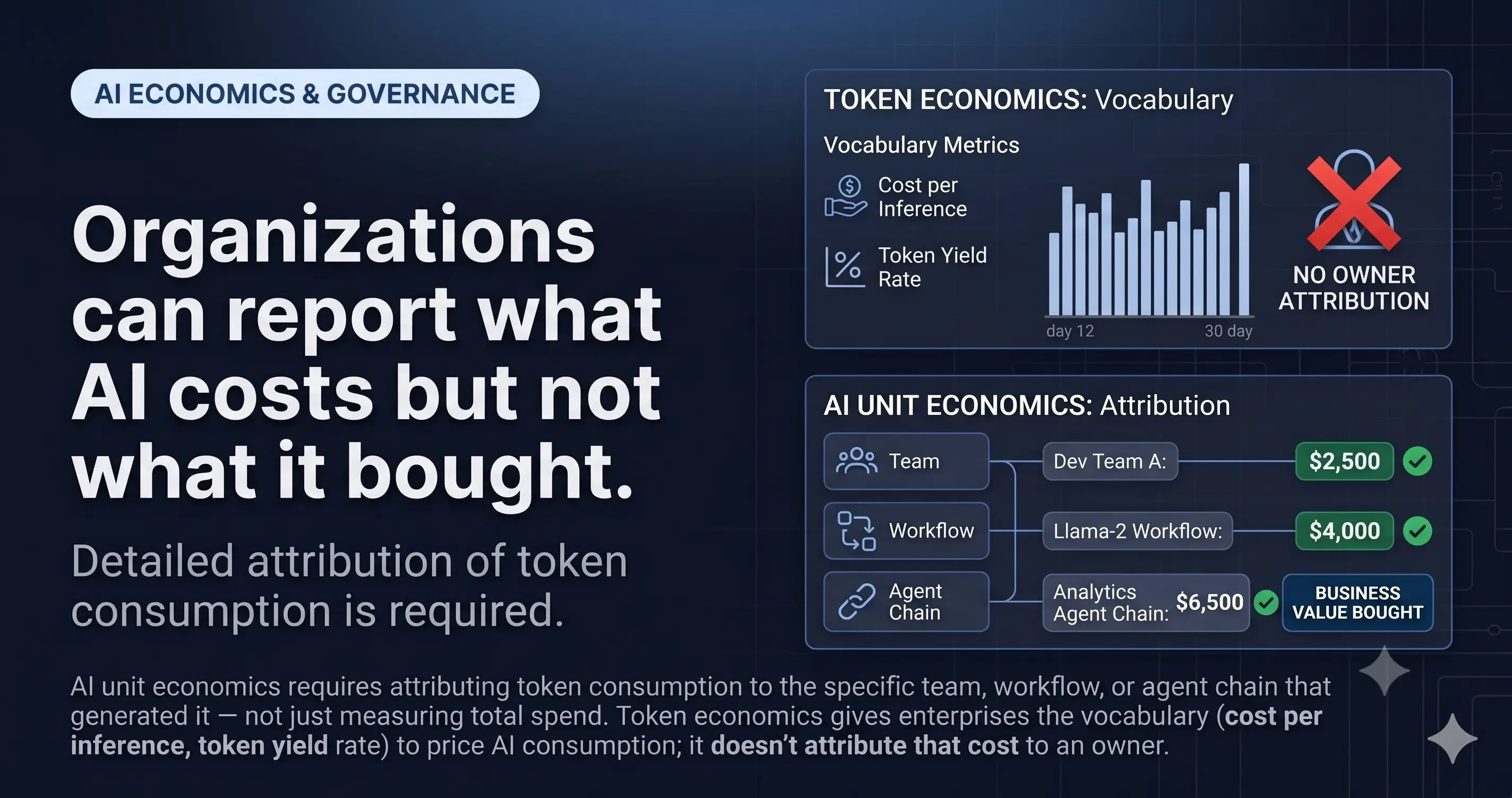
Token Economics Gave AI Spend a Vocabulary. It Still Has No Owner.
FinOps Foundation's token economics framework names the AI cost problem correctly. But naming a metric and attributing it to a team, workflow, or chain are two different disciplines — and most enterprises only have the first.

FinOps for AI: From Cloud Chaos to Business Clarity
Cloud was complex. AI made it explosive. Enterprise AI spend grew 5.8× in two years. A $400M collective leak in unbudgeted agentic AI spend hit Fortune 500 companies in Q1 2026 alone. 73% of FinOps teams report AI costs exceeded original projections. This is the definitive guide to what FinOps for AI actually requires — why legacy cost tools cannot govern it, what business clarity looks like when it is working, and how DigiUsher's FinOps OS turns AI cost chaos into measurable cloud ROI.
DigiUsher Is Now Microsoft Azure ISV Co-Sell Ready and Listed on the Microsoft Marketplace
DigiUsher has achieved Microsoft Azure ISV Co-Sell Ready status and is live on the unified Microsoft Marketplace — the platform that consolidated Azure Marketplace and AppSource in September 2025 and now hosts 6M+ monthly visitors. Microsoft sellers can co-sell DigiUsher to enterprise customers. Purchases are MACC-eligible, meaning they count 100% toward existing Azure Consumption Commitments. This is what Azure ISV Co-Sell Ready actually means, how MACC procurement works, and why this is the most commercially efficient way to purchase enterprise FinOps governance.