From FOCUS to FinOps OS: Turning Cost Standards into Autonomous Governance
But clarity alone does not create control.
Leadership Perspective
In the first two blogs of this series, we explored:
• Why FOCUS is becoming the common language of cloud and AI economics • How enterprises can implement FOCUS correctly at a technical level
But clarity alone does not create control.
Most organizations reach a point where cost data is normalized, visible, and standardized—yet cloud spend continues to drift, budgets are breached, and accountability remains unclear.
This is the moment when enterprises discover a critical truth:
Standards enable insight. Operating models enable outcomes.
This final blog examines how organizations move from FOCUS compliance to FinOps maturity by adopting a FinOps Operating System (FinOps OS)—and how DigiUsher is designed to power that transition.
Executive Summary
FOCUS provides a consistent cost and usage foundation, but it does not:
• Enforce budgets • Prevent runaway AI spend • Allocate accountability automatically • Govern marketplace or SaaS consumption • Trigger corrective actions in real time
To solve these challenges, enterprises need a FinOps OS—a system that embeds financial governance directly into cloud operations.
This article explains:
-
Why FOCUS ≠ FinOps maturity
-
What a FinOps OS actually is
-
The governance layers enterprises need beyond standards
-
How DigiUsher operationalizes FOCUS into autonomous control
Why FOCUS Alone Is Not Enough
FOCUS standardizes what cloud costs mean.
It does not decide:
-
Who owns the cost
-
When spend becomes unacceptable
-
What actions should be taken
-
How tradeoffs are evaluated
As the FinOps Foundation emphasizes, FinOps is a cultural and operational practice, not a data format.
Without operational enforcement, enterprises fall into a familiar pattern: • Clean data • Better dashboards • Same overspend
This is where most FinOps programs stall.
The Shift: From Cost Intelligence to Cost Control
Traditional FinOps tooling is built around visibility.
A FinOps OS is built around control.
| Traditional FinOps | FinOps OS |
|---|---|
| Post-spend analysis | Pre-spend and in-flight control |
| Reporting dashboards | Policy-driven automation |
| Manual optimization | Continuous enforcement |
| Reactive finance | Predictive governance |
This shift mirrors transformations already seen in: • Security (from logging to zero trust) • Reliability (from monitoring to SRE) • Compliance (from audits to continuous control)
Cloud economics is following the same path.
What Is a FinOps Operating System?
A FinOps OS is not a tool—it is a control plane.
It sits between: • Cloud providers • Engineering teams • Finance and procurement • Leadership and governance
Its purpose is to ensure that every unit of cloud spend is intentional, accountable, and aligned to business outcomes.
Core Layers of a FinOps OS
1. Standards-Based Cost Engine (FOCUS)
FOCUS acts as the foundation: • Unified cost semantics • Multi-cloud normalization • AI, SaaS, and marketplace readiness
Without this layer, governance cannot scale.
2. Policy & Guardrail Layer
This is where governance begins.
Examples: • Budget thresholds by team or product • AI cost caps by environment • Marketplace spend approvals • Mandatory tagging enforcement
Policies must be: • Machine-enforceable • Role-aware • Context-driven
3. Ownership & Accountability Layer
FinOps maturity requires clear economic ownership.
A FinOps OS: • Assigns owners automatically • Escalates anomalies in real time • Aligns cost responsibility to decision-makers
This eliminates the “someone else’s bill” problem.
4. Automation & Runtime Actions
True governance requires action.
Examples: • Rightsizing underutilized resources • Pausing non-production AI workloads • Blocking unapproved marketplace purchases • Alerting finance before budgets are breached
This is where cost control becomes continuous—not episodic.
5. Executive & Board Visibility
Leadership needs: • Predictable forecasts • ROI attribution • Risk exposure views • Confidence in financial controls
A FinOps OS transforms cloud cost data into financial governance artifacts suitable for board review.
Why AI and Marketplaces Demand a FinOps OS
AI, marketplaces, and SaaS break traditional cost controls because: • Usage is API-driven • Costs scale instantly • Commitments are opaque • Procurement is decentralized
Leading AI platforms like OpenAI, Anthropic, Mistral, Hugging Face, and Perplexity introduce consumption models that cannot be governed manually.
Only a FinOps OS can: • Apply real-time guardrails • Track unit economics • Balance innovation with fiscal discipline
The DigiUsher Approach: FOCUS-Native by Design
DigiUsher was built with a clear philosophy:
FOCUS is the cost engine. DigiUsher is the operating system.
Key characteristics: • Native FOCUS ingestion and normalization • Policy-driven governance at runtime • Automated ownership assignment • AI and marketplace spend control • CFO- and CIO-ready reporting
Rather than layering governance on top of reporting, DigiUsher embeds it directly into cloud operations.
Outcomes Enterprises Achieve
Organizations operating with a FinOps OS consistently report: • Reduced budget variance • Faster forecasting cycles • Improved AI cost discipline • Stronger finance-engineering alignment • Higher confidence at the board level
This is not optimization—it is financial control at cloud speed.
From Standardization to Strategic Advantage
FOCUS gives enterprises a common language.
A FinOps OS gives them leverage.
As cloud, AI, and marketplaces continue to reshape enterprise economics, governance must become: • Continuous • Automated • Embedded
Anything less is no longer sufficient.
References (Short)
• FinOps Foundation – FinOps Framework & FOCUS • Gartner – Cloud Financial Management maturity • McKinsey – Cloud & AI operating models • Deloitte – Financial governance in cloud environments
DigiUsher in 15 min
See what your cloud and AI costs are really telling you.
Book a walkthrough and see how DigiUsher ties spend to the teams, workloads, and outcomes behind it.
Book my 15-min discovery callNo hard pitch · tailored to your stack
Continue Reading
More from the DigiUsher editorial team.
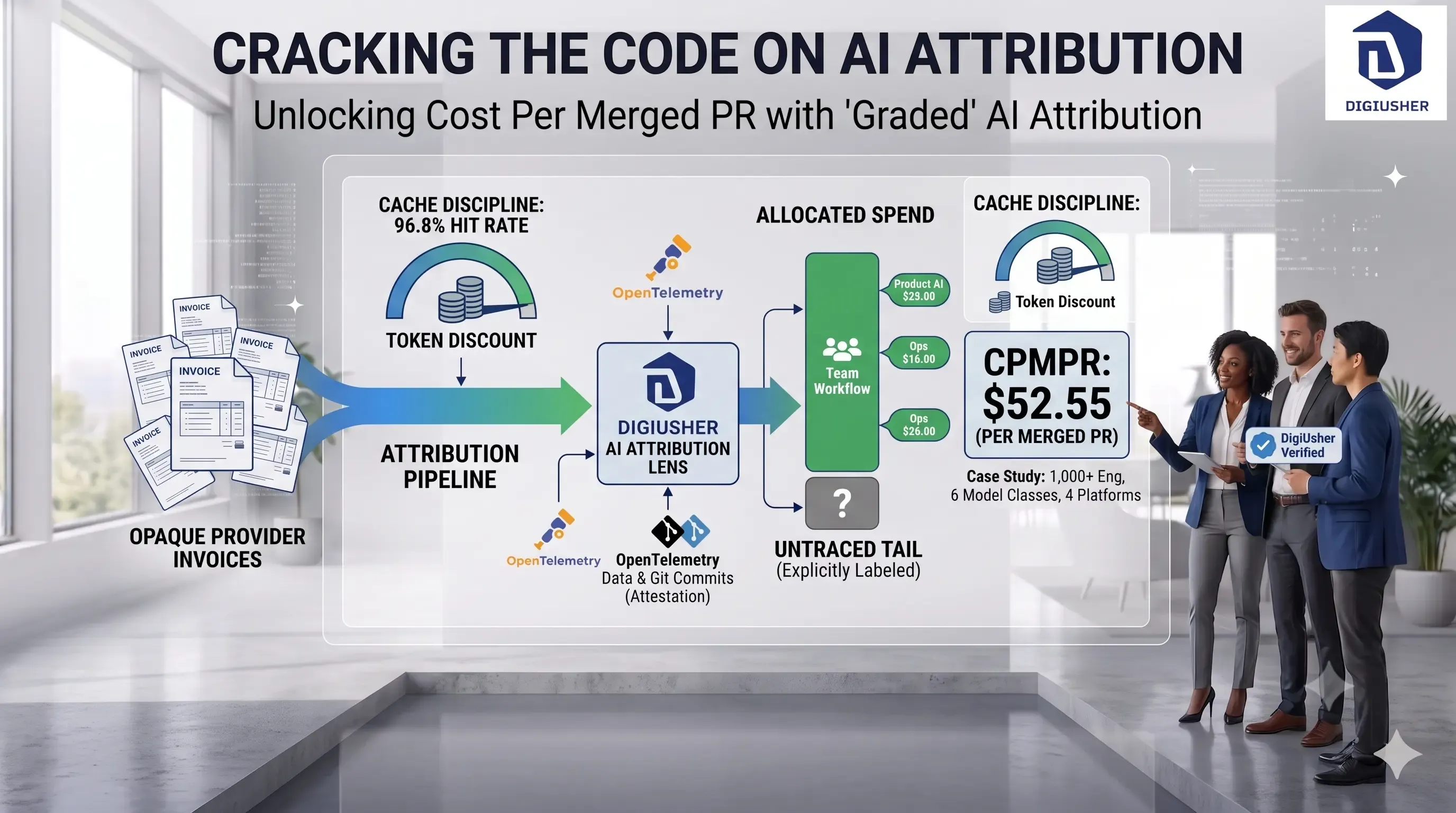
$52.55 Per Merged Pull Request: How One 1,000-Engineer Firm Priced Its Own AI Spend
A public technology firm with 1,000+ engineers refused to run its AI spend on faith. Here's the ledger it built instead — $52.55 per merged PR, 96.8% cache-hit rate, and a blended cost of $0.75 per million tokens.

AI Unit Economics: Why Your AI Invoice Can No Longer Answer the Board’s Question
98% of FinOps teams now manage AI spend, but almost none can price a merged pull request. Here's the framework for AI unit economics in 2026 — and why the invoice alone can't answer the board's question.
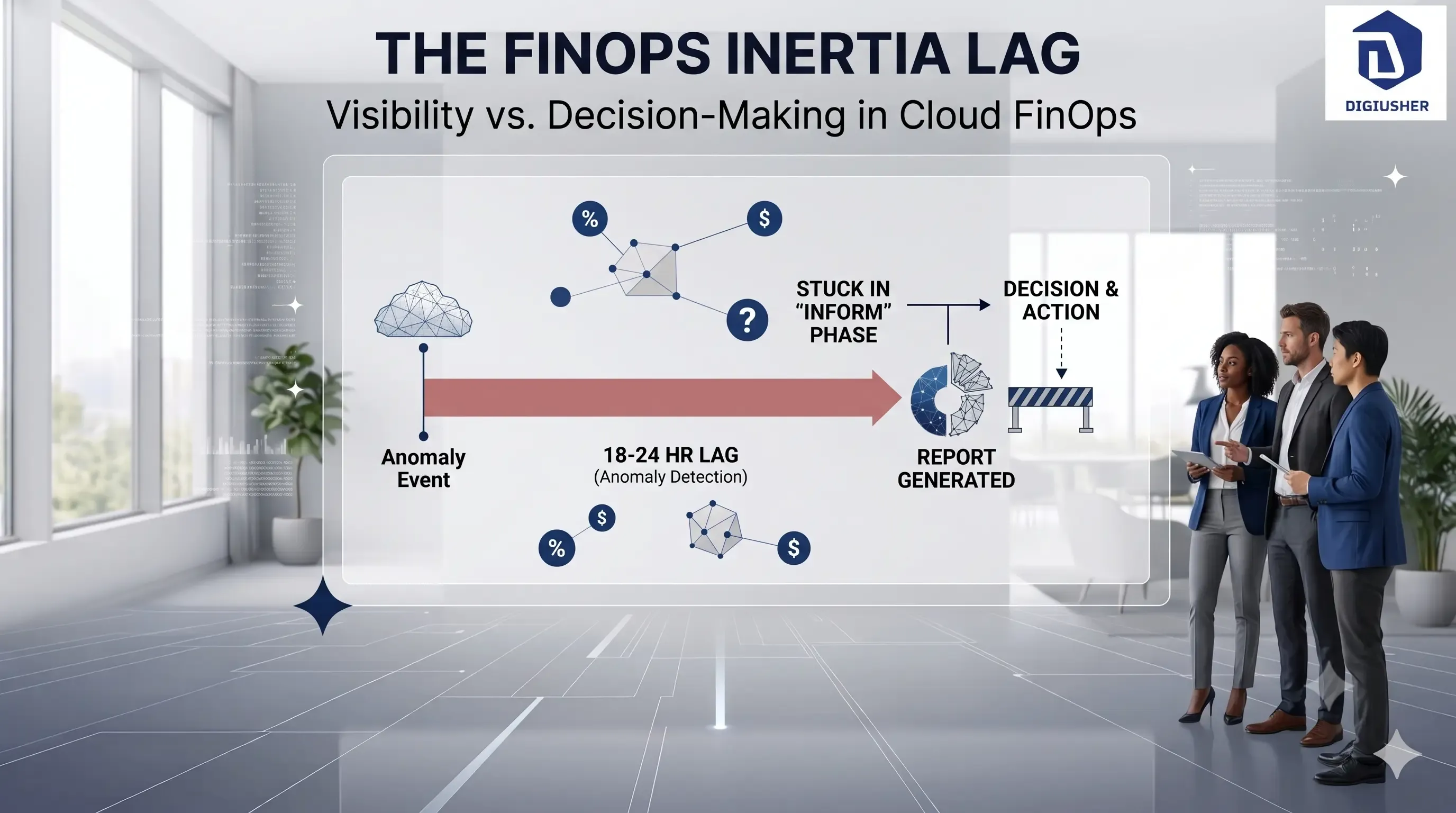
Most FinOps Programs Stall at "Inform" — and Never Reach Optimize
Visibility tools generate reports, not decisions. Legacy FinOps tools carry an 18-to-24-hour anomaly detection lag, according to the DigiUsher live TCO index — and that lag, not a lack of dashboards, is why most programs never leave the Inform phase.