How CFOs Can Govern Cloud ROI in 2026
Cloud spend now averages ~10% of revenue and 89% of CFOs say rising costs are eroding profitability. This evidence-backed framework shows how finance leaders can move from reactive reporting to proactive cloud ROI governance using DigiUsher's FinOps OS
Executive Summary
In 2026, cloud spend is no longer a technical bill line item — it has become a strategic financial variable that directly affects margins, forecasts, and investor confidence.
Research paints a stark picture of the current state:
- Cloud infrastructure now averages ~10% of revenue for technology businesses
- 89% of CFOs report that rising cloud costs have negatively impacted profitability
- 71% re-forecast cloud costs quarterly due to volatility — yet only 26% say forecasts closely align with actual spend
- AI workloads alone represent ~22% of cloud spend and are growing rapidly
Tracking spend is no longer enough. CFOs must govern cloud economics proactively — tying consumption to ROI, forecasting accuracy, budget adherence, and strategic investment decisions.
1. Cloud Costs Are a CFO-Level Financial Risk
Cloud infrastructure has become one of the largest operating costs after headcount for technology companies. This is no longer an IT problem — it is a finance problem.
The evidence is unambiguous:
89% of CFOs report that rising cloud costs have negatively impacted profitability, compelling finance teams to build formal governance models previously absent in most organizations. Cloud’s variable, usage-driven cost behavior means it can spike faster and more unpredictably than traditional capital expenditures — without the governance mechanisms that protect CFOs from those surprises.
Cloud economics is now a P&L and cash-flow management challenge requiring finance ownership similar to capital expenditure or FX risk.
The CFOs most exposed are those whose engineering teams can provision cloud resources — including expensive GPU instances and AI API calls — without finance visibility or approval gates.
2. Distinguishing Visibility from Financial Governance
Cloud cost visibility tools are widespread. Financial governance is not.
Native tools — AWS Cost Explorer, Azure Cost Management, GCP Billing reports — help with reporting and insight, but lack the mechanisms to enforce financial policy, budget constraints, or operational accountability across teams.
The gap is significant. According to PwC analysis:
| Governance Maturity | Cloud Waste | Forecast Accuracy |
|---|---|---|
| No formal governance | ~27% waste | Variance >±25% |
| Visibility tools only | ~18% waste | Variance ±15–20% |
| Embedded governance (FinOps OS) | <5% waste | Variance <±10% |
84% of enterprises report that managing cloud costs remains a central challenge — not merely a reporting problem. The conclusion is clear: CFOs need governance frameworks that embed financial control into execution systems, not retrospective dashboards that explain overspend after it has occurred.
3. CFO Priorities for Cloud ROI in 2026
Gartner’s CFO Priorities Survey for 2026 makes cloud governance a measurable financial target:
- 56% of CFOs list enterprise-wide cost optimization within their top five priorities
- 51% include improving forecast accuracy and quality as a core focus area
These priorities reflect a structural shift — from reactive cost reporting toward predictive governance, where CFOs ensure cloud expenditure tracks to strategic value rather than engineering convenience.
The CFOs leading this shift share a common characteristic: they treat cloud spend decisions the same way they treat capital allocation decisions — with ownership, accountability, and outcome measurement built in from the start.
4. The Economics of Modern Cloud and AI Spend
AI workloads are changing the calculus of cloud economics in ways that traditional finance models cannot absorb without deliberate adaptation.
Generative AI and machine learning are driving cloud spend growth that outpaces traditional application workloads. Some forecasts indicate a fourfold increase in GenAI-related bills over the next three years — driven not by more infrastructure, but by more intensive use of model inference APIs.
The CFO challenge with AI spend is structural:
- Token-based billing is non-linear — doubling usage can more than double cost
- Costs are distributed across multiple vendors (OpenAI, Anthropic, Azure OpenAI, Vertex AI) with incompatible billing formats
- Engineering teams can independently scale AI usage without triggering traditional budget approval workflows
- ROI is measured in business outcomes (NPS improvement, automation savings, revenue uplift) that are harder to attribute than compute hours
Finance leaders must balance short-term margin pressure with long-term competitive gains — a calculation that requires AI cost transparency before the invoice arrives, not after.
5. A Framework for CFO-Level Cloud ROI Governance
5.1 Establish Financial Ownership and Accountability
Define cloud cost ownership at the smallest meaningful unit of ROI — product team, business unit, or feature line. Tagging and cost attribution frameworks, enforced automatically, turn cloud consumption into budgetable financial assets rather than black-box charges.
Every cloud resource must have a named owner before it can be governed. Without this foundation, every other governance layer is built on sand.
5.2 Implement Predictive Budgeting and Real-Time Guardrails
Static annual budgets cannot govern continuous, variable consumption. CFOs must institute dynamic, data-driven guardrails that:
- Trigger automated actions when spend thresholds are approaching — not after they are breached
- Provide real-time spend forecasting updated as usage changes
- Connect cloud consumption directly to approved financial targets
As Deloitte notes, embedding governance into execution workflows — rather than relying on post-hoc cleanup — is essential for sustainable cloud economics.
5.3 Integrate Cloud Forecasts with Business Metrics
The most effective CFOs tie cloud forecasts directly to business outcomes:
| Business Metric | Cloud Cost Signal |
|---|---|
| Revenue growth forecast | Cloud cost per incremental revenue dollar |
| Customer acquisition | CAC per cloud unit consumed |
| AI feature development | Inference cost per feature per user |
| Operational efficiency | Automation savings vs. cloud cost of automation |
This integration elevates cloud cost from a bookkeeping exercise to a strategic planning KPI — one that belongs in board reporting alongside revenue, headcount, and capital deployment.
5.4 Automate Continuous Rightsizing and Resource Governance
Automated rightsizing, idle resource shutdown, and tiered procurement models are the operational backbone of CFO-level governance. Without automation, financial plans continually drift from reality as engineering teams provision and forget resources across multi-cloud environments.
McKinsey confirms that continuous optimization consistently outperforms periodic reviews in volatile cloud environments — reducing waste not through quarterly cleanup exercises but through ongoing enforcement of resource hygiene standards.
6. The Real Cost of Ungoverned Cloud: What the Numbers Say
FinOps Foundation data indicates that average enterprises suffer cloud waste of around 30% when governance is absent. Structured FinOps and financial governance frameworks consistently close this gap.
Organizations with mature cloud governance report:
- Reduced budget variance — fewer end-of-quarter surprises that compress reported margins
- Clear AI ROI attribution — spend linked to business outcomes, not just infrastructure consumption
- Improved forecasting accuracy — within ±10% variance targets that CFOs can defend to boards
- Strategic reinvestment capacity — optimization savings redirected to growth initiatives
Deloitte Cloud Economics Study: Organizations with automated enforcement of cloud cost policies are 4× more likely to meet budget targets.
The financial case for governance is not about cutting cloud spend — it is about ensuring every pound and dollar of cloud investment is traceable, attributable, and delivering measurable return.
7. How DigiUsher’s FinOps OS Helps CFOs Govern Cloud ROI
DigiUsher’s FinOps Operating System provides the control plane CFOs need to move from visibility to governance:
| Capability | What It Delivers for CFOs |
|---|---|
| Automated Cost Attribution | Tagging enforcement for accurate P&L reporting across every cloud account |
| Dynamic Budget Guardrails | Policy engine that stops overspend before it impacts the P&L |
| Predictive Forecasting | Anomaly detection and spend forecasting tied to financial outcomes |
| AI and Marketplace Integration | Full capture of token billing and Marketplace charges in one model |
| Executive Dashboards | Board-ready ROI metrics in the language of finance, not infrastructure |
DigiUsher is built on a FOCUS 1.4 native engine, meaning cost data from AWS, Azure, GCP, Snowflake, Databricks, Kubernetes, and AI platforms is normalized into a single, interoperable financial model — eliminating the fragmented provider-specific views that prevent accurate forecasting.
Deployed as SaaS or BYOC (Bring Your Own Cloud) for organizations with data sovereignty requirements, and delivered globally through SI partners including Infosys, Wipro, and Hexaware.
8. Actionable Recommendations for CFOs
| Priority | Action | Outcome |
|---|---|---|
| Tag and Attribute | Enforce cost ownership with enterprise tagging standards | Every charge has a P&L owner |
| Govern at Runtime | Replace reactive reporting with automated guardrails | Overspend stopped before it hits margins |
| Forecast Holistically | Combine cloud spend with business KPIs | Forecasts the board can trust |
| Rightsize Continuously | Enable policy-driven compute optimization | Sustained waste reduction without manual reviews |
| Govern AI and Marketplace | Normalize all consumption charges into one financial model | No more invisible AI or SaaS spend |
Frequently Asked Questions
Why is cloud spend now a CFO-level financial risk rather than an IT cost?
Cloud infrastructure has become one of the largest operating costs after headcount for technology companies, averaging ~10% of revenue. 89% of CFOs report that rising cloud costs have negatively impacted profitability. The variable, usage-driven nature of cloud billing means costs can spike faster than traditional capital expenditures — without the governance mechanisms that protect CFOs from those surprises. This makes cloud a P&L and cash-flow management challenge requiring formal finance ownership, not just IT reporting.
What is the difference between cloud cost visibility and cloud cost governance?
Visibility tools — AWS Cost Explorer, Azure Cost Management, GCP Billing reports — report on what has already been spent. Governance frameworks embed financial policy, budget constraints, and operational accountability into the systems that execute cloud workloads. Visibility informs; governance enforces. The 27% average cloud waste figure from PwC exists precisely because most organizations have deployed visibility tools without governance frameworks.
How should CFOs forecast cloud costs more accurately in 2026?
Accurate cloud forecasting requires three things: normalized cost data across all cloud providers using a standard like FOCUS, dynamic models that update in real time as consumption changes, and integration with business metrics so forecasts reflect product roadmap decisions rather than historical trends alone. PwC notes that finance teams achieving less than ±10% forecast variance use robust governance models with real-time data feeds — not quarterly reconciliation exercises.
How do AI workloads change cloud ROI governance for CFOs?
Generative AI introduces non-linear, token-based billing where costs can grow fourfold with modest increases in usage volume. Unlike traditional compute — which scales predictably — AI inference costs depend on model selection, prompt length, and request frequency in ways standard cloud budgeting tools cannot model. CFOs need AI-specific governance that tracks token consumption per team, maps inference costs to business outcomes, and enforces spend caps at the service level.
What outcomes can CFOs expect from implementing a FinOps governance framework?
FinOps Foundation data indicates average enterprises waste ~30% of cloud spend without governance. Structured FinOps programs deliver: reduced budget variance through automated enforcement, improved forecast accuracy through real-time cost intelligence, and strategic reinvestment capacity by redirecting optimization savings. Deloitte notes organizations with embedded cloud governance are 4× more likely to meet budget targets and report cloud as a controlled financial variable to investors.
How does DigiUsher’s FinOps OS differ from native cloud cost tools?
Native cloud cost tools report on spend within their own environment. DigiUsher’s FinOps OS operates across all clouds simultaneously, normalizes cost data to the FOCUS standard, enforces tagging policy, triggers automated budget actions, and maps costs to business-level metrics — cost per customer, cost per inference, cloud cost per revenue dollar. Where native tools inform, DigiUsher governs.
References
- PR Newswire — CFOs Take Ownership as Cloud Becomes a Financial Risk Factor
- CFOtech UK — CFOs Tighten Grip as Rising Cloud Costs Hit Tech Margins
- Gartner — Top Priorities for CFOs in 2026 Include Cost Optimization
- PwC — Cloud Cost Optimization and FinOps
- CFO Dive — Generative AI Cloud Spend
- FinOps Foundation — FOCUS Specification
- Deloitte — Cloud Economics and Governance Practices
DigiUsher in 15 min
Give your board a cost-to-outcome view they can actually act on.
DigiUsher connects cloud and AI spend to the outcomes it funds, in language finance already speaks.
Book my 15-min discovery callNo hard pitch · specific to your stack
Continue Reading
More from the DigiUsher editorial team.
The New CIO Mandate: Governing Cloud and AI ROI Like Capital Assets
CIOs must now govern cloud and AI spend with the same rigour as CapEx. Learn the capital asset governance framework, hyperscaler trends, and how DigiUsher's FinOps OS operationalizes ROI discipline across AWS, Azure, GCP, and AI workloads.
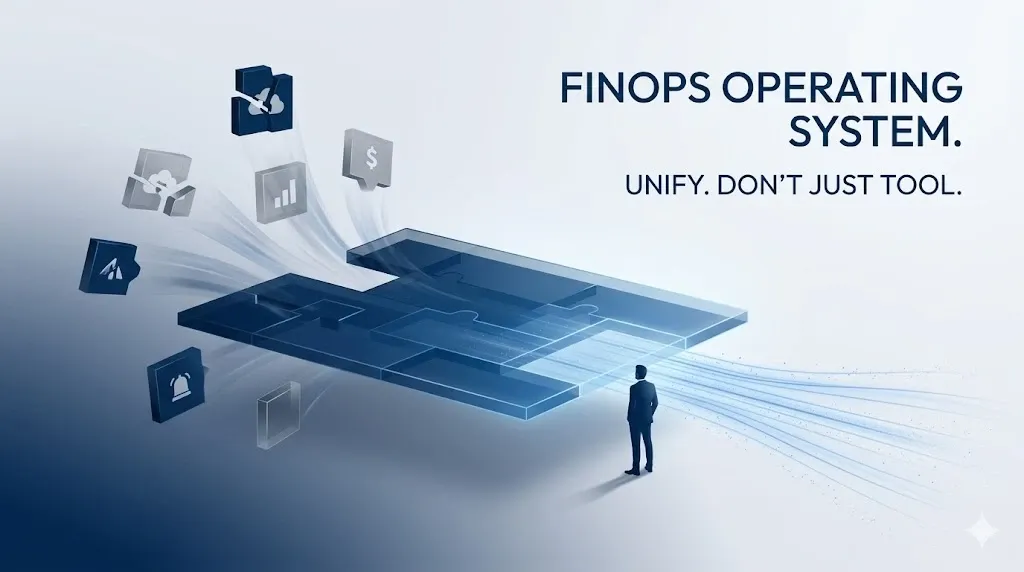
Why You Need a FinOps Operating System — Not Just Tools
Traditional FinOps tools deliver visibility. A FinOps Operating System delivers governance. Learn why the category shift from cost dashboards to a FinOps OS is the defining enterprise cloud decision of 2026 — and how DigiUsher built the control layer that CIOs, CFOs, and FinOps teams actually need.
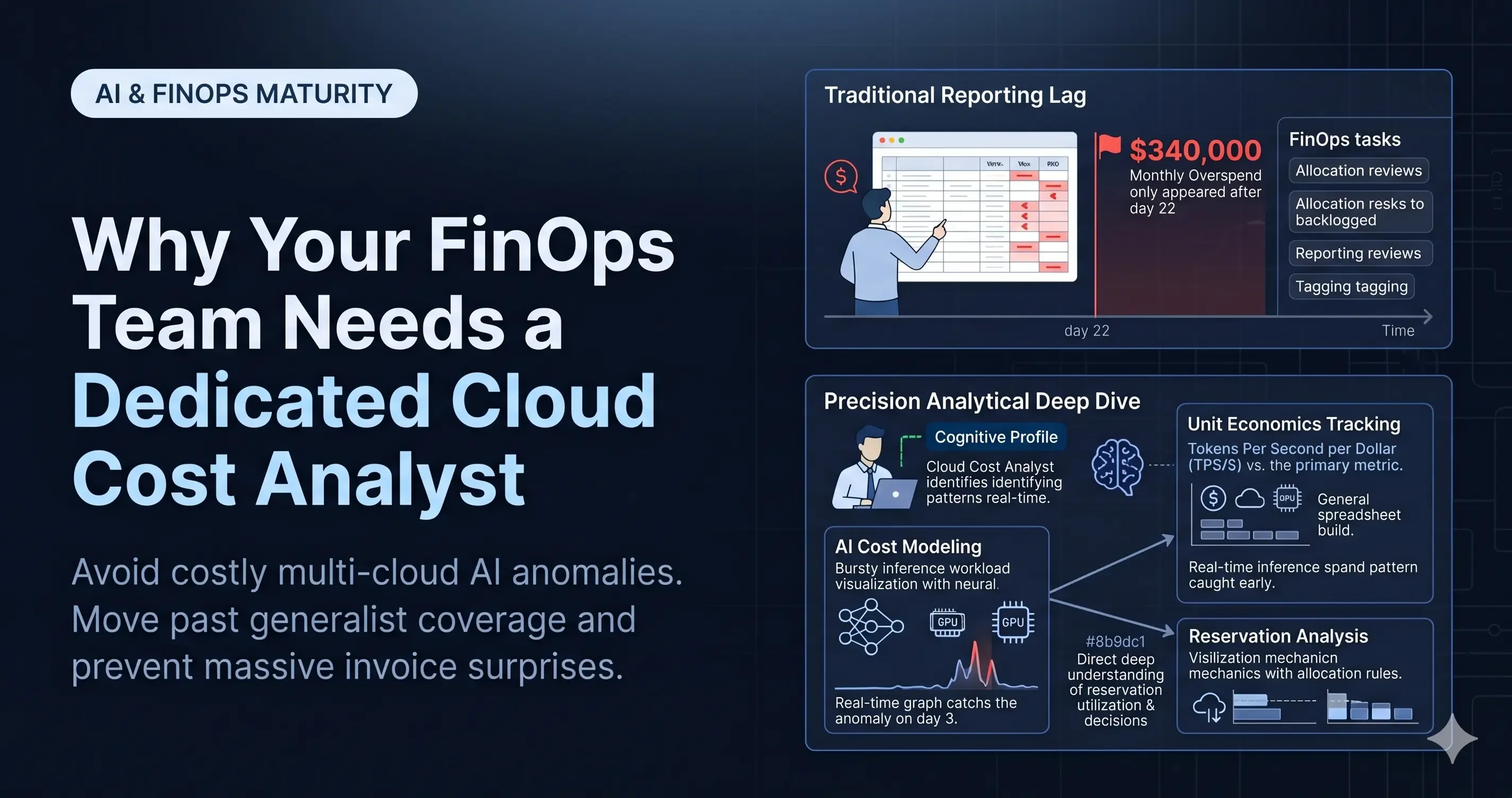
Why Your FinOps Team Needs a Dedicated Cloud Cost Analyst in 2026
Explores the emerging role of specialized cloud cost analysts and how they differ from traditional financial analysts in driving FinOps success