Why DigiUsher Rebuilt Its Cost Engine on FOCUS — and Why That Decision Is Now an Enterprise Advantage (Blog 3/5 Series)
In 2023, DigiUsher bet its platform architecture on FOCUS before hyperscalers committed to it. Here is why that decision was made, what it cost, and what it delivers.
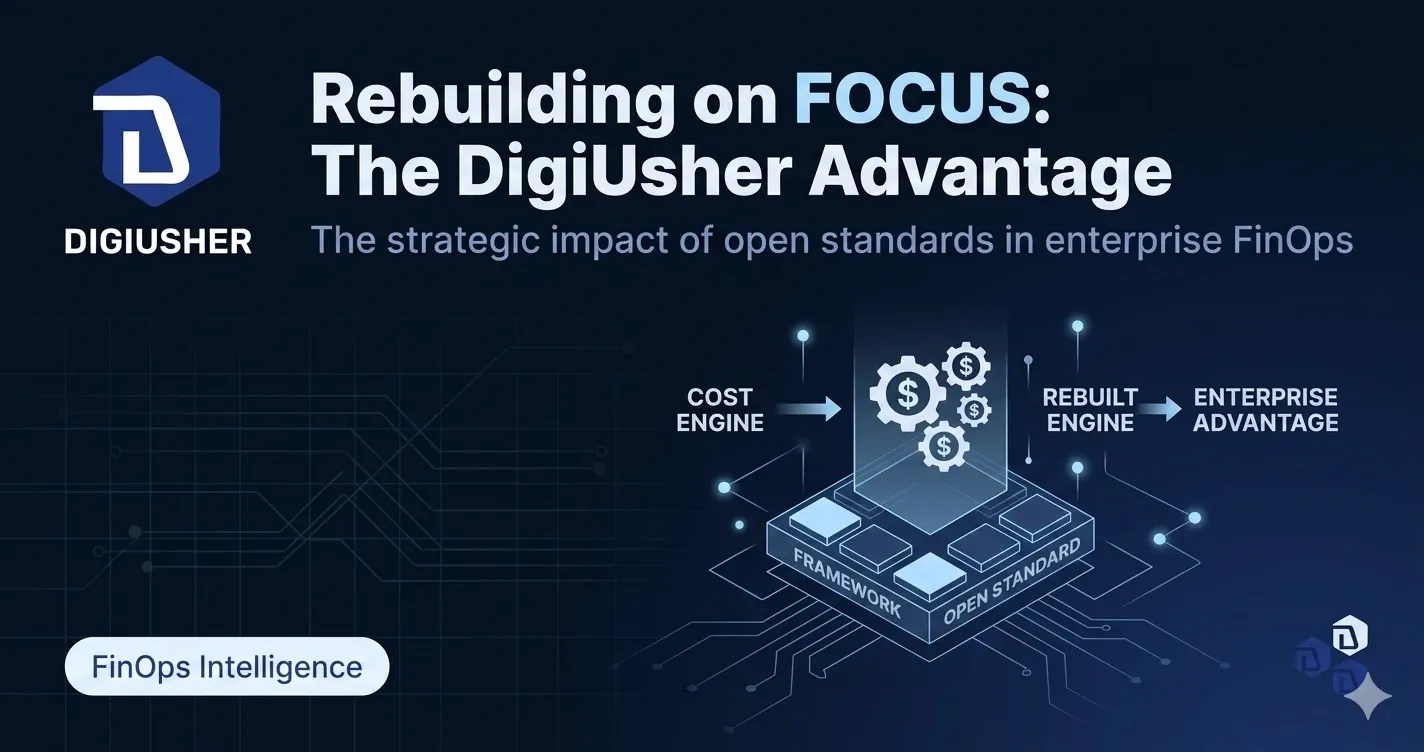
Before any FinOps practitioner in 2023 could write a single allocation query, they faced a prerequisite training burden that most organisations quietly absorbed as a cost of doing cloud. AWS had its own vocabulary for billing: lineItem/UsageType, lineItem/Operation, product/instanceType, cost columns that numbered in the dozens and required months of familiarity before they yielded reliable analytical results. Azure had an entirely different vocabulary. GCP had a third. Then came the FinOps Foundation’s framework concepts — separate from any cloud provider’s terminology. Then the FinOps platform vendor’s proprietary schema — another vocabulary, another training investment. By the time a practitioner was functional across a three-cloud estate, they had effectively become fluent in four or five incompatible languages, each of which needed to be relearned whenever a provider restructured their billing format.
The FinOps Foundation now offers six separate certification tracks for practitioners. To reach Professional-level certification, practitioners must first hold a FOCP, then a FOCUS Analyst certification, then complete 40 to 50 hours of professional coursework. All of this is separate from the cloud provider-specific billing courses, separate from the FinOps platform vendor’s training library, and separate from the Kubernetes and AI-specific modules that govern the new cost categories appearing on most FinOps teams’ scope. The community these certifications serve has grown to over 100,000 practitioners — each of them carrying this compounding training burden as table stakes for doing their jobs.
We built DigiUsher to make that burden structurally unnecessary. Every architectural decision we made was shaped by a single conviction: customers should only ever need to learn one language to govern their full technology estate. That language is FOCUS.
Executive Summary
- DigiUsher made the architectural commitment to build FOCUS-native from the ground up — before any major hyperscaler had committed to native FOCUS exports — accepting slower initial delivery in exchange for an architecture that would not require future migration
- The core observation driving the decision: customers were losing significant time and money learning parallel, incompatible billing vocabularies — one per cloud provider, one per FinOps platform, one per FinOps Foundation certification track — all of which became partially obsolete each time a provider updated their billing format
- DigiUsher normalises all cloud providers in the estate regardless of which FOCUS version each supports — handling multi-version reconciliation internally so practitioners query a single consistent schema
- DigiUsher extended FOCUS semantics to technology categories without official specification support — including Kubernetes namespaces, Snowflake, Google Workspace, Slack, GitHub, and Google BigQuery — so practitioners govern the full estate from one query surface
- AWS FOCUS 1.2 went generally available at re:Invent 2025; Azure, GCP, OCI, and Alibaba Cloud all implemented native FOCUS exports; 93 of the Fortune 100 now participate in FinOps Foundation programmes — the market moved to where the architecture already was
- The advantage compounds with every new FOCUS release: data centre, private cloud, sustainability, and labour cost integration are on the specification roadmap, each of which DigiUsher absorbs without schema migration
The Fork in the Road: What the Decision Actually Cost
The architectural choice available to every FinOps platform builder was not subtle. The faster path was clear and well-travelled: build an internal proprietary schema optimised for performance and developer velocity, ingest AWS, Azure, and GCP billing data into it using custom ETL pipelines, surface familiar cost views quickly, and either ignore FOCUS entirely or add a FOCUS export layer later when the specification matured and customers started asking for it. Every significant FinOps platform in the market at that point had taken a version of this path. The proprietary schema approach got products to market faster. It generated demos that looked compelling immediately. It required no dependency on an external working group’s release cadence.
The FOCUS-native path was slower, harder, and carried genuine uncertainty. In 2023, FOCUS was a working draft maintained by the FinOps Foundation. No major hyperscaler had committed to implementing it natively. The specification had not yet reached a stable 1.0 release. Building a production platform on a working-draft specification meant accepting that the schema could change between releases, that the practitioner community’s familiarity with FOCUS was limited, and that early customers would be using a platform whose data model was defined by something that did not yet have the hyperscaler buy-in that would eventually make it inevitable.
We chose the FOCUS-native path. We accepted the slower initial delivery. We committed to a data model that was defined by the open specification rather than our own engineering preferences.
The reasoning was not a prediction about FOCUS’s success. It was a structural observation about the alternative’s failure mode. Every platform built on a proprietary schema would eventually face the same decision we were deferring: when FOCUS became the industry standard — and we believed it would, because the problem it solves is real and the FinOps Foundation had the right parties in the room — those platforms would need to migrate their data models, rebuild their allocation hierarchies, and retrain their customers on new terminology. The longer they waited, the more expensive that migration would become. Building FOCUS-native in 2023 cost us initial delivery speed. It purchased us the right to never do that migration at all.
The Conviction: One Language for Every Practitioner
The training burden we observed was not a skills gap problem. It was a schema problem masquerading as a skills gap problem.
When a practitioner needed to understand why their AWS compute costs had increased, they queried lineItem/UsageType and cross-referenced reservation/EffectiveCost against lineItem/UnblendedCost. When the same question needed to be answered for Azure, they queried MeterCategory and reconciled CostInBillingCurrencyAmortised against CostInBillingCurrency. When the organisation added a third cloud, the practitioner learned a third billing vocabulary. When the FinOps team’s scope expanded to include Databricks and Snowflake, the vocabulary expanded again. Each new provider added hours of platform-specific training that produced knowledge with no transfer value to any other provider in the estate.
The FinOps Foundation was beginning to articulate FOCUS precisely as the answer to this. FOCUS defines EffectiveCost once, for all providers. It defines ServiceCategory once. It defines ChargeType, BillingAccountType, CommitmentDiscountStatus, and ResourceName once — with semantics that carry consistently across every provider that implements the specification. A practitioner who learns FOCUS column semantics has learned the analytical vocabulary for AWS, Azure, GCP, OCI, Alibaba Cloud, Databricks, and every future provider that implements the specification. The per-provider retraining cycle ends.
Our conviction was specific: if we built DigiUsher’s data model on FOCUS from the ground up, our customers would only ever need to learn one language. Not one language per cloud, not one language for cloud and a different one for SaaS, not one language for the platform and another for the specification. One language. The FOCUS language. Practitioners trained on DigiUsher would be, simultaneously, practitioners trained on FOCUS — and their knowledge would be portable across any other FOCUS-native tool or platform they encountered. Also, all stakeholders—from FinOps practitioners and executive leadership to finance, procurement, and engineering—speak a single language: the language of FOCUS.
This was not a feature. It was an architectural commitment with compound returns. Every hour a practitioner does not spend relearning per-provider billing vocabulary is an hour available for optimisation, governance, and the business-value attribution work that FinOps exists to do.
The Engineering Reality: Normalising a Multi-Version World
Committing to FOCUS-native architecture immediately created a problem that no specification document prepared us for: the real world does not update uniformly.
By the time enterprise customers began running DigiUsher across their full technology estates, the FOCUS ecosystem looked exactly as a phased-adoption ecosystem looks in practice. AWS was on FOCUS 1.2, announced as generally available at re:Invent 2025. Azure was on FOCUS 1.1. A customer’s Oracle Cloud implementation was still on FOCUS 1.0. Their Alibaba Cloud deployment, added to the estate after a merger, had begun FOCUS 1.2 implementation but had not yet completed full column coverage. Four providers, three FOCUS versions, varying conformance levels across the 77-column specification.
A FOCUS-compatible platform — one that stores data in its own proprietary schema and derives FOCUS-labelled fields on output — sidesteps this problem by absorbing every provider’s data into its own format and applying FOCUS labels at the analytics layer. The problem it creates is that the FOCUS labels become approximations: each provider’s billing data has been translated into a proprietary intermediate format, and the FOCUS column values are derived from that translation rather than from the provider’s own FOCUS export.
A FOCUS-native platform faces the problem directly: it must ingest data from providers at different specification versions and deliver a consistent query surface to practitioners who should not need to know which version any given provider supports.
We solved this through an internal multi-version normalisation layer that handles version reconciliation at ingestion time. Where a provider’s FOCUS export omits columns introduced in later versions — because they are on FOCUS 1.0 and the column was added in 1.2 — DigiUsher applies specification-defined default values and flags the absence in the dataset metadata. Where a provider’s FOCUS conformance includes a column but does not populate it for all charge types, DigiUsher normalises the behaviour across providers so the query surface reflects consistent semantics.
The practitioner querying EffectiveCost across a five-cloud estate receives a consistent result from one query. They do not need to know that two of those clouds are on FOCUS 1.2, one on FOCUS 1.1, and one on FOCUS 1.0. They do not manage version incompatibilities in their SQL. They write FOCUS queries. DigiUsher handles the rest.
Multi-Version FOCUS Normalisation in Practice
──────────────────────────────────────────────────────────────────────────────
Provider          FOCUS Version     DigiUsher Handling
──────────────────────────────────────────────────────────────────────────────
AWS               1.2 (GA)          Full column set — native ingestion
Azure             1.1               1.2 columns backfilled per spec defaults
                                    where not populated; flagged in metadata
GCP               1.1 (partial)     Conformance gaps documented; derived
                                    columns normalised to spec semantics
OCI               1.0               1.1 + 1.2 columns backfilled per spec
                                    defaults; full EffectiveCost normalisation
Alibaba Cloud     1.2 (in-progress) Available columns ingested natively;
                                    incomplete columns flagged in metadata
──────────────────────────────────────────────────────────────────────────────
Practitioner experience: Single FOCUS query across all five providers.
Version differences handled at ingestion — not in analyst SQL.
──────────────────────────────────────────────────────────────────────────────
Extending FOCUS Beyond the Specification’s Reach
The FOCUS specification ratifies coverage for technology categories when the working group has produced a complete, validated data model and major providers have committed to implementation. This process takes time — deliberately. The result is a specification that is precise, well-validated, and broadly adopted wherever it applies.
The reality of enterprise technology estates is that FinOps teams must govern categories the specification has not yet reached. In 2026, 90% of FinOps teams govern SaaS alongside cloud. Snowflake does not yet produce a native FOCUS export. Neither does Google Workspace, Slack, GitHub, or Google BigQuery query-level attribution. Kubernetes namespace-level cost allocation is not covered by cloud provider FOCUS exports, which operate at infrastructure resource level rather than at the workload orchestration layer above it.
An enterprise committed to FOCUS-First FinOps faces a choice at each of these boundaries: wait for the specification to catch up, maintain a parallel non-FOCUS system for uncovered categories, or extend FOCUS semantics to those categories directly. We chose to extend.
DigiUsher’s extension approach applies FOCUS column vocabulary and semantics to technology categories that do not yet have official provider FOCUS support. The extension does not modify the official FOCUS specification. It maps each category’s available billing data into FOCUS column structures — ServiceCategory, ServiceName, ResourceID, ResourceName, ChargeType, EffectiveCost, BilledCost — using the specification’s semantic definitions as the mapping target.
The SaaS and platform categories DigiUsher currently governs through FOCUS-extended schema include Databricks (now with official FOCUS 1.2 support, though DigiUsher’s coverage predated the official release), Snowflake credit consumption and warehouse sizing, Kubernetes namespace and workload-level attribution across EKS, AKS, GKE, and OKE, Google Workspace seat-level billing by organisational unit, Slack enterprise plan costs allocated to teams and business units, GitHub Actions minutes and Copilot seat licensing by team, and Google BigQuery query-level attribution by project and user.
For a practitioner using DigiUsher, querying Snowflake credits alongside AWS compute alongside GitHub Actions costs requires the same FOCUS SQL syntax as querying any other combination of providers. There is no separate interface for “extended” categories. The query surface is unified because the schema is unified.
Four Scenarios That Show What This Unlocks
Abstract architectural commitments are most clearly evaluated through concrete situations. These four scenarios are realistic — they describe problems that enterprise FinOps teams navigate daily — and each one shows a capability that depends directly on the FOCUS-native and FOCUS-extended architecture described above.
Scenario One: The Full Product Cost Stack
A platform engineering team at a global financial services company needs to report the total technology cost of running their customer onboarding product. The product runs AWS ECS tasks for the application layer, BigQuery jobs for the analytics pipeline, GitHub Actions for the CI/CD process, and Slack for the internal notification layer. Their FinOps platform does not support GitHub Actions or Slack billing. BigQuery costs appear in a separate dashboard. The engineer exports four separate billing files, normalises them manually, writes a Python script to aggregate them, and produces a report that is three days stale by the time the product manager sees it.
With DigiUsher’s FOCUS-extended schema, all four cost sources carry ServiceCategory, ResourceName, and Tags in FOCUS semantics. A single GROUP BY ProductTag query across the unified schema returns the complete product cost in real time. The product manager has a dashboard. The platform engineer writes one query, not four pipelines.
Scenario Two: The New Provider Zero-Day
A Head of FinOps at a retail enterprise learns on a Tuesday that the data engineering team has provisioned a Snowflake environment, negotiated a $2.4M annual commitment, and begun running production workloads. The Snowflake environment does not exist in the FinOps platform’s billing data. It will take six weeks of ETL mapping work before Snowflake credit consumption appears in the allocation model. During those six weeks, $460K of committed Snowflake credits will burn without governance visibility.
With DigiUsher, Snowflake credit billing maps to FOCUS virtual currency lifecycle columns at ingestion. The Head of FinOps configures the Snowflake billing connection. Credit burn-down against the $2.4M commitment appears in the allocation dashboard alongside cloud infrastructure spend, in the same EffectiveCost metric, before the first major workload runs. Governance day zero, not governance day 42.
Scenario Three: The Kubernetes Namespace Attribution Gap
A platform engineering team running a shared AKS cluster for five product teams receives a monthly bill for the cluster. The cluster cost appears in Azure billing as a single infrastructure resource. Distributing that cost across five teams requires understanding pod CPU requests, memory limits, persistent volume usage, and node pool composition — none of which appears in Azure’s native billing data. The team builds a custom Kubernetes cost allocation model using Prometheus metrics and a spreadsheet, which drifts from actual billing by 12 to 18% each month.
With DigiUsher’s FOCUS-extended Kubernetes schema, namespace-level cost attribution maps to FOCUS ResourceName(namespace), ResourceType (namespace), ServiceCategory (Containers), and EffectiveCost using actual usage data from the cluster. The five product teams receive chargeback reports in the same FOCUS-schema dashboard as their AWS and GCP spend. The platform engineering team stops maintaining a spreadsheet. The attribution drift disappears because the model runs from live cluster data, not manual estimation.
Scenario Four: The AI Token Governance Moment
A CTO is asked by the CFO to explain why AI infrastructure spend increased 340% in Q3 while the AI product’s revenue contribution grew 40%. The FinOps platform surfaces Azure OpenAI costs as a single line item under “AI/ML”. There is no attribution to specific products, models, or use cases. There is no per-inference cost metric. There is no visibility into whether the cost increase was driven by higher token consumption, model upgrades, or batch processing jobs running at peak pricing windows.
With DigiUsher’s FOCUS-native AI token governance, Azure OpenAI spend carries FOCUS virtual currency lifecycle columns: ConsumedQuantity (tokens), ConsumedUnit, PricingCurrencyEffectiveCost (per-token cost), and Tags applied at the application layer by engineering. The CTO can answer the CFO’s question from a single query: 68% of the cost increase was attributable to one product feature that triggered synchronous GPT-4o calls for every user session, where asynchronous processing would have reduced token consumption by half. The governance insight is available in 90 seconds. The architecture that makes it available required no custom data pipeline — only FOCUS-native ingestion of a provider that produces FOCUS 1.2 billing data.
How the Market Confirmed the Bet
The architectural risk of the FOCUS-native decision in 2023 was real. The specification was unproven at enterprise scale. Hyperscaler commitments to FOCUS implementation were neither confirmed nor announced. Practitioners who had spent years building expertise in native provider billing formats had no immediate reason to prioritise FOCUS familiarity. The market could have moved slowly, fragmented, or consolidated around a different standard.
What happened instead was a validation sequence that accelerated faster than any reasonable timeline assumed.
The FinOps Foundation’s working group — which included contributors from AWS, Azure, GCP, Oracle, and a growing list of SaaS and data platform providers — ratified FOCUS 1.0 as a stable, production-ready release. Within a year, major providers began shipping FOCUS exports. Azure followed. Google Cloud followed with a BigQuery view and Looker template. Oracle Cloud Infrastructure implemented FOCUS support. At FOCUS 1.2 in May 2025, Alibaba Cloud, Databricks, and Grafana announced support simultaneously — demonstrating that the specification’s reach was extending beyond the Western hyperscaler ecosystem into data platforms and observability infrastructure.
Then came the signal that removed any remaining ambiguity about the specification’s trajectory: AWS announced FOCUS 1.2 as generally available at re:Invent 2025. AWS — the largest cloud provider by market share, the provider whose Cost and Usage Report had been the de facto billing schema for FinOps practice for a decade — committed to FOCUS as a production-ready first-class export. When AWS moves, the market interprets it as a standard, not a working group project.
By December 2025, 10 providers supported native FOCUS exports. 93 of the Fortune 100 participated in FinOps Foundation programmes. 57% of practitioners were planning FOCUS adoption within 12 months. The FinOps Foundation changed its mission from “advancing the people who manage the value of cloud” to “advancing the people who manage the value of technology” — expanding the specification’s mandate to the full technology estate DigiUsher had been built to govern from the start.
The architecture DigiUsher built in 2023 was not in the right place at the right time. It was built for the destination the industry was always heading toward.
Why the Advantage Compounds From Here
The structural advantage of FOCUS-native architecture does not peak at the moment of adoption. It compounds with every new specification release, every new provider implementation, and every new technology category the FinOps Foundation ratifies.
The FOCUS roadmap includes capabilities currently under active working group development. Data centre and private cloud billing standardisation would bring on-premises infrastructure into the same FOCUS schema as cloud spend — a capability that 48% of FinOps teams now need, with that number growing as hybrid estates mature (FinOps Foundation State of FinOps 2026). Sustainability and carbon emission data integration is under development, driven by enterprise ESG reporting requirements that are increasingly inseparable from technology cost governance. Early-stage discussions within the Foundation address labour cost integration — connecting engineering personnel costs to technology investment in a unified Technology Value Management model.
For DigiUsher, each of these expansions follows the same pattern: the FinOps Foundation ratifies a new category, providers implement FOCUS exports for it, and DigiUsher adds it as a data source to an existing schema with zero migration work required. The platform’s governance scope expands automatically with the specification. Customers inherit the new capability without rebuilding their allocation models, retraining their practitioners, or migrating to a new platform version.
For platforms built on proprietary schemas, each new FOCUS category requires a choice: build another translation layer from the provider’s native billing format to their internal schema, then re-derive FOCUS-labelled fields on top of it — or undertake the schema migration they deferred in 2023. The migration cost grows with every new category added to the estate. The longer the deferral, the larger the eventual disruption.
The FinOps Foundation’s expansion into data centre, sustainability, and Technology Value Management is not a distant roadmap item. It is the natural endpoint of the scope expansion that has been underway since FinOps teams were first asked to govern SaaS, then AI, then data platforms. The question every enterprise CTO and Head of FinOps should be asking their FinOps platform vendor is not “do you support FOCUS?” It is “what happens to our allocation models, dashboards, and chargeback reports when FOCUS 1.4 ratifies data centre billing standardisation next year?”
For DigiUsher customers, the answer is: nothing. They get the new capability.
Five Questions Every CTO Should Ask About FOCUS Architecture
The vendor evaluation framework for FOCUS architecture is direct. These five questions separate genuine FOCUS-native platforms from compatibility layers — and the distinction matters for every enterprise that expects to govern more technology categories in 2027 than it governs today.
Question One: Is FOCUS your primary datastore schema, or does FOCUS describe your output format? A platform that stores data in a proprietary schema and exports to FOCUS on request is FOCUS-compatible. A platform where FOCUS columns are the columns in the database is FOCUS-native. Ask to see the schema. The answer will be unambiguous.
Question Two: Can you demonstrate a single query returning EffectiveCost across AWS, Azure, and a SaaS provider using FOCUS columns, with no intermediate joins? If the answer involves a mapping table, a derived column, or a separate SaaS dashboard, the platform is not FOCUS-native at the query surface. The demonstration should be one SELECT statement.
Question Three: How do you handle providers on different FOCUS versions simultaneously? The answer reveals whether multi-version normalisation is handled by the platform at ingestion or deferred to the practitioner at query time. A FOCUS-native platform should have a documented answer that involves no practitioner effort.
Question Four: What happens to our dashboards and allocation models when a new FOCUS version is ratified? A FOCUS-native platform absorbs new specification versions at the data layer. A compatibility layer requires a translation layer update that may propagate to customer-facing dashboards and allocation hierarchies.
Question Five: How do you govern technology categories without official FOCUS provider support — Kubernetes namespaces, Snowflake, Google Workspace, GitHub Actions? The answer reveals whether the platform’s unified schema claim extends beyond official FOCUS coverage. A platform that routes non-covered categories to a separate interface has not solved the single-language problem.
DigiUsher’s FOCUS-native architecture answers all five questions directly: FOCUS is the datastore schema; a single query returns results across all providers; multi-version reconciliation is handled at ingestion; new FOCUS versions require no migration; and the extended schema covers Kubernetes, Snowflake, Google Workspace, Slack, GitHub, and BigQuery in the same query surface as cloud infrastructure.
That architecture is available on AWS Marketplace (AWS ISV Accelerate Partner), Azure Marketplace (Azure ISV Co-Sell Ready, MACC-eligible), and GCP Marketplace. For regulated enterprises requiring data sovereignty — including the leading private bank that deployed DigiUsher in a full BYOC configuration — self-hosted deployment maintains complete FOCUS schema integrity. SI partners including Infosys and Wipro deliver DigiUsher globally, working against the FOCUS specification rather than a proprietary vendor schema, which means the delivery knowledge they build is portable and vendor-independent. SOC 2 Type II certified. GDPR compliant.
Frequently Asked Questions
Why did DigiUsher build on FOCUS rather than a proprietary schema?
DigiUsher’s founding team observed that customers were being asked to master multiple incompatible billing vocabularies — one per cloud provider, one per FinOps platform, one per FinOps Foundation certification track — as separate, non-interoperable learning investments. The FOCUS specification was the only community-governed answer to this fragmentation with hyperscaler working group participation. Building FOCUS-native from the ground up — before hyperscalers committed to implementation — cost initial delivery speed. It purchased an architecture that every new FOCUS release, every new provider implementation, and every new technology category strengthens rather than complicates.
What does it mean to extend FOCUS beyond the official specification?
DigiUsher applies FOCUS column vocabulary and semantics to technology categories that do not yet have official provider FOCUS exports — including Kubernetes namespaces, Snowflake credits, Google Workspace seats, Slack enterprise billing, GitHub Actions minutes, and BigQuery query attribution. Extension maps available billing data from these services into FOCUS column structures, preserving the single-language experience for practitioners while official specification coverage catches up with enterprise technology estates.
How does DigiUsher handle providers on different FOCUS versions simultaneously?
DigiUsher’s multi-version normalisation layer handles version reconciliation at ingestion: where a provider’s FOCUS export omits columns introduced in later versions, DigiUsher applies specification-defined default values and documents the absence in metadata. Practitioners query a single consistent FOCUS schema regardless of which version any given provider supports. The version management is DigiUsher’s responsibility, not the practitioner’s.
What is FOCUS-First FinOps?
FOCUS-First FinOps is the architectural and organisational philosophy of building FinOps platforms and training practitioners on FOCUS as the primary data model and vocabulary — rather than provider-specific billing terminology or FinOps platform-vendor proprietary schemas. Practitioners learn one language — FOCUS column semantics — that applies regardless of whether cost originates from AWS, Databricks, Snowflake, or a Kubernetes cluster. DigiUsher was built on FOCUS-First principles from the ground up.
Why does the FOCUS architecture matter for regulated industries?
For regulated enterprises requiring data sovereignty, a FOCUS-native platform enables full BYOC self-hosted deployment without compromising schema integrity. The data model is defined by the open specification — not the vendor’s proprietary format — so deployment inside the customer’s own infrastructure perimeter does not require any vendor-managed schema components. A leading private bank deploys DigiUsher in this configuration, governing its full technology estate from a BYOC environment where billing data never leaves the institution’s perimeter.
How does DigiUsher’s flat licensing relate to FOCUS-native architecture?
As FOCUS expands to cover more technology categories, DigiUsher’s governance scope expands without additional licensing cost. A customer whose estate grows from three clouds to five clouds plus Databricks plus Snowflake pays the same flat enterprise licence. FOCUS-native architecture makes this commercially viable: zero per-provider ETL mapping work means zero per-category cost to recover through volume-based pricing. Governance cost does not scale with the problem it governs.
What technology categories does DigiUsher’s extended FOCUS schema cover?
Beyond official FOCUS specification coverage: Kubernetes (EKS, AKS, GKE, OKE) at namespace and workload level; Snowflake credit governance; Google Workspace seat-level billing; Slack enterprise plan costs; GitHub Actions minutes and Copilot seat licensing; and Google BigQuery query-level attribution. Databricks, now with official FOCUS 1.2 support, was covered in DigiUsher’s extended schema before the official release.
How does the FOCUS architectural bet compound over the next three to five years?
The FOCUS roadmap includes data centre billing standardisation, private cloud coverage, sustainability and carbon data integration, and early-stage labour cost integration into Technology Value Management. Each new category the FinOps Foundation ratifies becomes a data source DigiUsher adds to an existing schema with zero migration. Platforms on proprietary schemas must rebuild translation layers or undertake schema migrations for each new category. The gap between the two architectures widens with every specification release.
References
- FinOps Foundation — State of FinOps Report 2026 — Primary source for scope statistics: 90% SaaS governance (up from 65%), 98% AI governance (up from 63%), 48% data centre governance; FinOps Foundation mission update from “cloud” to “technology” (2026)
- FinOps Foundation — State of FinOps Report 2025 — Primary source for FOCUS adoption intent: 57% planning adoption in 12 months; 54% targeting pipeline integration (2025)
- FinOps Foundation — Learn Platform — Source for six-track certification structure: FOCP, FCE, FCP, FCFA, FinOps for Containers, FinOps for AI; prerequisite structure (FOCP + FCFA required before FCP exam) (2025)
- FinOps Foundation — FOCUS Specification — Primary source for FOCUS 1.0 (2023), 1.1 (November 2024), 1.2 (May 2025), 1.3 (December 2025) ratification history and capability definitions
- Linux Foundation Press — FOCUS 1.3 Launch — Source for 10+ provider support: Alibaba, AWS, Databricks, Google Cloud, Grafana, Huawei, Microsoft, OCI, OVH Cloud, Tencent; 93 of Fortune 100 in Foundation programmes (December 2025)
- FinOps Foundation — Introducing FOCUS 1.2 — Source for FOCUS 1.2 Cloud+ unified schema, virtual currency lifecycle columns, Alibaba Cloud + Databricks + Grafana adoption (May 2025)
- FinOps Foundation — AWS re:Invent 2025 FinOps Updates — Source for AWS FOCUS 1.2 GA announcement at re:Invent 2025
- Microsoft Azure — What is FOCUS? Cost Management Documentation — Source for Azure FOCUS dataset efficiency: 49% fewer rows, ~30% smaller data size versus native billing datasets (2025)
- Forrester — Public Cloud Market Outlook 2026 — Source for $1.03 trillion projected global public cloud spend (2026)
- FinOps Foundation — FOCUS Column Library — Source for 77-column count, 14-category structure, column names, and FinOps capability mappings (2025)
- Network World — FinOps Foundation Sharpens FOCUS to Reduce Cloud Cost Chaos — Source for FinOps Foundation community growth to approximately 100,000 practitioners; FOCUS 1.3 shared cost allocation technical detail (December 2025)
- FinOps Foundation — Introducing FOCUS 1.3 — Source for FOCUS 1.4 roadmap: features under active development from community backlog built during 1.3 cycle (December 2025)
The training burden that preceded FOCUS was not a skills problem. It was a schema problem. When the schema unifies, the burden disappears — but only for platforms built on the schema, not on a translation of it.
See DigiUsher’s FOCUS-First architecture across your full technology estate in 30 minutes
DigiUsher is the only FinOps Operating System built FOCUS-native from the ground up — governing multi-cloud infrastructure, Kubernetes, AI workloads, Databricks, Snowflake, Google Workspace, Slack, GitHub, and BigQuery from one FOCUS-schema query surface. In 30 minutes, we will show you a live query across your estate architecture and answer all five evaluation questions directly.
Available on AWS Marketplace (AWS ISV Accelerate Partner), Azure Marketplace (Azure ISV Co-Sell Ready, MACC-eligible), and GCP Marketplace. SOC 2 Type II certified. GDPR compliant. BYOC deployment for regulated industries.
Request a 30-minute session → digiusher.com/request-a-demo
Related Posts
The Broken Cost Schema Problem: Why Every FinOps Team Is Solving the Same Problem from Scratch · 12 May 2026 The market-level problem this architectural decision was built to solve — the hidden ETL tax that billing schema fragmentation imposes on every enterprise FinOps team before FOCUS.
FOCUS 1.3 Decoded: What Changed, What It Governs, and What It Means for Your FinOps Stack · 19 May 2026 The technical companion — the complete anatomy of FOCUS versions 1.0 through 1.3, covering what each release unlocked and why the specification’s evolution validates the 2023 architectural bet.
FOCUS in Production: How DigiUsher’s FOCUS-Native Engine Delivers Real-Time Allocation, AI Token Governance, and €1M in 45 Days · 2 June 2026 The outcomes proof — what the architectural decisions described in this post deliver in production, including the European energy utility’s €1M saving in 45 days.
FOCUS Is the New Procurement Standard: How the FinOps Industry’s Billing Specification Became a Vendor Evaluation Weapon · 9 June 2026 The evaluation framework — seven questions that separate genuine FOCUS-native platforms from compatibility wrappers, and why FOCUS conformance is now a board-level procurement criterion.
Cloud Cost Optimisation Is Dead: Why FinOps Must Now Govern the Full Technology Estate · 14 April 2026 The strategic context — why governing a full Cloud+ estate demands a unified billing standard rather than category-by-category normalisation pipelines.
DigiUsher in 30 min
Your regulated AI workloads deserve attribution that survives an audit.
DigiUsher maps every workload to an owner and a policy — so compliance reviews start from evidence, not spreadsheets.
Book a 30-min walkthroughNo hard pitch · tailored to your stack
Continue Reading
More from the DigiUsher editorial team.
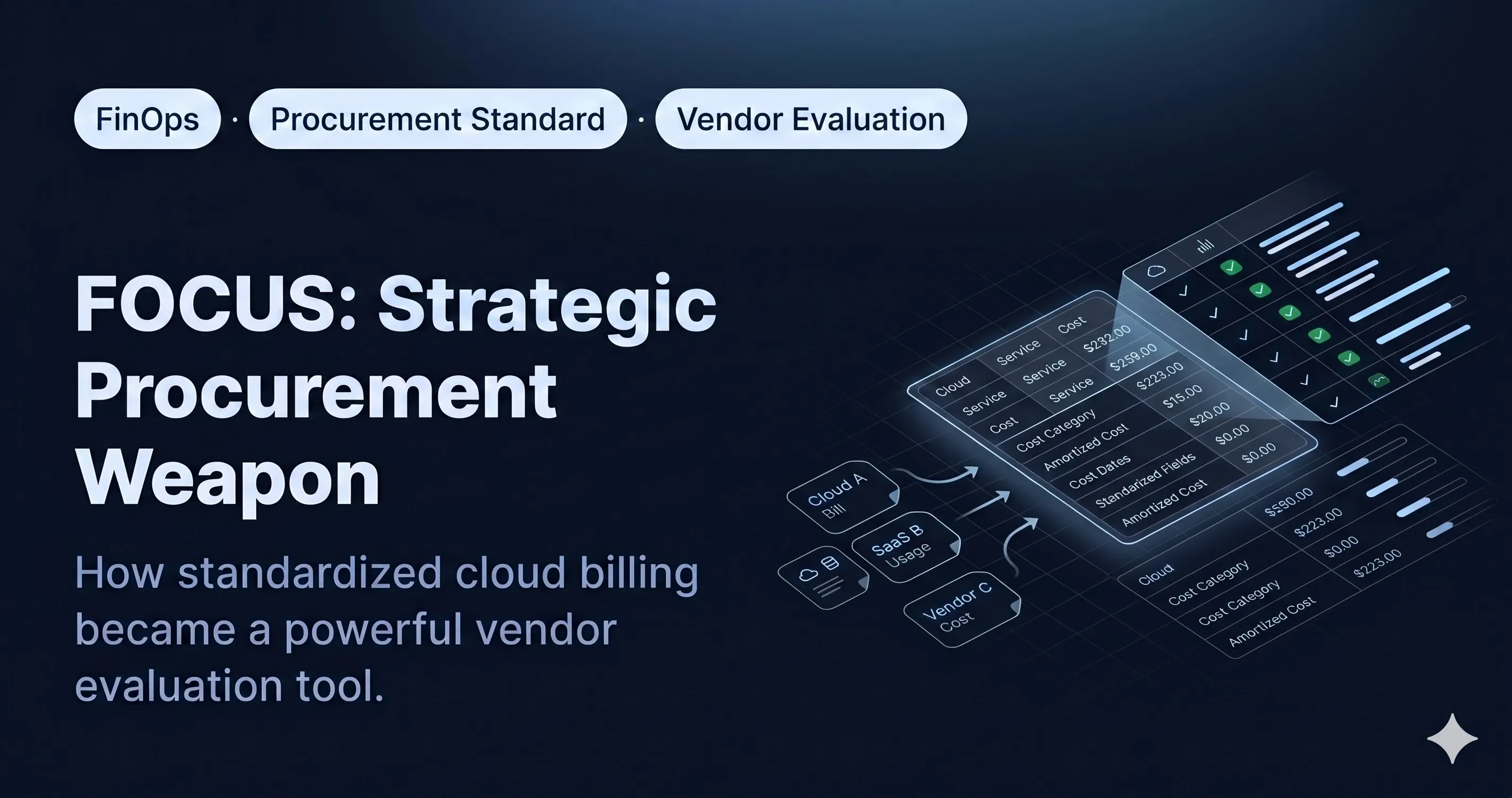
FOCUS Is the New Procurement Standard: How the FinOps Industry's Billing Specification Became a Vendor Evaluation Weapon (Blog 5/5 Series)
By end-2025, every major hyperscaler produced native FOCUS billing exports. When the data generators all speak the same schema, your platform either does too — or it doesn't.
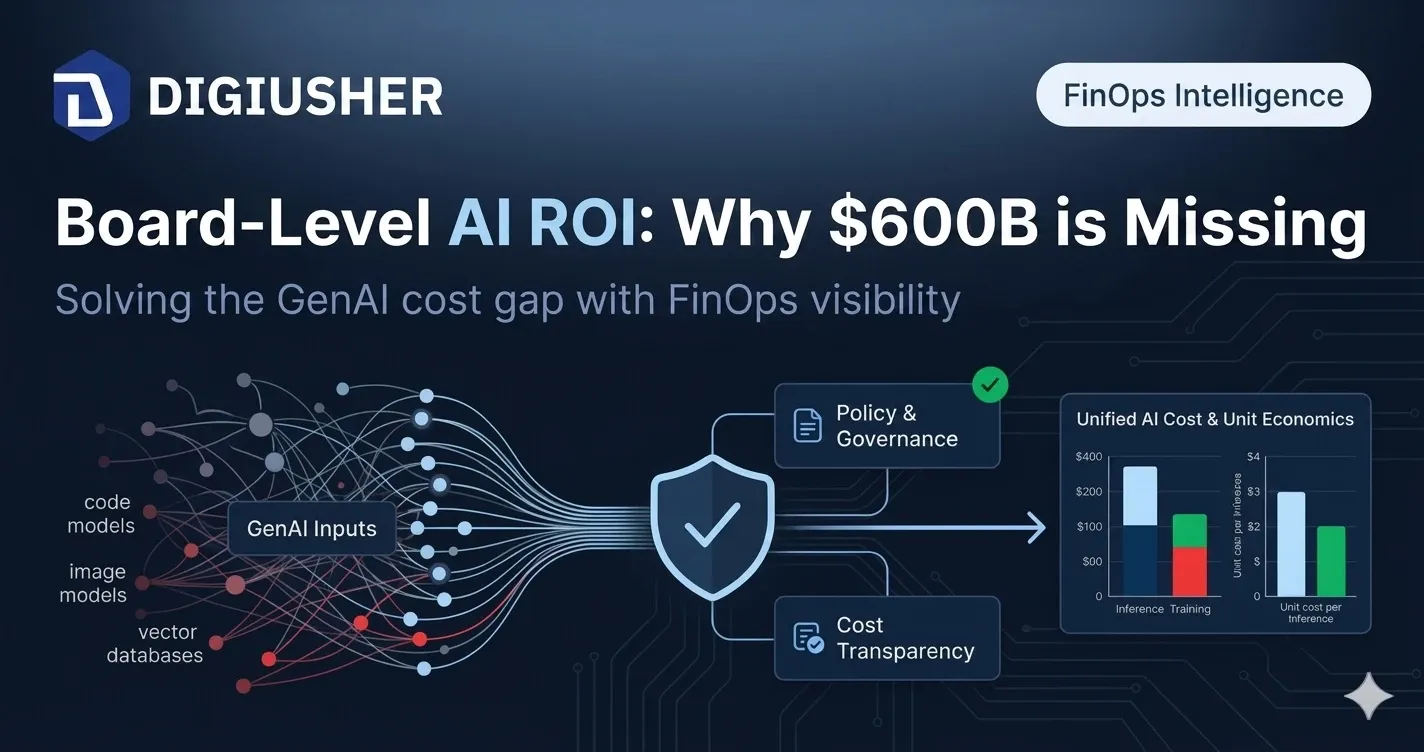
Board-Level AI ROI: Why $600B in Investment Is Delivering Single-Digit Returns — and What Fixes It
Only 7% of CFOs see high ROI from AI despite $270B in enterprise spend forecast for 2026. Here's the governance framework boards are demanding — and why cost attribution is the missing layer.
Board-Level Cloud and Data Centre ROI: Governing the Full Technology Estate in 2026
Cloud waste runs at 29-35% of spend. GPU idle time hits 30-60%. Data centre costs surpass $650B in 2026. Here is the board-level governance framework that connects every infrastructure dollar to measurable business value.