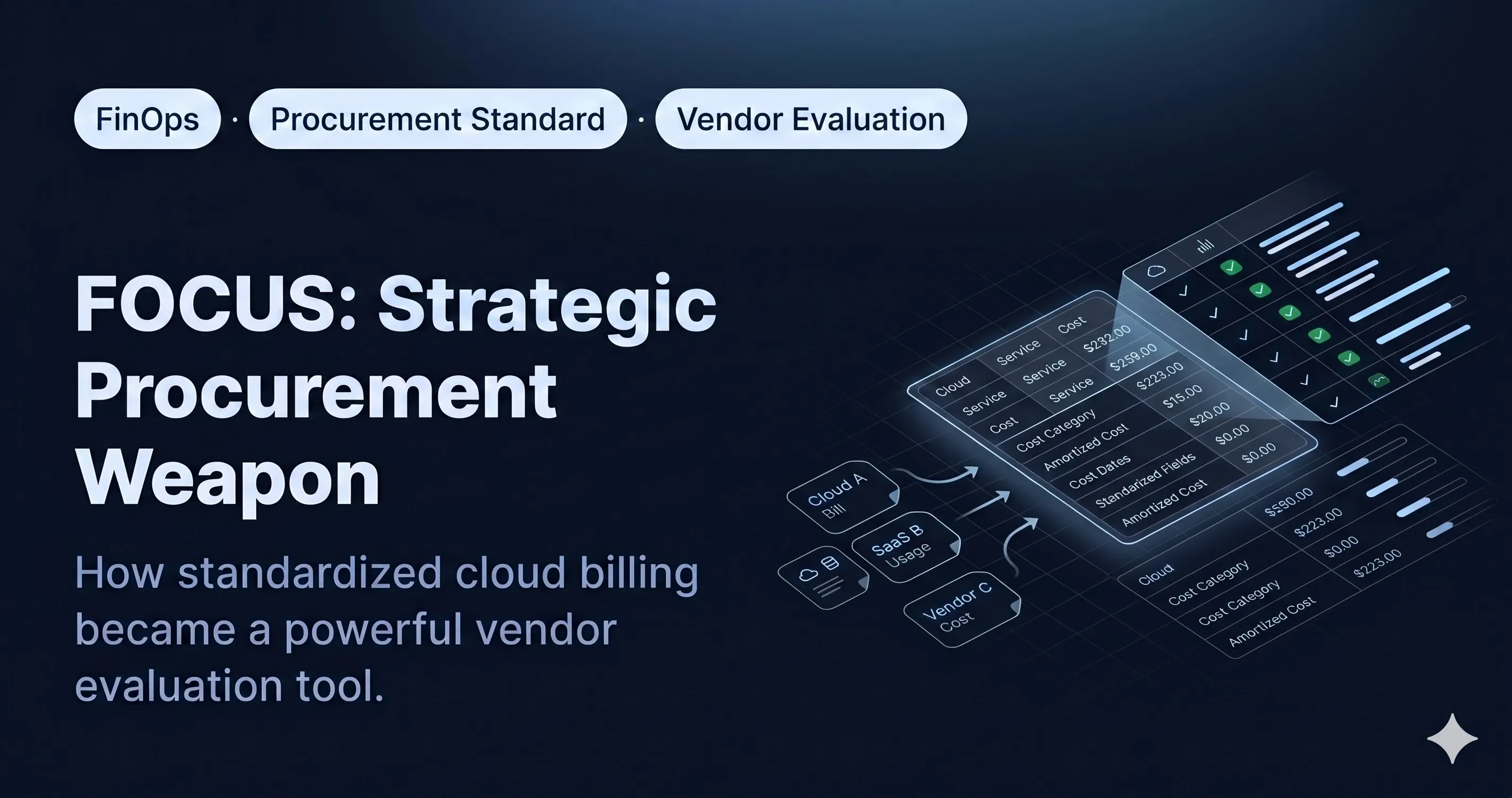
FOCUS Is the New Procurement Standard: How the FinOps Industry's Billing Specification Became a Vendor Evaluation Weapon (Blog 5/5 Series)
By end-2025, every major hyperscaler produced native FOCUS billing exports. When the data generators all speak the same schema, your platform either does too — or it doesn't.
By the end of 2025, every major hyperscaler had committed to native FOCUS billing exports. AWS announced FOCUS 1.2 as generally available at re:Invent. Azure had been shipping production FOCUS exports since version 1.1. Google Cloud, Oracle, Alibaba, and Databricks followed. The organisations that generate the world’s enterprise technology billing data now all produce that data in the same schema.
When the data generators all speak the same language, the question for every enterprise FinOps platform buyer becomes brutal in its simplicity: does your platform?
Not “does your platform export to FOCUS?” Not “does your platform have a FOCUS integration on the roadmap?” The question is whether the platform was built on FOCUS — whether FOCUS is the data model, not a label applied to data stored in a proprietary schema underneath it. The distinction determines the quality of every governance decision made on that data. It determines which providers can be onboarded at zero engineering cost. It determines whether a new FOCUS version release makes the platform more capable or more expensive to maintain. It determines whether the platform can govern the full technology estate when FOCUS expands to data centre, private cloud, and sustainability — or whether each new category requires new translation work.
FOCUS has crossed the chasm. The question the enterprise community now needs to answer is not whether to adopt the specification. It is how to use it as a procurement weapon.
FOCUS Has Crossed the Chasm: From Specification to De Facto Standard
A technology standard crosses the chasm from emerging specification to de facto standard when the organisations that generate the underlying data commit to implementing it — not just the organisations that consume it. Before that moment, adoption is optional and platform-dependent. After it, non-adoption becomes a structural disadvantage that compounds over time.
FOCUS crossed that threshold during 2025. AWS implementing FOCUS 1.2 as GA is not a product decision by a cloud cost management tool. It is a data infrastructure decision by the world’s largest cloud provider, affecting the billing format of every AWS customer’s spending. Azure shipping production FOCUS exports is not a feature. It is a commitment to produce billing data in a shared, vendor-neutral schema that any downstream system can ingest without custom normalisation. When those two providers — who together represent the majority of enterprise cloud spend — produce native FOCUS data, the ETL pipelines that every non-FOCUS-native platform built to normalise their billing data become a liability rather than a capability.
The institutional signals confirm the trajectory. The FinOps Foundation’s 1,192-respondent State of FinOps 2026 survey, representing $83B+ in annual cloud spend, shows FOCUS as the normative data foundation for the entire discipline’s expansion — from cloud infrastructure through SaaS, AI, data platforms, private cloud, and data centre. 93 of the Fortune 100 participate in FinOps Foundation programmes. 57% of practitioners plan FOCUS adoption in the next 12 months; only 18% have no plans to adopt at all.
The FinOps Foundation’s own mission update in 2026 — from “advancing the people who manage the value of cloud” to “advancing the people who manage the value of technology” — is the institutional declaration that FOCUS’s mandate is not a cloud billing standard. It is the unified schema for Technology Value Management across the full enterprise technology estate.
The Three Stages of Technology Standard Adoption
Every technology standard follows a recognisable adoption trajectory. Understanding where FOCUS sits on that trajectory clarifies the stakes of the procurement decisions enterprise buyers are making right now.
Stage One: Working Group. The specification exists as a draft maintained by a working group. Participation is voluntary. The primary movers are the vendor community and practitioner advocates who stand to benefit most immediately from standardisation. Risk of adoption is high — the specification may change, may fail to gain sufficient support, or may be superseded by a competing approach.
Stage Two: Early Adoption. The specification reaches a stable version. A small number of providers implement it. Forward-thinking enterprises begin building on it. The majority waits for broader adoption before committing. The specification’s survival is no longer in question, but its scope and implementation depth remain uncertain.
Stage Three: De Facto Standard. The primary data generators implement the specification natively. Holdouts face growing compatibility friction as the ecosystem builds tools, workflows, and governance processes around the specification. Not adopting begins to carry costs that are invisible when adoption is low and concrete when adoption is high. Enterprises that deferred commitment are now paying for that deferral.
FOCUS is in Stage Three. The hyperscalers have implemented. The practitioner community has organised its certification and governance processes around the specification — the FinOps Foundation requires FOCUS Analyst certification as a prerequisite for Professional-level FinOps credentials. The Conformance Programme launching in 2026 will produce auditable, publicly comparable implementation records for every provider and platform. The question is no longer whether FOCUS will be the standard. The question is whether your platform was architected for the world it already describes.
For platforms built on proprietary schemas, Stage Three creates a specific and growing problem: every new provider that implements FOCUS natively reduces the relative value of the proprietary normalisation pipeline those platforms built. The ETL work they spent engineering capacity on becomes, incrementally, a mapping from one FOCUS-format source to a proprietary intermediate, then back to FOCUS-labelled fields on output. The value of the middle layer declines with every provider that moves to FOCUS native.
For platforms built on FOCUS-native architecture, Stage Three is the validation of every architectural commitment made before the hyperscalers signalled their intent.
Why FOCUS Conformance Belongs in Every FinOps RFP in 2026
Technology procurement RFPs have always included technical standards compliance as an evaluation criterion — SOC 2 Type II for security posture, ISO 27001 for information security management, GDPR compliance for data protection. These criteria work because they are verifiable, binary, and consequential: either the vendor has the certification or they do not, and the absence of the certification disqualifies them from regulated enterprise procurement.
FOCUS conformance should be evaluated at the same level in every FinOps platform RFP in 2026 — with the same specificity, the same verification requirements, and the same disqualification logic for vendors who cannot substantiate their claims.
The reason FOCUS conformance has not yet been standard in enterprise RFPs is the same reason it was not standard in 2024: the Conformance Programme did not exist. “We support FOCUS” has been a self-declared, unverifiable claim that any platform could make by adding a FOCUS export button to their interface. The FinOps Foundation’s Conformance Programme, launching in 2026, changes this. The programme produces public, auditable Conformance Gap Reports for every participating provider and platform — specifying which FOCUS columns are natively populated versus derived, which column requirements are fully met versus partially met, and which FOCUS version’s capabilities the implementation actually supports.
When the Conformance Programme delivers those reports, “we support FOCUS” becomes a testable claim with a verifiable answer. Enterprise procurement teams should begin requiring the Conformance Gap Report as a standard RFP deliverable now — both to signal to vendors that the evaluation criterion exists and to establish a baseline for comparison when the official reports become available.
The governance stakes are concrete. An enterprise selecting a FinOps platform today will operate that platform for three to five years. Over that period, FOCUS will expand from its current coverage to include data centre, private cloud, sustainability, and potentially labour cost integration. A platform built on FOCUS-native architecture inherits each of those expansions automatically. A platform built on a proprietary schema must rebuild its translation layer for each new category — and must fund that rebuild through either vendor investment or customer licence increases. The total cost of ownership difference between a FOCUS-native and a FOCUS-compatible platform is not visible on the day of contract signature. It becomes visible at every FOCUS specification release for the duration of the contract.
The Structural Disadvantage Facing Non-Native Platforms
The structural disadvantage of non-FOCUS-native platforms is not a capability gap today. Most enterprise FinOps platforms can produce a dashboard that looks similar across AWS, Azure, and GCP cost data. The disadvantage is architectural and compounding — it becomes more significant with each new provider implementation, each new FOCUS version, and each new technology category the specification absorbs.
The core problem is the translation layer. A platform built on a proprietary internal schema must translate incoming data into its own format before any analysis can happen. When providers produce FOCUS-format billing exports, that translation maps FOCUS-format input through a proprietary intermediate schema and re-derives FOCUS-labelled fields on output. The result is that the FOCUS column values in the analytics surface are approximations of what the provider reported — translated through a proprietary schema layer that introduces semantic drift. EffectiveCost in a FOCUS-compatible platform carries the platform vendor’s interpretation of what EffectiveCost means, not the specification’s definition applied to the provider’s data directly.
This semantic drift matters most precisely when it matters most: in cross-provider cost comparisons, in allocation models built on consistent cost metric semantics, and in AI unit economics analysis where token costs from multiple providers need to be comparable in the same metric framework. A 3% difference in EffectiveCost between a FOCUS-native and a FOCUS-compatible interpretation across a $50M cloud estate is a $1.5M variance that appears nowhere on any platform dashboard — because both platforms label their cost column EffectiveCost with apparent consistency.
The compounding dimension is the roadmap problem. Every new FOCUS version requires a compatibility-layer platform to update its translation logic for each new column, each new column semantic, and each new dataset. FOCUS 1.3 added five Allocation columns, a Contract Commitment dataset, and data freshness metadata — each of which requires new mapping logic in a compatibility-layer platform before those capabilities are available to customers. FOCUS-native platforms absorb these additions as data layer updates. Compatibility-layer platforms absorb them as engineering projects.
At the current FOCUS release cadence of approximately two versions per year, the compounding maintenance cost of a compatibility layer is substantial. Over a three-year platform contract, a compatibility-layer vendor must execute six to eight translation layer updates to maintain parity with the specification — in addition to maintaining the underlying proprietary schema and all other product development commitments. That engineering overhead is what percentage-of-spend pricing is partly designed to fund.
The FOCUS Roadmap: What the Specification Will Govern Through 2028
The FinOps Foundation’s FOCUS roadmap is directional rather than committed to specific release dates, but the scope signals are clear and supported by the 2026 State of FinOps demand data.
Data centre and private cloud. 48% of FinOps teams now govern data centre costs (up 12%) and 57% govern private cloud (up 18%). Both numbers are growing faster than any other category except AI. The FinOps Foundation’s mission explicitly includes data centre as part of the technology estate FOCUS is designed to standardise. Data centre and private cloud billing standardisation — enabling the same FOCUS schema query to cover on-premises infrastructure alongside cloud infrastructure — is the most structurally significant expansion on the near-term roadmap.
Sustainability and carbon data. ESG reporting requirements are driving corporate sustainability programmes into direct intersection with technology cost governance. Carbon emissions associated with cloud infrastructure, GPU compute, and data centre operations are becoming mandatory reporting items in multiple regulatory frameworks. The FinOps Foundation has confirmed active efforts to incorporate carbon and sustainability data into future FOCUS releases — adding columns that associate technology spend rows with carbon emission data, enabling cost and carbon to be governed from the same schema.
Licensing and software asset management. 64% of FinOps teams now govern software licensing (up 15%). The boundary between FinOps and IT Asset Management is dissolving, driven by the need to attribute enterprise software licence costs alongside cloud and SaaS spend in a unified allocation model. FOCUS’s SaaS billing coverage established the schema foundation; licensing standardisation extends it to non-consumption-based software costs.
Labour cost integration. The FinOps Foundation has begun exploring the integration of labour cost data — the personnel cost of engineering and FinOps teams — into the Technology Value Management framework. If a platform engineering team costs $2.4M per year in personnel and governs $80M in cloud spend, the total cost of the governance function cannot be assessed without including both. Labour cost integration represents the most ambitious potential scope for future FOCUS releases — the column structure that would make true Technology Value Management calculable from a single schema.
For enterprises evaluating FinOps platforms today, the roadmap question is not academic. It is the most commercially significant question in the evaluation: does the platform’s architecture make each of these expansions additive and automatic, or does each one require a negotiation, a project, and a licence revision?
DigiUsher’s FOCUS Roadmap Commitment
DigiUsher was built on FOCUS-native architecture in 2023. That architectural commitment is permanent — not a phase of development, not a compatibility layer staged for replacement, but the foundational data model from which every product capability is built.
Our roadmap commitment on FOCUS follows directly from that foundation.
Data centre and private cloud. DigiUsher’s FOCUS-extended schema already applies FOCUS column semantics to categories without official specification support — Kubernetes, Snowflake, Google Workspace, Slack, GitHub, BigQuery — as a pattern of extending the specification’s vocabulary to enterprise governance scope ahead of official ratification. We will apply the same pattern to data centre and private cloud billing data, governed through the same FOCUS query surface as cloud infrastructure, without requiring customers to manage a separate system until official FOCUS specification coverage arrives.
Sustainability. DigiUsher will integrate carbon and sustainability data into the FOCUS-native schema as the FinOps Foundation ratifies sustainability columns — and will offer an extended coverage model for sustainability attribution ahead of official ratification, consistent with our approach to other pre-specification categories. Enterprises subject to CSRD, SEC climate disclosure rules, or equivalent sustainability reporting frameworks will be able to query carbon attribution alongside cost attribution from a single FOCUS-schema dataset.
Conformance Programme. DigiUsher will pursue FinOps Certified FOCUS Conformant status through the Conformance Programme when it launches in 2026. We will publish our Conformance Gap Reports publicly, per provider and per FOCUS version supported, as a commitment to the transparency that the Conformance Programme is designed to enforce across the ecosystem.
Flat licensing through scope expansion. As FOCUS expands to data centre, private cloud, sustainability, and licensing, DigiUsher’s flat enterprise licensing model remains unchanged. Governance scope expansion does not trigger licence renegotiation, additional tier pricing, or percentage-of-new-spend fees. The architectural commitment to FOCUS-native eliminates the per-category implementation cost that makes percentage-of-spend pricing economically necessary for platforms with translation layers.
This roadmap commitment is a public accountability signal. Enterprises evaluating DigiUsher can hold us to it at every FOCUS release. It is the kind of commitment a FOCUS-native platform can make without reservation — because the architecture makes it the lowest-cost path. It is not a commitment that FOCUS-compatible platforms can make with the same credibility, for the same reason.
The Seven-Question FOCUS Evaluation Framework for Enterprise Buyers
The following seven questions form the FOCUS evaluation framework that every enterprise FinOps RFP should include. Each question is calibrated to reveal whether a platform is genuinely FOCUS-native or operating a compatibility layer. Each answer has a verifiable right and wrong form. The framework is vendor-neutral in framing and surgical in effect — enterprise buyers can apply it to any FinOps platform they are evaluating, including DigiUsher.
The Seven-Question FOCUS Evaluation Framework
──────────────────────────────────────────────────────────────────────────────
Q   Question                               What the answer reveals
──────────────────────────────────────────────────────────────────────────────
1   Is FOCUS your primary datastore         Native: FOCUS is the schema.
    schema, or your output/export           Compatible: proprietary schema +
    format?                                 FOCUS translation on output.

2   Demonstrate a single SQL query          Native: one SELECT, all providers,
    returning EffectiveCost across AWS,     FOCUS columns, no joins.
    Azure, and one SaaS provider using      Compatible: requires mapping join
    FOCUS columns. No intermediate joins.   or provider-specific sub-query.

3   When a new FOCUS version is             Native: data-layer update only.
    ratified, what changes in our           Customer dashboards unaffected.
    dashboards, allocations, and            Compatible: translation layer
    chargeback reports — and who owns       update required. Propagates to
    the migration?                          customer-facing views.

4   How do you govern services without      Native + Extended: Kubernetes,
    official FOCUS provider support —       Snowflake, Workspace, GitHub,
    Kubernetes, Snowflake, Workspace,       BigQuery queryable in FOCUS
    GitHub Actions?                         column semantics natively.
                                            Compatible: separate interface
                                            or not supported.

5   Provide your FOCUS Conformance          Native: willing and ready.
    Gap Report (when the programme          Compatible: may not have the
    launches) for each supported            depth of implementation the
    provider, specifying which columns      report would reveal.
    are natively populated vs. derived.

6   For BYOC/self-hosted deployment,        Native: FOCUS schema intact on-
    does the FOCUS schema remain intact     premises, no vendor components.
    inside our infrastructure perimeter     Compatible: proprietary schema
    without vendor-managed components?      in self-hosted environment.

7   What happens to your licensing as       Native + Flat: licence unchanged
    FOCUS expands to data centre, private   as scope expands.
    cloud, and sustainability categories?   Compatible + % of spend: licence
                                            scales with new category coverage.
──────────────────────────────────────────────────────────────────────────────
Score: A platform that answers all seven questions cleanly is FOCUS-native.
       A platform that deflects, qualifies, or cannot answer Q2 on demand
       is operating a compatibility layer.
──────────────────────────────────────────────────────────────────────────────
These seven questions should appear in every FinOps platform RFP issued in 2026. They should be scored as pass/fail, not as weighted criteria where partial answers accumulate points. A platform that cannot demonstrate Q2 on demand — a single FOCUS query across multiple providers without intermediate joins — has not implemented FOCUS as its primary data model, regardless of what the marketing materials claim.
The questions create a framework that enterprise procurement teams own. They are not a DigiUsher sales tool — they are a specification-compliance test that any FinOps buyer can apply independently. The fact that DigiUsher answers all seven questions cleanly is a consequence of the architecture, not the purpose of the framework.
What Technology Value Management Requires of the Platform It Runs On
The FinOps Foundation’s mission update in 2026 is not a marketing rebrand. It is a scope declaration. “Managing the value of technology” — as opposed to “managing the value of cloud” — encompasses the full technology estate: cloud infrastructure, SaaS, AI workloads, data platforms, Kubernetes, data centre, private cloud, licensing, and eventually labour cost. Technology Value Management is what FinOps becomes when it grows up.
Technology Value Management requires a platform architecture that can govern the full technology estate from a single query surface without per-category ETL pipelines, without proprietary intermediate schemas, and without per-provider training for the practitioners who query it. It requires a data model that is defined by a specification — not by a vendor — so that every expansion of governance scope adds a data source rather than rebuilding a schema. It requires flat licensing so that the cost of governance does not scale proportionally with the scope of what is governed.
The $83B+ in annual cloud spend represented by the State of FinOps 2026 survey is not the technology cost surface that FinOps teams will govern in 2028. That surface will include the same cloud spend plus data centre, private cloud, and sustainability reporting obligations. The platform selected today needs to govern all of it — not because FOCUS has already ratified all of it, but because the architecture that handles what FOCUS has ratified is the same architecture that handles what FOCUS will ratify.
78% of FinOps practices now report to the CTO or CIO. The governance decisions those FinOps leaders make are board-level capital allocation decisions — not operational cost reports. The platform those leaders operate needs to produce board-level insight with board-level credibility: sourced from a specification-defined schema, auditable against provider invoices, and consistent across every technology category in the estate.
FOCUS is the specification. A FinOps Operating System built natively on that specification is the platform. The seven evaluation questions are the procurement mechanism that connects them.
DigiUsher is available on AWS Marketplace (AWS ISV Accelerate Partner), Azure Marketplace (Azure ISV Co-Sell Ready, MACC-eligible), and GCP Marketplace. SI partners — including Infosys, Wipro, and Hexaware — deliver DigiUsher globally, working against the FOCUS column library rather than a proprietary schema, which means delivery knowledge is portable and specification-backed. Flat enterprise licensing. SOC 2 Type II certified. GDPR compliant. BYOC deployment for regulated industries.
Frequently Asked Questions
Is FOCUS now a de facto standard for enterprise FinOps?
Yes. Every major hyperscaler — AWS, Azure, GCP, OCI, Alibaba — now produces native FOCUS billing exports. AWS announced FOCUS 1.2 as GA at re:Invent 2025. 93 of the Fortune 100 participate in FinOps Foundation programmes. 57% of practitioners plan adoption in the next 12 months. The FinOps Foundation updated its mission to position FOCUS as the normative schema for the full technology estate. A standard becomes de facto when the data generators implement it. That condition has been met.
What is Technology Value Management?
Technology Value Management is the discipline of connecting total technology investment — cloud, SaaS, AI, data platforms, Kubernetes, data centre, and on-premises — to measurable business outcomes at board level, using a FOCUS-native cost engine as the single auditable source of truth. It extends FinOps from operational efficiency into strategic capital allocation. The FinOps Foundation formally adopted Technology Value Management as the expanded scope of the discipline through its 2026 mission update.
What should every enterprise FinOps RFP require about FOCUS?
Seven questions: Is FOCUS your primary datastore schema or your output format? Demonstrate a single FOCUS query across AWS, Azure, and one SaaS provider with no joins. What changes in our dashboards when a new FOCUS version is ratified? How do you govern services without official FOCUS support (Kubernetes, Snowflake, GitHub)? Provide your FOCUS Conformance Gap Report. Does BYOC deployment maintain FOCUS schema integrity? What happens to licensing when FOCUS expands to data centre and sustainability?
What will FOCUS cover in future versions?
Active development for FOCUS 1.4 draws from a backlog built during the 1.3 cycle. Directional signals indicate data centre and private cloud billing standardisation (needed by 48% and 57% of FinOps teams respectively), sustainability and carbon emission data integration, and licensing and software asset cost coverage. Labour cost integration into Technology Value Management is under early-stage discussion.
What is the FOCUS Conformance Programme?
A formal FinOps Foundation certification programme launching in 2026 that produces auditable, public Conformance Gap Reports for each provider’s FOCUS implementation — specifying which columns are natively populated, which are transformation-derived, and which are not supported. It transforms “we support FOCUS” from a self-declared claim into a verifiable, comparable compliance record analogous to SOC 2 Type II for security.
Why does the FOCUS architecture decision matter more now than in 2023?
In 2023, FOCUS was an emerging specification. Today it is a de facto standard with hyperscaler commitments, an institutional conformance programme, and a documented expansion roadmap. Platforms built on FOCUS-native architecture compound their advantage with every release, every new provider, and every new category. Platforms built on proprietary schemas compound their maintenance burden in the same direction. The architectural decision that was a bet in 2023 is now a structural position — and the gap widens with every passing quarter.
How does flat licensing relate to FOCUS as a procurement standard?
Platforms priced as a percentage of cloud spend face a compounding misalignment as FOCUS expands governance scope: licence cost grows with scope expansion. FOCUS-native architecture eliminates the per-category implementation cost that percentage-of-spend pricing is designed to recover — enabling flat enterprise licensing where governance scope can expand from three clouds to the full technology estate without a proportional licence increase. DigiUsher’s flat licensing is architecturally enabled by FOCUS-native design, not commercially optional.
How should enterprises prepare for FOCUS 1.4?
Three actions: confirm the FinOps platform in use is FOCUS-native before scope expansion reaches data centre and private cloud; build the internal cost allocation taxonomy in FOCUS column semantics now, so it does not require reworking as new categories arrive; request the FOCUS Conformance Gap Report from the platform vendor when the programme launches to validate the depth of the implementation, not just the presence of the FOCUS label.
References
- FinOps Foundation — State of FinOps Report 2026 — Primary source for 1,192 respondents / $83B+ cloud spend represented; FinOps mission update from “cloud” to “technology”; 78% CTO/CIO reporting; 48% data centre governance (up 12%); 57% private cloud (up 18%); 98% AI governance; sustainability ESG as growing engagement area (2026)
- FinOps Foundation — State of FinOps Report 2025 — Primary source for 57% FOCUS adoption intent; 18% not planning adoption (2025)
- FinOps Foundation — Introducing FOCUS 1.3 — Source for FOCUS 1.4 backlog under active development post-1.3 cycle; Conformance Programme launch in 2026 with Conformance Gap Reports (December 2025)
- Linux Foundation Press — FOCUS 1.3 Launch — Source for 10+ providers with native FOCUS support: Alibaba, AWS, Databricks, Google Cloud, Grafana, Huawei, Microsoft, OCI, OVH Cloud, Tencent; 93 of Fortune 100 in FinOps Foundation programmes (December 2025)
- FinOps Foundation — FOCUS Specification — Source for FOCUS Steering Committee and Maintainers engaging in roadmap development and release planning post-1.3 (2025)
- FinOps Foundation — FOCUS 1.0 General Availability — Source for FOCUS extensibility roadmap: SaaS, PaaS, licensing, software, sustainability metrics described as future scope from original 1.0 GA release (2024)
- FinOps Foundation — Adopting FOCUS: The FinOps Open Cost and Usage Specification — Source for three FOCUS adoption approaches (Small-Scale, Large-Scale, Blended); data-driven decision framework for FOCUS adoption timing (December 2025)
- GitHub — FinOps Open Cost and Usage Specification Repository — Source for FinOps Certified FOCUS Conformant programme structure; FOCUS versioning approach inspired by Semantic Versioning 2.0; breaking changes follow formal deprecation cycle
- nOps — State of FinOps 2026 Recap and Key Takeaways — Source for practitioner context: FOCUS as normative foundation for Cloud+ scope expansion; 78% CTO/CIO reporting implication for FinOps as technology leadership (March 2026)
- ISG Research — FinOps Buyers Guide 2025 — Source for 1 in 5 enterprises investing in coordinated FinOps effort between IT and Finance through 2026 (2025)
- Forrester — Public Cloud Market Outlook 2026 — Source for $1.03 trillion projected global public cloud spend (2026)
- Amnic — FOCUS Complete Guide 2026 — Source for sustainability active efforts in future FOCUS releases; FOCUS-first as major differentiator in vendor pitches through 2026; Kubernetes container attribution in active FOCUS working group discussion (April 2026)
FOCUS has already won. The only question left is whether your platform was built for the world it describes — or built for the world it replaced.
Put all seven evaluation questions to DigiUsher in 30 minutes
DigiUsher answers all seven FOCUS evaluation questions without qualification, caveat, or deferral to a roadmap. In 30 minutes, we will demonstrate a live FOCUS-native query across your estate architecture, walk through our multi-version normalisation approach, show our extended schema coverage for Kubernetes and SaaS, and explain exactly what our flat licensing model means as FOCUS expands to data centre, private cloud, and sustainability.
Available on AWS Marketplace (AWS ISV Accelerate Partner), Azure Marketplace (Azure ISV Co-Sell Ready, MACC-eligible), and GCP Marketplace. Flat enterprise licensing. SOC 2 Type II certified. GDPR compliant. BYOC deployment for regulated industries. Delivered globally by Infosys, Wipro, and Hexaware.
Request your 30-minute FOCUS evaluation session → digiusher.com/request-a-demo
Related Posts
The Broken Cost Schema Problem: Why Every FinOps Team Is Solving the Same Problem from Scratch · 12 May 2026 The market-level problem that made FOCUS inevitable — the billing schema fragmentation that the procurement standard in this post was built to resolve.
FOCUS 1.3 Decoded: What Changed, What It Governs, and What It Means for Your FinOps Stack · 19 May 2026 The technical specification reference — the complete column-level anatomy of FOCUS 1.0 through 1.3, essential context for evaluating what a vendor’s Conformance Gap Report should contain.
Why DigiUsher Rebuilt Its Cost Engine on FOCUS — and Why That Decision Is Now an Enterprise Advantage · 26 May 2026 The architectural decision story — why the evaluation framework in this post was designed by a team that made the FOCUS-native commitment three years before the market confirmed it.
FOCUS in Production: How DigiUsher’s FOCUS-Native Engine Delivers Real-Time Allocation, AI Token Governance, and €1M in 45 Days · 2 June 2026 The production proof — what a platform that answers all seven evaluation questions cleanly actually delivers in enterprise deployments.
Cloud Cost Optimisation Is Dead: Why FinOps Must Now Govern the Full Technology Estate · 14 April 2026 The strategic context — why FOCUS has become a procurement standard, and why governing the full technology estate demands unified billing standardisation rather than category-specific tools.
DigiUsher in 30 min
See which team owns every dollar — in real time.
DigiUsher turns raw billing data into allocation finance trusts — chargeback, showback, and guardrails included.
Book a 30-min walkthroughNo hard pitch · tailored to your stack
Continue Reading
More from the DigiUsher editorial team.
Why DigiUsher Rebuilt Its Cost Engine on FOCUS — and Why That Decision Is Now an Enterprise Advantage (Blog 3/5 Series)
In 2023, DigiUsher bet its platform architecture on FOCUS before hyperscalers committed to it. Here is why that decision was made, what it cost, and what it delivers.
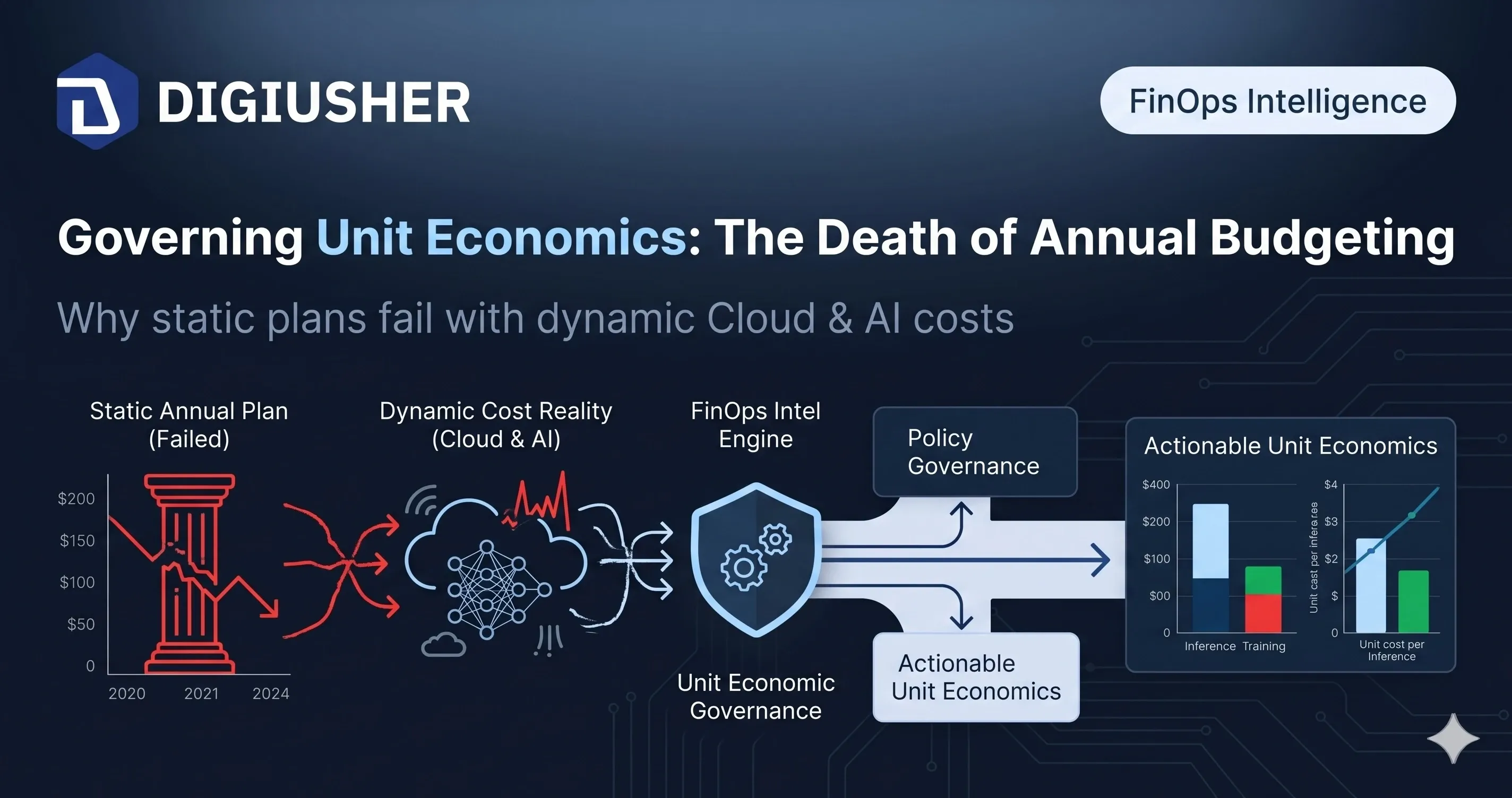
Why Cloud and AI Budgets Fail Annual Planning
Annual planning was built for fixed assets. Cloud and AI spend is consumption-driven, non-linear, and breaks the 12-month budget cycle. Here is what replaces it.
Board-Level AI ROI: Why $600B in Investment Is Delivering Single-Digit Returns — and What Fixes It
Only 7% of CFOs see high ROI from AI despite $270B in enterprise spend forecast for 2026. Here's the governance framework boards are demanding — and why cost attribution is the missing layer.