Cloud and AI Economics in Regulated Industries: Why Governance Cannot Leave the Perimeter
AI spending hits $2.52T in 2026 while enterprise GPUs sit 5% utilized. For banks, insurers and healthcare, the cost surface is now a sovereignty problem. Here is the governance model that fits.
Worldwide AI spending will reach $2.52T in 2026, a 44% jump in a single year, and roughly $1.37T of that is infrastructure — servers, accelerators and the data centers to house them. The enterprise GPU fleets buying into that boom run at about 5% effective utilization. An organization can therefore be the proud owner of the most expensive infrastructure layer it has ever operated and, simultaneously, the worst-utilized. That paradox is uncomfortable everywhere. In a regulated industry, it is also a compliance event waiting to happen.
The reason is structural. To govern this cost surface, a platform must process billing records, resource tags, usage telemetry and AI inference metadata. In a bank, an insurer, a hospital network or a government agency, that data does not behave like ordinary operational exhaust — it contains, or can be used to reconstruct, regulated information. The question for a regulated CFO or CIO is no longer only “what does our AI cost?” It is “can the tool that tells us what our AI costs be allowed to see what it needs to see, where it needs to see it?”
For most FinOps platforms built for the consumer-software era, the honest answer is no. This briefing explains why, and what a governance model built for the perimeter looks like instead.
Executive Summary
- AI spend has overrun its governance. Worldwide AI spending hits $2.52T in 2026 (Gartner), yet 98% of FinOps teams who now “manage” AI mostly mean they can confirm the spend exists — not attribute it to value (FinOps Foundation, State of FinOps 2026).
- GPU economics break the old cost model. Enterprise GPU fleets run at roughly 5% effective utilization, the core of a $400B+ infrastructure waste problem (VentureBeat / Cast AI, 2026). Static batching alone can leave accelerators idle 70-85% of the time.
- Regulation has moved the goalposts. The EU AI Act becomes broadly applicable on 2 August 2026, carrying penalties of up to 7% of global turnover, while 54% of IT leaders now rank AI governance a top enterprise risk, up from 29% two years ago (Kiteworks, 2026).
- The cost surface cannot leave the perimeter. For regulated industries, governing cost means processing data that residency, sovereignty and audit rules say must stay inside the security boundary — which disqualifies SaaS-only architectures before evaluation begins.
- The structural fix is deployment topology, not features. A FOCUS-native FinOps Operating System deployed via BYOC keeps governance inside the perimeter while resolving cost across every cloud, Kubernetes cluster and AI workload.
The Three Forces Colliding
Three independent trends have converged on the regulated enterprise at the same time, and each one alone would justify a rethink of cost governance. Together they make the old model untenable.
The first force is the sheer scale and concentration of AI spend. Gartner’s January 2026 forecast puts worldwide AI spending at $2.52T, growing 44% year over year, with AI infrastructure absorbing roughly $1.37T of it. Within the wider IT budget, data center systems spending is the single fastest-growing category at 55.8% growth, and total data center spending rises 31.7% to clear $650B. The spend is not just large; it is migrating into the least-instrumented layer of the stack, where conventional cloud cost tooling has the weakest grip.
The second force is the expansion of FinOps scope itself. The FinOps Foundation’s State of FinOps 2026, drawn from 1,192 organizations representing $83B in annual technology spend, found that 98% of practitioners now manage AI spend — up from 31% just two years earlier. That is the fastest cost-category adoption the Foundation has recorded. The Foundation went so far as to change its mission from managing “the value of cloud” to managing “the value of technology.” Scope expanded faster than the tooling, governance frameworks and skills needed to handle it.
The third force is regulatory gravity. The EU AI Act reaches its main application date on 2 August 2026, with penalties for prohibited practices reaching 7% of global annual turnover. Sector regimes — GLBA in financial services, HIPAA in healthcare, FedRAMP for federal workloads, CJIS for law enforcement — each assume the operator can produce a clean chain of custody for the data any system touches. The US CLOUD Act adds a sharper edge: it can compel an American provider to disclose data even when the servers sit in Frankfurt or Sydney. Sovereignty has shifted from a procurement footnote to, in Microsoft’s own framing, a leadership discipline grounded in risk management and continuity.
Each force pushes in the same direction. Spend is exploding, the mandate to govern it has become near-universal, and the data needed to govern it has become legally radioactive. The enterprise that treats these as three separate projects will solve none of them.
The GPU Economics Problem
The accelerator is where cloud economics and AI economics stop being the same discipline. A CPU-hour is fungible and cheap to waste in small quantities. A GPU-hour is neither.
Consider the unit cost. A single H100-class accelerator runs $2 to $3 per hour on cloud; a 64-GPU training cluster burns roughly $4,600 a day; a production inference fleet can clear $50,000 a month. Against those numbers, idle time is not a rounding error. Independent analysis converging from Cast AI, Anyscale and Gartner places effective enterprise GPU utilization at around 5% — the center of what VentureBeat has characterized as a $400B+ infrastructure problem. The waste has two distinct origins, and they compound.
The first origin is procurement behavior from the scarcity era. When GPUs were genuinely hard to obtain in 2023 and 2024, the rational move was to secure capacity, not to use it efficiently. Fleets were over-committed at procurement time because availability, not efficiency, was the binding constraint. Those decisions made sense then and create structural waste now.
The second origin is execution-idle: the accelerator sitting unused even while a job looks healthy. Training jobs idle between batches, waiting on CPU preprocessing, data loading and checkpointing, so effective utilization on a “running” job can sit at 40-60%. Inference services sized for peak traffic hold their GPUs at 3 a.m. when traffic is a tenth of peak. Static batching leaves the accelerator idle between requests; continuous batching, using techniques such as paged attention, can lift utilization from 15-30% to 60-80% — a three-to-four-fold throughput gain at the same hardware cost.
The Compounding GPU Waste Problem
──────────────────────────────────────────────────────────────
Layer                          Typical state        Consequence
──────────────────────────     ─────────────        ──────────────
Procurement (scarcity-era)     Over-committed       Reserved > needed
Scheduling                     Static batching      15-30% utilization
Inference (peak-sized)         Idle off-peak        90% idle at trough
Attribution                    Account-level only   No per-model cost
──────────────────────────────────────────────────────────────
Net effect: a fleet over-committed at procurement, running idle
workloads, with no per-model attribution → ~5% effective use.
──────────────────────────────────────────────────────────────
For a regulated enterprise, this problem mutates into something harder. Many banks, insurers and health systems cannot route sensitive inference through a public model endpoint, so they self-host GPU capacity to keep data inside the perimeter. That decision converts a variable cloud bill into fixed capital sitting on the balance sheet. A self-hosted accelerator at 5% utilization is not an over-provisioned cloud line item that can be switched off next month — it is depreciating capital whose return depends entirely on utilization the organization may not even be measuring. Idle detection and per-model attribution stop being optimization niceties and become financial controls. You cannot govern what you cannot see, and a cost tool that resolves spend only to the account level cannot see the GPU at all.
Why Regulated Industries Are Structurally Different
The instinct of most cost-governance tooling is to centralize. Pull every cloud’s billing export, every cluster’s telemetry and every AI provider’s usage data into one multi-tenant environment, normalize it there, and serve insights back. For an unregulated business that model is efficient and entirely reasonable. For a regulated one it is often a non-starter, and the reason is worth stating precisely.
Cost data is not innocent. Billing records reveal which services run where and at what volume. Resource tags carry project names, customer identifiers and environment labels. AI inference telemetry can expose prompt patterns, model usage and data flows. In aggregate, this metadata can reconstruct a surprising amount about regulated operations — which is exactly why residency and sovereignty rules treat it as in-scope. A tool that requires this data to leave the perimeter to function is asking the organization to create the precise exposure its regulators exist to prevent.
This is why 54% of IT leaders now name AI governance a top enterprise risk, up from 29% two years earlier, and why 95% of senior executives describe sovereign AI as mission-critical. The governance gap is not only that spend is uncontrolled; it is that the obvious tools for controlling it can themselves breach the rules. A SaaS-only FinOps platform that processes cost data in its own cloud may fall foul of GDPR data-residency requirements, complicate the audit-of-custody that HIPAA and GLBA assume, and expose the organization to cross-border access risk under the CLOUD Act.
The regulated enterprise therefore needs to invert the default. The data should not travel to the governance platform; the governance platform should come to the data. That single inversion — deployment topology rather than feature set — is the architectural decision that separates a platform a regulated CISO can approve from one that cannot pass security review at all.
In regulated industries, the question is no longer whether you can govern your cost surface. It is whether the tool that governs it is allowed to exist inside your perimeter. Everything else is a feature comparison that never gets to happen.
The BYOC Governance Model
A FinOps Operating System resolves the colliding forces only if it is built on two foundations at once: a data model that can normalize the entire technology estate, and a deployment model that respects the perimeter. DigiUsher is built on both.
On the data foundation, DigiUsher is FOCUS-native rather than FOCUS-compatible. The distinction is architectural. A compatibility layer ingests each cloud’s billing data into a proprietary schema and exposes a FOCUS-shaped view on top; the specification is a presentation layer over a data model that predates it. DigiUsher uses the FinOps Open Cost and Usage Specification as its core data model, so multi-cloud infrastructure, Kubernetes, AI inference and SaaS are normalized into one consistent structure at the moment of ingestion. For a regulated multi-cloud enterprise, that is the difference between clean cross-cloud attribution and per-cloud reconciliation work that breaks down at exactly the AI and Kubernetes boundaries where regulated organizations most need precision.
On the deployment foundation, DigiUsher offers BYOC — Bring Your Own Cloud — paired with a Secure Relay Proxy. The platform runs inside the customer’s own cloud account or data center. Billing telemetry, resource metadata and AI inference data are processed inside the customer’s security boundary; they never transit to a vendor’s multi-tenant environment. Full cross-cloud and AI governance runs, but the data stays home. This is the model that lets a platform satisfy data-residency, sovereignty and chain-of-custody obligations rather than work around them. DigiUsher’s validated proof point here is a deployment at a leading private bank — regulated-industry BYOC at institutional scale, not a pilot.
On the AI layer, DigiUsher’s governance was built for accelerator economics rather than retrofitted from cloud infrastructure tooling. That means GPU idle detection that surfaces the difference between requested and utilized accelerators per namespace; token budget caps that stop runaway consumption before it bills; agentic kill-switches that halt an autonomous workload exceeding its ceiling; and per-chain attribution that resolves cost to the model, the agent and the business unit. These are the controls that turn the 5%-utilization problem from a quarterly surprise into a managed line.
SaaS-only model           vs.   DigiUsher BYOC model
──────────────────────          ──────────────────────────────
Data leaves perimeter           Data stays inside perimeter
Vendor multi-tenant cloud       Customer's own account / DC
Residency risk under CLOUD Act  Sovereignty preserved
Audit-of-custody gap            Clean chain of custody
% of spend (scales with you)    Flat enterprise licensing
FOCUS-compatible export layer   FOCUS-native core data model
Cloud cost tool + AI bolt-on    AI governance built native
──────────────────────────────────────────────────────────────
The commercial model reinforces the architecture. DigiUsher prices on flat enterprise licensing, not a percentage of the spend it governs. The contrast matters precisely in this context: a percentage-of-spend model — commonly around 3% — means the governance bill rises in lockstep with the AI infrastructure spend climbing toward its $1.37T share of the market. The enterprise pays more to govern exactly when costs expand fastest, and the vendor profits from the waste rather than from removing it. For a regulated organization carrying large fixed GPU capital, that misalignment is acute. Flat licensing decouples the cost of governance from the size of the estate, so scaling AI does not scale the platform bill.
This full-estate, perimeter-respecting capability is what defines a FinOps Operating System rather than a cloud cost dashboard. DigiUsher carries SOC 2 Type II certification and GDPR compliance, is an AWS ISV Accelerate Partner and Azure ISV Co-Sell Ready, and is delivered and operated inside regulated environments by global system integrators including Infosys, Wipro, Hexaware, Persistent Systems, and Coforge — the delivery muscle that matters when the deployment lives inside a bank’s own infrastructure rather than a vendor’s.
What to Evaluate
The regulated enterprise choosing a platform for cloud and AI economics is making an architectural decision, and architecture cannot be patched with features after the fact. Seven criteria decide the outcome, and each one quietly disqualifies a class of alternatives.
| Evaluation criterion | What regulated buyers require | DigiUsher |
|---|---|---|
| Deployment topology | Runs inside the perimeter (BYOC), data never leaves | ✅ BYOC + Secure Relay Proxy |
| Data model | FOCUS-native core, true cross-cloud normalization | ✅ FOCUS-native architecture |
| AI governance depth | GPU idle detection, token caps, kill-switches, per-chain attribution | ✅ Native AI governance |
| Pricing model | Flat licensing, decoupled from spend | ✅ Flat enterprise licensing |
| Estate scope | Multi-cloud + Kubernetes + AI + SaaS + data center | ✅ Full technology surface |
| Compliance posture | SOC 2 Type II, GDPR, clean audit-of-custody | ✅ SOC 2 Type II, GDPR |
| Delivery model | GSI-deployable inside regulated environments | ✅ Infosys, Wipro, Hexaware, Persistent Systems, Coforge |
Read the table as a sequence of filters rather than a feature list. A platform that cannot deploy inside the perimeter fails the first criterion and the rest never get tested. A FOCUS-compatible platform fails the second the moment cross-cloud and AI attribution is required at granularity. A percentage-of-spend platform fails the fourth as soon as the AI estate scales. A single-category cloud cost tool fails the fifth and the third together, because AI governance retrofitted onto an infrastructure tool cannot reason about accelerator workloads. The criteria are buyer requirements, not vendor claims — which is the point. They are the questions a regulated CISO, CFO and Head of FinOps should be asking in the room, regardless of which platforms are on the shortlist.
The deeper shift underneath the table is the move the FinOps Foundation has formalized: from managing the value of cloud to managing the value of technology. Practitioners with executive alignment report two-to-four times more influence over technology selection decisions. The conversation has moved from the cost-report to the boardroom, and the board’s question is unforgiving — not “how much did we spend?” but “what enterprise value did we generate?” Answering it requires resolving cost to a business unit, which requires attribution, which requires a data model and a deployment model that can see the whole estate without breaching the perimeter. That is the entire argument of this briefing, compressed.
Frequently Asked Questions
What are cloud and AI economics in regulated industries?
Cloud and AI economics in regulated industries is the practice of governing the full cost of technology infrastructure under the constraint that sensitive data and its metadata cannot freely leave the organization’s security perimeter. In an unregulated business, cost governance is mainly a financial and operational problem; in a bank, insurer, hospital or agency, it is also a sovereignty, residency and audit problem, because the billing records and AI telemetry needed to attribute cost often contain or reveal regulated information. The economics are shaped by AI spending reaching $2.52T in 2026, GPU fleets at roughly 5% utilization, and regimes such as the EU AI Act, GDPR, GLBA and HIPAA that constrain where cost data can be processed.
Why is GPU utilization so low in enterprise AI deployments?
Enterprise GPU fleets run at around 5% effective utilization because of two compounding forms of waste. Procurement over-commitment from the 2023-2024 scarcity era left fleets reserved beyond need. Execution-idle waste then keeps accelerators unused between batches and at off-peak hours even on healthy jobs — static batching can leave a GPU idle 70-85% of the time. For regulated enterprises that self-host AI to keep data inside the perimeter, this waste is depreciating capital on the balance sheet, which makes idle detection and per-model attribution financial-control requirements rather than optimization niceties.
What is BYOC and why does it matter for FinOps in regulated industries?
BYOC, or Bring Your Own Cloud, is a deployment model where the FinOps platform runs inside the customer’s own cloud account or data center rather than the vendor’s multi-tenant SaaS. It matters because cost governance requires processing billing data, tags, telemetry and AI metadata that in regulated industries can contain or reconstruct regulated information. A SaaS-only platform requires that data to leave the perimeter, risking residency breaches and cross-border access exposure under regimes like the CLOUD Act. A BYOC deployment with a Secure Relay Proxy keeps data inside the perimeter while delivering full governance, which under GDPR, the EU AI Act, GLBA or HIPAA is often the difference between a deployable platform and one that fails security review.
How much are enterprises spending on AI and cloud in 2026?
Worldwide AI spending is forecast at $2.52T in 2026, up 44% year over year (Gartner), with infrastructure alone near $1.37T. Data center systems spending grows fastest at 55.8%, and total data center spending rises 31.7% past $650B. Yet 98% of FinOps teams who now manage AI mostly mean they can confirm it exists, not attribute it to outcomes. For regulated enterprises the picture is harder because a meaningful share of AI compute is self-hosted to keep data inside the perimeter, converting variable cloud cost into fixed capital that must be utilized efficiently to justify its return.
How does DigiUsher govern cloud and AI economics for regulated enterprises?
DigiUsher is a FinOps Operating System governing the full technology cost surface — multi-cloud, Kubernetes, AI inference and training, GPU fleets, SaaS, and data center — on a single FOCUS-native foundation, deployable entirely inside a regulated customer’s perimeter. Its BYOC deployment with a Secure Relay Proxy keeps billing and AI metadata inside the boundary while full governance runs. On the AI layer it provides GPU idle detection, token budget caps, agentic kill-switches, and per-chain attribution. Pricing is flat enterprise licensing rather than a percentage of spend. Credentials include a private-bank BYOC deployment at institutional scale, SOC 2 Type II, GDPR, and delivery through Infosys, Wipro, Hexaware, Persistent Systems, and Coforge.
What should regulated enterprises evaluate when choosing a FinOps platform for AI?
Evaluate against seven structural criteria: deployment topology (BYOC vs SaaS-only), data model (FOCUS-native vs compatible), AI governance depth (idle detection, token caps, kill-switches, per-chain attribution vs reporting), pricing (flat vs percentage of spend), estate scope (full surface vs single category), compliance posture (SOC 2 Type II, GDPR, clean chain of custody), and delivery model (GSI-deployable inside regulated environments). Each criterion silently disqualifies platforms architected for unregulated, SaaS-only, single-cloud or percentage-of-spend models, which is why the decision is architectural rather than a feature comparison.
What happens when regulated organizations fail to govern AI costs?
Three failures compound. Financially, ungoverned AI spend grows non-linearly through idle GPUs, over-provisioned inference and uncapped agentic workloads, widening the AI ROI gap; organizations without structured cost management waste 32-40% of spend. Operationally, the absence of attribution means finance cannot tell the board what value the AI generated. From a compliance standpoint, if cost data is processed outside the perimeter to enable governance, the organization may breach residency or sovereignty obligations — and 54% of IT leaders already cite AI governance as a top enterprise risk. The compounding effect is that the tooling adopted to control cost can itself create regulatory exposure.
Why does percentage-of-spend pricing penalize AI-heavy enterprises?
Percentage-of-spend pricing, commonly around 3% of governed spend, means the governance bill rises in direct proportion to the AI infrastructure spend climbing toward $1.37T in 2026. The enterprise pays more to govern exactly when costs expand fastest, and the vendor profits from waste rather than from removing it. For regulated enterprises carrying large fixed GPU capital, the inflated base makes this worse. Flat enterprise licensing decouples governance cost from estate size, so scaling AI does not scale the platform bill and the vendor’s incentive aligns with the customer’s goal of reducing cost.
References
- Gartner — Worldwide AI Spending Will Total $2.5 Trillion in 2026 (January 2026)
- Gartner — Worldwide IT Spending to Grow 13.5% in 2026, Totaling $6.31 Trillion (April 2026)
- Gartner — Worldwide IT Spending to Grow 10.8% in 2026, Totaling $6.15 Trillion (February 2026)
- FinOps Foundation — State of FinOps 2026 Report
- Linux Foundation / FinOps Foundation — State of FinOps Survey 2026 Press Release (February 2026)
- VentureBeat — Why Enterprise GPU Utilization Is Stuck at 5% (April 2026)
- VentureBeat — 5% GPU Utilization: The $401 Billion AI Infrastructure Problem (2026)
- Spheron — AI Inference Cost Economics in 2026: GPU FinOps Playbook (April 2026)
- Kiteworks — Top AI Governance Solutions for Regulated Industries in 2026 (March 2026)
- Microsoft Cloud Blog — Navigating Digital Sovereignty at the Frontier of Transformation (April 2026)
- Domino.ai — AI Automation Challenges in Regulated Industries (February 2026)
- SiliconANGLE — FinOps Becomes a Boardroom Strategy for AI Spending (May 2026)
In a regulated enterprise, the platform that governs your cloud and AI cost surface must respect the same perimeter as the data it measures. Deployment topology — not the feature list — is the decision that determines whether governance is even possible.
See your full cloud and AI cost surface without it ever leaving your perimeter. Book a 15-minute briefing with DigiUsher’s FinOps OS team. We will map your multi-cloud, Kubernetes and AI estate against the seven evaluation criteria above, walk through the BYOC and Secure Relay Proxy deployment model used by regulated institutions including a leading private bank, and show how GPU idle detection and per-chain AI attribution surface waste your current tooling cannot see. SOC 2 Type II, GDPR, AWS ISV Accelerate, Azure ISV Co-Sell Ready. → Book my 15-min discovery call
Related reading
- GPU Cost Governance for Azure OpenAI, AWS Bedrock & Google Vertex AI — 19 Mar 2026 — The practitioner playbook behind the GPU utilization and idle-detection argument in this briefing.
- AI Unit Economics: Why Your AI Invoice Can No Longer Answer the Board’s Question — 28 April 2026 — How per-chain attribution turns ungoverned AI spend into board-ready value reporting.
- Why You Need a FinOps Operating System — Not Just Tools — 15 March 2026 — Defines the FinOps OS category underpinning the full-estate model applied here.
- Why DigiUsher Rebuilt Its Cost Engine on FOCUS — and Why That Decision Is Now an Enterprise Advantage — 24 February 2026 — Expands the architectural distinction this briefing relies on at the cloud and AI boundaries.
- Why FinOps Is Now a Board-Level Responsibility — 30 January 2026 — Grounds the executive-influence and Technology Value Management themes framing why regulated CFOs and CIOs own this problem.
DigiUsher in 15 min
Your regulated AI workloads deserve attribution that survives an audit.
DigiUsher maps every workload to an owner and a policy, so compliance reviews start from evidence rather than spreadsheets.
Book my 15-min discovery callNo hard pitch · specific to your stack
Continue Reading
More from the DigiUsher editorial team.
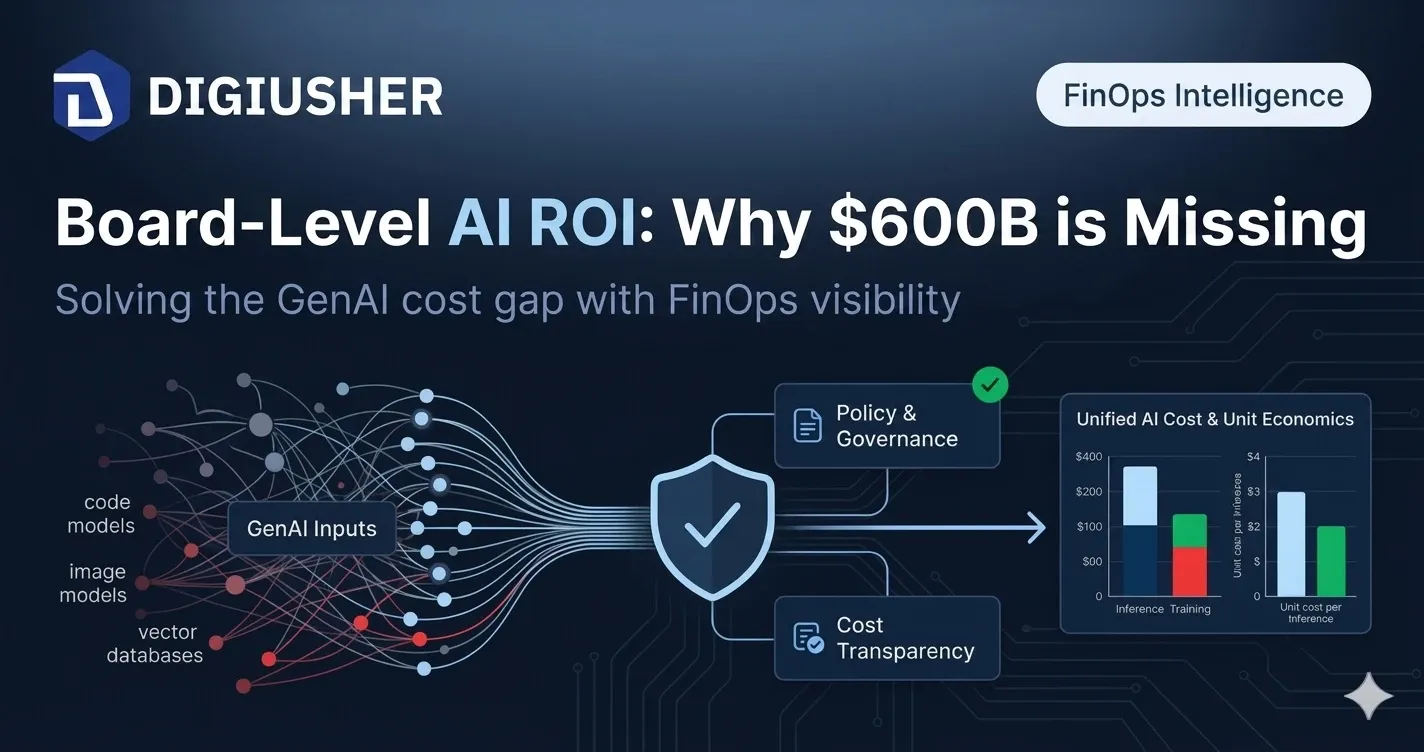
Board-Level AI ROI: Why $600B in Investment Is Delivering Single-Digit Returns — and What Fixes It
Only 7% of CFOs see high ROI from AI despite $270B in enterprise spend forecast for 2026. Here's the governance framework boards are demanding — and why cost attribution is the missing layer.
Seven Signals from the State of FinOps 2026: Why Technology Value Management Is Now a Board-Level Mandate
8% of FinOps teams now govern AI spend. Gartner forecasts $2.52T in global AI investment. The State of FinOps 2026 rewrites the rules for every CTO, CFO, and Head of FinOps.
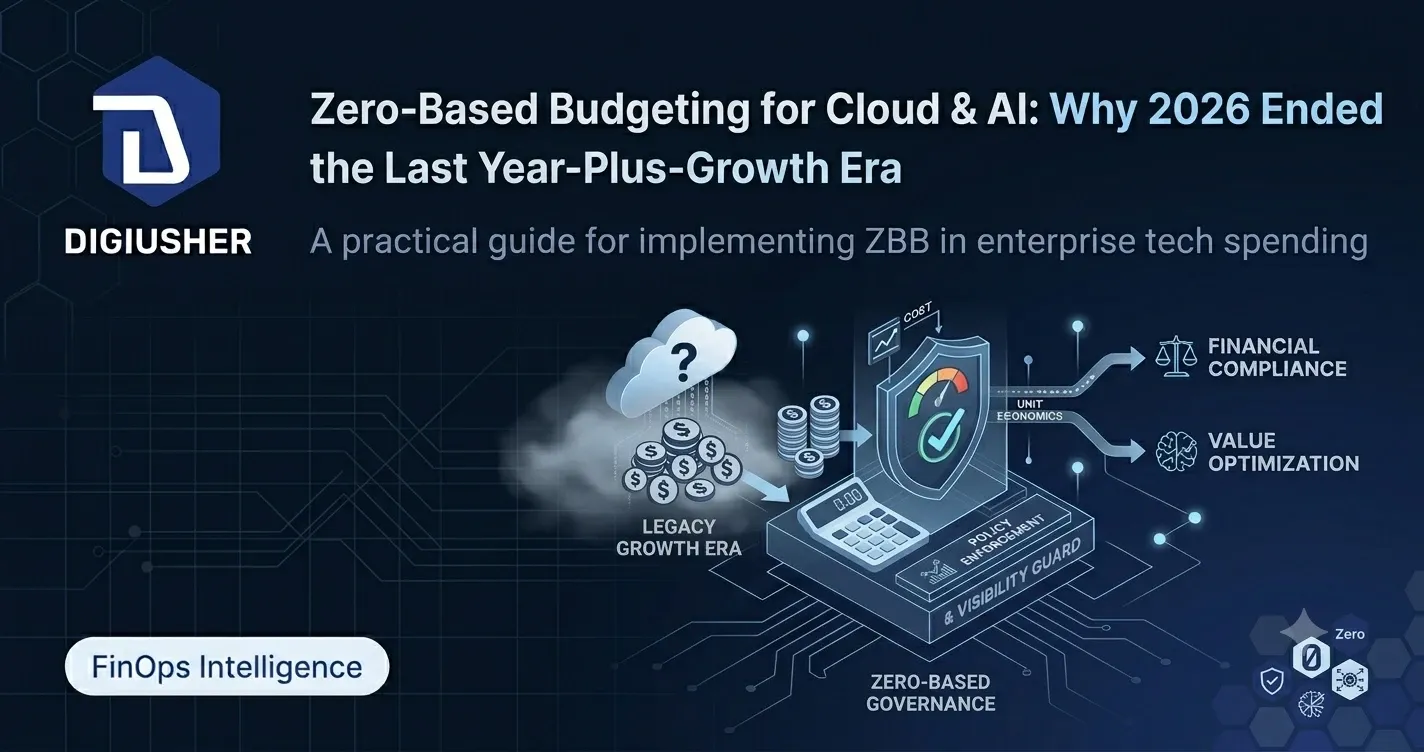
Zero-Based Budgeting for Cloud and AI: Why 2026 Ended the Last-Year-Plus-Growth Era
80–85% of enterprises miss AI cost forecasts by 25% or more. Zero-based budgeting is the discipline that ends the last-year-plus-growth model for cloud and AI spend.