FOCUS in Production: How DigiUsher's FOCUS-Native Engine Delivers Real-Time Allocation, AI Token Governance, and $1M in 45 Days (Blog 4/5 Series)
84% of enterprises report AI cost margin erosion. Only 14% achieve Kubernetes chargeback. FOCUS-native production architecture resolves both — here is the anatomy.
A large public listed Enterprise firm did not deploy DigiUsher to normalise billing data. It deployed DigiUsher to govern a multi-cloud technology estate at enterprise scale — and within 45 days, that governance delivered $1M in savings. Not from a reporting exercise. Not from a dashboard. From decisions made possible only when every cost in the estate is visible in real time, attributed to the right owner, and comparable across providers in a single query without normalisation lag.
That outcome is what the FOCUS-native architecture produces in production. This post is its anatomy.
The enterprise FinOps challenge in 2026 is not a tooling shortage. The market has more FinOps platforms than any organisation needs. The challenge is structural: 84% of enterprises report AI costs cutting gross margins by more than 6% (AI Cost Governance Report 2025), yet only 15% can forecast those costs within ±10%. 70% of Kubernetes CPU and memory requests are never utilised (CAST AI 2025) — three consecutive years of the same number — and only 14% of organisations running Kubernetes have implemented chargeback (CNCF 2024). These are not governance failures from a lack of intent. They are governance failures from a lack of the right data, at the right speed, in the right schema.
This post covers six production capabilities that require FOCUS-native architecture — and could not be delivered at the same quality or speed from a platform operating a proprietary schema or a compatibility layer: real-time multi-cloud allocation, AI token governance, GPU idle detection and agentic kill-switches, Kubernetes namespace chargeback under FOCUS 1.3, the European energy utility outcome anatomy, and contract commitment tracking at regulated enterprise scale.
Executive Summary
- 84% of enterprises report AI costs eroding gross margins by more than 6% — driven by ungoverned inference architectures, prompt inflation, and GPU infrastructure that sits idle 95% of the time
- Only 14% of organisations running Kubernetes have implemented chargeback — the 86% that have not absorb shared cluster costs as unattributed overhead that compounds with every new team onboarded to shared infrastructure
- FOCUS 1.3’s five Allocation columns — AllocatedMethodID, AllocatedMethodDetails, AllocatedResourceID, AllocatedResourceName, AllocatedTags — transform Kubernetes chargeback from a political dispute into an auditable, specification-backed governance process
- FOCUS 1.2’s virtual currency lifecycle columns provide the data foundation for AI unit economics: cost per token, cost per inference, and cost per business outcome — the metrics the board is asking for but most FinOps teams cannot yet produce
- A European energy utility achieved €1M in savings within 45 days of DigiUsher deployment — not from a single optimisation action but from four simultaneous governance improvements that became visible the moment FOCUS-native schema unified the multi-cloud estate
- Average enterprise AI budget grew from $1.2M to $7M in two years (IDC FutureScape 2026); governance capability must scale at the same rate or margins continue to erode
From Data Model to Decision: How FOCUS-Native Changes Speed of Insight
The most underappreciated benefit of FOCUS-native architecture in production is not the cost of building fewer ETL pipelines. It is the elimination of the delay between cost being incurred and cost being visible to the people who need to act on it.
In a platform built on a proprietary internal schema, billing data arrives from multiple providers, passes through transformation pipelines, gets mapped to internal dimensions, is reconciled against the platform’s own cost model, and eventually surfaces in dashboards — a process that, for multi-cloud enterprises with several providers, introduces 24 to 48 hours of analytical lag at minimum. For AI workload costs, where token consumption can spike 100x overnight when a prompt inflation issue or a recursive agentic loop enters production, 48-hour lag is not a governance inconvenience. It is a governance failure. The cost has already compounded by the time anyone sees it.
In a FOCUS-native platform, billing data arrives from providers in the FOCUS schema and is queryable in that schema immediately. There is no transformation pipeline between the provider’s FOCUS export and the analytical surface. AWS EffectiveCost is the value AWS placed in the FOCUS EffectiveCost column. Azure OpenAI ConsumedQuantity is the token count Azure reported in the FOCUS virtual currency lifecycle row. No intermediate translation. No proprietary reinterpretation. No lag introduced by mapping logic that runs on an ingestion schedule.
For platform engineering and FinOps teams managing estates where AI workload costs are volatile and Kubernetes cluster costs are shared across dozens of teams, this architectural difference translates directly into the quality of decisions they can make. Real-time visibility at FOCUS schema granularity means anomaly detection can fire on actual FOCUS data rather than on derived approximations. Budget alerts trigger on FOCUS EffectiveCost as it accumulates, not on a lagged proxy metric. Agentic kill-switches engage when token consumption crosses FOCUS ConsumedQuantity thresholds in the current charge period, not when a dashboard catches up to yesterday’s usage.
Speed of insight is the production benefit that accumulates invisibly across every day of normal operations — and becomes the most visible capability the moment an AI cost emergency or a commitment coverage gap surfaces at the wrong time.
Multi-Cloud Allocation in Real Time: No ETL Lag, No Schema Translation
Multi-cloud cost allocation fails at the data layer before it fails at the governance layer. The allocation model may be well-designed, the hierarchy may be thoughtfully structured, and the chargeback rules may be precisely calibrated — but if the underlying cost data from five cloud providers is arriving through five separate ETL pipelines at different cadences, in different schemas, with different cost column semantics, the allocation output will carry accumulated normalisation error that no governance process can fully correct.
FOCUS-native multi-cloud allocation eliminates the ETL layer between the providers and the query surface. When AWS, Azure, GCP, OCI, and Alibaba Cloud all produce FOCUS-format billing exports, and the FinOps platform ingests those exports directly into FOCUS columns, a cost allocation query that groups by ServiceCategory, aggregates EffectiveCost, and filters by Tags runs against a single schema that carries consistent semantics across all five providers simultaneously.
Multi-Cloud Allocation Query — FOCUS-Native vs Proprietary Schema
──────────────────────────────────────────────────────────────────────────────
Task: Total compute EffectiveCost by cost centre, all providers, current month

FOCUS-Native (DigiUsher):
──────────────────────────────────────────────────────────────────────────────
SELECT
  Tags['CostCentre']      AS cost_centre,
  SUM(EffectiveCost)      AS total_effective_cost,
  BillingCurrency
FROM focus_cost_and_usage
WHERE
  ChargePeriodStart >= DATE_TRUNC('month', CURRENT_DATE)
  AND ServiceCategory = 'Compute'
GROUP BY Tags['CostCentre'], BillingCurrency
ORDER BY total_effective_cost DESC;

Result: One query. Five clouds. Consistent EffectiveCost semantics.
Response time: Sub-second on current period data.
──────────────────────────────────────────────────────────────────────────────

Proprietary Schema (compatibility-layer platform):
──────────────────────────────────────────────────────────────────────────────
Step 1: Run AWS normalisation pipeline → proprietary EC2 rows
Step 2: Run Azure normalisation pipeline → proprietary VM rows
Step 3: Run GCP normalisation pipeline → proprietary GCE rows
Step 4: Map each provider's service to internal 'compute' category
Step 5: Reconcile cost column semantics per provider
Step 6: Join to internal dimension table for cost centre attribution
Step 7: Aggregate and deduplicate

Result: One query against the internal schema.
Prerequisite: Steps 1-6 must have completed on their respective schedules.
Lag: 24–48 hours minimum for full multi-cloud data availability.
──────────────────────────────────────────────────────────────────────────────
The allocation accuracy difference between these two approaches is not marginal. It is structural. Every intermediate transformation in steps one through six introduces a potential error: a service mapped to the wrong internal category, a cost column interpreted differently for one provider than another, a tag normalised with different rules for different clouds. These errors do not surface as single-point failures. They surface as persistent, low-level discrepancies between what the FinOps platform reports and what appears on the provider invoice — the discrepancies that finance teams flag every month and that FinOps practitioners spend days investigating.
FOCUS-native allocation eliminates this error class by design: the provider’s data is the platform’s data, translated by nobody.
AI Token Governance Through FOCUS: From Monthly Surprises to Daily Control
The average enterprise AI budget grew from $1.2M per year in 2024 to $7M in 2026 (IDC FutureScape 2026). That five-year trajectory would represent growth. Compressed into two years, it represents a governance crisis. 84% of enterprises report AI costs cutting gross margins by more than 6%. Only 15% can forecast AI costs within ±10%. Nearly one in four miss by more than 50%.
The reason AI costs are so difficult to forecast is structural. Cloud workload costs scale with provisioning decisions that engineers make deliberately. AI inference costs scale with model behaviour, prompt architecture, context window size, and request volume — patterns that can shift by an order of magnitude when a single prompt template changes or when an agentic workflow introduces a recursive loop that no one designed for. AI costs accumulate every second a model is serving requests. The unit is the token. The bill is the accumulation of billions of them.
FOCUS 1.2’s virtual currency lifecycle columns are the specification’s answer to this governance problem. They provide the data structure required to govern AI token consumption at the level of precision the problem demands.
FOCUS 1.2 AI Token Governance — Column Reference
──────────────────────────────────────────────────────────────────────────────
Column                          Definition in AI Context
──────────────────────────────────────────────────────────────────────────────
ServiceCategory                 'AI' — normalised across Azure OpenAI,
                                AWS Bedrock, Google Vertex AI, Databricks

ServiceName                     Provider's model service name
                                (e.g., 'Azure OpenAI Service',
                                'Amazon Bedrock', 'Vertex AI')

ConsumedQuantity                Token count consumed in the charge period
                                (input + output tokens per billing row)

ConsumedUnit                    'tokens' — provider's unit label

PricingCurrencyListUnitPrice    Per-token list rate in pricing currency

PricingCurrencyEffectiveCost    Amortised token cost after committed
                                rate discounts — the primary metric
                                for AI unit economics

BilledCost                      Invoice amount for the charge period —
                                for cash flow and AP reconciliation

Tags                            Applied at application layer: product,
                                team, model version, use case, workflow ID

ChargeType                      'Usage' for inference, 'Purchase' for
                                committed token/credit purchases
──────────────────────────────────────────────────────────────────────────────
DigiUsher ingests Azure OpenAI, AWS Bedrock, Google Vertex AI, Databricks, and direct API provider billing data in FOCUS 1.2 format. Every token consumption row arrives in the FOCUS schema with ConsumedQuantity, PricingCurrencyEffectiveCost, and ServiceCategory: AI pre-populated by the provider. No custom ETL interprets token billing. No proprietary model translates inference units into an internal cost metric.
The governance capabilities that flow from this are direct.
Token budget caps are configured per product, per team, and per agentic workflow. When ConsumedQuantity accumulated within a ChargePeriodStart window crosses a defined threshold for a given Tags['Product'] value, DigiUsher triggers an alert — and optionally a governance action — before the billing period closes. The cap enforces against FOCUS data, not against a derived metric built from API logs.
AI unit economics — the board-level metric — is calculated as PricingCurrencyEffectiveCost divided by ConsumedQuantity, aggregated by Tags['UseCase'] or Tags['Product']. Cost per token by product, cost per inference by model version, cost per customer interaction by channel: all derivable from a single FOCUS query across all AI providers in the estate.
Burn-down analysis for committed token purchases tracks ConsumedQuantity accumulated against the ContractCommitmentQuantity in the FOCUS 1.3 Contract Commitment dataset — providing daily visibility into whether committed token volumes are being consumed at the rate required to avoid overage charges or to justify the commitment size at renewal.
Cross-provider cost comparison — GPT-4o versus Claude versus Gemini versus a fine-tuned open-source model — is a direct query when all providers produce FOCUS 1.2 billing data. PricingCurrencyEffectiveCost per ConsumedQuantity by ServiceName returns cost per million tokens for every AI provider in the estate, in the same currency, using the same metric definition. Model routing decisions — which model tier to use for which task class — become financially rigorous rather than architecturally approximate.
GPU Idle Detection and Agentic Kill-Switches: The Second Layer of AI Cost Control
GPU infrastructure sits idle 95% of the time in typical enterprise deployments (VentureBeat Q1 2026). At $2.01 per GPU-hour for an H100 at on-demand pricing, a 100-GPU node pool running at 5% utilisation accumulates $2.01 × 100 × 24 = $4,824 per day in infrastructure cost against which only $241 of capacity is delivering active inference throughput. The remaining $4,583 is provisioned headroom billing at full rate.
Token-based AI API costs are visible in FOCUS virtual currency lifecycle rows. GPU infrastructure costs are visible in FOCUS compute rows — the same ServiceCategory: Compute rows that describe EC2, Azure VM, and GCP Compute Engine instances — with no native signal in the billing data indicating whether those GPU instances were processing inference at full capacity or sitting idle. The gap between what the bill says and what the infrastructure was actually doing is the governance problem GPU idle detection solves.
DigiUsher resolves this by correlating FOCUS compute cost rows for GPU instance types — identifiable through ServiceName and ResourceType filtering for GPU SKUs — against actual inference request telemetry from the AI platform layer. Where a GPU instance is billing at full on-demand rate and the corresponding inference request log shows near-zero throughput for that time window, DigiUsher surfaces the idle capacity cost as a governance alert: a specific resource, a specific cost, a specific time window of waste.
The agentic kill-switch addresses a different but related failure mode. Agentic AI workflows — autonomous systems that chain multiple model calls, execute tool invocations, and iterate on retrieval — can enter runaway consumption patterns where recursive loops, prompt expansion, or tool call failures cause token consumption to escalate far beyond intended design parameters. Unlike a static inference request that returns a result in one call, an agentic workflow in a failure state can continue consuming tokens indefinitely until it is interrupted.
DigiUsher implements agentic kill-switches as rate-based governance policies: when ConsumedQuantity accumulated within a defined rolling window for a specific Tags['WorkflowID'] exceeds a configured multiple of the workflow’s baseline consumption pattern, the policy triggers an automated intervention — a notification to the engineering team, a rate limit applied at the API gateway layer, or a workflow suspension. The trigger fires on FOCUS data in the current period, not on a retrospective analysis. The intervention happens before the billing period closes.
Kubernetes Namespace Chargeback: FOCUS 1.3 Shared Cost Allocation in Production
Only 14% of organisations running Kubernetes have implemented chargeback (CNCF 2024). The primary reason is not technical. It is political. Kubernetes cost allocation has historically produced numbers that no one fully trusts — because the methodology for splitting shared cluster costs was invisible, auditing it was impossible, and the resulting disagreements between platform teams and product teams consumed more organisational energy than the chargeback was worth.
FOCUS 1.3’s Allocation columns change this specific dynamic. The five new columns — AllocatedMethodID, AllocatedMethodDetails, AllocatedResourceID, AllocatedResourceName, and AllocatedTags — do not change how Kubernetes costs are split. They document how the split was made, in the billing data, alongside the cost figure it produced.
DigiUsher’s Kubernetes cost governance process in production operates in four stages.
Stage One — Cluster Cost Ingestion. Cloud provider billing data for Kubernetes node pools, persistent volumes, and cluster management fees arrives in DigiUsher in FOCUS format — ServiceCategory: Containers, ServiceName: Amazon EKS or Azure Kubernetes Service or Google Kubernetes Engine, with cluster-level ResourceID and ResourceName. DigiUsher combines these infrastructure cost rows with workload-level utilisation data from cluster metrics to produce namespace-level cost attribution.
Stage Two — Shared Cost Documentation. The cluster control plane, ingress layer, monitoring stack (Prometheus, Grafana, kube-state-metrics), and kube-system namespace generate costs that belong to the platform, not to any single application namespace. DigiUsher records the allocation of these shared costs using the FOCUS 1.3 Allocation columns: AllocatedMethodID carries the allocation policy identifier, AllocatedMethodDetails documents whether the split is proportional by namespace CPU request, by actual CPU utilisation, or by a flat platform overhead fee. Finance teams and product teams can audit the exact methodology from the billing data row.
Stage Three — Namespace-Level Attribution. Application namespaces receive their allocated cluster cost — compute nodes proportional to resource requests or actual utilisation, persistent volume costs by claim, and a documented share of shared platform overhead. FOCUS Tags applied to Kubernetes resources via namespace labels flow through to the allocation model: cost-centre, team, product, environment. Cross-namespace cost aggregation by business dimension is a GROUP BY query against FOCUS Tags.
Stage Four — Chargeback Reports. Kubernetes namespace costs appear in the same FOCUS-schema chargeback report as cloud infrastructure, AI token, and SaaS costs. Finance teams reconcile one unified report — not a separate Kubernetes cost allocation spreadsheet alongside the cloud cost report.
Kubernetes Chargeback — FOCUS 1.3 Allocation in Practice
──────────────────────────────────────────────────────────────────────────────
Cluster:              production-eks-eu-west-1
Monthly node cost:    $28,400 (AWS EKS, 12× m6i.4xlarge)
Shared infra cost:    $2,100 (control plane, ingress, monitoring)
──────────────────────────────────────────────────────────────────────────────
Namespace             Alloc Method      Allocated Cost    AllocatedMethodID
──────────────────────────────────────────────────────────────────────────────
payments-api          CPU utilisation   $8,920            CPU_UTIL_WEIGHTED
data-pipeline         CPU utilisation   $6,440            CPU_UTIL_WEIGHTED
customer-portal       CPU utilisation   $4,680            CPU_UTIL_WEIGHTED
ml-inference          CPU utilisation   $5,320            CPU_UTIL_WEIGHTED
shared-platform       Platform fee      $2,100            PLATFORM_FLAT_FEE
kube-system           Platform fee      Included above    PLATFORM_FLAT_FEE
──────────────────────────────────────────────────────────────────────────────
AllocatedMethodDetails: "Proportional allocation by 30-day rolling average
CPU utilisation per namespace. Shared platform overhead allocated as fixed
monthly fee across all application namespaces. Methodology documented per
FOCUS 1.3 specification sections 6.4.2 and 6.4.3."
──────────────────────────────────────────────────────────────────────────────
Finance team audit path: AllocatedMethodID → allocation policy registry →
documented calculation rules → cluster metrics data source.
Political dispute surface area: eliminated.
──────────────────────────────────────────────────────────────────────────────
The documentation of allocation methodology in the billing data row itself is the change that makes Kubernetes chargeback politically tractable. Product teams can verify their namespace’s share is calculated on the same documented basis as every other namespace. Platform teams can demonstrate their allocation logic is specification-backed. Finance teams can audit without requiring a custom query against cluster metrics.
The €1M Proof Point: European Enterprise (Public Traded Utility Firm) Case Anatomy
A large public listed Enterprise firm deployed DigiUsher across a multi-cloud estate — Azure as the primary infrastructure provider, with AWS and GCP workloads running in parallel across different operational divisions, each with their own procurement and technology governance track record. The organisation’s FinOps function had existed for two years before DigiUsher deployment, producing monthly reports from a combination of native cloud cost tools and a FinOps platform operating a proprietary normalisation schema. The reports were accurate at the account level. They were not actionable at the workload level. And they arrived, inevitably, after the month had closed.
The GSI delivery team deployed DigiUsher in the first week. FOCUS-native ingestion of Azure, AWS, and GCP billing exports required no ETL pipeline construction — the providers’ FOCUS-format billing data mapped directly into DigiUsher’s query surface. DigiUsher’s FOCUS-extended schema added Kubernetes namespace attribution for the organisation’s AKS clusters within the same deployment. Full estate visibility — multi-cloud, Kubernetes, and AI workload costs — was available in a single query surface within the first 72 hours of deployment.
The €1M saving emerged from four governance improvements that became simultaneously visible in the first week, each of which would have required separate investigation workflows in the organisation’s prior tooling.
Commitment coverage gaps across regions. The organisation held significant Azure Reserved Instance and AWS Savings Plan commitments purchased at the portfolio level. DigiUsher’s FOCUS CommitmentDiscountStatus and CommitmentDiscountCategory columns revealed that Reserved Instance utilisation in three Azure regions fell below 40% — while the same workload types ran on on-demand compute in two adjacent regions that the commitment purchasing cycle had not covered. The uncovered on-demand spend was running at list rate against committed capacity sitting under-utilised in the wrong regions. Real-time visibility against FOCUS EffectiveCost versus ListCost at the regional level — available from day one — quantified the gap. Commitment rebalancing decisions were made in week two.
GPU idle time in AI inference workloads. Two operational divisions had provisioned Azure GPU VM node pools for AI inference workloads supporting predictive maintenance and energy demand forecasting models. DigiUsher’s GPU idle detection correlated FOCUS compute rows for GPU SKUs against inference request telemetry, revealing that one division’s GPU pool was operating at 8% average utilisation across business hours and near-zero utilisation overnight — while billing at full on-demand rate 24 hours a day. A scale-to-zero schedule for off-peak hours and a downsize of peak-capacity node pool configuration reduced that division’s GPU infrastructure cost by 61% within three weeks.
Untagged compute across account boundaries. The organisation’s AWS estate included 23% of running EC2 instances with no cost centre tag — the result of two years of engineering team growth outpacing the tagging governance programme. In the prior tooling, these appeared as unallocated costs absorbed at the account level. DigiUsher’s FOCUS ResourceType and ResourceName columns, cross-referenced against the organisation’s CMDB data loaded via Tags, allowed the FinOps team to attribute 78% of the previously untagged compute to specific cost centres by resource naming convention — without requiring engineering teams to re-tag infrastructure. The attribution surfaced €340K in compute costs that had been reported as ungoverned overhead for 18 months.
Data egress double-counting across cloud boundaries. The organisation moved analytical data between Azure Blob Storage and AWS S3 as part of a cross-cloud analytics architecture. Data egress charges appeared in both providers’ billing — Azure charged for outbound data transfer, AWS charged for inbound data processing and API calls. In the prior tooling, these appeared as separate cost lines in separate provider dashboards. In DigiUsher’s unified FOCUS schema, both provider rows carried ServiceCategory: Networking with Tags['DataPipeline'] allowing the cross-provider data movement cost to be aggregated as a single architectural expense — and to be assessed against the alternative of consolidating the analytics workload on a single cloud. The architectural decision to consolidate eliminated the cross-cloud egress cost entirely.
The combination of these four improvements — commitment rebalancing, GPU idle reduction, untagged compute attribution, and egress elimination — produced the €1M saving within 45 days. Each of the four was visible from the first week. The speed of the outcome was a direct function of the speed of insight: no ETL lag, no normalisation wait, no separate tool per cloud. One FOCUS schema, one query surface, immediate governance action.
Contract Commitment Tracking at Regulated Scale
FOCUS 1.3’s Contract Commitment dataset solves a governance problem that scale makes urgent and regulation makes mandatory: the need to know, at any point in the month, the exact status of every active technology contract commitment — its remaining units, its burn-down trajectory, and its expiry profile — without joining cost and usage data against separately maintained procurement records.
For regulated enterprises managing hundreds of Reserved Instance and Savings Plan commitments across multiple clouds, plus enterprise software contract terms for SaaS and AI providers, the Contract Commitment dataset provides a single, permissioned, auditable record of all active commitment terms. A query against the dataset returns every active commitment with its ContractCommitmentPeriodStart, ContractCommitmentPeriodEnd, ContractCommitmentQuantity (total committed units), and current ConsumedQuantity from the cost and usage dataset — enabling real-time commitment coverage and burn-down analysis without a data join across two schemas.
DigiUsher surfaces the Contract Commitment dataset as a first-class governance view alongside cost and usage data. For a regulated bank deploying DigiUsher in a BYOC self-hosted configuration — where billing data never leaves the institution’s infrastructure perimeter — the Contract Commitment dataset is available with the same schema integrity as the cloud deployment. Commitment terms, expiry dates, and burn-down trajectories are queryable by treasury and procurement teams with appropriate permissions, separately from the full cost and usage dataset that the FinOps team accesses.
The practical governance improvement is specific. A $4.2M AWS Enterprise Agreement commitment renewing in 90 days requires a burn-down analysis showing whether current consumption will exhaust the commitment before expiry — or whether renegotiation of commitment terms is required to avoid under-utilisation penalties. Before the FOCUS Contract Commitment dataset, this analysis required exporting commitment data from AWS Cost Explorer, joining it against normalised cost data in the FinOps platform, and reconciling the result against the original contract document. With the FOCUS Contract Commitment dataset in DigiUsher, the same analysis is a single query against two FOCUS datasets — and the result is auditable against the specification-defined column definitions rather than a custom join that carries its own normalisation assumptions.
DigiUsher implements every capability described in this post natively — across multi-cloud infrastructure on AWS, Azure, GCP, OCI, and Alibaba Cloud; Kubernetes clusters across EKS, AKS, GKE, and OKE; AI workloads on Azure OpenAI, AWS Bedrock, Google Vertex AI, Databricks, and direct API providers; and the full SaaS and data platform layer such as Salesforce, O365, and Google Workspace. The FOCUS 1.3 Contract Commitment dataset, Allocation columns, data freshness metadata, and FOCUS 1.2 virtual currency lifecycle columns are all available as first-class fields in DigiUsher’s production query surface — not as derived approximations, but as the provider-specified values that arrive in FOCUS-format billing exports.
For regulated enterprises requiring data sovereignty, DigiUsher’s BYOC deployment maintains full FOCUS schema integrity inside the customer’s own infrastructure perimeter — the same FOCUS-native schema that governs the managed cloud deployment, with no vendor-managed schema components required inside the customer’s environment. A leading private bank deploys DigiUsher in this configuration.
Global SI partners — including Infosys, Wipro, Hexaware, Persistent Systems, Coforge — deliver DigiUsher implementations at enterprise scale. Delivery teams work against the FOCUS column library, not a proprietary schema, which means the implementation knowledge compounds across engagements rather than being siloed inside a single vendor’s technical documentation.
DigiUsher is available on AWS Marketplace (AWS ISV Accelerate Partner), Azure Marketplace (Azure ISV Co-Sell Ready, MACC-eligible), and GCP Marketplace. Flat enterprise licensing — not priced as a percentage of cloud spend. SOC 2 Type II certified. GDPR compliant.
Frequently Asked Questions
What is AI unit economics in FinOps?
AI unit economics is the per-output cost measurement framework that attributes AI inference spend — token consumption, GPU compute, model API calls, and agentic chain execution — to specific business outcomes. Key metrics are cost per token, cost per inference, cost per resolved ticket, and cost per automated decision. Calculated using FOCUS 1.2 virtual currency lifecycle columns: ConsumedQuantity, ConsumedUnit, and PricingCurrencyEffectiveCost. Without FOCUS-native AI billing ingestion, unit economics require custom ETL that combines cloud billing with AI provider API logs — introducing 24 to 48 hours of analytical lag and producing metrics finance teams cannot audit against provider invoices.
How does FOCUS handle AI token billing and governance?
FOCUS 1.2 introduced virtual currency lifecycle columns for AI governance: ConsumedQuantity (token count), ConsumedUnit (provider’s billing unit), PricingCurrencyListUnitPrice (per-unit list rate), and PricingCurrencyEffectiveCost (amortised token cost after commitment discounts). These columns are populated by Azure OpenAI, AWS Bedrock, Vertex AI, and Databricks in their native FOCUS exports — making token-level attribution, burn-down analysis, and budget cap governance available from a single FOCUS query without custom pipeline engineering.
What is the Platform Team Financial Control Plane?
The Platform Team Financial Control Plane is the governance architecture embedded at the platform engineering layer that provides real-time cost attribution, chargeback, and policy enforcement for shared infrastructure — Kubernetes clusters, shared API gateways, multi-tenant AI inference environments — without requiring application teams to instrument workloads for cost visibility. It operates on FOCUS-native schema: namespace-level EffectiveCost from ResourceName and Tags columns, allocation methodology documentation from FOCUS 1.3 Allocation columns, and automated governance policies that trigger from FOCUS data rather than from custom telemetry.
How does DigiUsher deliver Kubernetes namespace chargeback?
DigiUsher maps Kubernetes cluster costs into FOCUS columns — ServiceCategory: Containers, ResourceName: namespace, EffectiveCost — and documents shared infrastructure cost allocation using FOCUS 1.3 AllocatedMethodID and AllocatedMethodDetails columns. The allocation methodology is recorded in the billing data row alongside the cost figure, making Kubernetes chargeback auditable rather than opaque. FOCUS Tags from Kubernetes namespace labels flow through to the allocation model for cross-namespace business dimension aggregation.
Why did the Enterprise firm, a customer of DigiUsher, achieve €1M in savings in 45 days?
Four governance improvements became simultaneously visible when FOCUS-native schema unified the estate’s billing data: Reserved Instance coverage gaps across Azure regions, GPU idle time in AI inference node pools, untagged compute attributed by resource naming convention, and cross-cloud data egress double-counting. Each was quantified within the first week of deployment. Governance decisions executed over the following 44 days produced the combined €1M saving. The speed was a function of FOCUS-native real-time visibility — no ETL lag, no normalisation wait, one query surface across all providers.
How does DigiUsher govern agentic AI costs?
Through three mechanisms: token budget caps defined per product, team, or workflow that trigger alerts when FOCUS ConsumedQuantity crosses thresholds; per-chain attribution using FOCUS Tags applied at the orchestration layer for cost-per-workflow analysis; and automated kill-switches that halt or downgrade AI workflows when consumption-rate anomalies are detected in real time against FOCUS data in the current charge period.
What is GPU idle detection in FinOps?
GPU idle detection identifies provisioned GPU capacity not actively processing inference requests — GPU infrastructure that sits idle 95% of the time in typical enterprise deployments yet bills at full on-demand rate continuously. DigiUsher surfaces GPU idle time by correlating FOCUS compute rows for GPU instance SKUs against actual inference request telemetry, identifying time windows where GPU capacity is billing at full rate while generating near-zero throughput.
How does FOCUS 1.3 shared cost allocation work for Kubernetes?
FOCUS 1.3’s five Allocation columns — AllocatedMethodID, AllocatedMethodDetails, AllocatedResourceID, AllocatedResourceName, AllocatedTags — document the methodology used to split shared Kubernetes cluster costs alongside the cost figure in every billing row. Before FOCUS 1.3, practitioners received an allocated cost number with no visibility into how it was calculated. FOCUS 1.3 makes the allocation methodology auditable — ending the political disputes that prevented most organisations from implementing Kubernetes chargeback.
References
- Mavvrik / AI Cost Governance Report 2025 — Primary source for 84% gross margin erosion, 15% forecast accuracy within ±10%, nearly 1 in 4 missing by more than 50% (September 2025)
- VentureBeat — Enterprise GPU Utilization: Why 95% of AI Infrastructure Spend Is Wasted — Source for 95% GPU idle time; cost-per-inference TCO priority jump from 34% to 41% in Q1 2026 (May 2026)
- IDC FutureScape 2026 — Source for average enterprise AI budget growth from $1.2M (2024) to $7M (2026); organisations will still underestimate AI infrastructure costs by up to 30% despite dedicated FinOps resources
- Spheron — AI Inference Cost Economics 2026 — Source for 55–80% of enterprise AI GPU spend going to inference rather than training (April 2026)
- CAST AI — Kubernetes Cost Benchmark 2025 — Source for 70% of requested Kubernetes CPU and memory resources never utilised — consistent for three consecutive years; sample: 2,100+ organisations (2025)
- CNCF — Annual Survey 2024 — Source for 49% of organisations seeing costs jump after Kubernetes adoption; only 14% running chargeback (2024)
- FinOps Foundation — State of FinOps Report 2026 — Source for full allocation as the #2 FinOps priority; 78% of FinOps practices reporting to CTO or CIO; 98% governing AI spend; 90% governing SaaS (2026)
- FinOps Foundation — FOCUS Specification: Introducing FOCUS 1.3 — Source for five Allocation columns (AllocatedMethodID, AllocatedMethodDetails, AllocatedResourceID, AllocatedResourceName, AllocatedTags), Contract Commitment dataset structure, data freshness metadata (December 2025)
- FinOps Foundation — Introducing FOCUS 1.2 — Source for virtual currency lifecycle columns: ConsumedQuantity, ConsumedUnit, PricingCurrencyListUnitPrice, PricingCurrencyEffectiveCost; Cloud+ unified reporting (May 2025)
- DigiUsher — The Death of Chargeback: Why Cost Allocation Is Failing in the Kubernetes and AI Era — Source for 30–50% of cloud resources untagged; $400M collective agentic AI spend leak in Fortune 500 in Q1 2026; 73% of FinOps teams reporting AI costs exceeded projections
- Ecosystm — The Emerging Economics of Enterprise AI: A Practical Guide for 2026 — Source for spiky AI spend patterns, GPU and accelerator economics, diverse consumption model complexity; shift from cost of compute to cost per outcome (February 2026)
- Microsoft Azure — What is FOCUS? Cost Management Documentation — Source for Azure FOCUS dataset efficiency: 49% fewer rows, ~30% smaller data size; FOCUS virtual currency lifecycle column documentation (2025)
The €1M saving was not a reporting achievement. It was a governance achievement — made possible because the data was right, the schema was unified, and the insight arrived before the billing period closed.
See DigiUsher’s FOCUS-native production capabilities across your estate in 30 minutes
DigiUsher delivers every capability in this post in production today — real-time multi-cloud allocation, AI token governance with budget caps and agentic kill-switches, GPU idle detection, Kubernetes namespace chargeback with FOCUS 1.3 Allocation methodology documentation, and Contract Commitment tracking at regulated enterprise scale. In 30 minutes, we will walk you through a live demonstration against your estate architecture.
Available on AWS Marketplace (AWS ISV Accelerate Partner), Azure Marketplace (Azure ISV Co-Sell Ready, MACC-eligible), and GCP Marketplace. Flat enterprise licensing. SOC 2 Type II certified. GDPR compliant. BYOC deployment for regulated industries.
Request a 30-minute session → digiusher.com/request-a-demo
Related Posts
The Broken Cost Schema Problem: Why Every FinOps Team Is Solving the Same Problem from Scratch · 12 May 2026 The foundational problem this production architecture was built to solve — the billing schema fragmentation that makes real-time, cross-estate governance impossible before FOCUS.
FOCUS 1.3 Decoded: What Changed, What It Governs, and What It Means for Your FinOps Stack · 19 May 2026 The specification reference — the complete column-level anatomy of FOCUS 1.2 and 1.3, covering the virtual currency lifecycle, Allocation, and Contract Commitment capabilities underpinning every section of this post.
Why DigiUsher Rebuilt Its Cost Engine on FOCUS — and Why That Decision Is Now an Enterprise Advantage · 26 May 2026 The architectural story — why the production outcomes described in this post are only possible when the platform was built FOCUS-native from the ground up rather than adapting a proprietary schema.
FOCUS Is the New Procurement Standard: How the FinOps Industry’s Billing Specification Became a Vendor Evaluation Weapon · 9 June 2026 The evaluation framework — seven procurement questions that separate platforms delivering these production outcomes from those that cannot.
The Death of Chargeback: Why Cost Allocation Is Failing in the Kubernetes and AI Era · 28 April 2026 The governance context — why traditional chargeback models fail at the speed and granularity that Kubernetes and AI infrastructure demands, and what replaces them
DigiUsher in 30 min
Track every namespace cost without a spreadsheet.
DigiUsher attributes shared cluster spend down to the namespace and workload, across every cloud you run.
Book a 30-min walkthroughNo hard pitch · tailored to your stack
Continue Reading
More from the DigiUsher editorial team.
Reading the Skies: What Bessemer’s State of AI 2025 Means for Business Leaders, FinOps, and the Future of Cost Visibility
Bessemer's State of AI defined the era's growth archetypes — Q2T3, Supernovas, Shooting Stars. Eight months on, 2026 has answered with a harder question: velocity produces waste as fast as it produces value. Average enterprise AI budgets grew from $1.2M to $7M in two years. 73% of FinOps teams report AI costs exceeded original projections. Inference now accounts for 85% of enterprise AI spend. This updated executive playbook translates the Bessemer framework into the financial discipline enterprises need now
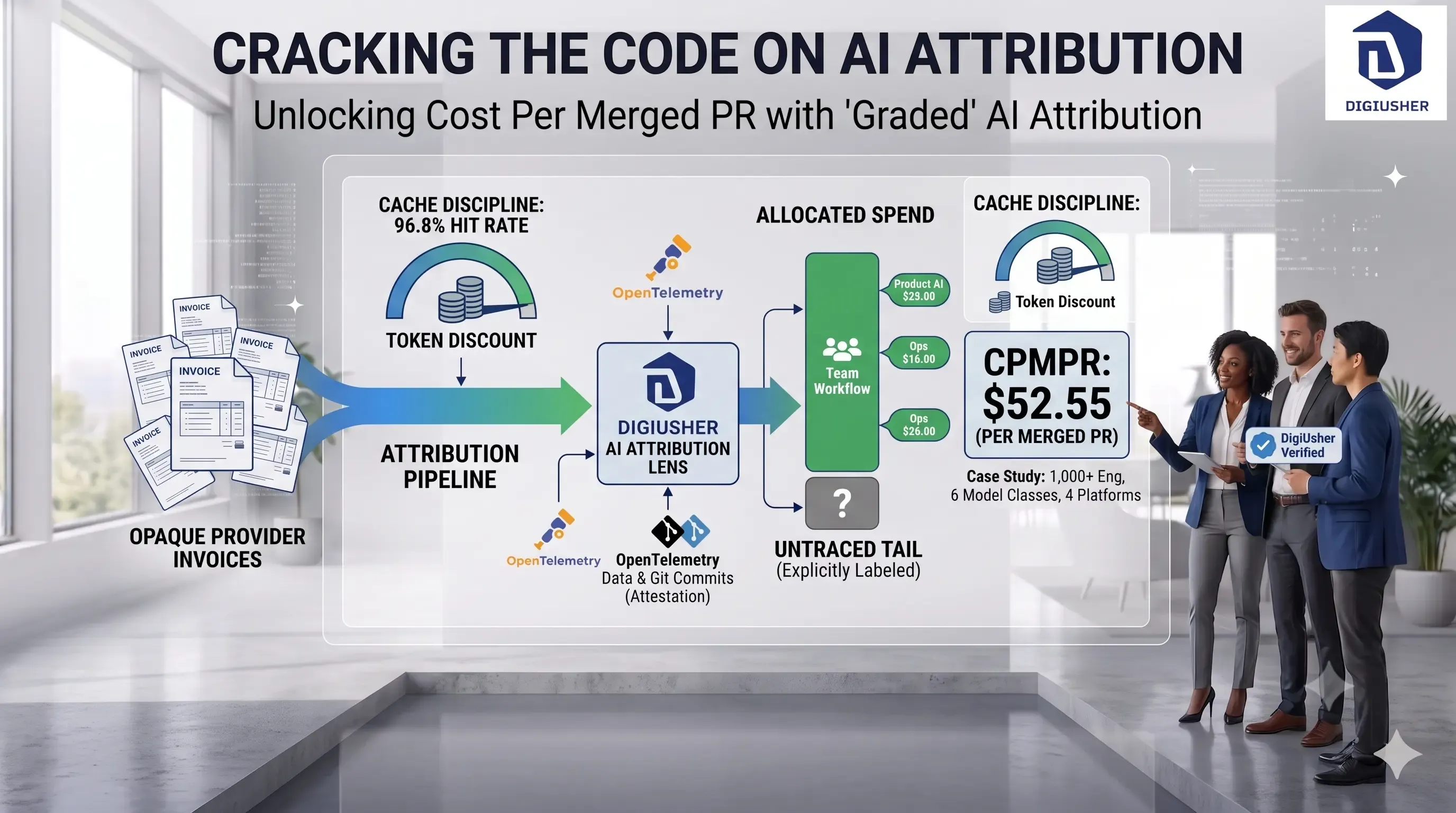
$52.55 Per Merged Pull Request: How One 1,000-Engineer Firm Priced Its Own AI Spend
A public technology firm with 1,000+ engineers refused to run its AI spend on faith. Here's the ledger it built instead — $52.55 per merged PR, 96.8% cache-hit rate, and a blended cost of $0.75 per million tokens.

AI Unit Economics: Why Your AI Invoice Can No Longer Answer the Board’s Question
98% of FinOps teams now manage AI spend, but almost none can price a merged pull request. Here's the framework for AI unit economics in 2026 — and why the invoice alone can't answer the board's question.