Product Update: Inside October Month of DigiUsher Platform Engineering
DigiUsher shipped five governed capability threads in October — a new SaaS domain: Salesforce, identity governance, anomaly triage and unit economics — with zero re-platforming.
Ninety percent of FinOps teams now manage or plan to manage SaaS spend, up from 65% a year ago, and most of them are still doing it in a separate tool from the one that governs their cloud bill. In October 2026, DigiUsher shipped five releases that close that gap and a few others: Salesforce costs in the FOCUS format next to cloud costs, anomaly detection with fewer false alarms and a named owner for every anomaly, fine-grained permissions through groups and roles, system-defined unit economics for every organization, and budgets that are set automatically from the last three months of cost. All of them are live for every customer, starting today.
This is what it means for you.
1. Salesforce costs in FOCUS, next to your cloud costs
Salesforce spend now uses the same FOCUS format we use for AWS, Azure and GCP.
How it works for you: connect Salesforce, and DigiUsher reads your invoices, including the PDFs. It parses the prices from those invoices and attributes licence cost to each user who holds a seat. File storage usage is included too. We show you the contracted rates taken directly from your invoices.
So we go beyond cloud spend. Your SaaS costs come into the same platform, in the format the industry has adopted, rather than a parallel tool with its own export. That matters more than it sounds: enterprises lose an average of $19.8M a year to unused and underutilised SaaS licences, and Gartner expects a 25% overspend penalty through 2028 for organisations without centralised SaaS visibility. Salesforce licensing and storage now show up as commitments alongside your existing cloud reservations, which is the condition under which that waste actually becomes visible.
2. Fewer false alarms, and an owner for every anomaly
We rebuilt our anomaly detection to cut false alarms. Each anomaly comes with a root cause analysis that points to the resources and SKUs behind it.
Anomalies now have a full lifecycle. Each one is assigned to an owning team and a person. When someone dismisses an anomaly, they record why, such as a planned event or business growth, and that reasoning feeds back into future detection. Every owner gets an inbox where they can compare expected cost with actual cost and see related anomalies on the same series.
Anomalies are also available through our MCP tools, so you can ask an assistant to dig further without leaving your workflow. This is worth building properly: 58% of AI projects now exceed their budget by more than 40%, and a chart nobody owns is a big part of why spend moves before anyone with the authority to act on it sees a credible signal.
3. Fine-grained permissions
Larger teams asked for access control that matches how they are actually organized. We launched groups and roles, so admins can manage access, add exceptions for individual users, and make sure each user sees only the cost data they are allowed to see.
Access control and cost attribution are really the same problem from two directions: attribution asks who a cost belongs to, access control asks who was authorised to see or change it. With 78% of FinOps practices now reporting into the CTO or CIO organisation rather than Finance, up from 61% in 2023, those two questions increasingly have to be answered by the same system, not two separate ones that have to be reconciled by hand.
4. System-defined unit economics
To make unit economics easier to start with, DigiUsher now provides ready-made metrics and formulas. As soon as you onboard your cloud account, you can see cost per unit on day one and build your own formulas from there.
A cost number on its own doesn’t tell you much. Spend falling 8% could mean anything. Cost per unit falling while output grows tells you exactly what’s working. System-defined unit economics is our term for making that second kind of number available immediately rather than something a practitioner has to build from scratch over several weeks: ready-made formulas on day one, extendable as your reporting needs grow.
5. Budgets on autopilot, with you in control
Every pool and your whole organization get a budget each month automatically, based on the average of the last three months. You can still set budgets in advance or override them at any time.
Budgets follow the FinOps Foundation framework. You see variance to actual and variance to forecast, whether each budget is on track, at risk or over, and a Crawl, Walk or Run accuracy rating once the month closes, measured against the Framework’s own targets of ≤20% variance for Crawl, ≤15% for Walk, and ≤12% for Run. That bar is real: only 15% of organisations currently meet the FinOps Foundation’s benchmark of 5% or lower spend-to-plan variance, and teams exceed their cloud budgets by an average of 17%. Add a budget widget to any dashboard to keep it in view without opening a separate report.
Also shipped
- Home page: rebuilt around savings, open items and quick links.
- SpendIQ: one query bar with a single field picker.
- Kubernetes: each node pool shows how much you save by moving from today’s cost to its planned size.
- Recommendations: new recommendations for AWS CloudWatch log groups and metric streams.
All of this is live for every customer now. If you’d like to see Salesforce costs or the anomaly inbox on your own data, get in touch.
Frequently Asked Questions
What does it mean to put Salesforce costs in the FOCUS format? FOCUS, the FinOps Foundation’s common billing schema already used across AWS, Azure and GCP inside DigiUsher, now covers Salesforce too. Connect Salesforce and DigiUsher reads the invoices, including PDFs, parses contracted rates, and attributes licence cost per seat, so it sits in the same reports, budgets and unit economics as your cloud spend rather than a separate SaaS tool.
How is this anomaly detection different from a basic cost-spike alert? A basic alert tells you a number moved. This one adds root cause analysis down to the resource and SKU, a named owner and an inbox, and a lifecycle that records why an anomaly was dismissed so future detection gets sharper.
Why does fine-grained access control matter for cost data? Because attribution without access control isn’t governance, it’s a report that can’t survive a disputed budget review. Groups and roles mean each person sees only the cost data they’re actually authorised to see.
How do system-defined unit economics work on day one? Ready-made metrics and formulas, cost per workload, cost per merged pull request, cost per pipeline run, are available the moment you connect a cloud account, instead of a blank canvas you build from scratch over several weeks.
How are the new automatic budgets calculated, and can I still set my own? From the trailing three-month average of actual cost, for every pool and the whole organization. You can set a budget in advance or override it at any time, and each month closes with a Crawl, Walk or Run accuracy rating against the FinOps Foundation’s own variance targets.
What should a FinOps team check before relying on automatic budgets? Whether the last three months are representative, rather than skewed by a one-off migration or a newly onboarded domain, and who on the team is expected to override the number when a known event is already on the calendar.
What happens if SaaS spend like Salesforce stays outside your FinOps platform? It stays invisible until the renewal, reconciled by hand if at all, and absent from every budget, anomaly and unit economics view you already rely on for cloud. Enterprises lose an average of $19.8M a year to SaaS licence waste alone.
Five releases this month: SaaS in FOCUS, anomalies with owners, access that matches your org chart, unit economics by default, budgets that run themselves. All live, all today.
If you’d like to see Salesforce costs or the anomaly inbox on your own data, get in touch.
Book my 15-min discovery call → · SOC 2 Type II · GDPR · FOCUS-conformant
Continue Reading
- Product Updates - Budgets Re-egineered to Purpose Driven (Sep 21, 2026) — the September release that set up the Budgets domain this month builds on.
- $52.55 Per Merged Pull Request: How One 1,000-Engineer Firm Priced Its Own AI Spend (Jul 21, 2026) — a real customer’s cost-per-merged-PR ledger.
- AI Unit Economics: Why Your AI Invoice Can No Longer Answer the Board’s Question (Jul 16, 2026) — the framework behind this release’s default unit economics.
- Why Shadow IT Is a Financial Risk, Not an IT Problem (Mar 3, 2026) — the governance gap Salesforce-in-FOCUS is built to close.
- Most FinOps Programs Stall at “Inform” — and Never Reach Optimize (Jul 14, 2026) — why anomalies with no owner keep programs stuck reporting instead of acting.
References
- FinOps Foundation — State of FinOps 2026
- FinOps Foundation Framework — Budgeting, Crawl/Walk/Run Variance Targets
- Gartner, cited in SaaS Spend Waste Analysis (2026)
- Zylo — 2026 SaaS Management Index
- Gartner — Identity and Access Management Market Forecast, 4Q25
- FinOps Foundation benchmark, cited via Apptio Cloudability
- FinOps Foundation 2026 budget variance data, cited via Sedai
- Gartner, cited in FinOps AI Spending Analysis (2026)
© 2026 DigiUsher Limited. All rights reserved. Privacy Policy · Terms of Service · Trust Center
DigiUsher in 15 min
Track every namespace cost without a spreadsheet.
DigiUsher attributes shared cluster spend down to the namespace and workload, across every cloud you run.
Book my 15-min discovery callNo hard pitch · specific to your stack
Continue Reading
More from the DigiUsher editorial team.
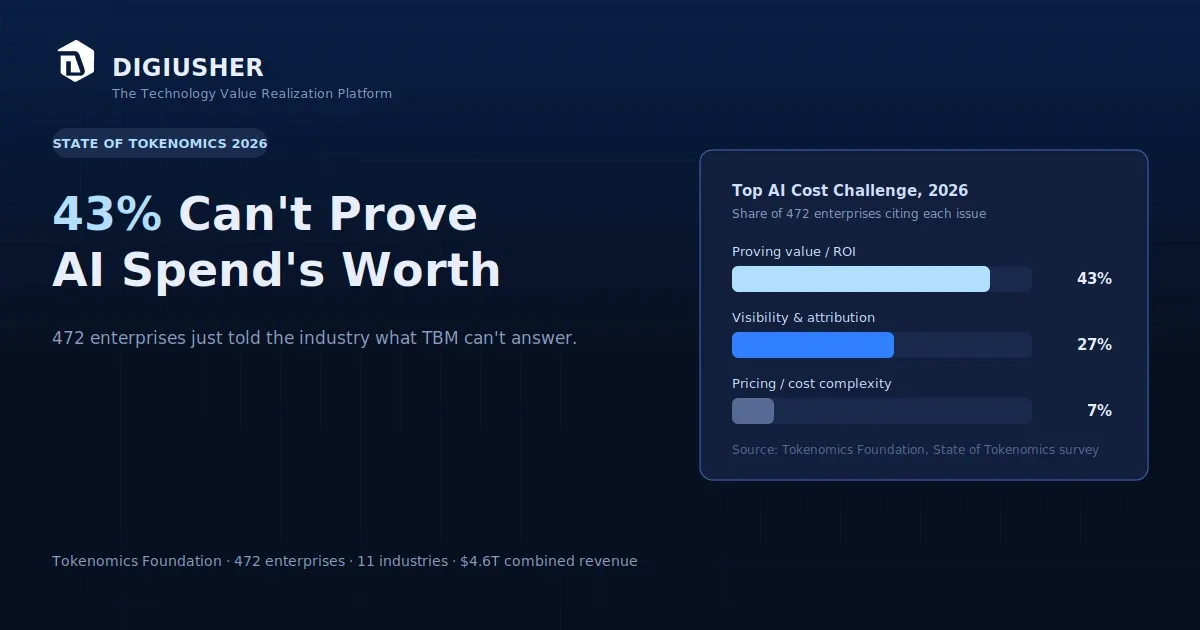
The State of Tokenomics 2026: What 472 Enterprises Just Told the Industry TBM Can't Answer
472 enterprises just told the Tokenomics Foundation their top AI cost challenge isn't pricing. It's proving value. Here's what that means for FinOps in 2026.
Product Updates - DigiUsher Ships Its First AI Cost Attribution Feature
Only 39% of organisations can attribute any business impact to their AI spend. DigiUsher's release shipped AI Lens and began a new enhanced allocation-engine to close that gap.
Product Updates - Budgets Re-egineered to Purpose Driven
DigiUsher launched new enhanced Budgets domain — the capstone of a quarter spent building toward Technology Value Realisation.