The $2.5 Trillion AI Hangover: Why the C-Suite is Facing an Expensive Reality Check on ROI
AI spending is hitting $2.52T , yet 95% of projects yield zero ROI. Discover how the C-suite can survive the "tokenmaxxing" hangover with DigiUsher.
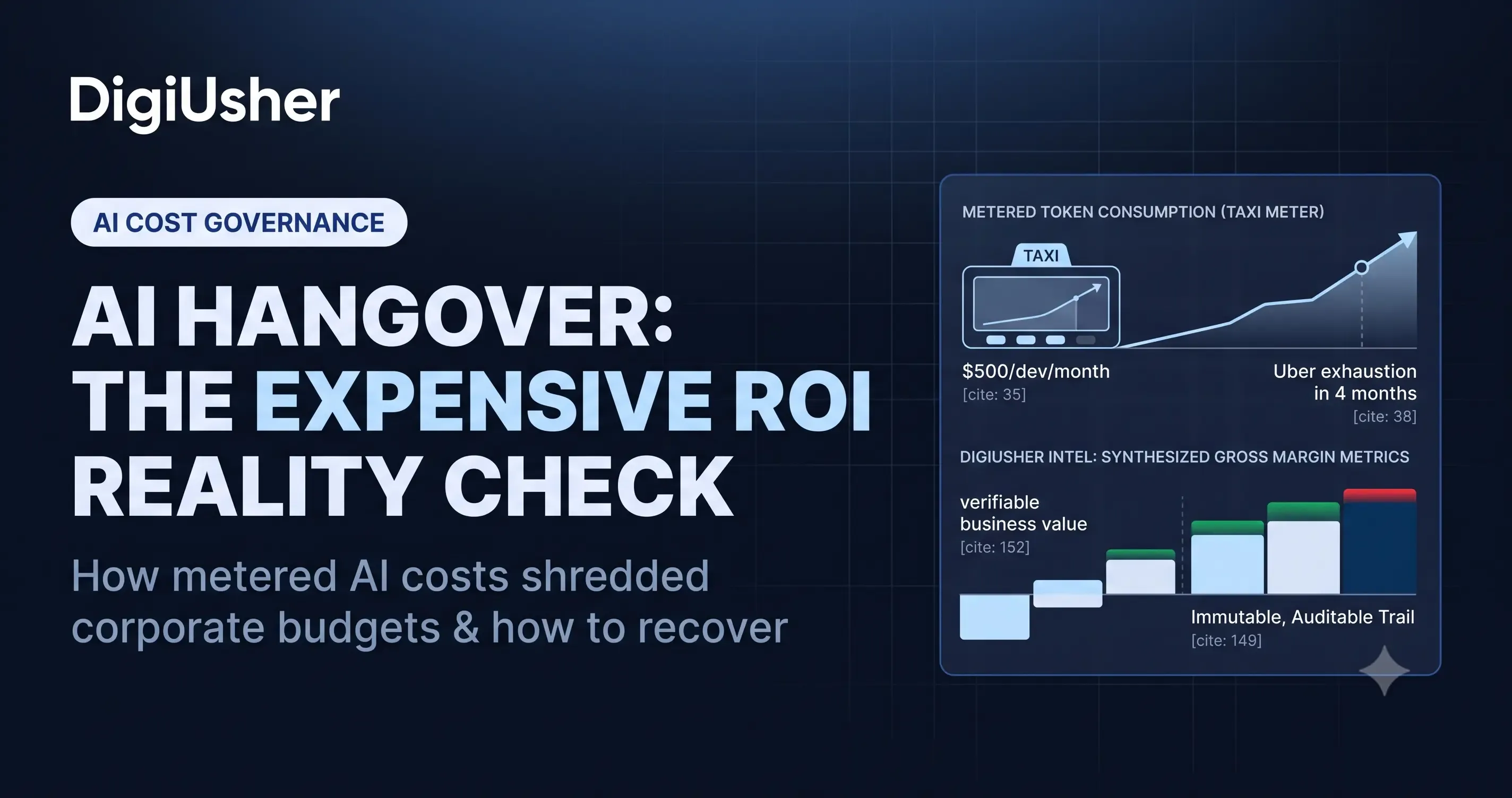
The Executive Summary: The $2.5 Trillion Illusion
The massive corporate rush to adopt artificial intelligence has run into a hard financial wall. While boards of directors and chief executives continue to demand rapid deployment, the actual financial returns have proven to be virtually non-existent for the vast majority of enterprises. This execution gap is not a technical failure, but an architectural and financial tracking disaster. Traditional flat-rate software subscription models have been replaced by highly unpredictable, metered consumption costs that scale exponentially with adoption, leaving corporate finance teams entirely unable to model or control their expenditures.
To stop the bleeding, corporate leaders must immediately move beyond unmonitored experimentation, establish strict cost-governance frameworks, and treat artificial intelligence compute consumption as a variable, real-time cost of goods sold rather than a passive information technology expense.
The Saturday Night Barbecue Paradox: The C-Suite’s Language Crisis
On a warm Saturday evening, a professional standing by a backyard barbecue does not explain a home kitchen renovation using phrases like “leveraging paradigm-shifting culinary optimization frameworks” or “deploying high-integrity appliance integration suites”. Instead, the speaker uses clear, relatable “weekend language”. The storyteller explains that the marble countertop was beautiful but cost twice the estimate, the plumbing work took three extra weeks, and the new stove cooks a steak perfectly. The guests engage, ask questions, laugh, and repeat the story to others because it is conversational, clear, and grounded in reality.
Yet, on Monday morning, that natural clarity vanishes inside the corporate office. The same executive steps into the boardroom and bombards colleagues with a 118-slide PowerPoint deck choked with twelve-bullet sentences written in tiny ten-point fonts. This presentation style, historically known as the “show up and throw up” approach, serves primarily to hide an uncomfortable truth: the company has spent millions of dollars on a technology where nobody can explain the actual business value.
The corporate world is currently caught in a massive investment spiral. Driven by the fear of being left behind, 88% of organizations have deployed artificial intelligence in at least one business function. The share of technology budgets allocated to these tools is projected to jump from 8% to 13% over the next two years. Globally, enterprise artificial intelligence spending is racing toward $2.52 trillion, representing a massive 44% year-over-year increase.
The complication is that these investments are hitting a financial tipping point. Static IT budgets are being shredded by metered usage charges that arrive like an unexpected taxi invoice. To survive this transition, enterprise leaders must apply Barbara Minto’s pyramid principle: state the recommendation immediately, support it with mutually exclusive and collectively exhaustive arguments, and back those arguments with hard financial metrics.
| Spend Metric | Value | Temporal Context | Source |
| Global Enterprise AI Spend | $2.52 Trillion | Projected 2026 | Gartner Trend Report |
| Year-over-Year Spend Increase | 44% | 2025 to 2026 | Gartner Trend Report |
| Average IT Budget Allocation | 13% | Projected 2027/2028 | Deloitte Tech Trends |
| Data Center Electricity Growth | 26% | Projected 2026 | Gartner Announcement |
Pillar 1: The Metaphor of the Taxi Meter—How Tokenmaxxing is Killing the Corporate Budget
For decades, enterprise software was purchased like a monthly bus pass. An organization paid a predictable flat fee per user license, and those users could run queries, click buttons, and enter data all day without incurring an extra dime of expense.
Generative models have fundamentally destroyed this predictability, turning software into a metered taxi cab where the fare increases with every single block driven. Every single interaction with a large language model—whether a customer service query, a database search, or a line of code generated—is translated into “tokens”.
Because each transaction is metered, the more successful an internal tool becomes, the larger the resulting bill.
This unmonitored consumption has triggered a series of silent budget collapses across major corporations.
In early 2026, Uber rolled out an advanced coding assistant called Claude Code to its developers. The rollout was highly successful from an adoption standpoint, with 95% of the engineering workforce using the tool and artificial intelligence agents authoring roughly 10% of all code.
However, because the engineering leadership failed to establish cost controls, the financial bills were astronomical.
The token consumption per developer jumped rapidly, running between $500 and $2,000 per month.
In a single, hands-on demonstration of the software, an engineering lead managed to burn through $1,200 worth of compute tokens in just two hours.
As a result, Uber completely exhausted its entire 2026 artificial intelligence tools budget in only four months, forcing the company’s Chief Operating Officer, Andrew Macdonald, to publicly question the value of the spend.

Other corporate giants have faced similar reckonings. ServiceNow exhausted its annual token allocation before mid-year.
Amazon was forced to shut down its internal software developer leaderboard after realizing that employees were actively “tokenmaxxing”—intentionally running massive, repetitive, and computationally bloated queries simply to climb the internal standings and signal corporate activity.
At Meta, executives were forced to issue an internal warning to 6,000 employees that token allocations were being capped, noting that unmonitored internal usage was on track to cost the firm billions of dollars in 2026 alone.
In the most extreme documented case, an unnamed enterprise customer reportedly managed to blow $500 million on model consumption in a single month after removing its platform usage caps.
This cost crisis is poised to worsen with the transition to autonomous agentic systems. Unlike a conversational chatbot that takes a single prompt and stops, an autonomous agent runs in continuous loops. It evaluates its own work, calls external databases, encounters errors, retries the task, and operates for hours without human supervision.
Because of this constant execution, an autonomous agent can consume up to 1,000 times more tokens than a standard user prompt to solve the same problem.
Furthermore, these agents run on physical infrastructure that is facing severe shortages. Server memory has become a major bottleneck.
Due to high demand, server DRAM prices rose 50% through 2025, with an additional 55% to 60% increase hitting in early 2026, making the cost of running these metered tools continuously higher.
| Corporate Entity | Incident Context | Financial / Budgetary Impact | Action Taken |
| Uber | Claude Code deployment to 5,000 developers | Exhausted full-year 2026 budget in 4 months; $500–$2,000/dev monthly bill | Implemented strict cap of $1,500/employee monthly |
| ServiceNow | Unrestricted internal developer access | Exhausted annual token allocation before mid-year | Implemented usage rationing and caps |
| Amazon | Gamified internal developer leaderboard | Employees gamed system via “tokenmaxxing” | Terminated the leaderboard program |
| Meta | Tool sprawl and unmonitored employee usage | Projected internal spend running into billions | Issued internal memo capping employee token budgets |
| Unnamed Enterprise | Removed cloud usage limits for testing | Reported $500 Million compute bill in one month | Re-implemented system-level usage gates |
Pillar 2: The Phantom Return on Investment and the Scapegoating of the CIO
As these massive compute bills arrive on the desks of corporate finance teams, a quiet war has erupted between the Chief Executive Officer and the Chief Information Officer.
The Board of Directors issues a broad, vague mandate to “implement artificial intelligence across the organization now,” but does so without defining any clear financial targets or accountability models.
The CIO is then tasked with executing this plan, only to face a staggering failure rate.
The Disconnect Between Belief and Reality
According to MIT’s Project NANDA, an overwhelming 95% of enterprise generative projects have failed to show a single dollar of measurable financial return within six months of deployment.
Similarly, a survey conducted by Kyndryl reveals that 61% of senior business leaders report feeling significantly more pressure to prove the financial returns of their technology investments than they did just twelve months ago.
The pressure is driven by investors, 53% of whom expect to see positive financial results in six months or less, while 84% of chief executives privately admit that those returns will take far longer to materialize.
This disconnect has created an alignment crisis inside the executive suite.
The Protiviti Global Transformation Survey, which polled 852 executives in partnership with the University of Oxford, found that technology leaders are twice as confident in their projects as business leaders.
While 61% of CIOs and CTOs believe their transformations are succeeding, only 30% of CEOs and boards agree that the technology is driving any revenue growth.
The COO stands out as an enthusiast, with 40% selecting these tools as a primary growth driver, but this enthusiasm rarely translates into a healthy balance sheet.

The Illusion of “Hours Saved”
To defend their budgets, many CIOs point to “hours saved” or “productivity gains”.
But on Monday morning, these metrics prove to be entirely theoretical.
If an assistant saves an employee twenty minutes a day, but the organization’s headcount and payroll remain exactly the same while the technology bill doubles, the business has not actually saved any money.
Furthermore, research indicates that developers using automated code generators often take longer to complete their work.
Because the tools are prone to hallucinations, engineers spend hours debugging subtle mistakes and reviewing generated scripts, creating a convincing illusion of productivity while actually slowing down the release cycle.
Jim Covello, the Head of Global Equity Research at Goldman Sachs, notes that truly transformative technologies like the internet disrupted markets because they immediately offered lower-cost solutions.
Amazon did not need a decade to prove its business model; it could sell books cheaper than traditional retailers on day one because it did not have to pay for physical real estate.
Generative models, by contrast, represent an incredibly high-cost, energy-intensive technology attempting to replace low-cost, routine human tasks.
The economics of this trade are fundamentally broken.
If a company fires mid-level writers or support staff to save fifty thousand dollars in salaries, but replaces them with a technology system that costs seventy thousand dollars in token consumption and requires constant oversight from expensive senior engineers, the company has actively destroyed its profit margins.
Pillar 3: Running a Ferrari on an Unpaved Road—The Legacy Data Debt Bottleneck
The third major barrier to achieving a clear financial return is that companies are attempting to run cutting-edge models on broken, outdated data foundations.
Many organizations suffer from years of accumulated data debt and technical silos.
According to Gartner, 38% of all enterprise project failures are caused directly by poor data quality or highly restricted data availability.
A model cannot accurately answer a customer query or forecast corporate inventory if it cannot read the underlying databases.
The Data Preparation Cost
Many leadership teams assume that deploying a model is as simple as clicking a button.
In reality, the upfront cost of cleaning and structuring data is astronomical.
A major global yogurt manufacturer attempting to deploy automation in its logistics facilities had to spend millions of dollars simply cleaning its legacy shipping records before a model could ingest them.
This preparation cost is completely omitted from vendor sales pitches, leading to massive financial surprises once the deployment begins.
| Key Bottleneck Category | System Constraint | Operational / Security Risk | C-Suite Metric Impact |
| Legacy Data Architecture | Rigid ETL batch processes and unstructured silos | 48% of organizations cite data searchability as a hard barrier | Over 85% of models fail due to poor data quality |
| System Preparation Debt | Opaque systems lacking modern APIs and identity controls | Integration blocks scale; models cannot execute tasks | Millions spent on preprocessing before ingestion |
| Shadow AI & Governance Gap | Unsanctioned employees paste data into public platforms | LiteLLM supply chain and Moltbook API key leaks | Average global data breach cost rises to $4.4 Million |
The Rise of Shadow AI
Furthermore, traditional cloud financial tracking tools are entirely blind tomodern, fragmented hybrid environments.
Traditional systems process data through slow batch-processing pipelines, creating significant delays and preventing real-time tracking of compute usage.
Without absolute cost lineage from the native provider invoice down to the specific engineering team or product SKU, value leaks through poor adoption, and tracking returns becomes mathematically impossible.
This lack of control has also triggered a massive rise in “Shadow AI”.
When frustrated employees find that corporate systems are locked down or too slow, they turn to unsanctioned public tools to do their jobs.
They paste sensitive financial reports, customer database exports, and proprietary source code directly into public models, completely bypassing corporate security policies.
In doing so, they expose the enterprise to catastrophic data breaches.
Supply chain compromises, such as the LiteLLM compromise and the Moltbook viral tool vulnerability, have leaked thousands of corporate API keys to hackers, driving up the average global cost of a data breach to $4.4 million.
The Cultural Zeitgeist: AI Slop, Reddit Skepticism, and the LinkedIn Echo Chamber
The tension in the boardroom is mirrored by deep frustration across the broader digital landscape.
On professional platforms like LinkedIn, which was once a place for genuine networking, users complain that the feed has degenerated into an “AI ghost town”.
Because writing empty, upbeat corporate updates is boring, professionals use automated tools to generate their posts.
The result is a sea of identical, highly repetitive content filled with fake excitement, bullet points, and cringy diagrams.
Algorithms talk to algorithms in the comments, destroying any sense of human connection and sparking widespread mockery.
Users frequently parody this automated style, posting satirical updates like “my wife cheated on me and this is what it taught me about resilience in business”.
Meanwhile, on Reddit communities like r/sysadmin, r/BetterOffline, and r/theprimeagen, technical professionals speak with brutal honesty.
They describe the top-down pressure as a “400 billion dollar circle jerk” between massive tech companies trying to force tools like Copilot onto the market to justify their hardware spending.
System administrators report that non-technical managers, driven entirely by slick sales demos rather than objective data, assume that the technology can easily replace human workers.
One Reddit user summarized the corporate panic with a memorable analogy: “A shovel sure isn’t helpful when you’re falling from 36,000 feet, but if there was an AI powered shovel, you can bet someone would be trying to use it right now”.
Technologists report spending up to 115% of their working hours knocking down terrible technical ideas from upper management or being forced to build fragile, unworkable systems.
The general sentiment among hands-on operators is that the hype has completely outrun the technology’s actual capabilities, and that a massive market correction is inevitable.
The Path to Operational Excellence: Active Cost Governance and Portfolio Discipline
To survive this hangover, corporate leaders must move beyond the hype and implement a disciplined, operational approach to their technology investments.
First, executives must stop looking for a single, magical return-on-investment formula.
Gartner’s Twisha Sharma warns that treating every project with the same narrow financial lens will significantly undervalue important, non-financial benefits like faster decision-making and improved organizational agility.
Instead, CFOs should think of their projects like different types of travel.
A portfolio must balance routine productivity wins (short, predictable trips), targeted process improvements (medium-distance business travel), and highly selective transformational bets (long-distance, high-risk exploration).
  ┌───────────────────────────┬───────────────────────────┬───────────────────────────┐
  │   Routine Productivity    │    Process Improvement    │   Transformational Bet    │
  ├───────────────────────────┼───────────────────────────┼───────────────────────────┤
  │ Short, predictable trips  │ Medium-distance travel    │ High-risk, long-distance  │
  │ Fast, measurable paybacks │ Structured workflow shift │ Large competitive gambits │
  └───────────────────────────┴───────────────────────────┴───────────────────────────┘
Second, organizations must align their investments with human readiness.
McKinsey reports that companies that achieve a high return on capital do not run these tools as isolated science experiments; they embed them directly into the systems and processes their employees already use.
To close the return gap, leadership must actively balance their budgets, shifting away from the 93/7 technology-to-people ratio and investing heavily in workforce training, process redesign, and organizational change management.
Finally, technology teams must establish a “default cheap, escalate on evidence” routing protocol.
Instead of automatically routing every query to a flagship model, enterprises must build a decision matrix that directs basic classification, data extraction, and routine summarization tasks to smaller, highly specialized models.
Because these smaller models are up to 25 times cheaper to run than premium models, this simple architectural gate can dramatically lower compute costs and provide immediate financial stability.
Architecting Financial Accountability with DigiUsher
This is exactly where DigiUsher steps in to restore complete financial control over the fragmented hybrid cloud.
By replacing slow, batch-processed legacy pipelines with a FOCUS-Native Ingestion engine, DigiUsher delivers zero-lag cost analysis upon arrival, eliminating translation delays and reducing pipeline overhead by 30%.
Its Sequenced Chargeback Cascade maps multi-cloud, on-premise, and generative token consumption down to the exact developer squad, product SKU, or engineering department, establishing an immutable, auditable trail.
Through Bring Your Own Data (BYOD) predictive forecasting, DigiUsher bypasses flawed 30-day trailing averages, mathematically correlating technology expenditures with real-world corporate growth targets, marketing campaigns, and product launches.
Finally, its Bring Your Own Cloud (BYOC) deployment shield ensures absolute data sovereignty inside the corporate tenancy, bypassing months of vendor risk reviews while fully supporting strict FCA, DORA, and FedRAMP compliance mandates.
By converting opaque, metered token bills into synthesized, board-defensible gross margin metrics, DigiUsher enables C-level executives to eliminate wasted spend, protect profit margins, and capture verifiable business value.
DigiUsher in 30 min
Understand what each AI workload costs before scale amplifies the risk.
DigiUsher tracks cost per token, per inference, and per GPU hour — so your unit economics keep pace with adoption.
Book a 30-min walkthroughNo hard pitch · tailored to your stack
Continue Reading
More from the DigiUsher editorial team.
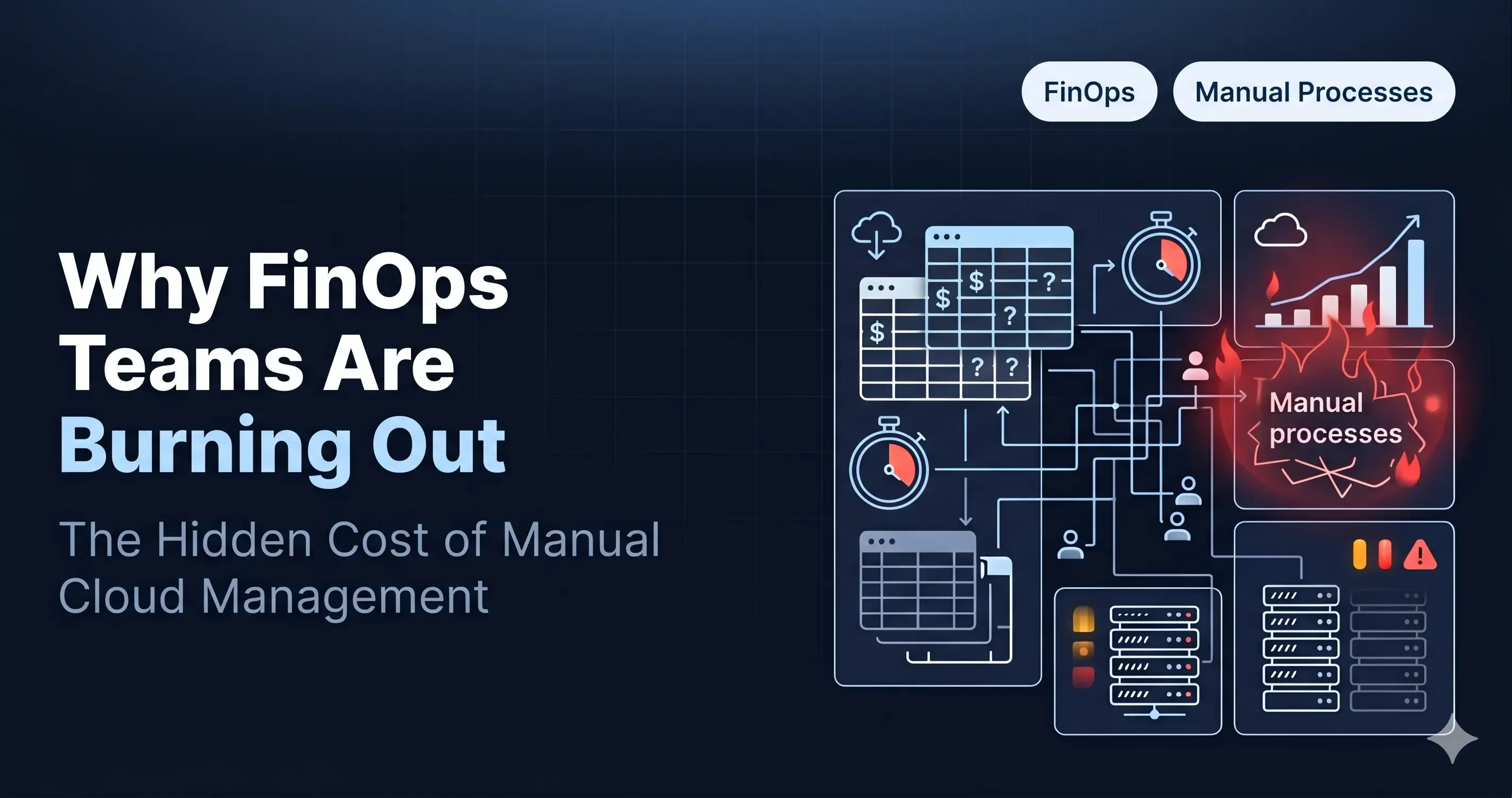
Why FinOps Teams Are Burning Out: The Hidden Cost of Manual Cloud Management
Addresses the growing burnout crisis in FinOps teams due to reactive, manual processes and constant fire-fighting, positioning automation and proactive governance as the solution
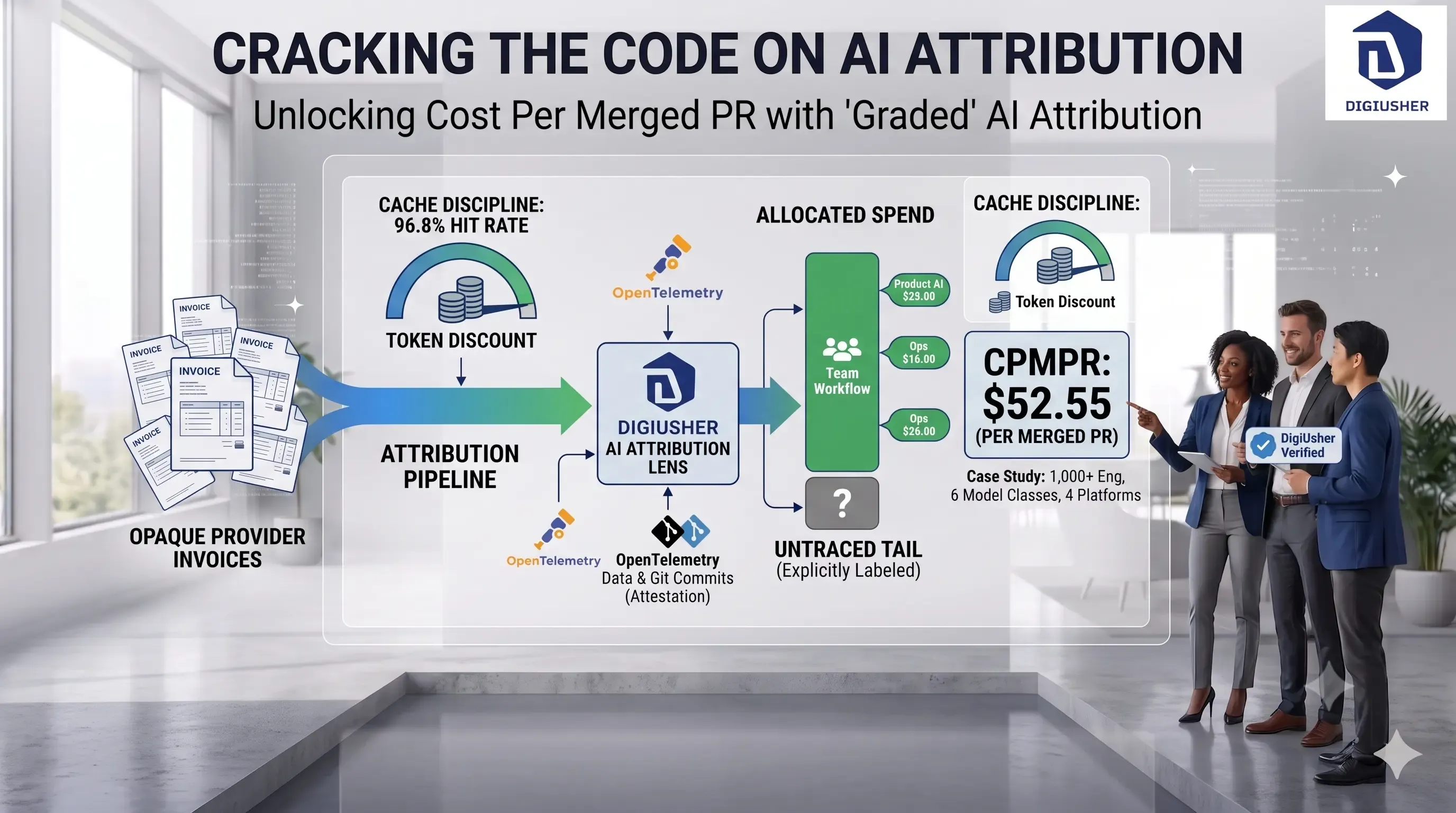
$52.55 Per Merged Pull Request: How One 1,000-Engineer Firm Priced Its Own AI Spend
A public technology firm with 1,000+ engineers refused to run its AI spend on faith. Here's the ledger it built instead — $52.55 per merged PR, 96.8% cache-hit rate, and a blended cost of $0.75 per million tokens.
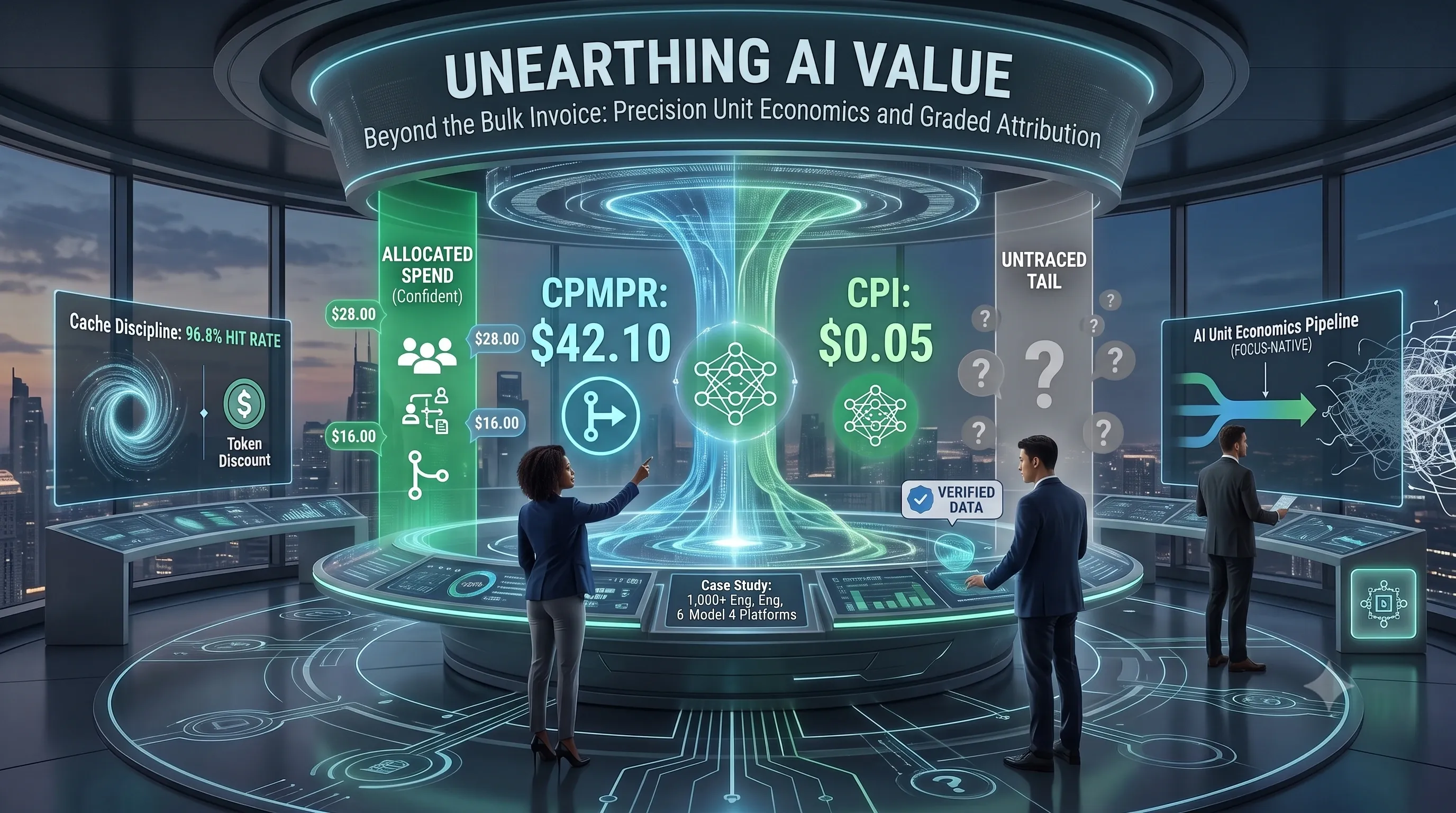
AI Unit Economics: Why Your AI Invoice Can No Longer Answer the Board’s Question
98% of FinOps teams now manage AI spend, but almost none can price a merged pull request. Here's the framework for AI unit economics in 2026 — and why the invoice alone can't answer the board's question.